
This article presents a continuation of addenda to https://msgtrail.com/posts/unmasking-the-dagapeyeff-cipher-a-multi-faceted-architecture
Addendum XIII (May 14): The lattice geometry is not unique, but a new asymmetry survives
Some findings worth recording. None of them is a decryption.
A “rare structure” claim turned out not to be rare after all
A previous line of work proposed reshuffling the 196 digit-pairs by treating their positions as coordinates in a 6×7 grid (a “residue lattice”). Out of 4200 similar reshufflings in that family, only 3 looked as structured as the chosen one, reported as roughly 1-in-3000.
I re-ran the same test against 29 different grid shapes (4×7, 5×7, 7×11, 8×11, and so on). At least 13 of these other shapes hit the same level of apparent rarity. Three (7×11, 8×11, 3×8) produce more structured results than 6×7. The 6×7 grid ranks 4-6 across this broader family, not 1.
The “rare structure” headline was therefore a generic property of the cipher’s pair-value statistics under any residue-style reshuffling. It does not single out 6×7 as the cipher’s actual encoding mechanism.
A small generator reproduces what previously looked structural
I wrote a generator that constructs synthetic 196-pair streams with two rules:
Sample pair values randomly from the cipher’s own 18-value pair frequency distribution.
Force the five anomalous pairs (04, 71, 92, 93, 94) into positions where index mod 14 == 13 (an independently-documented fingerprint of the real cipher).
That’s the whole construction. No language content, no encoded message, just the cipher’s pair frequencies plus one positional rule.
Running 100 such synthetic streams through the same structural test as the real cipher, the cipher’s measurement sits in the middle of the synthetic distribution (63rd percentile). The “structural surprise” that previously looked like a sign of a cryptographic mechanism is reproducible from a construction containing no plaintext.
A different 2D feature shows up that the generator does not reach
The cipher is printed as 8 rows of 50 digits (last row truncated to 45 cells). Look down each column and count maximal runs of 3+ identical digits stacked vertically. There are 17 such runs in total.
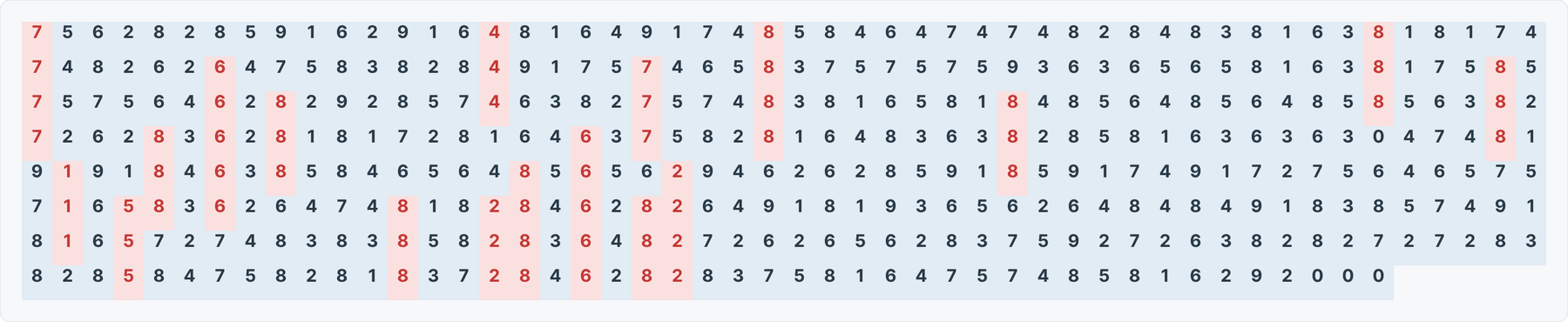
The total count itself is what the cipher’s overall structure would predict.
What’s surprising is where the runs are. 14 of the 17 are in the left half of the grid (columns 0-24). Only 3 are in the right half. The strict version (vertical runs of 4 or more identical digits) is even more lopsided: 6 long runs on the left, 0 on the right.
Sanity check: shuffle the pair values within each half independently, so each half keeps its exact pair-frequency distribution, but specific positions get randomized. Out of 1000 such shuffles, the cipher’s 14-vs-3 split is more extreme than 995 of them. That’s a real spatial feature of the published grid that no per-half-frequency-preserving construction reaches.
The two halves use different alphabets!
Split the cipher’s 196 pairs by which half the two digits land in: 96 pairs go to the left, 92 to the right, 8 span the boundary and are dropped. The two halves use structurally different Polybius coordinate systems:
Left half: first digits ∈ {6, 7, 8, 9}, second digits ∈ {1, 2, 3, 4, 5}. A 4×5 = 20-cell grid. No zero anywhere.
Right half: first digits ∈ {0, 6, 7, 8, 9}, second ∈ {1, 2, 3, 4, 5}. A full 5×5 = 25-cell grid. The single 0 digit in the cipher lives here.
These aren’t two halves of one cipher. They use different alphabets.
Languages: nothing decodes either half
Re-ran the standard attack, simulated annealing on the pair → letter mapping, scored against natural-language 4-letter frequencies, on each half separately, for English, Russian, French, and Esperanto. Two consistent observations:
The left half scores slightly above the random-shuffle baseline across all three non-English languages tested. The right half scores below baseline across the same three. No individual test hits conventional significance, but the direction is the same in 6 out of 6 cases.
Russian, vendored cleanly for the first time using a 33-letter Cyrillic quadgram corpus, joins English, French, and Esperanto on the killed list at the full-cipher level. All four plausible-plaintext languages D’Agapeyeff might have used are now null under simple Polybius decoding.
Additional attacks on the left half specifically, Polybius preceded by columnar transposition (8 column widths × 4 languages = 32 tests), and keyword-Polybius searches over D’Agapeyeff-relevant vocabulary, all came back null.
Where this leaves things
The left half is structurally distinct from any uniform-random null. It behaves consistently, across three unrelated languages, just slightly more language-like than random. But no decoder I’ve tried recovers a sentence from it.
The most parsimonious reading at present is: the cipher’s left half was constructed with some patterned writing rule, and the right half is a closer match to a uniform random null. Whether the pattern in the left half carries content, or is only the residue of D’Agapeyeff’s writing process, is the open question.
To be continued!
Comments
Nothing yet. Say the first thing.
Sign in to join the conversation.