
This is the second report in our Picks & Shovels series, where we take a trend that’s moving real money and hunt for the small, overlooked companies standing in the path of the spending. The logic is simple: when a structural shift sends capital flooding in one direction, the most durable money often isn’t with the household names in the headlines; it’s with the quieter suppliers sitting a layer or two down. Trend first, then the company we think is the cleanest way to play it. Issue #1 covered the reshoring of U.S. pharmaceutical manufacturing. This one covers a bigger and more urgent shift: the rearmament of the US.
Note: We will also be adding this company as Cliff Note #149
Over the past year, two separate conflicts with Iran have drawn down America’s most advanced missile interceptors faster than they can be replaced. These are the weapons that stop incoming ballistic missiles: they take two to three years to build, but can be spent in a matter of weeks.
The first, the twelve-day conflict of June 2025, drew heavily on the Terminal High Altitude Area Defense (THAAD) stockpile. The second and far larger, the 2026 war that opened with Operation Epic Fury in late February 2026, has driven the deepest draw yet. Taken together, the two conflicts have left the U.S. Patriot (PAC-3) interceptor inventory down by roughly half and its THAAD inventory down by about four-fifths from pre-war levels (CNN).
That is the tension now shaping Western defense budgets: stockpiles decades in the making can be drawn down in a single conflict, while the factories that replace them cannot keep pace. That mismatch between fast consumption and slow production is what we call the munitions-replenishment supercycle.
The setup, in four lines
The depletion was real, and it deepened in 2026: Since the start of the 2026 war with Iran, the U.S. has burned through roughly half of its Patriot (PAC-3) interceptors and about four-fifths of its THAAD interceptors, per Pentagon inventory reports described to CNN. Senior commanders have called the stockpile “dangerously low.”
The THAAD & PAC-3 stockpile is thin enough to shape decisions: The interceptor shortage was reportedly part of why the White House called off planned strikes on Iran in early August 2026.
The money is now structural: A record $1.5 trillion FY2027 request; the Army’s “Missiles” line jumps about 4.6x to roughly $36.6B; PAC-3 procurement alone goes from $1.6B to $12.2B.
The bottleneck is time, not money: 24-36-month lead times, a single-chokepoint rocket-motor base, and fragile sole-source sub-tier suppliers that can gate an entire program.
The pressure on the arsenal was built across two separate wars with Iran. The first was the twelve-day war of June 2025, when the U.S. fired more than 150 THAAD interceptors, roughly a quarter of its THAAD stockpile, defending Israel against Iranian ballistic missiles (CNN). The second and far larger is the 2026 war, which opened with Operation Epic Fury on February 28, 2026, paused at an April 8 ceasefire, and has flared through further phases since, leaving the conflict unresolved.
That second war is what drained the stockpile. By early August 2026, Pentagon inventory reports described to CNN that the U.S. had depleted roughly half of its Patriot (PAC-3) interceptors and about four-fifths of its THAAD interceptors, measured against prewar stocks that CSIS estimated at 2,200 modern Patriots and 452 THAAD interceptors (CNN). Senior U.S. commanders have called the munitions stockpile “dangerously low,” and Gulf allies that rely on the same systems have raised concerns that the shortage could hinder their own defenses.
Taken together, the two wars make the theme concrete. The interceptors that stop ballistic missiles are among the most sophisticated munitions made; they exist in small numbers, and they take years to replace. Deliveries are the proof: in FY2026 the US took delivery of just 172 new Patriot and 92 THAAD interceptors, roughly 20 a month combined, against a war that consumed over a thousand Patriots in months. CSIS does not expect either stockpile to return to prewar levels until mid-to-late 2029 (CSIS).
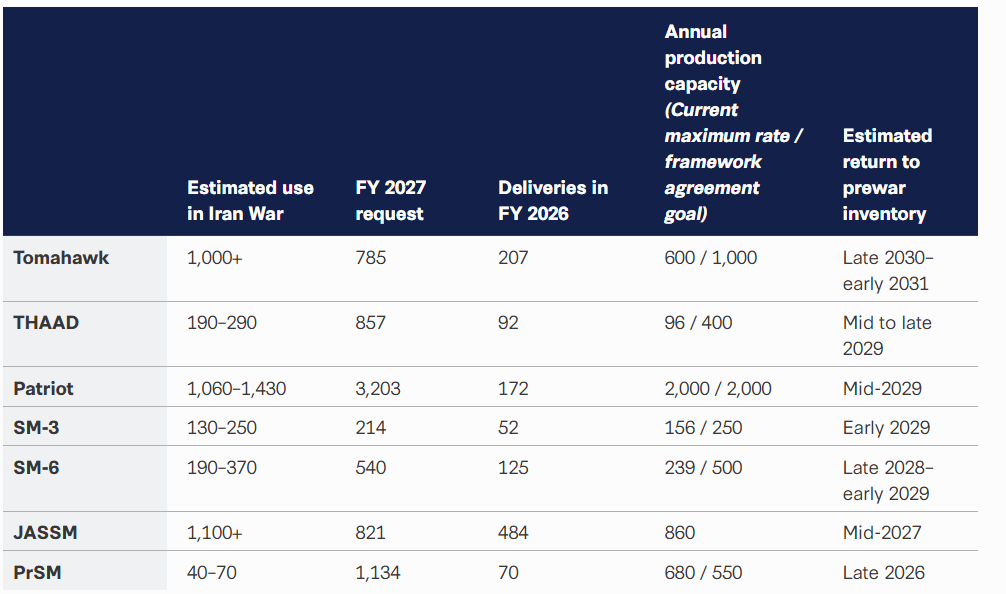
Source: Rebuilding U.S. Missile Inventory: A Multiyear Project
The clearest sign of how thin the magazine has gotten came in early August 2026, when President Trump called off a planned round of strikes on Iran. Defense Secretary Hegseth had been given the go-ahead on a Friday, but Trump stood the operation down the next day, and reporting tied the reversal in part to munitions. Dan Caine, the Joint Chiefs chairman, had flagged that interceptor stockpiles were already stretched thin from defending Israel during Operation Epic Fury. In other words, spending the inventory in one theater now limits what the US can do in the next one.
The exposure runs wider than Iran. With Patriot and THAAD inventories drawn down, experts noted:
US would struggle to fully defend its Gulf partners (Saudi Arabia and the UAE) and Israel at the same time.
Could not spare interceptors for Ukraine.
Would be short on magazine depth for any drawn-out fight with China over Taiwan.
The only fix is to build interceptors for years, and the FY2027 Budget already reflects this (Sources: CNN, Aug 4 2026; CNN video).
The budget has finally caught up to the problem, and it has done so structurally rather than as a one-year bump. On April 21, 2026, the Pentagon released a record $1.5 trillion FY2027 request, roughly a 42% increase, with munitions named an explicit priority. The clearest single indicator is the Army’s “Missiles” procurement account, which leaps from about $8.0 billion enacted in FY2026 to roughly $36.6 billion requested for FY2027, about 4.6 times higher. And the money is concentrated, not spread evenly: it piles into the interceptors and long-range strike weapons that were drained. PAC-3 Patriot procurement alone goes from about $1.6 billion to $12.2 billion, and THAAD from under $1 billion to $11.4 billion.
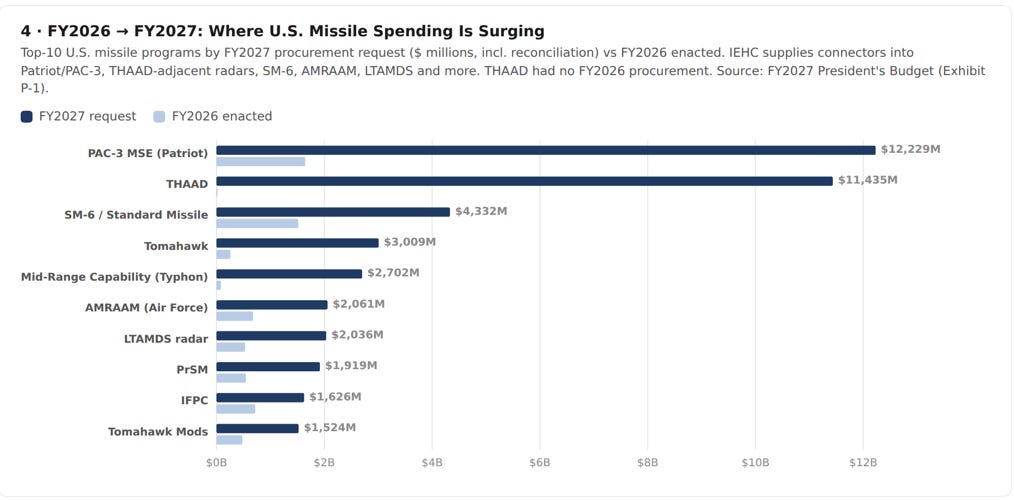
The spending does not stop at the immediate refill. The request also seeds a new, long-run source of interceptor demand: a large initial tranche, reported at roughly $18 billion, to begin building “Golden Dome,” a layered homeland missile-defense architecture (Breaking Defense).
This is not a plan to refill the magazine back to where it was, but to build it structurally deeper. It helps to separate procurement (the units Congress funds, which can take years to be used up) from production (the missiles actually built and delivered, which lag procurement by two to three years). On production, the targets step change well past historical rates:
PAC-3 deliveries averaged roughly 225 per year over the past decade, hit a record 500-plus in 2024, sit near a 650-per-year baseline today, and are contracted to reach 2,000 per year, about triple the current rate and nearly nine times the old average.
THAAD moves from about 96 per year toward a planned 400, a fourfold jump.
One caveat keeps this honest: Congress has not signed off yet. This is a request, not enacted spending, and part of the single-year jump is one-time “reconciliation” money (an estimated $24.5 billion of the Army missile total) that could get trimmed. But that is a point about one year’s dollar figure, not the trajectory. The production rate is already contracted and being built out to a permanently higher level, and even if Congress trims the top-line, it is trimming the size of a rebuild that still has to happen.
It would be easy to dismiss all this as an election-cycle trade, but three things argue for a genuine multi-year supercycle.
The first is that the demand is broad and diversified rather than dependent on any one government. It is bipartisan, it predates the current administration, and it is global. At the June 2025 Hague summit, NATO members raised their defense-spending target to 5% of GDP by 2035, up from the old 2% guideline that had taken a decade to reach, and the European Commission’s “ReArm Europe” plan mobilizes up to roughly €800 billion.
Currently, 19 countries operate Patriot, 16 field the PAC-3 MSE, and after the Iran war, the US has already approved the sale of 5,250 interceptors to Bahrain, Kuwait, Qatar, and the UAE alone to refill their stocks. Because PAC-3 and THAAD are sold worldwide through Foreign Military Sales and run through the same primes and sub-tier suppliers, all of those orders compete for the same finite production (NATO; European Commission; Reuters).
The second is that the flagship programs are committed under multiyear contracts of up to seven years, not the year-to-year buys that used to govern them. That shift matters more than it sounds. The old annual model was boom-and-bust: a good funding year could evaporate at the next appropriation, so suppliers were reluctant to build new plant for demand that might not survive. The multiyear frameworks remove that risk by guaranteeing volume out over years, and in these “capex-for-orders” deals the government commits the orders while the contractors put up their own capital to expand capacity in return.
PAC-3 alone now sits on a framework worth up to $58.6 billion over seven years, awarded to Lockheed Martin by the US Army in July 2026. That is what turns a one-year budget headline into committed, multi-year demand (Reuters).
The third is that physics enforces the timeline. A Patriot interceptor takes about 24 months to build and its solid rocket motor about 30, so capital committed today deploys over years no matter who is in office. And even as production is tripled and quadrupled, the arsenal is still being drawn down faster than it can be refilled, which is precisely what stretches this from a single budget cycle into a multi-year rebuild (FPRI).
Here is the part that matters for a picks-and-shovels investor. Even once the budget clears Congress, the binding constraint in this theme won’t be the dollars, but the industrial base, and the most under-appreciated chokepoint sits at the very bottom of the supply chain. The Pentagon’s own review of the defense industrial base found the number of small-business suppliers fell by roughly 40% over the past decade, and most prime contractors have little visibility below their immediate (Tier-1) suppliers (DoD, War on the Rocks). The result is a web of single points of failure. As analyses of the bottleneck repeatedly note, a single small supplier of a component can stall an entire missile program.
That crack in the wall is exactly where we want to stand. The surging missile programs, Patriot, THAAD, SM-6, AMRAAM, all rely on rugged, high-reliability electrical components that simply cannot fail, and building them to military specification is a small, unglamorous niche sitting directly in the path of a trillion-dollar wave. One microcap makes exactly that class of component, already counts Patriot among its named platforms, sits on a record and overwhelmingly defense-driven backlog, and quietly expanded its capacity ahead of the wave. The rest of this report is about that company.
Below the paywall, we cover:
The company and what it actually builds.
How directly it is exposed to the rearmament wave.
A look at the company’s valuation and its large multibagger potential.
The risks that could break the thesis.
Comments
Nothing yet. Say the first thing.
Sign in to join the conversation.