
We’re trying something new. In this series, we’ll take a trend that’s moving real money and hunt for the small, overlooked companies positioned to ride it. The logic is simple: when a structural shift sends capital flooding in one direction, the best opportunities often aren’t the household names in the headlines, but the quieter “picks and shovels” suppliers standing right in the path of the spending. Trend first, then the company (or companies) we think is the cleanest way to play it.
To kick it off, we’re starting with one of the clearest shifts happening right now: The Reshoring of U.S. Pharmaceutical Manufacturing.
On April 16, 2025, the U.S. Commerce Department opened a Section 232 national-security investigation into pharmaceutical imports. Over the following year, that finding hardened into a set of concrete tariff and procurement actions, all designed to reward companies that manufacture on American soil.
The result is a domestic capital-expenditure wave estimated at roughly $370–480 billion of announced commitments through 2030. The durable money in this theme does not sit with the drugmakers, for whom reshoring is a cost, but with the “picks and shovels”: the engineering, process-equipment, and consumables suppliers that design, build, and outfit the new plants.
Note: According to a more recent Reuters article, the most current tally of announced drugmaker commitments is closer to $500 billion.
National Security: COVID exposed the fragility of the supply chain: when it seized up, the US found it could not quickly make its own essential medicines. That reframed drug manufacturing from a cost-optimization question into a strategic one.
Geopolitics: Escalating US–China tension made reliance on Chinese API (APIs are the molecules that do the actual work inside a drug) supply look like a vulnerability, a current that also produced the BIOSECURE effort to push Chinese biomanufacturers out of U.S. federal procurement.
Tariffs (the actual catalyst): The Trump administration put a hard economic thumb on the scale, turning a slow-burn concern into a concrete, investable event.
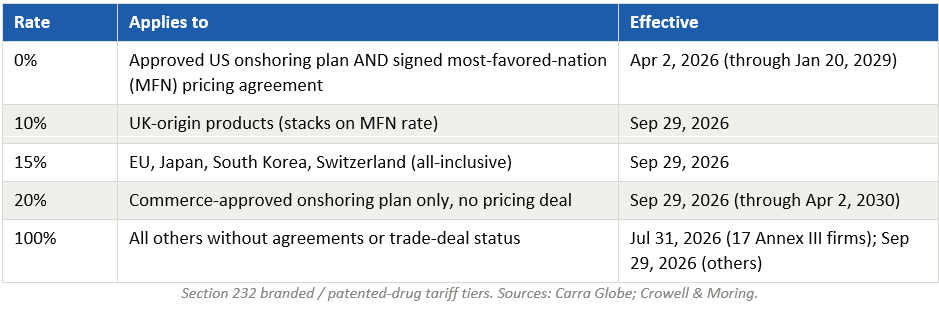
The vague “proposed tariffs” of early 2025 are now concrete. The policy runs on two tracks. Track one, finalized in April 2026 under Section 232 (the national-security trade statute), targets branded and patented drugs with a tiered rate structure designed as a carrot-and-stick to force onshoring:
Track two, announced on July 22, 2026, targets generic drugs, the high-volume, low-margin segment that Track one left untouched. It is a phased plan with a two-year grace period to relocate production, and it is still an announcement rather than a codified proclamation, so the exact dates may shift:
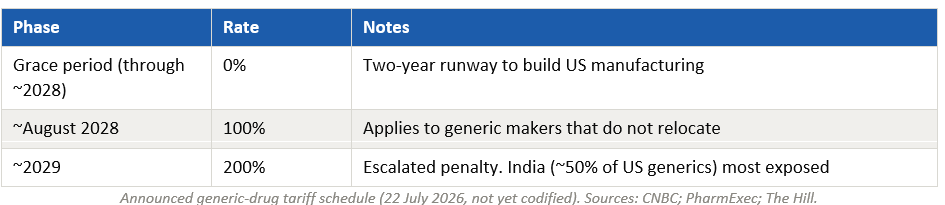
The combined message to the industry is simple: build in the United States, or pay a big tax. Note the important nuance on generics: they are about 90% of US prescriptions but only ~13% of spending and run on thin margins, so building domestic generic capacity is only economically marginal. The realistic near-term effect of Track Two might actually be drug shortages and rising generic prices if manufacturers reduce or discontinue production rather than reshore to the U.S., undermining the policy’s reshoring goal. It is the most contested part of the theme.
The evidence points to a multi-year, largely bipartisan supercycle rather than a single-administration trade, which is what makes it a long-term theme rather than a quarter-length one. Three reasons.
The Roots are bipartisan: A Biden-era essential-medicines and national-security foundation preceded the Trump executive order and tariffs that built on it, and the security framing is not partisan.
Structural drivers: The COVID supply-shock memory, China geopolitical risk, and a broader de-globalization / regionalization trend are already visible in semiconductors (the CHIPS Act), which transcend electoral cycles.
Physics locks it in: once a company commits several billion dollars and pours concrete on a plant that takes five years to build and eight-to-ten years to earn back, that capital deploys over a decade regardless of who is in office; you cannot un-pour a half-built plant.
Building a plant is sequential, so different suppliers get paid at different stages; the capital arrives in waves. First you pour concrete and erect the building: construction and engineering firms are paid first (2025–2027). Then, once the shell exists, you install the machinery inside bioreactors, stainless-steel process tanks, cleanroom systems, fume hoods, fill-finish lines: the process-equipment wave (2026–2028). Finally, once the plant runs, it buys filters, single-use bags, resins, and reagents on repeat: the recurring consumables-and-instruments wave (2028+)
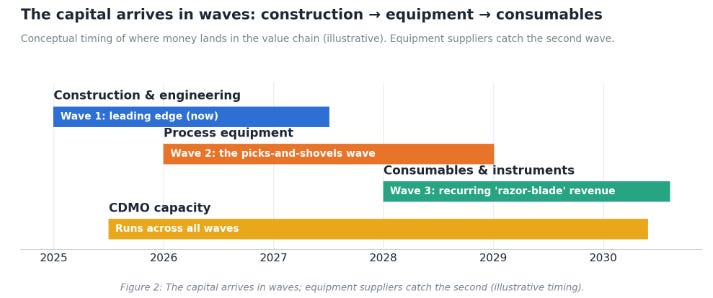
Has construction actually started? We are right at the leading edge. Lilly’s Pennsylvania injectables plant, for example, breaks ground in 2026 and is slated to come online in 2031; its Texas and Alabama API plants are moving from announcement toward groundbreaking. As of late 2025, most projects were still in planning. One equipment-maker CEO put groundbreakings at “2026 and 2027 at the earliest.”
The setup is clear. A multi-year, multi-hundred-billion-dollar wave of spending is coming, and the most durable money flows not to the drugmakers but to the companies that build and outfit the plants. The only question left is which one.
We think one micro-cap is the cleanest way to play it. It’s a profitable, nearly debt-free U.S. manufacturer that already makes the exact equipment these new drug plants need, and sells most of it as a single package. The company recently expanded capacity ahead of the wave, and it trades at a valuation that makes it hard to ignore.
Below the paywall, we cover:
The company and what it actually builds.
How directly it’s exposed to the wave.
Quick commentary on the company’s valuation.
The risks that could break the thesis.
We will end this discussion with a brief mention of a second stock that’s on our radar that we believe could be an eventual beneficiary at later stages of this trend.
Comments
Nothing yet. Say the first thing.
Sign in to join the conversation.