
This post is courtesy of Annie Crawford, who shared these thoughts at last month’s The Classical Dispatch conference, Repairing the Ruins. Follow Annie on X.
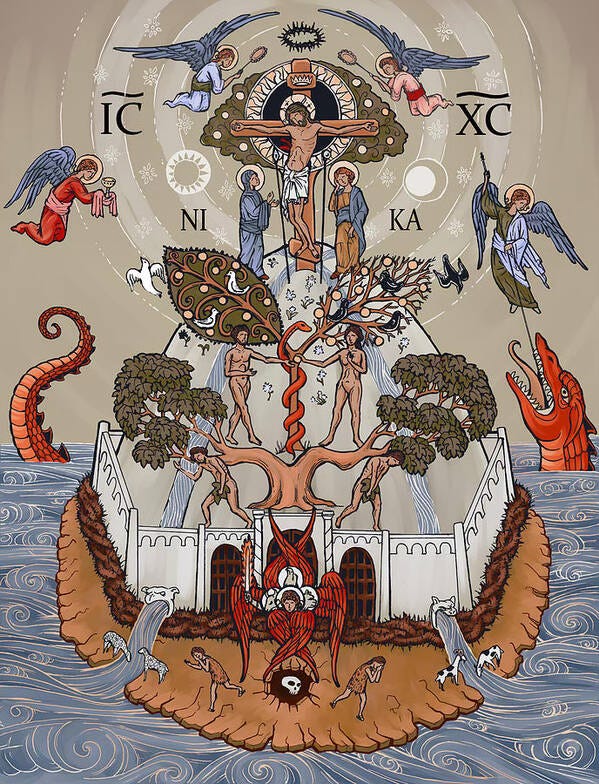
The Cosmic Mountain – Image designed by Jonathan Pageau
This year was one of the more difficult years I’ve had teaching. In my Ancients class, I had a large group of 15 year-old boys who really just didn’t care about reading the great books, or reading at all, or really learning at all. They were interested in looking cool and flying their drones and watching YouTube videos. I had to work triple time to engage this groups’ attention and try to make Plato’s Republic and the Aeneid at all meaningful to them.
My teaching hasn’t changed; I didn’t suddenly forget how to manage a classroom. I believe something is shifting in our culture.
More and more of our students are growing up in a world that feels increasingly detached from meaning. They spend more time scrolling screens than climbing trees, more time consuming digital representations of reality rather than encountering reality itself; our students are less and less in primary contact with things the Lord’s own hand has made. As a result, even students from faithful Christian families often struggle to experience the world as something charged with meaning and significance.
This presents classical Christian educators with a fundamental challenge. We cannot assume our students naturally perceive meaning or beauty in the world. We must help them recover their ability to see the world as charged with the Grandeur of God, to see its meaning flame out like shining from shook foil. Their imaginations are seared by trade; bleared, smeared with Tik Tok reels.
If we want to recover the meaning of the world, we first need to understand what we mean by “meaning.”
If you ask yourself what you mean by something, let’s say “beauty,” you will find yourself imagining something you find beautiful, perhaps a mountain sunset or a garden flower. When we connect the word beauty to that sunset, a sense of what beauty means begins to develop in my imagination, for meaning emerges through the symbolic relationship between things and ideas.
The Greek word symbol means “to throw together.” Symbols unite the concrete and the abstract, the physical and the spiritual, the visible and the invisible. A rose symbolizes love. A tree symbolizes life. Through these symbolic relationships, abstract ideas become meaningful.
This is why Lewis argues in his essay “Bluspels and Flalansferes” that the meaning of all language is ultimately rooted in either direct experience or metaphor made from that experience. For Lewis, there is no such thing as a “pure concept” or purely abstract from of meaning. The meaning of all language comes either from a direct literal reference to something concrete or from metaphor.
This is why, when you need to explain what you mean to someone, you will find yourself giving concrete examples and analogies saying “it’s like this.” For example, in physics, the abstract idea of gravity might gain meaning for us through the metaphor of physically falling. If you have experienced a fall, your body knows what gravity means and that meaning is brought to your mind through the imagination.
Thus, Lewis claims that “reason is the organ of truth but imagination is the organ of meaning.” Lewis’s spiritual father, George MacDonald, defines the imagination as “that faculty which gives from to thought.” The imagination is that faculty of mind that connects our sensory experience of the world to concepts and ideas.
In classical education, we often talk about the role of the moral imagination in forming virtue; however, Lewis urges us to go further. Imagination is not only essential to the formation of desires or character, it is essential to rational thought itself. If it is the imagination that gives meaningful form to our abstract thoughts, then Reason cannot work at all unless the imagination gives us something to reason ABOUT.
As C.S. Lewis scholar Michael Ward explains, “Things must rise up out of the swamp of nonsense into the realm of meaning ... Only then can we begin to judge whether their meanings are true or false. Before something can be either true or false it must mean.” And it is the imagination which gives our words and ideas and arguments meaning through its ability to perceive the forms of the world.
In other words, meaning must already be present within the things themselves, otherwise they could not be what George MacDonald calls a “garment of unveiling.” Unless both speaker and the one spoken to can see meaning in the forms from which language draws its metaphors, there could be no shared medium of actual communication. The language of creation is the essential ground of all human language.
When Jesus wanted to teach His disciples about the Kingdom of Heaven, He described the form and life of a tree. Jesus says that from a tiny, single seed grows the “largest of garden plants [which] becomes a tree, so that the birds come and perch in its branches.” Such is the Kingdom of Heaven.
The form of a large, branching tree evokes not only a sense of strong, steadfast, enduring life but also one of diversity within unity, and because this meaning is inherent to the fractal form of the tree, accessible to any person who has seen one, Christ could present the tree as a “garment of unveiling” to His disciples and to us.
We can tell many stories that employ the symbolism of a tree, and we can think about a tree in many ways, but none of our imaginative constructs will ever change the essential nature of a tree. A poet does not give meaning to a tree; the tree already contains meaning which the poet perceives and explores.
“Meaningful art is only possible because things themselves mean things. We do not invent meaning and project it onto the world. God is speaking to us through the forms of the things he has created,” Michael Ward concludes.
If the world is meaningless matter-in-motion, then modern pragmatic education makes sense. But if the world is a symbolic revelation of the Divine Logos, whose meaning is perceived through the imagination, then we need a very different kind of education.
As the Apostle John tells in the opening verses of his Gospel, “In the beginning was the Logos, and the Logos was with God, and the Logos was God... All things were made through Him, and without Him nothing was made that was made.” The Greek Logos means word, reason, meaning, identity, order. The Logos is the Divine Word of God who speaks the world into being, giving each thing its meaningful identity, its unifying principle of order and reason for being.
Thus, for Christians, the meaning of meaning makes sense. The Material world is full of metaphorical meaning because physical stuff is the language through which God tells us about Himself. Things mean things because God made the world so that mountains and clouds and sunsets would provide metaphorical meaning for true ideas.
Scripture itself reveals to us a symbolic, sacramental view of the world wherein all creation is made to be a garment of unveiling, a physical manifestation of spiritual meaning.
The task of the teacher is not merely to present many things, but to reveal how many things belong together. All the many parts of every course and every discussion and every assignment must all point toward this principle of unity in meaningful and memorable ways. Unity must be more than merely topical; it must be Logocentric, aimed at revealing how the unifying truth of this particular lesson and this particular class participate in the cosmic hierarchy; in other words, your principle of unity must reveal how all things are ultimately a revelation of Christ, the Logos for whom all things exist and in whom all things hold together.

Thanks for reading. Follow Annie here and here. If your school is an ACCS Member School, find her full talk here.
No posts
Comments
Nothing yet. Say the first thing.
Sign in to join the conversation.