
When it comes to parenting, there are no shortcuts. Lots of good advice should be given and taken, but it’s best to avoid anything that promises expedient results with minimal effort.
I picked up an analogy for parenting from Rachel Jankovic that has long since stuck with me: your family isn’t built by depositing the occasional gold bar, but rather by sprinkling gold dust for years. This approach to parenting redeemed mundane seasons of my life and gave meaning to the routine events which occupied my days.
When my family was young, I struggled with covetousness toward a dual-income family that drove luxury vehicles and went on expensive vacations. Because we were raising five kids on one income and sending them to private school, there was a lot we just couldn’t afford. For years, my family consumed a dozen eggs, a pound of bacon, a loaf of bread, and a half-gallon of orange juice every Sunday before church. For years, our tuition bill crested $30,000. We spent a lot of money on food and tuition—what our family needed to live and learn. We didn’t have a second income to spend on vacations and car payments, which caused me to doubt the value of my work because I didn’t have a paycheck to show for it.
After reading Rachel’s book, I realized that the parents I was so envious of were taking the gold nugget approach to parenting. Their expensive vacations and luxury items were rare deposits into their kids’ bank accounts, while the daily work of enculturation and habituation was outsourced to extended family and day care centers.
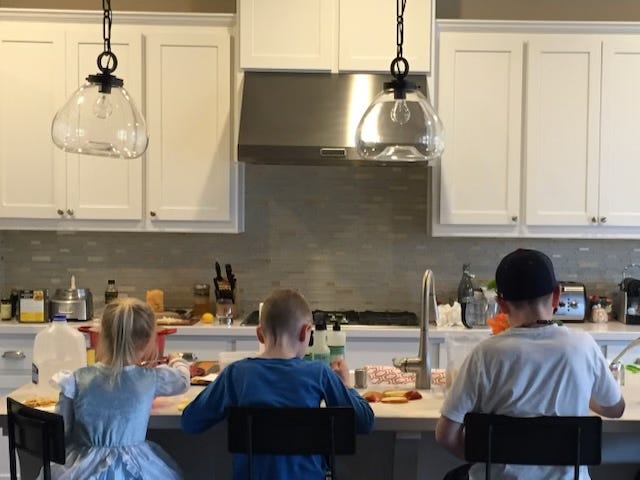
I wasn’t able to give my kids gold nuggets in the form of Disney vacations, but my kids were at my kitchen counter, eating boxed mac and cheese, where I could remind them to chew with their mouths closed and wash their hands. I could go over phonics rules and history timelines while cooking dinner or cleaning up snacks. The mundane minutes of raising my children were not outsourced. They were mine, and I could make the investment or squander the time. Because of Rachel’s metaphor, I chose to see my work as gold dust sprinkled every day, and I learned to repent of my covetousness. My deposits were small, but they were consistent.
When I decided to build a family rather than a resume, I was hugely influenced by Caitlin Flanagan’s book To Hell With All That. I had read a lot of books by Christian women, who told me I would be happiest at home, but it was Flanagan’s that sealed the deal. She sounded and looked exactly like who I aspired to be—beautiful, brilliant, and successful. Suffice it to say, she had something difficult to give up. The most persuasive premise in her book had nothing to do with Bible verses; it had to do with being honest about what she really wanted.
Flanagan shares her personal journey, which includes walking through grief after her mother’s death and confronting her own cancer diagnosis alongside witty social commentary on “loving and loathing her inner housewife.” As I read, I laughed, and I cried. And I realized what I really wanted was what Flanagan observed about her own childhood: “what a wonderful thing it had been to be raised at home, by a mother who loved me.” That’s what I wanted for my kids. I wanted a house full of people who knew I was there by choice. I wanted a home built upon a mother’s love, and I wanted to sprinkle lots and lots of gold dust—gold dust that looked like practicing instruments with them, soaking grass stains out of baseball pants, and making loaves and loaves of fresh bread.
At one point, Flannigan observes: “What’s missing from so many affluent American households is the one thing you can’t buy: the presence of someone who cares deeply and principally about that home and the people who live in it; who is willing to spend a significant portion of each day thinking about what those people are going to eat and what clothes they need for what occasions…” This was the choice I wanted to make—to be present at home, willing to spend my time with them and on them. Even though we couldn’t afford the luxury vehicles and our vacations looked like traveling for baseball tournaments, we were affluent by any standard. We lived in the suburbs, could afford a family membership to the YMCA, and rarely worried about when a check might clear. Yet, it still felt like a sacrifice to walk away from that second income. Recently, when I went back to work and saw the big, fat hole in my resume, I knew something very real had been sacrificed. It was hard again not to covet, but this time I was coveting the salary level, work experience, and impressive titles of other women on LinkedIn.
I know there are all sorts of families dealing with all sorts of economic pressure, and I know there are all sorts of exceptions we could make to all sorts of principles. But at the end of the day, even when I am struggling with covetousness, I still agree with Caitlin when she says, to Hell with chasing illusive happiness rather than building a life “neatly fitted around obligation and sacrifice.”
Coventry Christian Schools, May 26, 2026
Repairing the Ruins, ACCS, June 25-27, 2026
A Contemplation of Revolution, CiRCE National Conference, July 15, 2026
Trinity Knox Classical Academy, Waterford, CA, July 27, 2026
Evergreen Classical School, The Woodlands, TX, August 3, 2026
Faith Christian School, Roanoke, VA, August 5, 2026
Holy Rosary Family, Nashville, TN, August 7, 2026
Providence Classical School, Houston, TX, August 28, 2026
Hillsdale College, Hillsdale, MI, September 2, 2026
For help creating a more classical classroom, consider reading Thoroughness & Charm as a faculty or homeschool co-op this summer. I’d love to come kick off your experience of the book with a day of professional development seminars and workshops. Now is the time to book for back-to-school training in August.
The Thales College Certificate in Classical Education Philosophy Program(CCEP) consists of eight courses taken in any order, culminating in a certificate. Courses cost just $300 each and are held through Google Meet once every other week. Next session begins mid-April.
Louise Cowan on Shakespearean Tragedy Fall Seminar from the Cowan Center at the University of Dallas. Five Thursday evenings on Zoom. Registration opens in August. Subscribe to the Cowan Archive Substack to learn more.
No posts
Comments
Nothing yet. Say the first thing.
Sign in to join the conversation.