
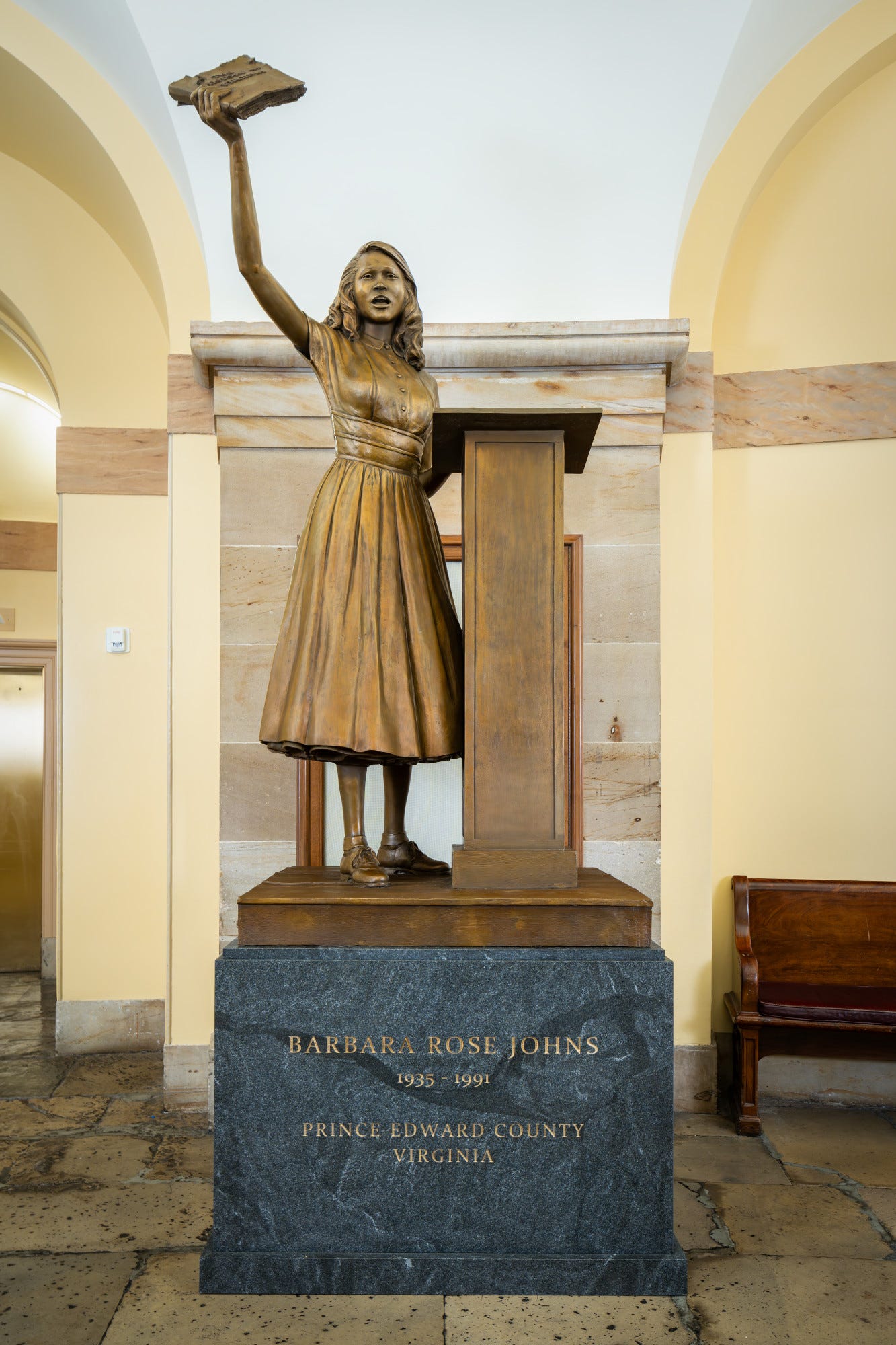
On April 23, 1951, a 16 year old Black girl by the name of Barbara Rose Johns decided she had enough with the conditions of her high school.
She was a student at R.R. Moton High School, an all-Black high school in Farmville, Virginia, that was set up to fail right from the jump. This was a school built to hold 180 students, but within one year of opening it was home to over 450 students. No gym. No cafeteria. No desks. No blackboards. All books and equipment were hand-me-downs from a nearby white school.
The county did their best to make this right, though. And by ‘did their best,’ I mean they did practically nothing at all: they built temporary facades for classrooms for extra students that were heated by potbelly stoves and ramshackily built to the point that roofs leaked during rainy seasons. The students, if you could believe it, had to use umbrellas in class.
Reverend Francis Griffin, both the President of the local NAACP and the Chair of the school’s PTA, told the school board something had to give, and new facilities were needed.
He was denied.
On that day in April in 1951, School principal M. Boyd Jones received a call about “racial problems” at the bus station in downtown Farmville, and when he left, all teachers received notes to bring their students to the ramshackle auditorium. And as the teachers arrived, they were surrounded by a group of students led by none other than Barbara to leave.
You see, friends, Barbara had faked the call to the principal. Barbara wrote the notes. And Barbara, on that day, took the stage and gave an impassioned plea to students and faculty… to go on strike to protest the poor conditions of the school.
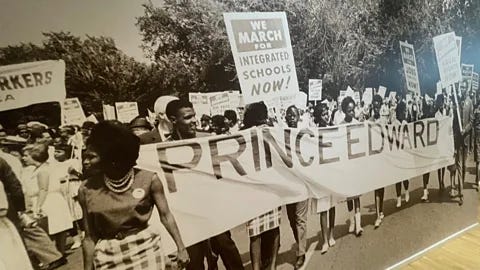
Over 450 people walked out and marched to the homes of members of the school board, who would not leave their homes. In fact, the students were told if they didn’t return, they would be expelled.
The students did not budge. In fact, this strike lasted two whole weeks.
Barbara, who again is only 16 years old at this time, reached out to the NAACP’s Special Counsel for the Southeastern Region of the United States asking for representation. The NAACP agreed… if the students would agree to seek an end to school segregation once and for all.
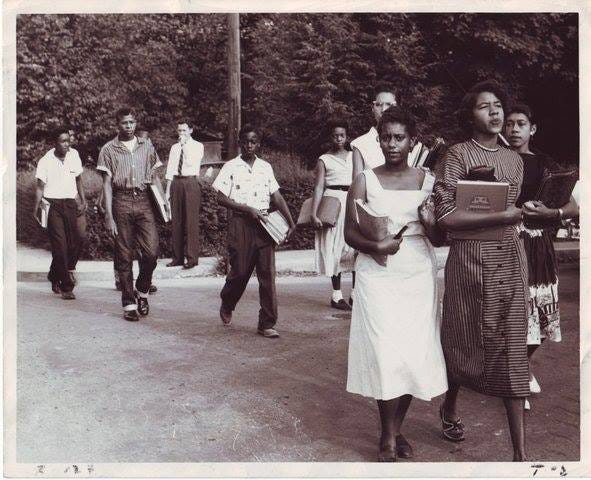
If this story in any way sounds familiar to you, that’s because it’s the foundation for what would eventually become known as Davis v. School County Board, one of the precursors to Brown v. Board of Education of Topeka, both of which were cases heard before the Supreme Court who decided, once and for all, that segregation in public education was unconstitutional and illegal.
You know that saying, “History is written by the victors”? It’s a bit of a misleading statement considering the gatekeeping that used to (and still does) exist within academia, but when it comes to the story of Barbara Johns, it is something that is considered rather unambiguously to be a case of victor-written history. And yet the story didn’t stop at the Supreme Court victory, even if it’s easier to summarize it as such.
Because what you might not be surprised to find out is that the decision was almost IMMEDIATELY denounced by white Virginians. It’s described as a “campaign of massive resistance,” where The Board of Supervisors for Prince Edward County refused to appropriate funds for the school district from 1959 to 1964. This ensured that Prince Edward County schools remained closed for five years, which led to (in an example of history mirroring itself) vouchers for private schools known as “segregation academies” being handed out to white students.
Segregation academies as a concept, and Black students all but being blocked out of education within the county, persisted until the Griffin v. Prince Edward County case, a separate case heard by the Supreme Court that found the closures to be violations of the 14th Amendment.
The story of Prince Edward County is one of the most patriotic stories I, as an American, can think of. An entire ethnicity was barred from proper and safe education, which is an internationally recognized human right as recognized by the United Nations. In response, a small but dedicated group of students fought for their HUMAN RIGHTS - and won. In response, they were called every slur in the book. They were called traitors. And most of all, they were called “un-American.”
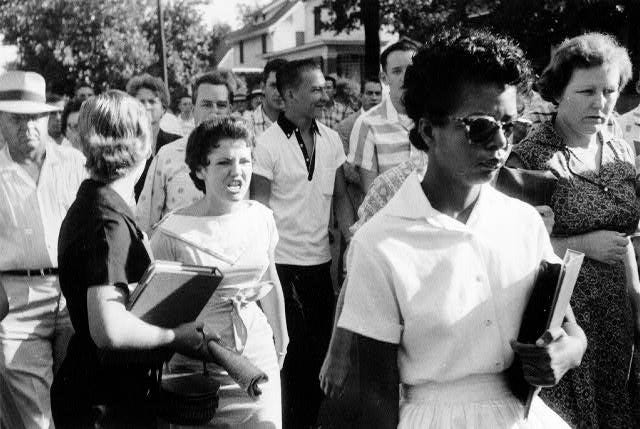
That’s the thing, though. Dissent is not the opposite of patriotism. Dissent is often VERY patriotic, and the only reason the country ever gets better. And the fact that Americans seem to think otherwise - that it’s often best to not “rock the boat” - means that American exceptionalism has failed us as a country.
Over the years, the label “un-American” has been used against labor organizers, civil rights activists, anti-war students, immigrants, LGBTQ people, socialists, teachers, and anyone who says the country is failing its own stated ideals. You can see this recently with Republican nominee for New York State Comptroller Joseph Hernandez (as well as many Republicans) calling Zohran Mamdani “un-American.” You can see this with the way Republicans speak about Barack Obama to this day: there’s a whole book alleging he’s the “un-American president!” President Trump called trans people “un-American.” And the idea that teachers are “un-American” is a remnant of the Red Scare!
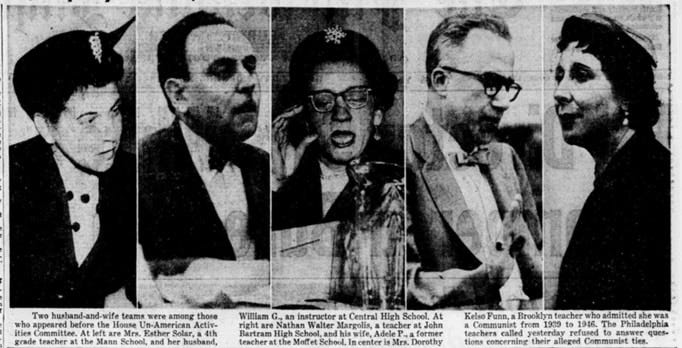
A lot of this rhetoric is acceptable, though, due to the uniquely American idea that there is a “right” way to be an American, and a “wrong” way to be one. We are taught that the U.S. is uniquely free, uniquely democratic, uniquely good. All families need a husband, a wife, two children, and a white picket fence. America, so the vibe goes, can do no wrong.
This is tragically a failing of the U.S. education system, which by the day is being systemically gutted by Donald Trump and the “leaders” at the slowly-dwindling Department of Education. A better education system would teach that the U.S. has democratic promises, violent contradictions, global power, and most importantly that it was social movements that forced the country to expand rights. America isn’t perfect. America has never been perfect.
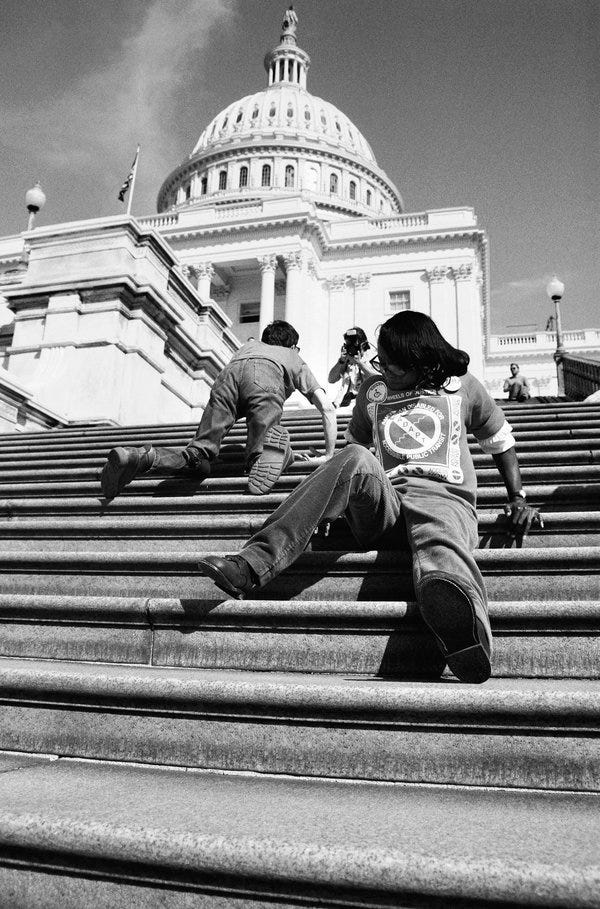
But you know what America has been? A nation of fighters. We’re a nation founded on dissent and “good trouble” leading to great accomplishments. Look at the long hard road to the passage of the Americans with Disabilities Act (the ADA) that fought against President Roosevelt’s 1935 declaration that people with disabilities were “unemployables.” Nearly 55 years of protests followed that eventually culminated in the legendary Capitol Crawl, where 60 activists with disabilities climbed out of their wheelchairs and up the 83 steps of the Capitol to protest their rights not being protected.
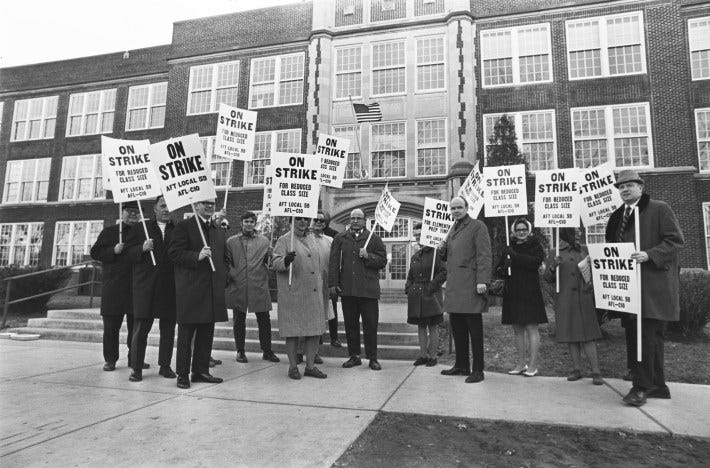
Or we can look at one of the most interesting yet underdiscussed education-related protests in American history: the 1970 Minneapolis Teachers’ Strike. In the late 60s, Minneapolis public school teachers saw huge class growth, and not nearly enough school supplies to match each student. In a sadly relatable turn of events, nearly every teacher relied on purchasing their own supplies or begging families for help.
The teachers unions and district administration negotiated the issues to no avail, and so after nearly a year of paused negotiations, the teachers’ bargaining units were preparing to take further action. These teachers were split up among two separate unions: the Minneapolis Federation of Teachers and the Minneapolis Education Association. The federation voted to go on strike, but the association did not.
And on the morning of April 9, 1970, 2,200 Minneapolis teachers picketed in front of district schools, which was actually illegal in Minnesota at the time. This put teachers at risk of losing their jobs, benefits, and pensions, and yet they persisted for twenty whole days. This resulted in the Minneapolis School District closing all schools on April 13, since more than half of the teachers were on strike. A compromise was reached on April 29, when MPS leadership gave the teachers increased wages and a new no-reprisal clause which made it so the school board couldn’t penalize any striking teachers.
This created a sort of Butterfly Effect moment: one year later, the Minnesota legislature passed the Public Employee Labor Relations Act (PELRA), which allows for public employees to strike legally if negotiations are deadlocked as long as certain requirements are met. Soon after, the Minnesota legislature passed new tax laws that completely overhauled the state’s public school systems: local property taxes funded schools and forced schools to balance their budgets.
But most importantly, the laws increased funding for public schools and fixed funding discrepancies between high-income and low-income schools. These laws are known as the “Minnesota Miracle,” and they would not have been possible without a little bit of dissent. If patriotism means commitment to the public good, then public schools are patriotic infrastructure - and it took a good bit of fight to make this patriotic miracle happen.
In response to Barbara Rose Johns’ part in the Davis protests, she was harassed for years, which included the Ku Klux Klan burning a cross in her front yard. At her parents’ insistence, she was sent to Montgomery, Alabama, to live with her uncle… civil rights pioneer Vernon Johns (contrary to popular belief he had nothing to do with Barbara’s own strike). But as her biography states, life was relatively peaceful for her after this: she received a degree in library science from Drexel University, got married, raised five kids, and lived in Philadelphia… where she became a librarian for the Philadelphia school system until her death from bone cancer in 1991.
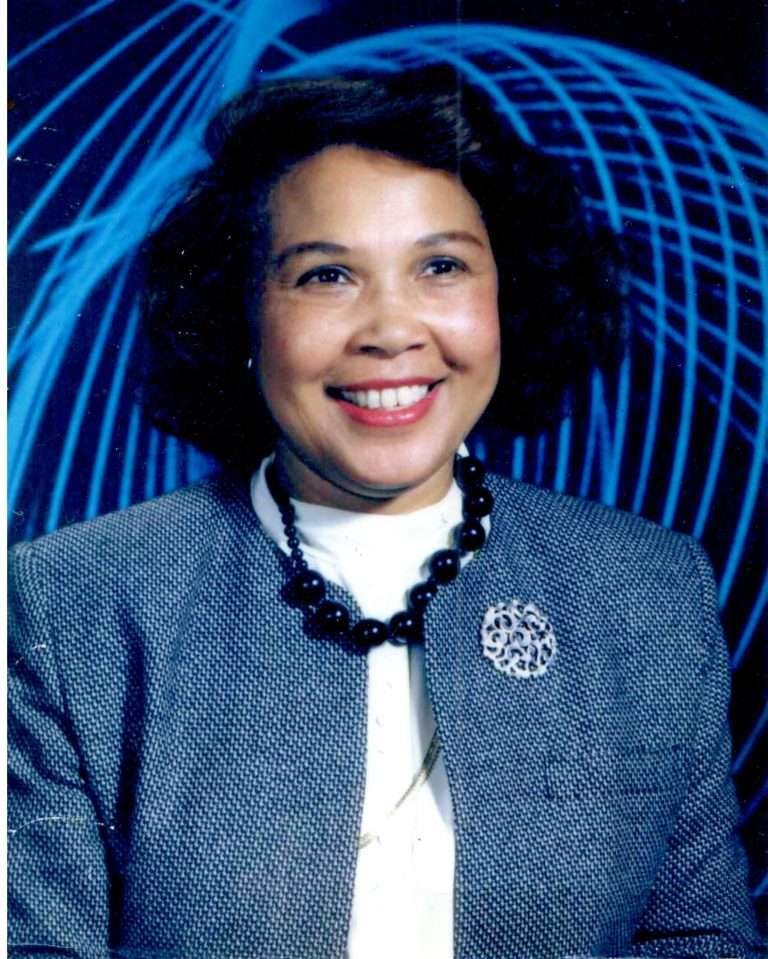
Barbara Rose Johns is an unsung patriot who objectively made the world a better place, and used her own accomplishments to give back to her community.
And I cannot think of anything more American than fighting for what’s right and then giving what you learned back to the youth who may one day fight their own good fight.
No posts
Comments
Nothing yet. Say the first thing.
Sign in to join the conversation.