
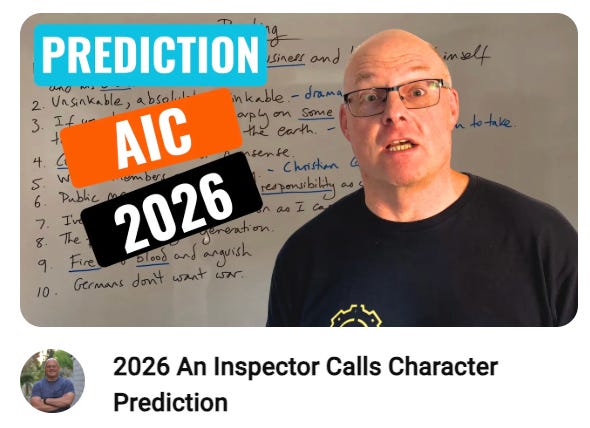
Last year there was considerable interest in exam predictions. It caused a bit of a scandal in teaching publications. A brouhaha, a feeding frenzy. I took a lot of flack from English teachers on Twitter. (I’m not on Twitter, but they turned up in the articles, and one such even added me on LinkedIn in a massive huff, saying no, she hadn’t meant me). Schools Week rang me up to see whether I was indeed a money-grabbing influencer.
This year, I wondered whether to make predictions at all.
But this is what a good teacher has to do. I always try to be an excellent teacher. After 34 years, ‘good’ is a low bar.
This year many of my predictions came good. I have no secret power. That’s the whole point. Anyone can do it - it is actually incredibly hard to be completely wrong.
I wonder if the teaching press will be seeking me out this year to hear why predictions are so essential to every English department in the country?
So, this is an email I sent to the TES. I sent a similar one to Schools Week:
You may remember last year, just after the GCSE literature exams, the TES published this article on exam predictions.

This would be a timely moment to revisit a counter argument - that YouTube predictions serve a valuable purpose, and that teachers who fail to make predictions are actually harming their students’ chances.
As a YouTuber I faced a lot of criticism as a consequence of this article, and this was also followed up in Schools Week. Here is their article.

The journalist, Jack Dyson, quoted me very partially:
‘You must make predictions for students’
But Dominic Salles, a YouTuber and former head of English who films his own exam predictions, said pupils “literally can’t revise the whole curriculum”.
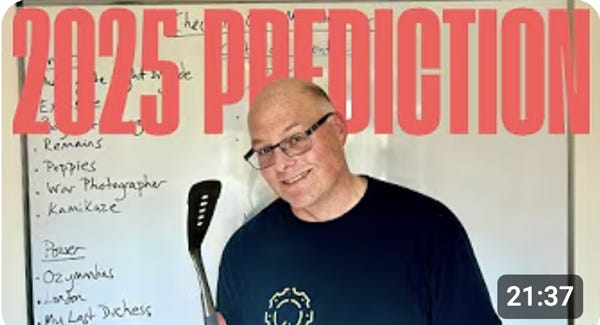
“You must make predictions to give your students the best chance.”
In a blog post, Salles said 68 per cent of his viewers “say they went up by at least one grade” from their mocks last year. This was based on an online poll Salles himself ran.
He added “departments which fail to prepare students in this way are failing their students – those marks are simply up for grabs, and exam grades are a zero-sum game.”
However, he also noted one of his English literature predictions was that those studying Macbeth would be tested on guilt. But the “actual question was ambition”.
While “thoughtless students” might “feel let down”, many would have “managed to apply what I taught” to what came up in the exam, he said.
He ignored my evidence that 25% said they went up by at least 3 grades, and that anyone who watched the whole video would have seen the same quotes matched to a range of other questions.
Focusing just on Macbeth, rather than my correct predictions was also a tiny bit biaised.
Pointing out my surveys of thousands of students was “an online poll Salles himself ran” makes the results sound cheap and manufactured. Adding incorrectly that my video was Tiktok instead of YouTube was a very low blow. Thanks Jack.
My email continues.
Other YouTubers in my space were criticised even more severely, one being targeted by ITV. They have chosen to make no predictions this year in order to avoid this intrusive attention. Your article has had real world consequences.
For most students, taking Macbeth, An Inspector Calls, A Christmas Carol and Power and Conflict, I predicted 2 of these exactly. My non-100% match predictions weren’t ‘wrong’, there would be an overlap with the actual question, especially as my videos show students how to apply the same quotations and analysis to other questions.
For example, my Romeo and Juliet prediction of masculinity would be 70-100% applicable to the actual question on conflict, depending on the skill of the student.
Would you be interested in my perspective as an article - I wouldn’t need to frame it as a riposte, rather a rationale for the benefits of making predictions and why all teachers should rethink their value.
I am fully expecting the answer to be “no”. (In fact, let’s be more realistic - I emailed 2 weeks ago. I won’t even get a reply).
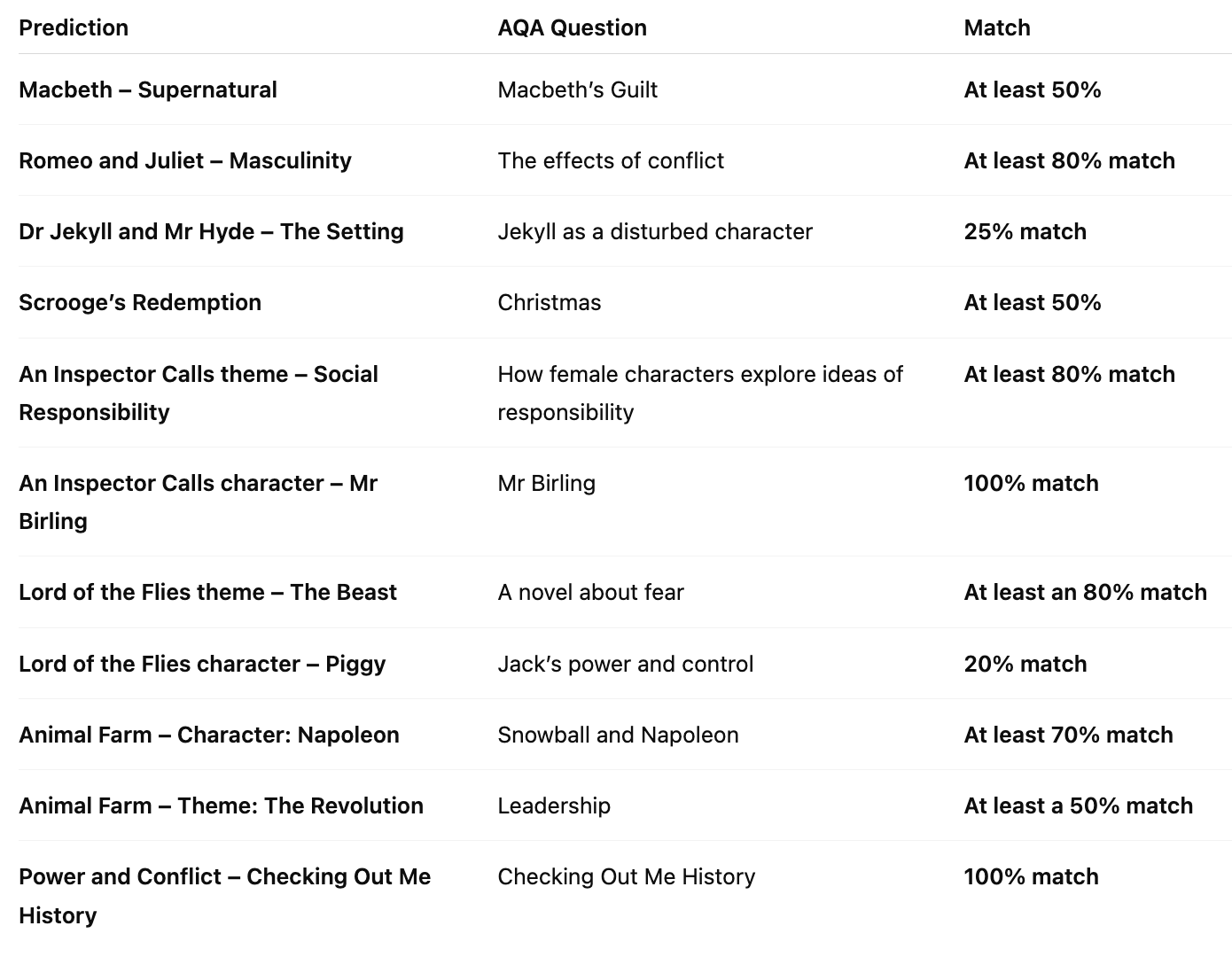
Paid subscribers will have read grade 9 essays on each of the predictions - I didn’t put Animal Farm on YouTube, but all the others were also videos.
This is an AI estimate of how many students study each text:
Macbeth: ~75%
Romeo and Juliet: ~20%
The Rest (Much Ado About Nothing, The Tempest, Julius Caesar, Merchant of Venice): ~5% combined.
A Christmas Carol: ~72% to 75%
The Strange Case of Dr Jekyll and Mr Hyde: ~15% to 20%
Frankenstein / The Sign of Four: ~5%
The Rest (Jane Eyre, Pride and Prejudice, Great Expectations): <3% combined.
An Inspector Calls: ~82%
Blood Brothers: ~10%
Lord of the Flies / Animal Farm: ~5%
The Rest (DNA, Diverse/Newer additions like My Name is Leon): <3% combined.
Power and Conflict: ~70% to 75%
Love and Relationships: ~25%
Worlds and Lives (introduced recently): <5%
When you look at the most common texts, you can see that over 100,000 students have the potential to get higher grades because they watched my prediction videos. Even more so if they are regular watchers of my main videos. Those watching my Power and Conflict and An Inspector Calls predictions will find my predictions matched 100% of 2 of their 4 questions. That’s potentially several grade boundaries.
There won’t be any newspaper headlines - YouTube teacher helps 100,000 students smash top grades. Or even tens of thousands. Or even a dozen. Nothing.
Nor will there be hundreds of English teachers emailing me and thanking me for their raised results.
That’s not why I do it.
Because thousands of students will get a better grade. The percentage of students allowed a grade 7-9 each year hovers around 20%, because the exam boards fix it that way (though they claim they don’t).
That means for you to get a grade 7, someone else has to miss out. Should that be regular readers of my Mr Salles Teaches English, or subscribers to my channel? Yes! That’s why the newsletter and channel exist.
I love helping students who want to do well.
And I also make predictions because the exams are no longer proper tests of English. Notice, I present all my predictions as an essay - ‘this is how you structure the essay’.
I don’t care about the extract, because that is not a real study of literature. It is the TikTok or YouTube Short approach. Snackable crisps instead of a meal.
I have no time for that - hopefully hundreds of students will remember that an essay is an argument that values their opinion and think of taking A level literature.
Making predictions helps students get higher grades. That’s what helps me press record.
Do I earn a fortune from this? Well, only one of my top 20 videos for the year was a prediction video. 3 out of my top 50 revenue generating videos were prediction videos. So, not exactly chasing the money. I’d earn way more by doing a 3 hour live the day before the exams.
English departments need to finish the curriculum by March of year 11, so that students have a chance of remembering what they have been taught.
Then they should pick the 2 or 3 most likely essay topics to come up on each text, and revise these in detail. In fact they should actually write those essays for students, or at the very least isolate the necessary quotes and ask AI to write those essays for them.
Study those essays and get students to write their own versions, from memory.
English departments which don’t do this are simply failing their students. Some of these predictions will be very high matches, like mine. Their students will inevitably get better grades. Even a low success rate, say 1 in 4, is still more than enough to tip over a grade boundary.
Yes, tell students these predictions are not guarantees - they are best bets. Students should revise more widely. Whatever. You know 80% won’t have time to do so.
But they will all revise the questions you’ve put in the curriculum.
Like I said, a team that doesn’t do this is a failing team.
A competent team will go further. They will add an extra prediction for each text, and make sure these are tested in each of the mocks. So all students learn at least 3 essays for each text. They will make bespoke mocks for their students, taking care to avoid whatever was tested in the previous year.
The best English departments will approach those essays with contrasting interpretations - let students form their own views from the clash of competing ideas. Lady Macbeth, hero or villain? Eric, truly changed or simply an angry drunk? Romeo and Juliet - victims or deservingly punished? Remember, that’s what literature used to be about right up until about 2012.
Even book clubs thrive on clashing opinions, before the nibbles and wine. It is, and always has been, the main reason to study any text, and yet it is hardly ever done in schools. English teaching has lost its way.
Next year my videos are going to start sharing the joy of books. Maybe there is an audience out there hungry for more.
Apparently AQA’s persuasive writing question was about technology and AI. That was exactly the topic of my video 2 nights before the exam:
Which was also exactly the topic of my Substack post below:
Predicting the most likely topic is not genius (though the advice to base your answers on Elon Musk and Bill Gates definitely is).
Share Mr Salles Teaches English
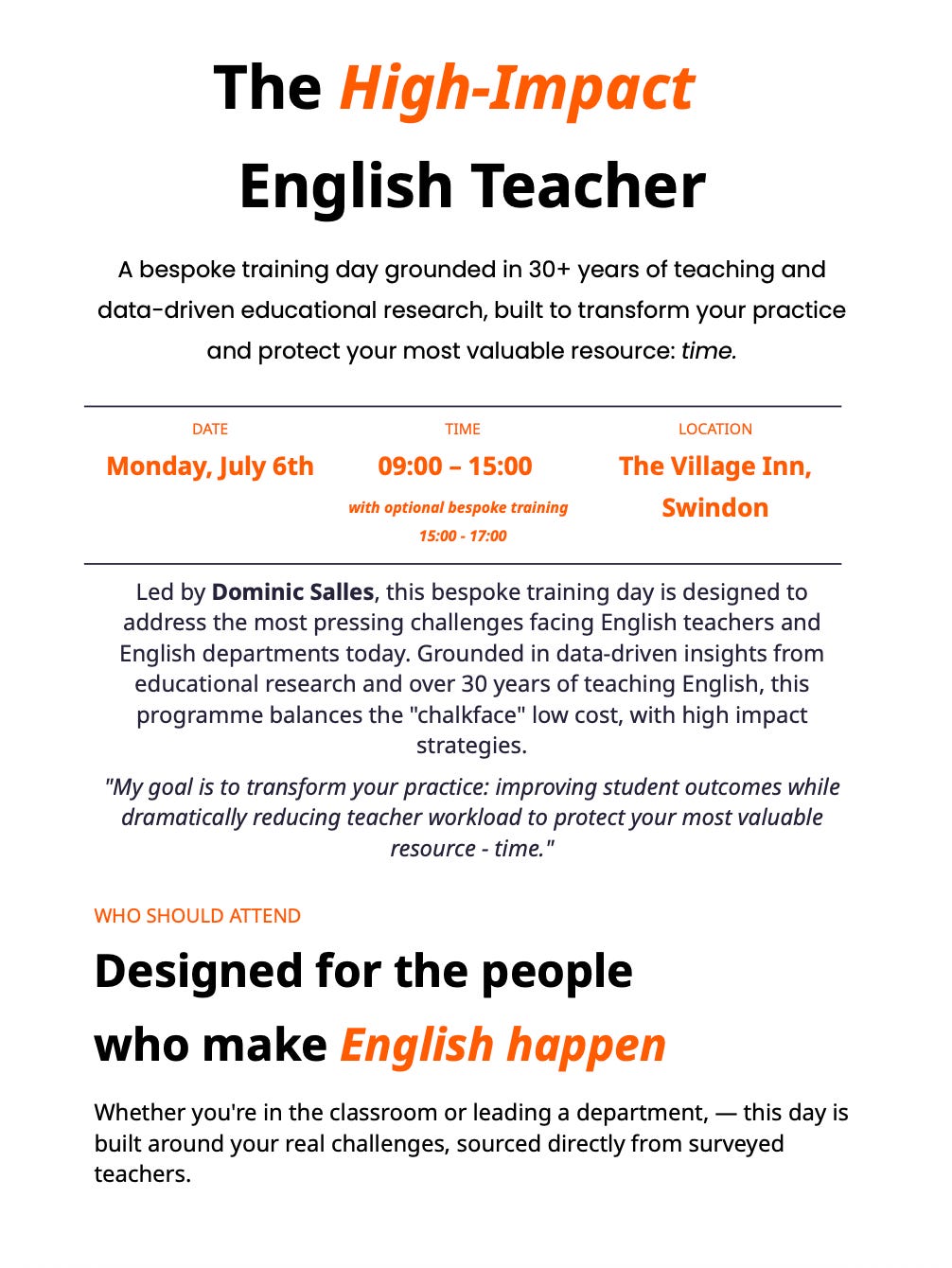
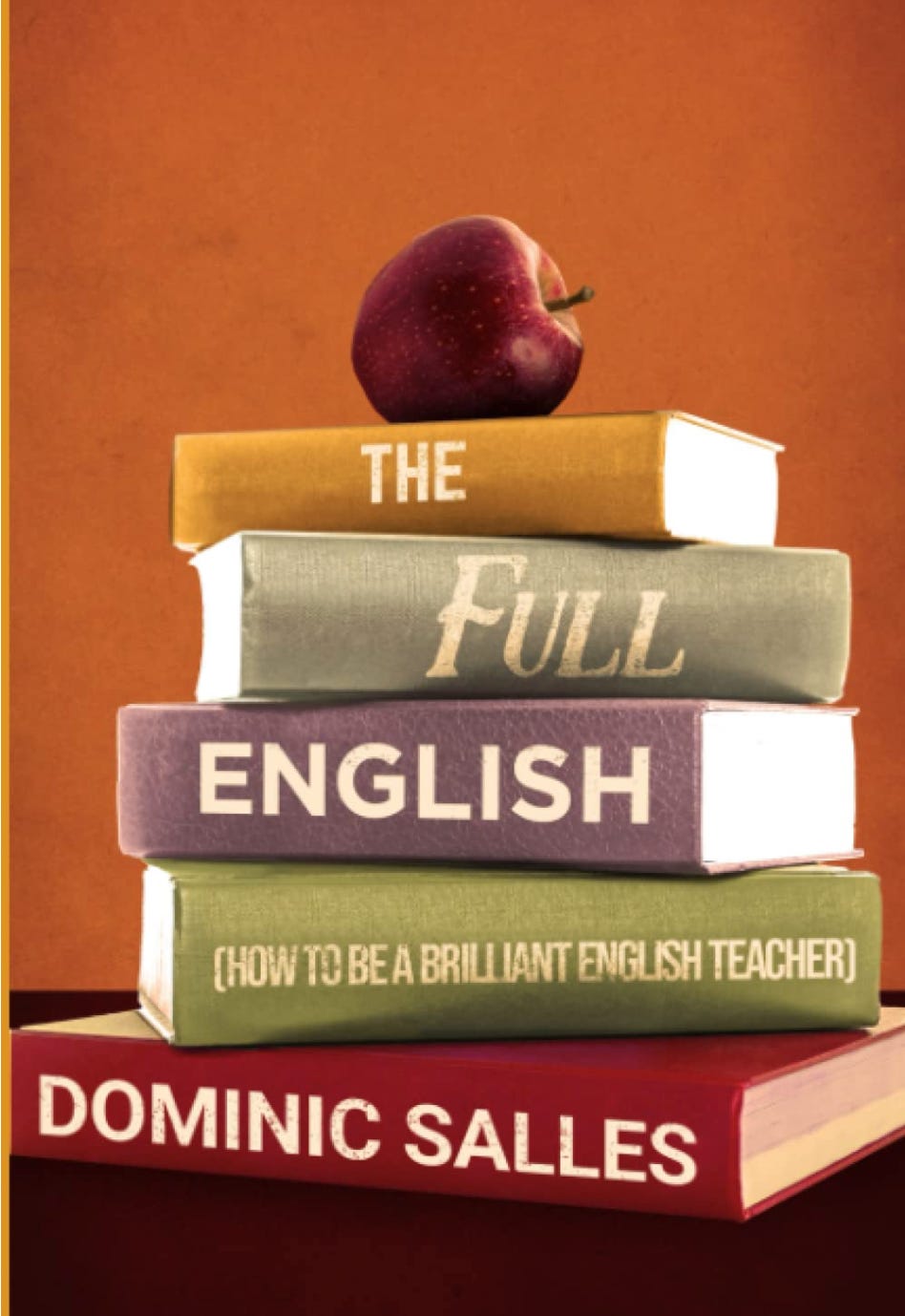
If you want dozens of top tips in how to be a highly effective English teacher, I’m running a live, in person course. Click on the image.
Or you can read my written guide here:
Comments
Nothing yet. Say the first thing.
Sign in to join the conversation.