
This post was requested by a paid subscriber, getting ready for her year 10 mock exams. She went through all of my essays on Jekyll and Hyde, and realised they were all about themes and Hyde.
Could I find her an exam answer on Jekyll?
Of course - for paid subscribers, most things are possible!
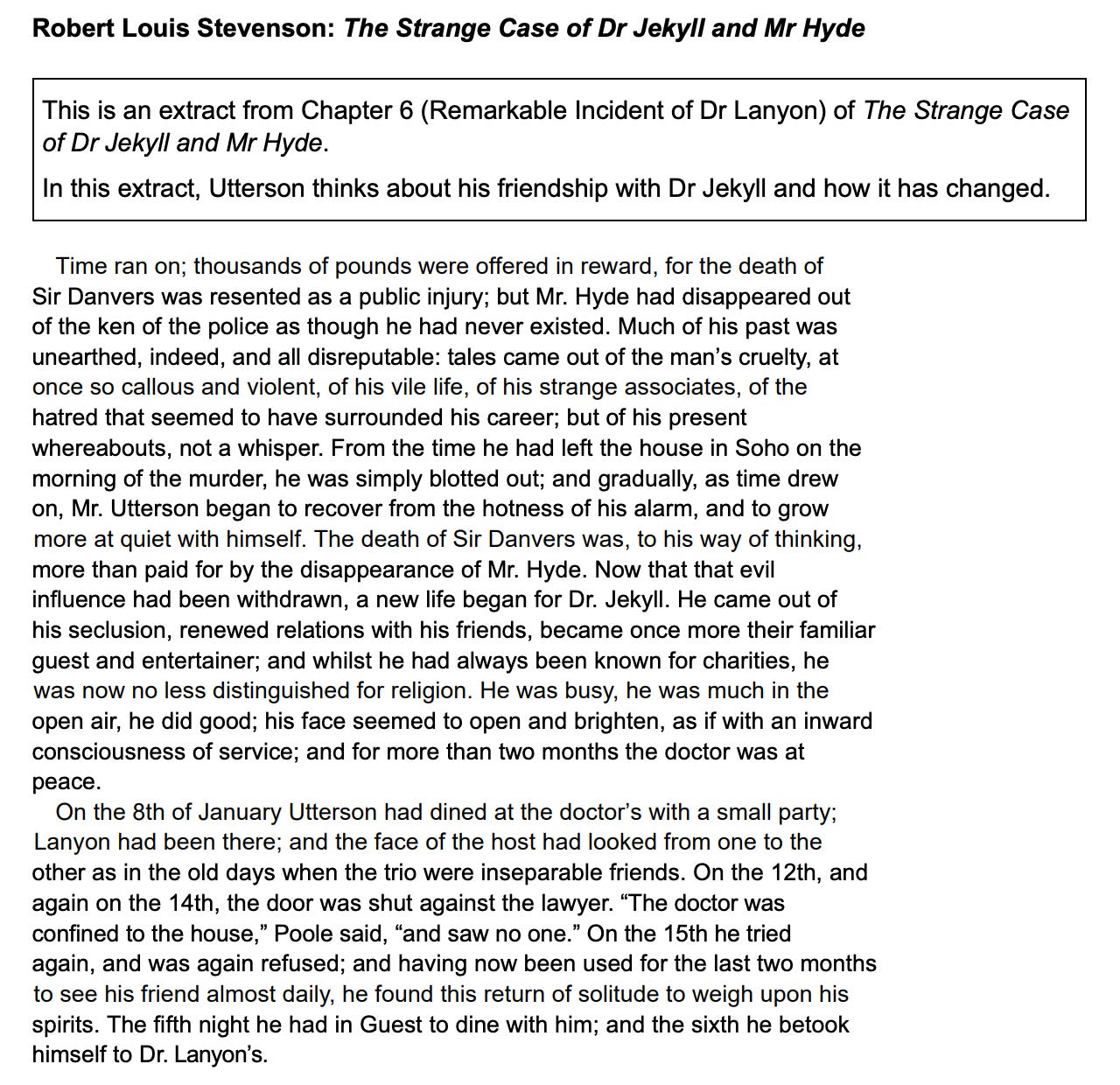
Read the extract from Chapter 6 (Remarkable Incident of Dr Lanyon) of The Strange Case of Dr Jekyll and Mr Hyde and then answer the question.
Starting with this extract, explore how Stevenson presents Dr Jekyll as a mysterious character.
Write about:
how Stevenson presents Dr Jekyll in this extract
how Stevenson presents Dr Jekyll as a mysterious character in the novel as a whole.
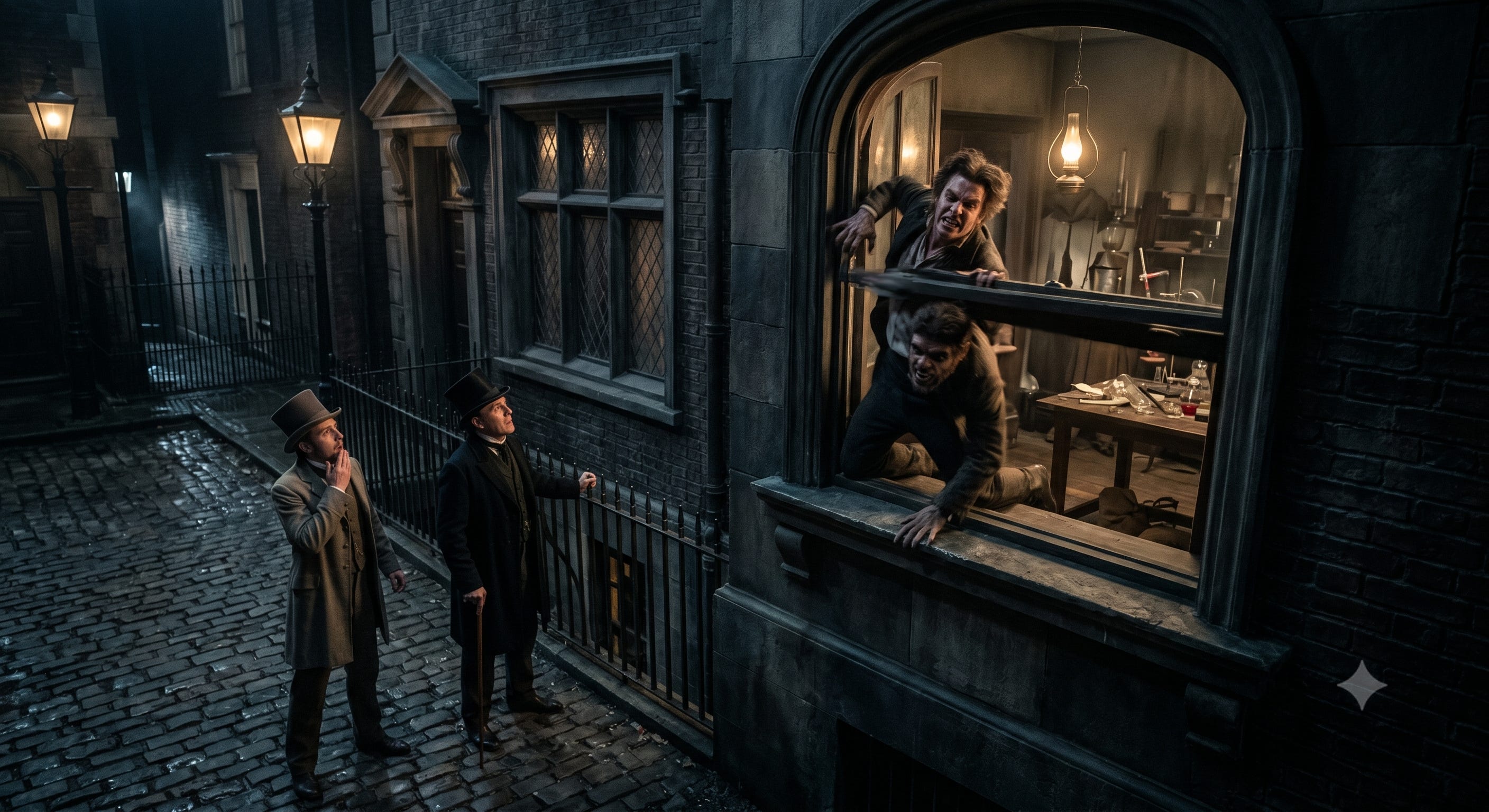
Personally, I think this is a horrible extract. This student didn’t panic. They have revised the scene where Jekyll transforms at the window, and suddenly slams it shut as he becomes Hyde.
Why? Because it is relevant to every question about Hyde, about Jekyll, about Utterson and to every theme.
It is a banker. See how they have used it here.
The themes of mystery and secrecy are crucial in The Strange Case of Dr. Jekyll and Mr. Hyde. The ending reveals that Jekyll’s secret life has been concealed throughout the novel. But Stevenson uses FORESHADOWING by presenting Dr Jekyll as mysterious. He changes both in behaviour and appearance. This is coupled with the dubious friends he keeps, so that even his closest friends like Utterson find him mysterious.
Both in the extract and the novel, Jekyll had abrupt changes in behaviour. Mysteriously, he becomes happy after the murder of Sir Danvers Carew, and rejoins society, coming “out of his seclusion”. However, only two months later “The doctor [is] confined to the house” again. This JUXTAPOSITION between his behaviours reveals a mysterious cause to his changeable nature. This highlights that Jekyll is mysterious even to his closest friends who can’t understand why he changes.
The VERB “secluded” suggests that he has not chosen to isolate himself, but society has isolated him. The VERB “confined” emphasises this further, as though there is a mysterious power forcing him to remain hidden in his home. This is visible when Utterson and Enfield speak to Jekyll from the courtyard beneath his window.
While they’re speaking “a sudden coolness came about his eyes” and Jekyll leapt back inside his house again. The ADJECTIVE “sudden” suggests that Jekyll’s sudden changes in behaviour have no visible cause. This mystery around his character uses FORESHADOWING to hint that Hyde and Jekyll are the same person.
Jekyll’s friends also highlight how mysterious he is. As Jekyll isolates himself from both Utterson and Lanyon, he appears to replace them with Mr Hyde. Utterson compares this to his new sociability “now that that evil influence had been withdrawn”. Hyde leaves and Jekyll’s behaviour turns to “the old days”.
The words “influence” and “withdrawn” emphasise the miserable influence Hyde has had on Jekyll. Hyde’s “evil” has influenced Jekyll’s actions. This emphasises a mystery that would so affect a respected Victorian gentleman. The mystery is a question about Jekyll’s motives for associating so closely with Hyde, who is a despicable murderer. This association is a stain on Jekyll’s reputation. The lack of a known reason for Jekyll’s friendship with Hyde highlights the mystery.
Previously, Utterson assumed the cause was Hyde blackmailing Jekyll. However, Jekyll assured him that he could “be rid of Mr Hyde” at any time. This implies that Hyde doesn’t have a real hold on Jekyll. But this adds further mystery, because it suggests that Jekyll associates with the evil Hyde voluntarily. Because he is a Victorian gentleman, Stevenson might be suggesting the attraction is a desire that Victorian society suppresses, because it is considered improper and disreputable. This resulted in gentlemen enjoying their desires in secret. This again highlights Jekyll’s mysterious nature.
Jekyll doesn’t just have changeable behaviour, he also changes in appearance. We first meet him as a “handsome, red faced man”. The ADJECTIVE “handsome” portrays Jekyll as an ideal version of masculine beauty. However, this contrasts with his later appearance as pale and sick. The reason for this change is part of the mystery.
The extract portrays Jekyll as returning to an open and “bright” appearance, as he suddenly returns to good health. But at the window he suddenly reverts to a state of sickness as a “sudden coolness” takes over. These repeated contrasts and switches are so sudden that the reader cannot explain their cause.
In conclusion, Jekyll’s mystery is emphasised by his unpredictability for which there appears to be no logical explanation. This uses FORESHADOWING for the final revelations of the cause, which is Jekyll’s immorality which attacks society’s norms.
The essay starts with a thesis statement which looks at the question, and then at Stevenson’s ideas.
The essay includes a clear understanding of ideas about Victorian society.
The student chooses a range of references to show their understanding.
The focus on ideas is a strength of the essay and is developed through out. This means it is Level 5 for both AO3 and AO1.
To get Level 5 in AO2, the student would need to develop comments on the writer’s methods and explore how these affect the meaning and ideas in the novel.
To jump from a 22/30 to a 30/30, examiners look for two things: deeper analysis of language (zooming in on specific words) and integrated contextual awareness (understanding why a Victorian writer used those specific choices).
The quotes used in the 22/30 version are good for plot summaries, but they don’t give you enough raw material to analyze Stevenson’s craft on a top-tier level.
Here are the highest-yielding quotes from the novella, broken down by your themes, that will give you the ammunition needed to secure full marks.
Instead of just using general descriptions of him staying inside, you want quotes that highlight the unnatural and frightening nature of his shifts.
“like some disconsolate prisoner”
METAPHOR / SIMILE: This goes far beyond just "staying inside." Comparing Jekyll to a prisoner implies he is trapped by his own mind or by Hyde. It hints at a lack of control, which heightens the mystery.
“the smile was struck out of his face and succeeded by an expression of such abject terror and despair”
VERB CHOICE & HYPERBOLE: The passive verb "struck out" implies a sudden, violent, external force (Hyde) taking control of his body. "Abject terror" is much stronger than "coolness" and shows a deep psychological crisis.
Your essay makes a great point about Jekyll risking his reputation by hanging out with Hyde. To get full marks, you need quotes that show how society reacts to this mystery.
“the moment I choose, I can be rid of Mr. Hyde”
IRONY: Keeping this quote is fine, but you must analyze the extreme IRONY of the statement. Jekyll thinks he is in control, but he is completely blind to his addiction.
“wild when he was young” / “the ghost of some old sin, the cancer of some concealed disgrace”
METAPHOR / CONTEXT: Utterson assumes Hyde is blackmailing Jekyll for past sins. Using words like "ghost" and "cancer" perfectly captures the Victorian fear of a hidden past ruining a gentleman's present reputation.
Share Mr Salles Teaches English
✅ Paid subscribers get number 3 in this list.
The ‘zooming in’ technique demonstrated and explained.
Grade 9 analysis of 3 more quotes.
This essay, upgraded to a full 30/30 essay.
5 reasons this meets to AO criteria at Level 5, so you can do the same.
✅ Paid subscribers get a grade 9 answer with my comments every week except the summer holidays, and access to the over 350+ already published. 🎓
✅ Substack thinks this is so good, that you can sample them free for a week. 👏
To get into the top mark band, your analysis of Jekyll’s appearance needs to directly contrast with the descriptions of Hyde. The mystery isn’t just that Jekyll looks sick—it’s that he looks deformed by his secret.
“large, well-made, smooth-faced man of fifty, with something of a slyish cast perhaps”FORESHADOWING / NUANCE: The phrase "slyish cast" is a vital detail. Even at his best, Jekyll has a hint of deceit or a hidden side to his character.
“He looked deadly sick... and held out a cold hand and bade him welcome in a changed voice”SENSORY IMAGERY: The "cold hand" and "changed voice" show that the transformation is physically altering his biology. It shows Jekyll is literally fading away as Hyde gets stronger.
To get a 22/30, you tell the examiner what a quote means. To get a 30/30, you pick apart a single word.
If you use the window scene quote:
“the smile was struck out of his face”
A 30/30 response would analyze it like this:
Stevenson uses the violent passive VERB “struck” to demonstrate that Jekyll is not in control of his own body. The choice of language implies an unprovoked, physical blow has removed his humanity, FORESHADOWING that Hyde is a separate, aggressive force tearing its way out from within the gentlemanly exterior.
Here are 3 high-impact quotes from the novel that fit perfectly with your essay’s focus on Jekyll’s behavior, appearance, and reputation.
For each quote, I have provided a top-band analysis using the “Zooming In” technique, directly answering how Stevenson uses Jekyll to build mystery.
“They saw it but for a glimpse, for the window was instantly thrust down”
Stevenson uses the sensory imagery of a “glimpse” to heighten the narrative mystery, deliberately rationing the information given to both the characters and the reader. The fact that Utterson and Enfield only catch a fleeting look at Jekyll’s terror prevents a rational explanation, forcing the reader to speculate on what horror could cause such a reaction.
This mystery is intensified through the ADVERB “instantly” and the violent passive VERB “thrust,” which emphasise the panic-stricken speed of Jekyll’s actions. This implies an urgent necessity to hide; the window acts as a physical barrier separating the respectable, public Victorian world from the hidden, taboo reality of Jekyll’s private life. By terminating the conversation so abruptly, Stevenson portrays Jekyll not as a man making a polite choice to go inside, but as a desperate prisoner frantically concealing something monstrous.
“I have had a shock and I shall never recover. It is a question of weeks. Well, life has been pleasant; I liked it; yes, sir, I used to like it. I am sometimes thinking if we knew all, we should be more glad to get away.”
Stevenson structures Lanyon’s dialogue to create an intense sense of mystery by highlighting the devastating psychological impact Jekyll’s secret has on others. Lanyon, previously established as a robust, rational man of science, is reduced to a state of fatalistic despair, declaring that “if we knew all, we should be more glad to get away.” The PRONOUN “all” functions as an ominous clue to Jekyll’s unmentionable secret, leaving the nature of his behaviour entirely unexplained at this point in the novella.
Furthermore, the shift from the past tense “life has been pleasant” to the detached “I used to like it” FORESHADOWS his death. Lanyon is so deeply traumatised by what he has discovered about Jekyll that he cannot—or will not—articulate it. This reinforces the Victorian code of secrecy and decorum, where some truths are too horrific to speak aloud.
“The doctor was confined to the house... and looking on the court with a silent flash of melancholy, like some disconsolate prisoner”
Stevenson uses a powerful SIMILE, comparing Jekyll to “some disconsolate prisoner,” to deepen the mystery surrounding his self-imposed isolation. A Victorian gentleman of Jekyll’s high social status should enjoy social freedoms and comfort, making his sense of confinement bizarre and contradictory. The ADJECTIVE “disconsolate” suggests profound grief, implying that Jekyll is trapped not by iron bars, but by a psychological or moral captivity of his own making.
This sense of hidden torment is amplified by the OXYMORON “silent flash of melancholy.” The word “flash” usually implies light and visibility, but pairing it with the internal, dark emotion of “melancholy” suggests a sudden, involuntary exposure of Jekyll’s internal agony. Through this imagery, Stevenson presents Jekyll as a man waging a desperate, secret war against himself, leaving the onlookers in the courtyard completely blind to the true nature of his captivity.
The themes of mystery and secrecy are crucial in The Strange Case of Dr. Jekyll and Mr. Hyde. By the end, we know that Jekyll has been keeping a secret throughout the entire course of the book. However, Stevenson uses FORESHADOWING by presenting Dr. Jekyll as a mysterious character. This taps into the contemporary interest in detective fiction, but is also an attack on Victorian morality and the hypocrisy of affluent gentlemen in society. He changes both in behaviour and appearance. This is coupled with the dubious friends he keeps, so that even his closest friends like Utterson find him mysterious.
Throughout the novella, as well as the extract, Dr. Jekyll has drastic and often sudden changes in his behaviour. After the death of Sir Danvers, Jekyll is happier, more open and comes “out of his seclusion”. However, after only two months, “The doctor [is] confined to the house” once more. The JUXTAPOSITION between the two attitudes presents Jekyll as an ever-changing man, and his mysterious nature is highlighted by the unknown reason behind both changes. This emphasises how Jekyll keeps to himself, and his once closest friends now no longer know him. The VERB “secluded” implies that it was not a choice he made himself, and perhaps he was secluded by society. The VERB “confined” further highlights this idea and pushes the mysterious nature of Jekyll, as there seems to be an unknown force or being that is keeping him hidden away in his home. Stevenson emphasises this later by expanding the setting into a SIMILE, describing Jekyll as looking out “like some disconsolate prisoner”. The ADJECTIVE “disconsolate” suggests deep sadness, which deepens the mystery because a rich Victorian gentleman should have complete freedom, yet he is a prisoner in his own home.
This happens again later on when Utterson and Enfield pass by Jekyll at a window on their walk. Amidst a normal conversation, “a sudden coolness came about his eyes” and Jekyll secluded himself in his house once more. Stevenson notes that “They saw it but for a glimpse, for the window was instantly thrust down”. The sensory imagery of a “glimpse” creates mystery because it limits what the characters can see. The ADVERB “instantly” and the violent VERB “thrust” show a panicked, urgent need to hide his face. The ADJECTIVE “sudden” further iterates the strange and seemingly unprovoked changes in Jekyll’s behavior. This highlights the mysterious nature of Jekyll’s character and sets up the FORESHADOWING that Jekyll and Hyde are truly one and the same.
The mystery of Jekyll is also illustrated through his acquaintances. As Jekyll grows further away from Lanyon and Utterson, he grows closer with Mr. Hyde. In reflection, Utterson remarks that “now that that evil influence had been withdrawn” Jekyll, Lanyon, and himself can return to “the old days”. The use of the VERBS “influence” and “withdrawn” highlight the bad effect Hyde had on Jekyll. Hyde is “evil” and clearly changed how Jekyll acted. This breakdown of friendships impacts others deeply, creating more mystery. For example, Lanyon later tells Utterson, “I have had a shock and I shall never recover... if we knew all, we should be more glad to get away”. The PRONOUN “all” acts as a clue to Jekyll’s hidden truth, and the breakdown in Lanyon’s health shows how terrifying Jekyll’s secret behaviour must be. This highlights Jekyll’s mysteriousness because he was a well-respected Victorian gentleman; it was strange that he associated with detestable people like Hyde, whose actions could have ruined Jekyll’s name. There is no good and proper reason why the two would be friends.
Earlier, Utterson had suspected that Hyde was blackmailing Jekyll, but Jekyll reassured him that whenever he chooses he “can be rid of Mr Hyde”. This statement is full of IRONY, because while Jekyll thinks he can end the relationship whenever he wants, he is actually completely trapped by Hyde. It pushes the idea that Jekyll is mysterious because if he is sure he can so easily be rid of Hyde, why do the two remain in touch? The fact that Jekyll was a Victorian gentleman only helps this idea, as society forced men to repress desires that they viewed as improper. This meant that many men snuck about town in secret to fulfill these desires.
Along with a change in behaviour, Jekyll’s appearance frequently changes. When we are first introduced to Jekyll, he is a “handsome, red faced man”. However, Stevenson adds detail by calling him a “large, well-made, smooth-faced man of fifty, with something of a slyish cast perhaps”. The phrase “slyish cast” acts as early FORESHADOWING, hinting that beneath his perfect exterior, he has a deceptive side. The ADJECTIVE “handsome” illustrates how Jekyll fulfills the beauty ideals for men at the time. However, this is JUXTAPOSED when we find Jekyll sick and pale looking. Stevenson writes that “He looked deadly sick... and held out a cold hand and bade him welcome in a changed voice”. The physical changes of a “cold hand” and a “changed voice” show that his physical appearance is altering unnaturally due to his secret life. The CONTRAST in appearance highlights Jekyll’s mysterious nature, as there is no reason for his change or unexplainable, sudden sickness.
In the extract, Jekyll once more is “open” and “brigh[er]”. The ADJECTIVES “open” and “brighter” further demonstrate the appealing appearance of Jekyll when he is healthy and contrasts his previously sick look. However, he changes again as a “sudden coolness comes about” him. Stevenson describes this as a “silent flash of melancholy”. This OXYMORON pairs the bright word “flash” with the dark word “melancholy”, showing a sudden, involuntary display of his inner sadness. The CONTRAST throughout the book further emphasises Jekyll’s mysterious nature, as Stevenson presents him as a man who unexplainably changes.
In conclusion, Jekyll is unpredictable throughout, but his mysterious nature is highlighted by the fact that Stevenson doesn’t give an explanation at the time as to why this is. This further FORESHADOWS the ending of the book and reflects how, despite being a Victorian gentleman, Jekyll is not excluded from socially immoral behavior. Stevenson’s wider point is that Jekyll represents men of his class, trapped inside their own immoral behaviours, and presenting a false facade of respectability to society while enjoying their damaging vices in secret.
Your essay moves beyond simple narrative retelling. By framing the theme of mystery not just as a plot device but as an “attack on Victorian morality and the hypocrisy of affluent gentlemen,” you establish a strong thesis. This conceptual approach shows the examiner that you are interpreting the text’s deeper significance rather than just describing events.
You don’t just “tack on” historical facts; you weave them into your analysis of Jekyll’s character. By linking his secrecy to the “Victorian society [that] forced men to repress desires that they viewed as improper,” you demonstrate a sophisticated understanding of how context shapes the text’s themes. You successfully link the “big picture” of the Victorian era to specific character actions.
You consistently move beyond identifying a technique to explaining its effect. You don’t just state that Stevenson uses an oxymoron or a simile; you analyse how phrases like “silent flash of melancholy” or “like some disconsolate prisoner” shape the reader’s perception of Jekyll’s internal conflict. You effectively analyse language at the word, sentence, and textual level.
The essay is well-structured and follows a clear, logical line of argument. By using transitions that connect the extract to the “whole text”, such as “Throughout the novella, as well as the extract”, you prove that you have an overview of the entire novel. This “whole-text” awareness is a hallmark of Level 6 responses, as it demonstrates that you are not solely reliant on the provided extract.
You select your quotations with purpose, embedding them seamlessly into your own sentences. Importantly, you don’t use “filler” quotes; every piece of evidence, from the “slyish cast” to “instantly thrust down”, is directly tied to your argument about Jekyll’s mysterious nature. This demonstrates the “judicious” use of references required for top-level marks.
Comments
Nothing yet. Say the first thing.
Sign in to join the conversation.