
“It is one thing to integrate technology within a human-centered, relational vision; it is quite another to be guided by an outlook that devalues human limits and promises a purely technical form of ‘salvation’.”
— Pope Leo XIV, Magnifica Humanitas (first encyclical, this week)
The Pope spent 37,000 words in the annual Magnifica Humanitas on AI, wealth inequality and the limits of GDP. That frame sits underneath almost every business story in this issue.
The aspirational middle is a casualty story. Hard luxury is running hot, art auctions just staged a $2.5 Billion Comeback, Richemont printed 11% growth in the same week that BOF analyzed 50 million aspirational consumers leaving the luxury market, in what Bain logs as the first contraction of the aspirational shopper base in twenty-three years. Jumeirah’s expanding Privé, ultra-private hospitality via charter yachts at $700K a week. Those chasing the middle are getting caught in hard spots, there’s a case study to be discussed over the AP x Swatch Chaos, and Gucci continues to make the right moves for cultural relevance yet still struggles to find sales.
Below that ceiling, Spirit shutters, and the largest housing market crashes show Florida’s exurbs give back COVID gains.
The barbell is very real. So fuck it, this weeks free. It’s hard enough out there.
MAGNIFICA HUMANITAS
Pope Leo XIV released his first encyclical, Magnifica Humanitas: On Safeguarding the Human Person in the Time of Artificial Intelligence, last week. Encyclicals are formal papal letters addressed to “all people of good will,” and function as a barometer of the Catholic Church’s position on the human condition.
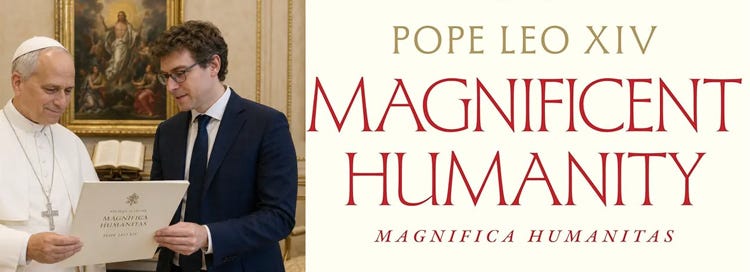
Leo signed his on the 135th anniversary of Leo XIII’s Rerum Novarum and presented it alongside Anthropic co-founder Chris Olah at the Vatican.
The core points: (1) AI is “not neutral” (2) the new threat is private transnational firms whose resources “surpass those of many Governments” (3) avoid the “Babel syndrome, the idolatry of profit that sacrifices the weak” (4) GDP is the wrong yardstick.
He also rejects transhumanism by name.
“It is important to move beyond the current metrics of development, which for more than eighty years have been tied to the concept of Gross Domestic Product (GDP), since these metrics almost systematically neglect aspects essential to the overall wellbeing of people and the environment.”
— Pope Leo XIV, Magnifica Humanitas
The letter lands as tech is facing a PR crisis. Gallup’s latest Gen Z read shows a generation shifting from “excited” to “angry”. 2026 commencement speakers got booed on three separate stages in eight days. Big Machine Label Group founder Scott Borchetta told MTSU graduates “AI is rewriting production as we sit here,” then snapped back at the boos with “Deal with it. Like I said, it’s a tool.” Eric Schmidt’s speech at the University of Arizona got drowned out and became the viral example of this graduating class’s sentiment.
The “it’s a tool” and “learn it or get left behind” narrative isn’t resonating. Reese Witherspoon’s April 16 Instagram urging women to learn AI, citing “the jobs women hold are 3x more likely to be automated by AI, yet women are using AI at a rate 25% lower than men,” drew 5M views and a complete ratio in the comments.
“Well, I guess my AI post got people talking. To be clear, no one is paying me to talk about this. I’m just a curious human.”
— Reese Witherspoon
A general consensus is forming that AI is putting leverage in the hands of very few while displacing the large majority. The Pope’s concern on the global level aligns with this. The still-offline population sits at 2.6 billion, with only 27% of people in low-income countries online. Nearly a third of the world is not in any position to leverage AI.
This is not the first time tech has disrupted humanity. The power loom and stocking frame triggered the Luddite movement. The Catholic Church has been around long enough that many themes may not repeat, but they definitely rhyme. Heliocentrism led to Galileo’s trial by the Roman Inquisition and lifelong house arrest. The printing press, invented in the 1440s, took information control out of centralized power and seeded mass literacy.
Pope Leo XIII touched on capital and labor in 1891 with Rerum Novarum, as the industrial revolution brought steam, mechanization, and the factory system to bear against human labor. 135 years later, Magnifica Humanitas explicitly connects the industrialization of the 1800s to the algorithms of today.
“There is a real possibility that AI will displace human labor at very large scale. If that happens, supporting those displaced will be a moral imperative of historic proportions.
This task will be difficult enough, but I worry most dialogue misses an even harder challenge. AI development is concentrated in a handful of wealthy nations. How can we ensure the gains of AI are shared globally? We do not have a mechanism for this.”
— Chris Olah, co-founder, Anthropic
The Verge ran the encyclical through Pangram, the AI detection tool, and found an aggregate ~46% AI-written across roughly 2,000 sampled words, with individual paragraphs scoring 40 to 100%. If the Vatican itself used LLMs to compose a moral indictment of LLM concentration, you cannot find better hypocrisy, or perhaps a tacit acknowledgment that this is a tool of the future. The Vatican has not publicly responded as of 2026-05-28.
I never imagined that in my time we’d be deeply considering anthropology, or the definition of what a human being is.
“For an algorithm, an error is a flaw to be corrected; for a person, however, an error can be a catalyst for profound change.”
— Pope Leo XIV, Magnifica Humanitas
ROYAL POP
A case study that touches on everything from compressed hype cycles, timeline dominance, brand dilution, chaos, and the role resale markets play, especially with luxury and coveted items.
Enough dust has settled on AP and Swatch’s Royal Pop collaboration that we can assess the positive and negative. I find the whole thing fascinating, especially the speed. What Beanie Babies did over years, Labubu did in months, and Royal Pop did in a week.
A set of eight Bioceramic pocket watches in two case styles, Lépine at $400 and Savonnette at $420, released worldwide May 16 with a one-per-person, per-day cap, dominated a news and hype cycle for a week. Then poof.
Of the two brands, Swatch comes out a winner. They know exactly what this is and it works for them every time. They ran a similar play with MoonSwatch in 2022, although that didn’t ding Omega or have nearly the impact on my timeline. Royal Pop was essentially a bigger co-brand with worse crowd control and a post-drop surprise that the piece is not a limited edition, which cratered the resale market. Hyped colorways went from roughly $4,400 to $1,200 in a single trading day, a 72% collapse.
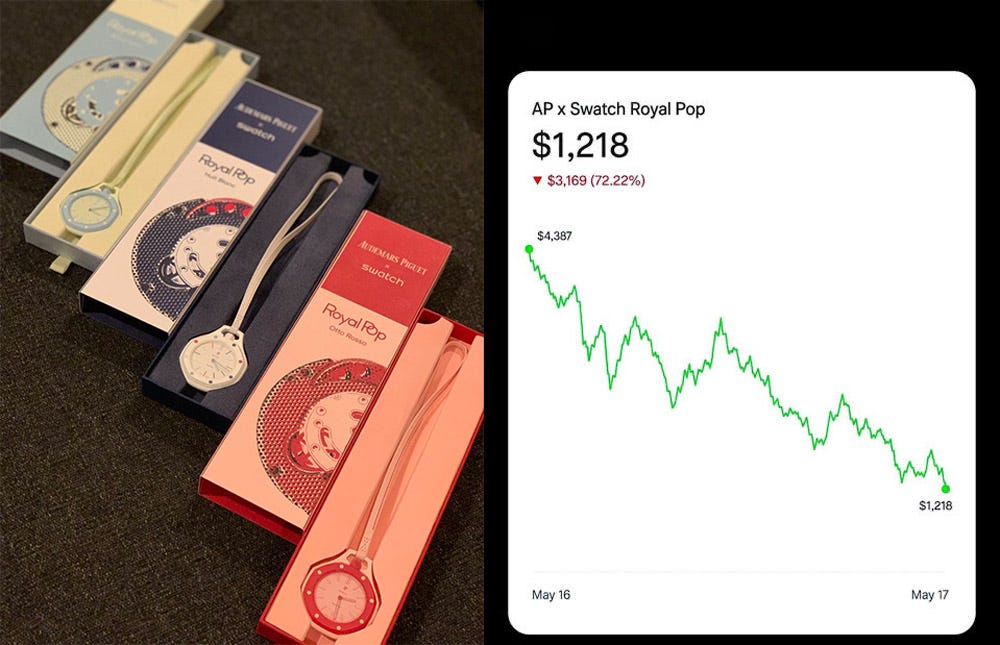
Swatch gains by bringing an accessible brand to their customers and garnering an insane amount of impressions. They can play in the “all press is good press” world. They have nothing to lose except answering for poor line management in stores.
AP on the other hand, I feel this diluted them. I understand the motivation, but when luxury brands chase aspiration over staying coveted, it hurts long term.
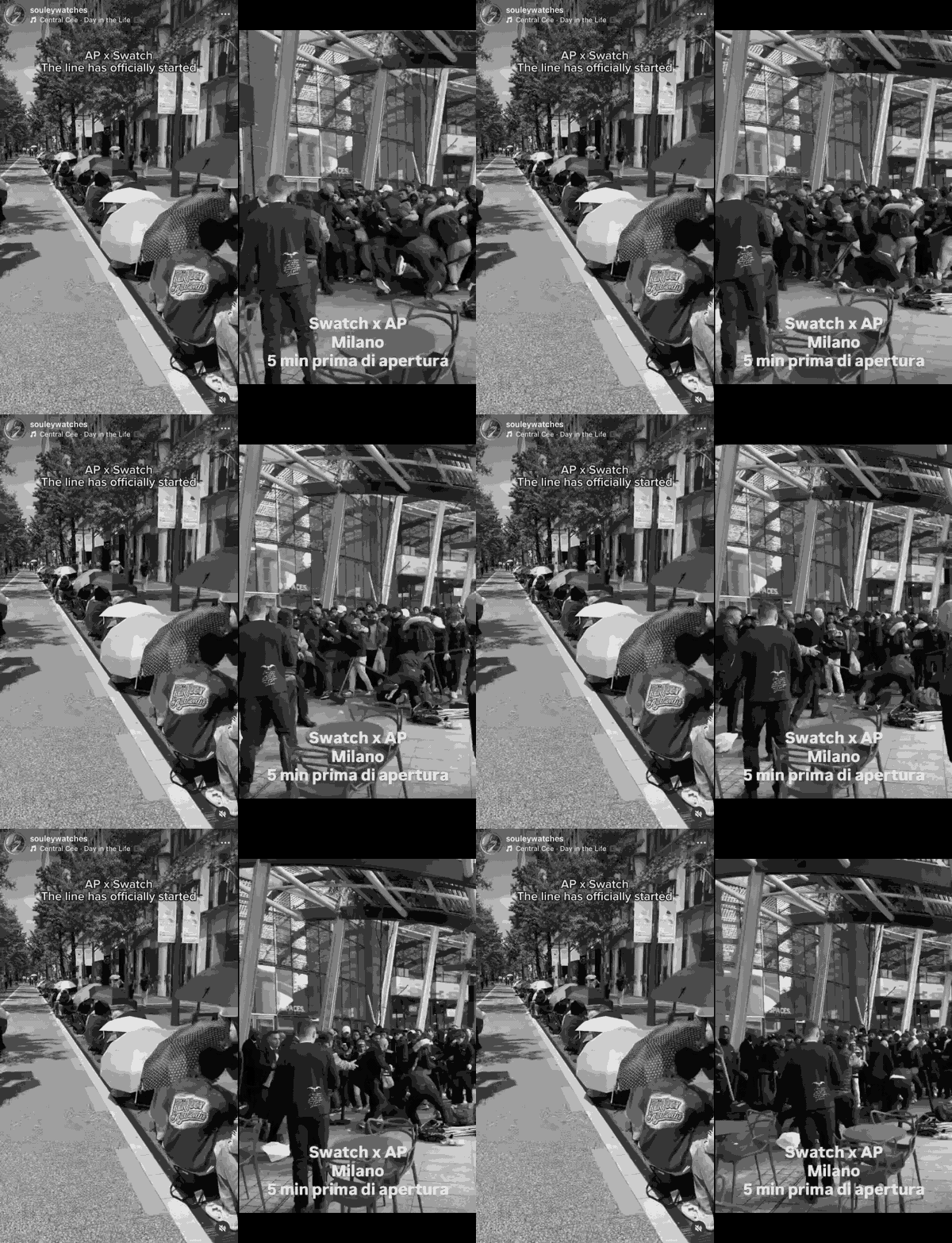
For both brands, headlines detailing sleeping bags, retail chaos, and police barricades are a bad look, but the damage is asymmetrical to a luxury brand now aligned with fights and store closures. The AP purchase experience should be PRISTINE. In fairness, social media excels at amplifying a narrative. Swatch closed approximately 20 of its 220 global stores citing safety, roughly 9%, which was enough to make it apocalyptic online.
Why AP moved this way
You could argue Audemars needed a mass consumer play.
They are still small when comparing awareness to a behemoth like Rolex. AP has an audience, and it is expanding, but they sell ~53,000 watches a year against Rolex’s ~1.15 million.
Women still make up about 20% of AP buyers and Resta has gone on the record targeting 45% by 2030. This collaboration gave them a bag charm with a lot of eyeballs.
AP also lost trademark cases in Japan in 2024 and the U.S. in 2025 where courts ruled core elements of the Royal Oak configuration “nondistinctive.” The Swatch collab reasserts the octagon as AP’s signature in cultural memory at a moment when AP cannot legally fence it. Lexology had the sharpest read on the IP-and-collab timing.
They actually carved this out as a philanthropic play, with 100% of revenue funding the new Audemars Piguet Académie de Savoir-Faire in Le Sentier, a free-to-attend four-year horological apprenticeship with an opening cohort of 40 students. They can write it off. A double pun: letting the masses get a “sorta AP” is actual charity for them.
“While Audemars Piguet is treating the collaboration as an insulated, almost philanthropic ‘special project,’ Swatch Group stands to gain significantly more commercial momentum. Despite some short-term negative sentiment driven by watch purists, the partnership represents a major cultural breakthrough for Swatch as it attempts to reverse recent financial stagnation.”
The pocket-watch format keeps the wrist category premium. Although there are videos on YouTube on how you can swap the bezel into a bought band for a very close approximation at a much lower cost.
This isn’t a watch story. It’s a luxury-accessability story, best examined in Jacob Gallagher’s NYT coverage of the trinket-as-status moment. The luxury market has long dangled accessible items for access when the majority of collections are price-point prohibitive, usually fragrance, wallets, or some signaling trinket.
The aspirational market buoys luxury, although in recent years this has waned considerably as people’s budgets are stretched thin and houses focus on high-net-worth clients. We get to this later with Richemont’s blow-out annual report. This year, the trinket is dominating the playbook. Hermès Rodeo charm at $640, Prada sailboat pendant, and now an AP $400 lanyard. Bag charm, bag charm, bag charm.
BoF’s podcast addresses the touchy point luxury brands often have a hard time admitting:
“For an industry built on status signalling and rigid gatekeeping, the mass participation of everyday consumers is often viewed by insiders not as democratisation, but as a dilution of exclusivity in luxury watchmaking.”
Audemars’s collector base does not like an accessibility play, nor are they looking for a PR stunt that demerits AP’s high-net-worth client experience. They want the brand coveted and the value held high.
“Opinions on this project are, of course, divided. They always are when luxury ventures beyond its traditional boundaries. That is exactly where relevance is reborn: when watchmaking provokes discussion, curiosity, desire, and even disagreement.”
— Ilaria Resta, CEO, Audemars Piguet, LinkedIn, May 13
AP answered this all with subtle shade. The brand’s own statement directed all operational questions back to Swatch, a soft public separation. Bloomberg TV on May 26 had a much-talked number: AP’s website received more than 10 times its typical annual visitor count in a single day.
The truth is, the timeline moves on quickly.
We’re already on to pile driving the new electric Lambo.
O32C SCRAPER
Filip Wojda Index’d the totality of 032c into a digital archive.
Scroll by image or dig deep into a listing of stylists, photographers, authors and talent. I love when people open source resources like this, a goldmine for creatives.
Go on, Filip! Would love to see a creative library of cabana, system, purple, all the indie mags in a format like this.
CHARLI XCX & NOTHING
Nothing’s been interesting to watch, their positioning first riding off the ‘dumb’ movement but also as one of the most design forward products I’ve seen since Apple. Their challenging cluttered spaces (phones, headphones, wearable tech) but managing to stand out.
The campaigns rolling out this year have been very meta, mixing BTS and candid with mega stars in a very aesthetically sharp way, the work has resonated with me. The latest campaign places Charli as the brands newest ambassador (with an equity deal alongside Casey Neistat, The Weekend, and Swedish House Mafia),
Locking the artist in a room with their headphones for 5 days to emphasize Nothings’ long battery shelf life.
I’m confused though…the BTS they posted here, makes it look as if it was a pretty normal photo shoot? Was she locked in a room with all these people for 5 days? Or was it a 5 day shoot (technicality)?
Process videos are major drivers right now, Coinbase is crushing it with these, showing the craft and effort into their video game spots, as is apple. We’re going to see a lot of brands going the distance to show manual craft in a world of AI. I’d have liked to see nothing come harder here, in this instance it almost works against the concept.
Design wise they’re killing it though.
LUXURY HOSPITALITY’S RUSIAN DOLL MOVES
Hospitality continues to capture luxury market share while consolidating at the top.
I wrote about Belmond’s pursuit of excellence over growth, which in many ways means focusing on a select set of smaller properties which can demand the most premium of rates via scarcity and a highly loyal customer base. The ultra-private end is becoming the most lucrative, Dubai-based Jumeirah is going beyond the boutique model into Privé which is essentially bespoke privatization of iconic properties for short durations.

Jumeirah is essentially buying scarcity, the first Privé offering was Thanda Island in Tanzania, a remote Marine Reserve, booked entirely for one group at a time. The second move is chartering the Maltese Falcon, one of the most architecturally distinctive sailing superyachts ever built, this time by-invitation, 12-guest charters booking at $700K/week.

The nautical space is heating up as major groups are all launching maritime extensions. The arms race is going in the opposite direction of scale, with each luxury group touting smaller, more private vessels with LESS rooms than the preceding launch. It’s like a Russian doll. Last year the Ritz launched Luminara with 224 suites, more recently the Four Seasons launched their maiden voyage to an even more exclusive 94 suites. The Orient Express Silenseas will enter the market as the world’s largest sailing ship, with only 54 suites, dedicating massive amounts of physical space to a very small number of guests. Aman will continue the contraction, the Amangati will only have 47 suites with no more than 94 guests at any time.
Jumeirah is still in a different field, these experiences are more akin to private charters, the model is establishing a private club type brand more than it is a revenue move.
ROMAIN GAVRAS
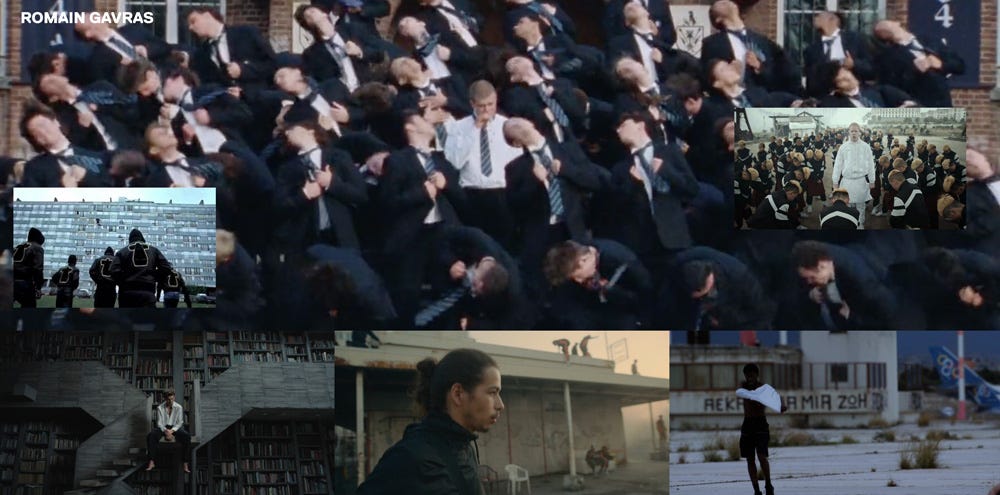
GENER8ION’s “STORM” is so iconically Gavras you could probably tell from a single gif he was behind it. For those not tracking, Romain is iconic. His CV spans decades, going back to some of my favorite videos from 20+ years ago. A bunch I didn’t even realize were his.
I love finding strength in an artist’s early work, because you see what they can do with paltry budgets. “I Believe” for Simian Mobile Disco (2007), shot in rural Romania, is such a banger. Simple. Nothing more than genius casting of local residents dancing. You can already see the through line of choreography and casting that evolves into his later work.
Justice’s “Stress” is one of my favorite videos and I had no idea he was behind it. Another example of pre-budget work that hits HARD, a perfect representation of the music, and you can see the influence on STORM’s punk-life depiction.
“I didn’t try to do something controversial, otherwise I would have put whores and Nazis in it. The idea was to make a really violent video to match the music. It’s shot in a realistic way. Lots of people thought it was true.”
— Romain Gavras on Justice’s “Stress,” Interview Magazine
The iconic aesthetic breaks out in 2012 when he goes full cinematic for No Church in the Wild, followed by M.I.A.’s “Bad Girls” and perhaps my favorite video of all time, Jamie xx’s “Gosh” in 2016. Set in Tianducheng, the abandoned clone of Paris in Hangzhou, China. Basically the playbook of “I Believe” on steroids: iconic location, impeccable casting, and the emergence of a signature use of choreography. These dominated commercial mood boards for years.
The features have been uneven. Athena (Venice main competition, 2022, Netflix) is the peak, an 83% Rotten Tomatoes single-shot banlieue uprising. Sacrifice his English-language debut. Netflix just acquired US rights to, nine months after it was panned at TIFF as the festival’s worst-reviewed premiere, currently sitting at 38% on Rotten Tomatoes. It’s getting received akin to Hype Williams’ Belly: image-rich, narratively muddled.
The body of work shows the style’s been there since day one.
VIDEO CALLS COME TO BRITISH AIRWAYS
9 years ago Luis C.K had a bit “Everything’s amazing and nobody’s happy” lambasting our idiotic lack of appreciation for the marvels such as the fact that we beam internet from SPACE and your pissed off about choppy wi-fi while you fly through a metal object in the air at 500mph
A decade later, we’ve got Starlink on United, American, Southwest, Alaska, and Hawaiian airlines and British airlines are about to let you take video calls mid-flight. Amazing advancements, except for the idea of now having to listen to people take zoom calls and say ‘can everyone see my screen’
The plane has been my last bastion of unavailability, it’s the only place I tune out, I relish a transatlantic flight without wi-fi and a rare excuse of being genuinely unreachable.
It’s all good though, British airlines asked everyone to “Please be considerate” on their website, I’m sure that will be the case. We’re going to see some iconic viral videos of people’s worst behavior here.
RICHEMONT HITS DOUBLE-DIGIT GROWTH
While LVMH and Kering’s fashion houses are stuck in turnaround mode, Richemont’s pure-play hard-luxury portfolio (watches plus jewelry) just printed the cleanest expression of where the chips are falling as the wealth gap widens. The group closed fiscal 2026 with sales of €22.4 billion, up 11%, with Q4 accelerating to 13%.
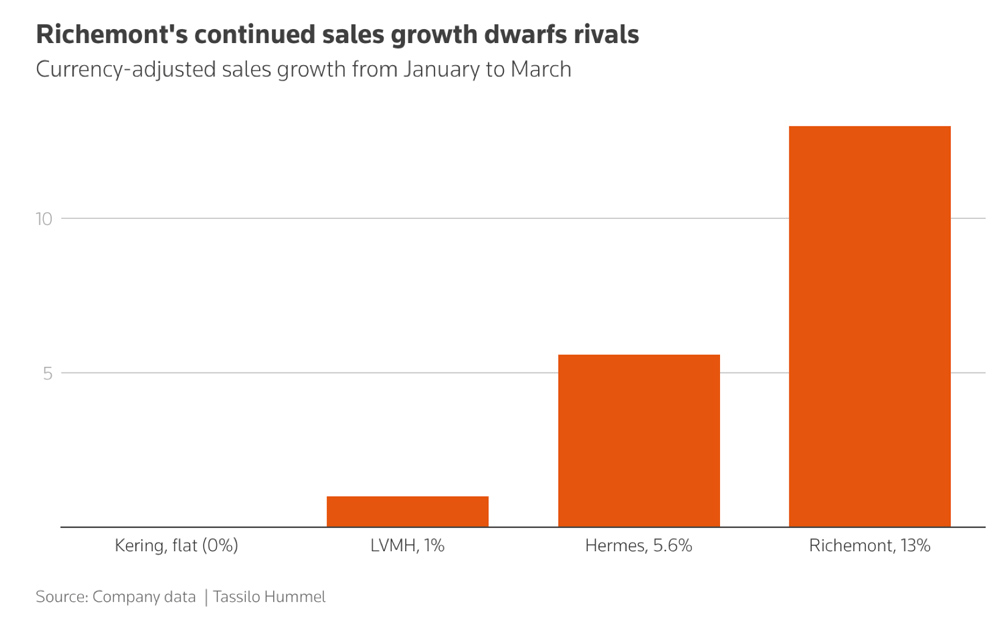
The Jewelry Maisons division (Cartier, Van Cleef & Arpels, Buccellati, Vhernier) did the heavy lifting. Up 14% for the full year, up 16% in Q4 on a 30.5% operating margin. This print widens Richemont’s outperformance over LVMH’s fashion-and-leather-goods division to 18 percentage points.
Richemont owns the four most valuable global brands in the category and has no major handbag, RTW, or beauty business to drag the mix. The group also avoids the muck of designer-musical-chairs. There’s no “celebrity creative director” coming in with a complete reinvention every rotation. The brands stay constant, and the money that would have gone to a creative reboot goes to ambassador campaigns instead.
Jewelry as a category is in a supercycle. Branded jewelry is up at every major holdco this quarter: LVMH watches-and-jewelry +7%, Kering jewelry +22%, Hermès jewelry +10%. Soft luxury is flat to down: LVMH fashion -2%, Gucci -14.3%.
This doesn’t mean hard luxury is on autopilot. Cultural relevance is critical in the branded-jewelry space, and Cartier’s ambassador roster is arguably the deepest celebrity bench in any single maison right now. Zoe Saldaña, Elle Fanning, Paul Mescal, BLACKPINK’s Jisoo, BTS’s V, Timothée Chalamet, Rami Malek, Jackson Wang, Yara Shahidi, Labrinth, Gemma Chan, Hyunjin, and Byeon Woo Seok all sit on the current roster. They understand how to show up as well, we’ve been fortunate to work with Cartier across many of their tentpole events.
Aspirational shoppers walked away from €3,000 handbags because price hikes outran perceived quality. They didn’t walk away from Cartier Love bracelets and Van Cleef Alhambra at the same rate, because the value proposition is closer to wearable bullion. This year’s run-up in precious-metal prices helped solidify that. Rupert acknowledged the cost pass-through on the analyst call directly: “This time, we had both [gold price and dollar] up. It was rather unforeseen. That hit us more than the tariffs.”
As Richemont pulls ahead of the maisons, the more interesting competition is coming from challenger labels eating into the high-jewelry space. Watch Anita Ko, Suzanne Kalan, Briony Raymond, and Spinelli Kilcollin, they’re set up to capitalize on the category concentration.
Richemont’s story is a larger metaphor for the K economy everyone keeps hammering on. Arts up (the New York spring auctions posted a $2.5 billion comeback the same week), hospitality is finding all its growth at the very top, Delta is crushing while Spirit shutters. The aspirational consumer is pulling back, and Richemont is not concerned. Christopher at DOTDOT DOT just hit a raw nerve in saying, the new aspirational entry point is ICE CREAM, if people stop buying $600 sneakers, sell $9 gelatos.
“Our cash flow this year was dramatically up. And we’re relatively relaxed about the next 18 to 24 months.”
— Johann Rupert, Founder and Chairman, Richemont, on the May 22 analyst call
ON THE OTHER SIDE OF THE GAP
The same dynamic playing out in luxury watches and yachts is playing out in housing and travel.
Fast Company’s read on the softest and strongest housing markets hit close to home. Per ResiClub, Florida has corrected heavily. Punta Gorda is down -25.3% from its July 2022 peak, Cape Coral-Fort Myers -18.8%, North Port-Sarasota-Bradenton -17.4%. Punta Gorda’s active inventory is +44% vs. April 2019, one of the most oversupplied metros in the country.

I’m seeing firsthand how this is hitting a generation least equipped to wait for a bounce back, those who are retired and aging. My mom lives in Punta Gorda. I’ve watched the market plummet as rentals dried up and insurance costs ballooned after three back-to-back hurricanes, most notably the devastating pair of Helene and Milton in late 2024. Florida homeowners insurance premiums rose an average 75% between 2021 and 2025, double the national rate, causing a carrying-costs enough to force sales.
Within a three-hour drive, in the same state, West Palm Beach luxury prices are +187% over the decade, with pending sales up ~40% YoY in April, the biggest jump among the 50 largest US metros (Redfin via Barron’s). Same state, same insurance market with the same hurricane exposure. One cohort can bear the cost.
The same group backing out of aspirational purchases and getting crushed on housing also just lost access to affordable travel. On May 2, Spirit Airlines stopped flying after 34 years. The same week, Delta posted a Q1 2026 record of $14.2B in revenue, with premium ticket revenue up 14% to $5.4B, something I wrote about in INTAKE 44.
There’s a much deeper business-management story here. CEO Dave Davis told CNBC, “We just kind of ran out of runway.” But a large cohort just lost budget travel options, as the Atlantic put it;
The low-cost carrier was a mess. But it was also an icon of budget travel, facilitating a kind of modest freedom for the masses.
Spirit pioneered ultra-low-cost flying. They were often the butt of jokes for seats that didn’t recline and free-for-all boarding, but they let people afford flying who may no longer be able to.
SPACE LEARNING
Space often gets a wrap with why spend all that money when there’s so many things on earth to address, but the work of going into and exploring space actually trickles down to breakthroughs benefiting us every day. Modern water purification, GPS, memory foam, home smoke detectors, all came from humanities reach for the stars.
Nasa just published what they learned in 2026, it’s a worthwhile look to understand how the International Space Station contributes to society at large via hundreds of experiments each year.
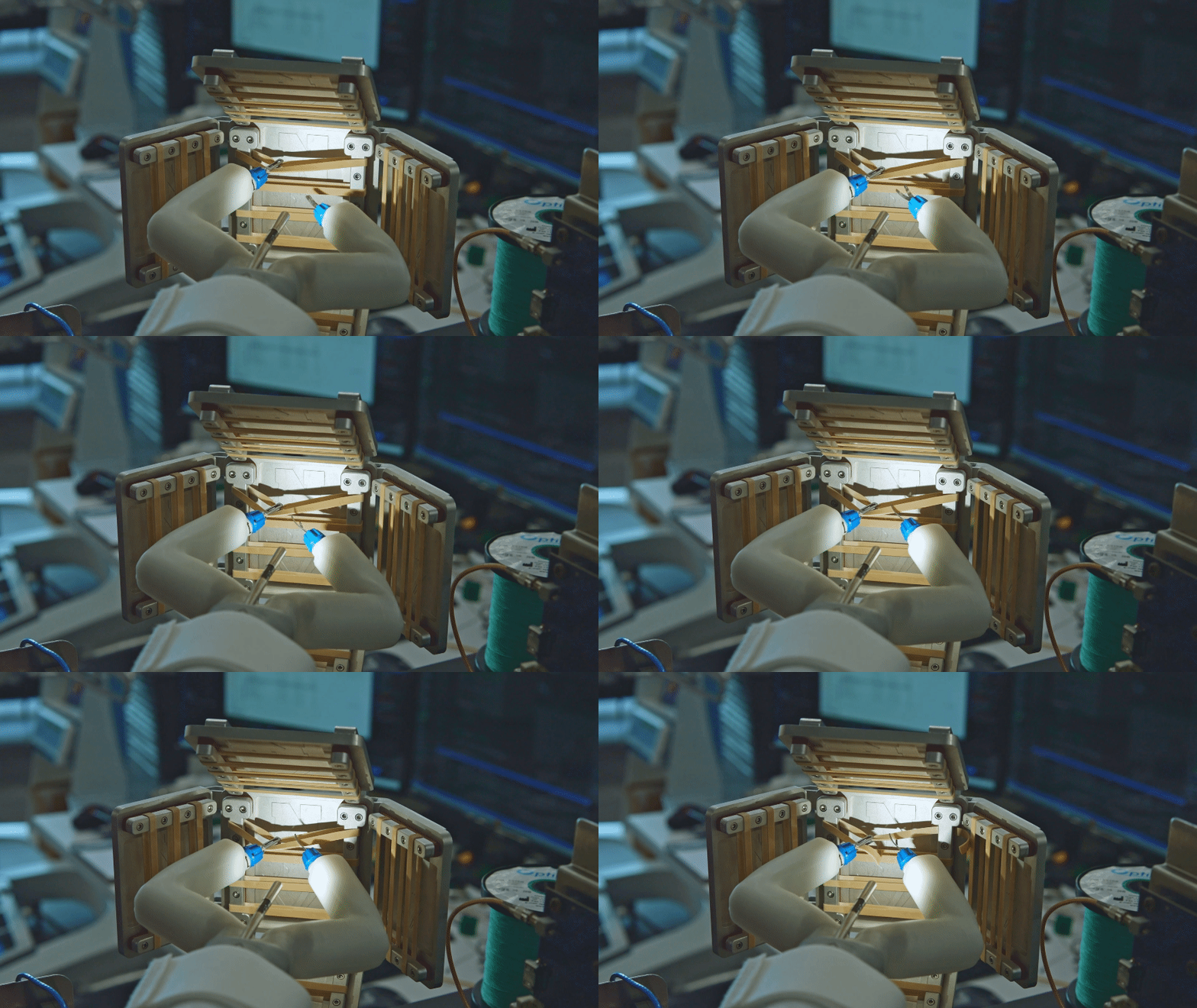
Can robots perform surgery in space? Can we solve bone growth in zero gravity? Longer batteries, long term exposure to microgravity, are part of this year’s contributions.
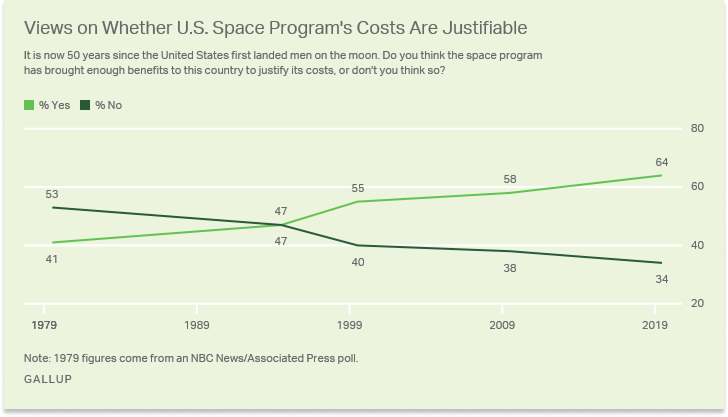
Unlike AI, Space is having a good PR year, were returning to the moon, Starship just got off the ground, and overall people are coming around to space programs investments.
EDITION PATRICK FREY

Backed by Patrick Frey, an Independent Swiss publishing house focused on platforming young artists via small print runs, often first time books. The site showcases the houses’ own books alongside a very well curated edit. I love supporting publishers like this.
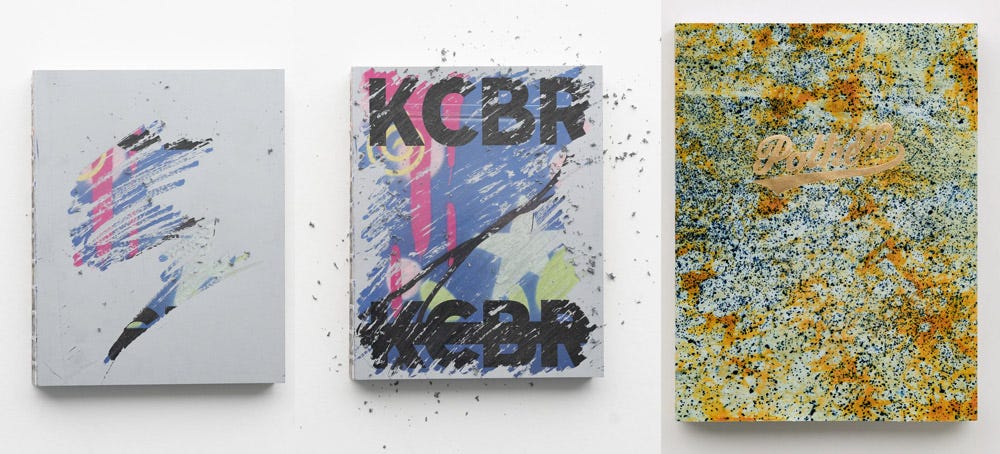
https://www.editionpatrickfrey.com/
- Thats it for this week
Comments
Nothing yet. Say the first thing.
Sign in to join the conversation.