
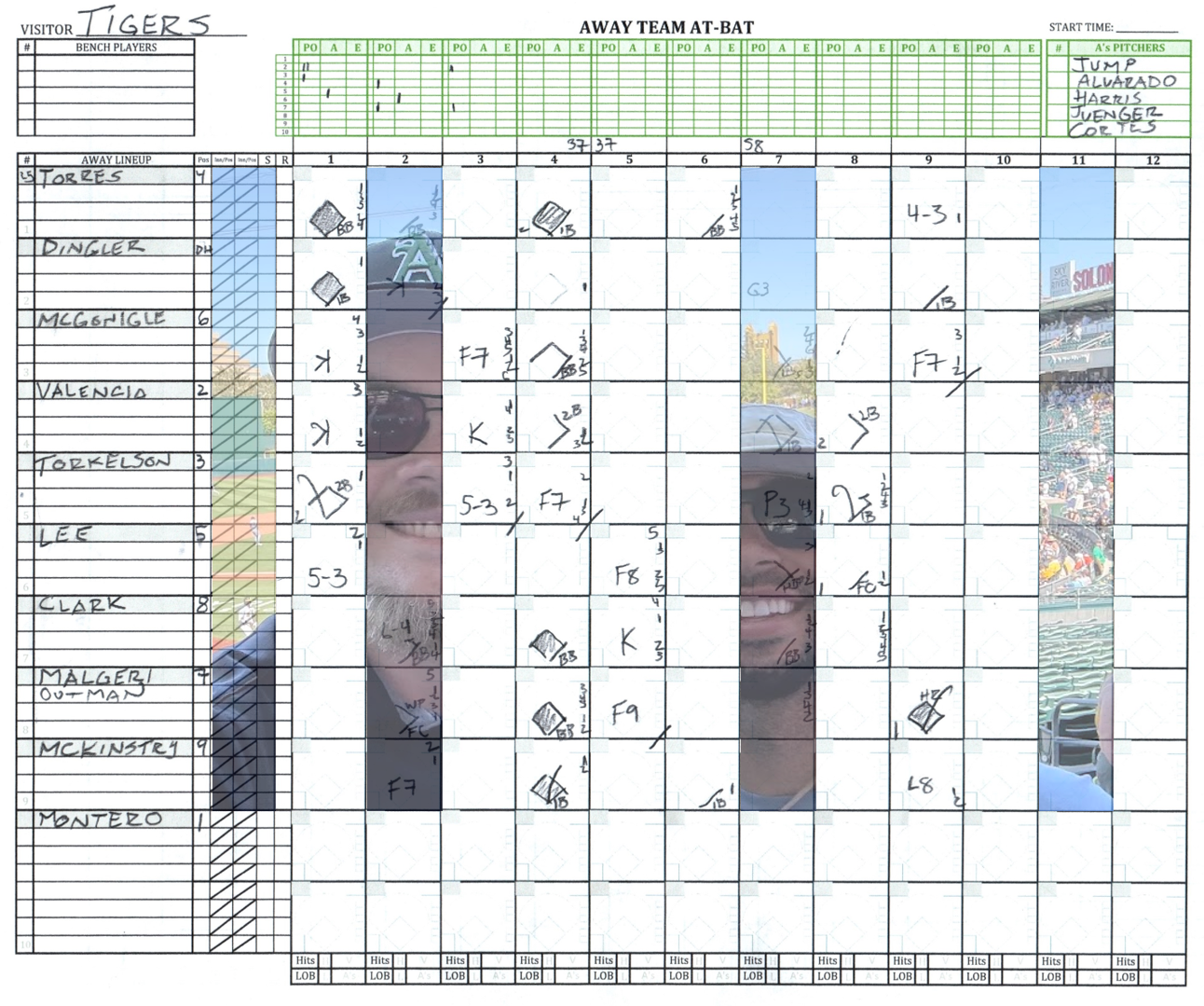
Today, I’m writing about this:
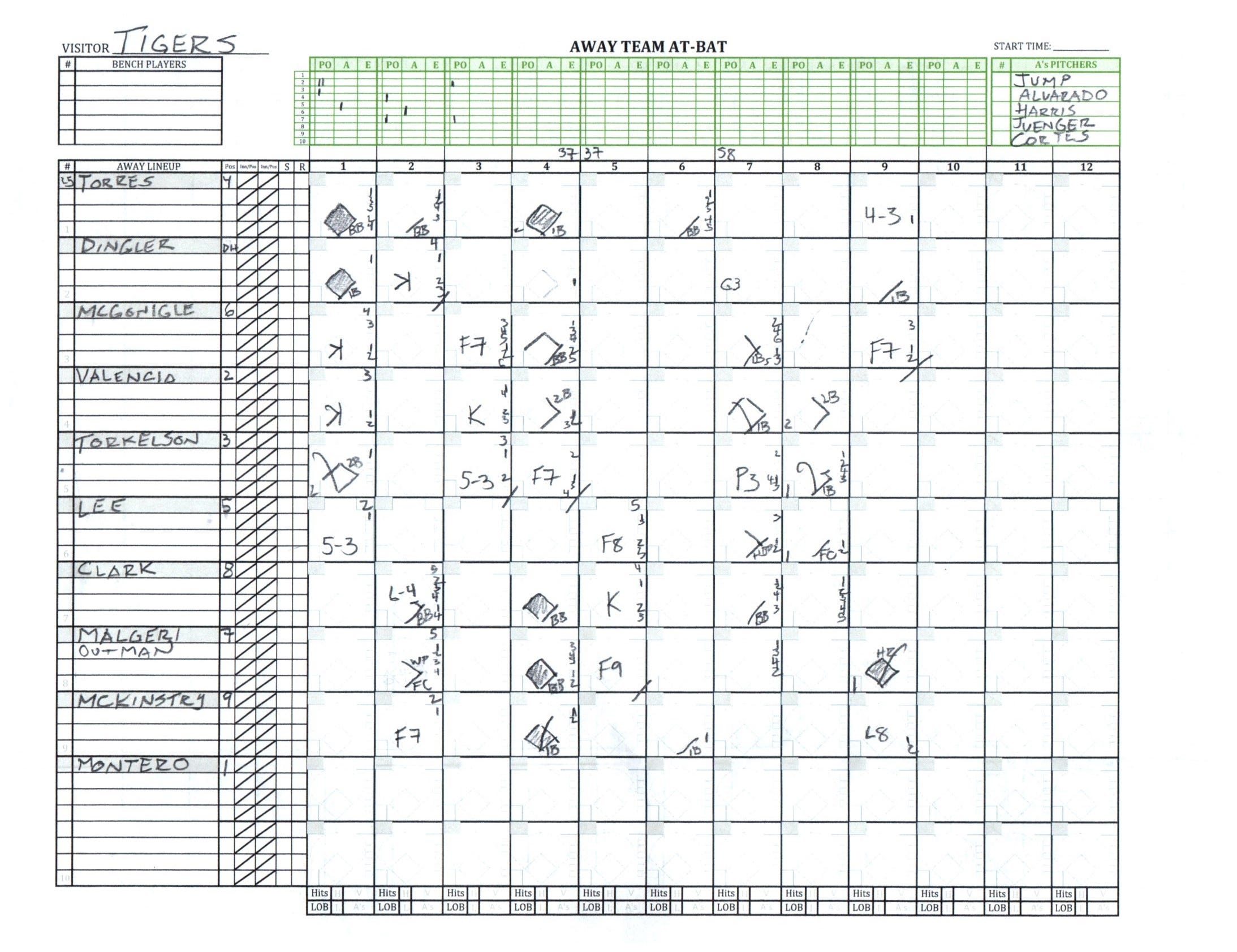
but nothing I write will make sense without context. Thus:
When I go to a baseball game, I keep score.
Objectively, this is a dumb thing. The team and league don’t need me monitoring them. The scoreboard works at Sutter Health Park, and an MLB-trained official scorer has sat in the booth for every game I’ve attended across the country. Tracking pitches, sketching batted ball trajectories, recording pinch hitters—all are wholly unnecessary expenditures of mechanical pencil lead.
But utility need not be the enemy of pleasure, and I really enjoy keeping score. Marking everything throughout the game keeps my nervous hands busy the same way a glass of water does at lunch, and scoring makes me feel connected to the sport and game even while I know all that “connected” is merely in my head.
Granted, keeping score for a team of nine- and ten-year-olds learning the sport is different than keeping score while the Miami Marlins face the Texas Rangers at Loan Depot Park. I didn’t start scorekeeping young: Even if I’d wanted to, that was my mom’s thing at my brother’s games. It wasn’t until high school that I gave it a try. We ran into a kid1 from the first fall team I helped coach at a minor league game one Saturday, and he carried a scorebook with him. He told us that he and his dad alternated innings during games, and he eagerly showed me two seasons’ worth of games penciled in. Seeing them chatting and scratching away in the middle of their book throughout the game was a lightbulb moment for me.
I bought a new scorebook that week. I began a hobby that’s stretched into its third decade.
Now, before I get too deep here, I recognize that some readers will have little background knowledge about baseball, let alone keeping score at a game of it, so let me offer an ultra quick tutorial. (For those that know the sport well or simply don’t care, you may, of course, skip ahead, not that you need me to tell you that.)
(The link will only work on the website after posting. I’m sorry.)
In a Major League Baseball game—I’ll stick with that level for simplicity—two teams of ten2 square off. Teams alternate nine hitters batting in sequence against an opposing pitcher, trading places with the other squad’s nine after every three outs. Each lineup gets nine chances to score runs, and the leader after eighteen three-out half innings is the winning team. If they’ve scored the same number, they play extra innings until that’s no longer the case.
Players score runs by touching the fourth of four counter-clockwise bases before the third out of an inning has been recorded. They reach base by successfully navigating3 an individual at-bat against the opponent’s pitcher. The defense initiates the action in baseball, and this means every game consists of successive one-on-one matchups in which offensive players respond to pitched balls.
Keeping score means tracking the results of these one-on-one matchups across the game. This lends well to a grid arrangement:
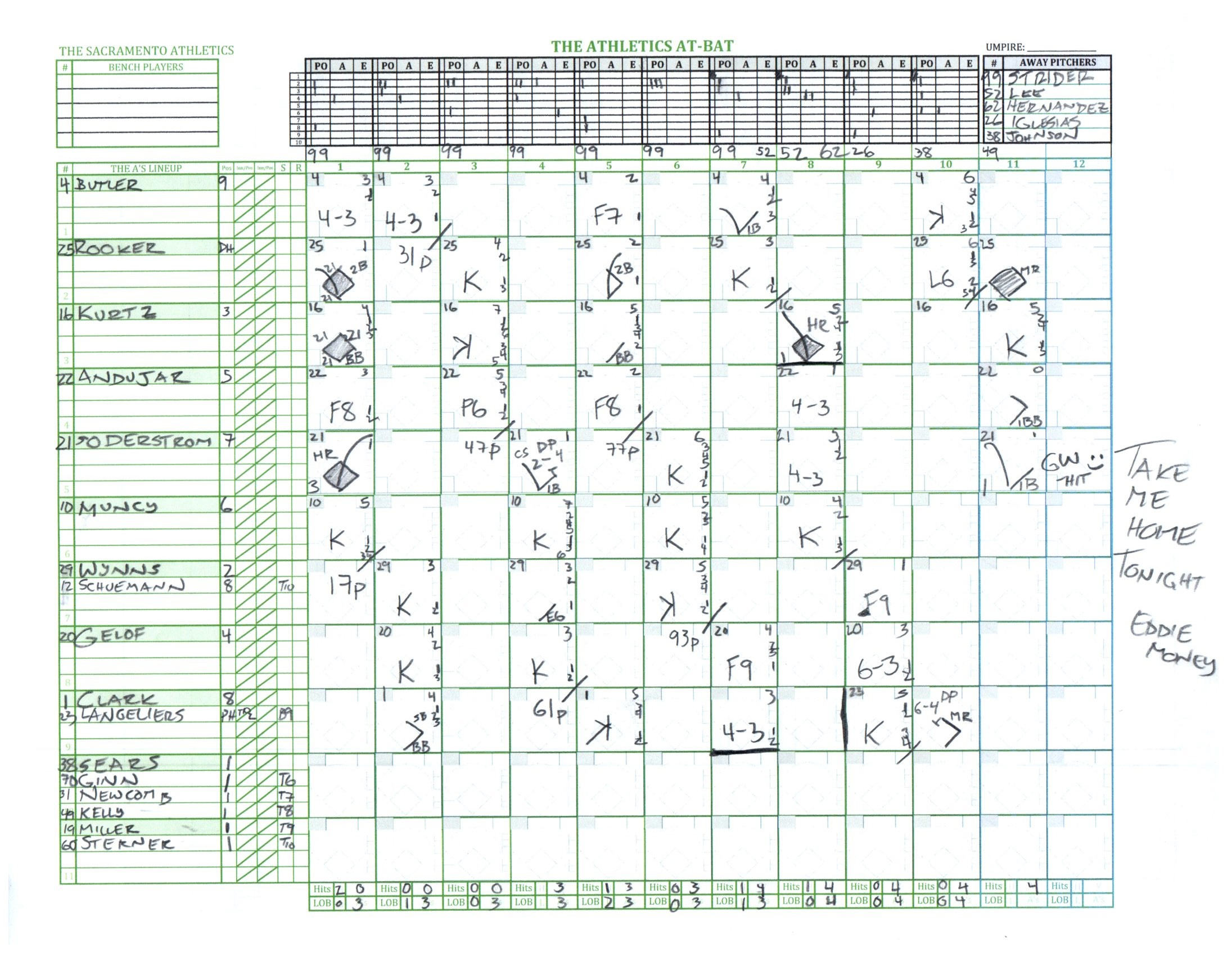
On the left side of a scorebook, you’ll see one team’s participating players, listed with their jersey number and position. For instance, above, you can see Nick Kurtz, who wears jersey number 16, batted third and played first base (position 3) on this day. The players bat in order from first through ninth—tenth on my card are the pitchers, who no longer hit, although they once did, albeit quite poorly—and then it loops back up to the top to begin anew.
To the lineup’s right, boxes with miniature baseball diamonds fill the bulk of the page. There, I record each confrontation’s outcome and trace the player’s path around the bases. I also record pitch count and more there, but the outcome is the only universal element across most scorecards.
Here’s how one would read a single row of the scorebook. We’ll use the leadoff hitter in that July 10th game, the A’s Lawrence Butler, since it was his birthday and bobblehead night.

Butler grounded out, second base to first base (4-3), in both the first and second innings. He flew out to left field (F7) in the fifth inning but singled (1B) to left field in the 7th. This game was tied after nine innings, so Butler got one at-bat in the 10th inning in which he struck out without swinging (ꓘ); had he swung and missed, it would have been a forward K. To summarize Butler’s day, we would say Butler went 1 for 5. He had one hit among five at-bats.
Now, since the activity is scorekeeping, I should note that Butler never scored on July 10, 2026. When a runner scores, I trace the entire diamond and then shade its interior.
Notice that Brent Rooker, the number two hitter

scored twice: once after his double (2B) in the first inning, and once after entering as the Manfred Runner (MR)4 in the eleventh inning.
As a younger head coach, my mom always kept book, but I did it myself when I became a co-head coach at the high school level. My tenure coincided with a funding-related cancellation of freshman sports, so our JV teams had massive rosters that encompassed two grades. I wanted information at my fingertips and an evolving visual representation of the action to inform decisions. Scorekeeping kept me organized.
My final game as a high school coach was in 2012, though, so while I have scored games since then as a coach during fall ball seasons, mostly I’ve kept score as a spectator. I’ve done it at A’s games, River Cats5 games, high school games, youth games, and even for five innings of a college game at UCLA in 2022 before seeing Hadestown.
For most, keeping score at a baseball game is an old-fashioned, vaguely nerdy endeavor. It looks like cryptic gibberish scribbled by a neurotic weirdo, and seeing as I have designed my own scorebook pages, printed them myself, and gleefully written a narrative tutorial about scorekeeping for this, you may label me as you see fit. Regardless, I find it fun, but I’d argue there’s value in keeping score at games, too.
For one, I remember games infinitely better if I’ve kept score. When I have enough sleep, I retain information pretty well in general, but I’m notably better when I write things down. It’s like pressing my pencil into the paper presses the happenings into my brain. I often recall baseball moments first as they appeared on a scorebook page; the boxes I scribbled in become conduits for accessing the visual memories those scribbles represented.
For another, each scorebook page becomes a DIY keepsake after the game. Yes, I do intentionally buy tickets for bobblehead giveaway nights because I like physical souvenirs, but these scorecards mean something because they’re made. A scorecard is meaningless until it’s written on; the making is what matters. I box away mini bats and outgrow t-shirts, but scorebook pages are cheap, space efficient, and unique to the specific game in question.
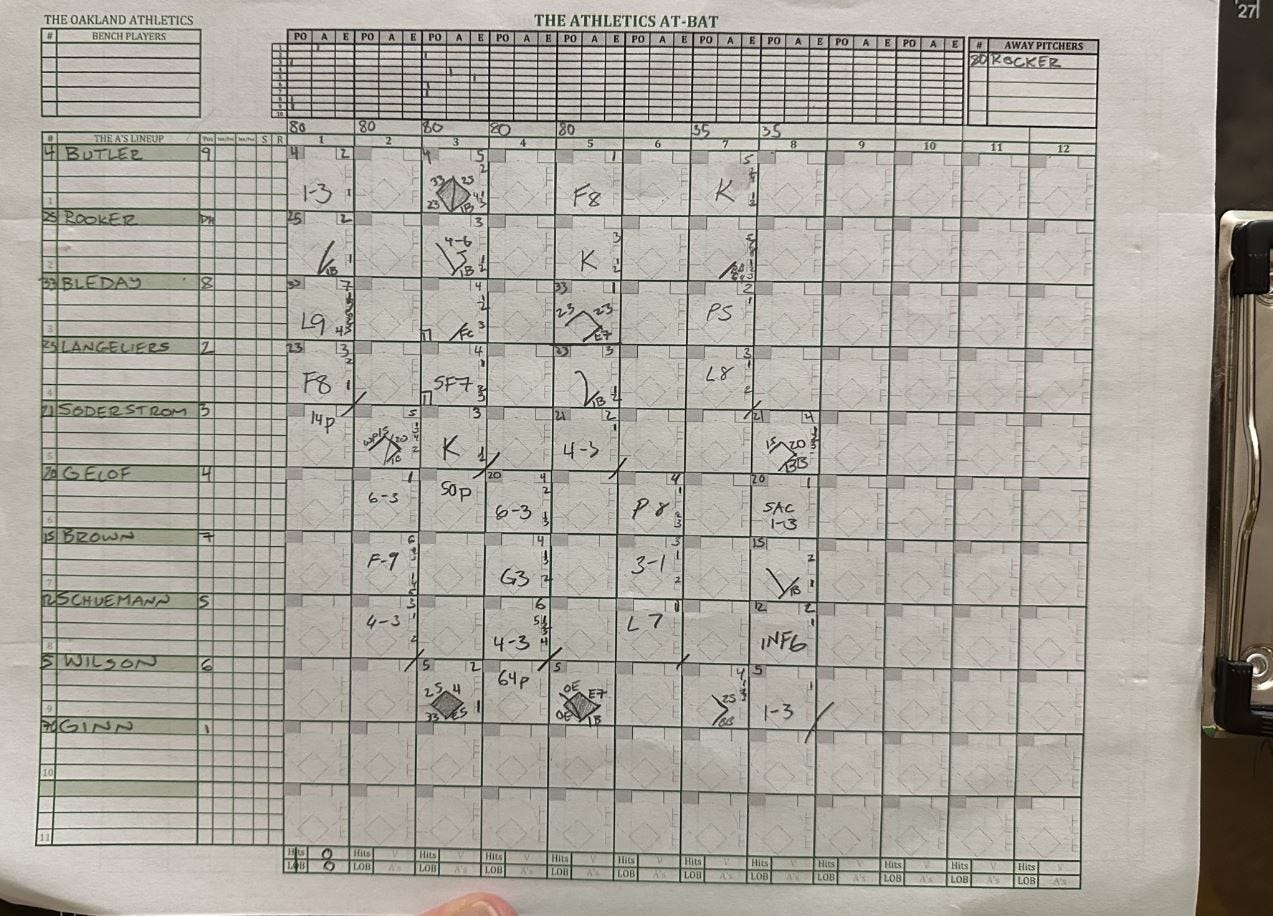
Moreover, as the years have gone on, these souvenirs have been not just mementos but collaborative ones as I started to share scoring duty with friends and family. Already this year, I’ve brought home pages completed in tandem with my dad, Nate, Natalie, and Larry; my mom and brother each took a few frames last year, and I’m pretty sure there are several innings done in Bria’s handwriting from 2023 as well. Although I did receive a replica Coliseum after the final game in Oakland, my favorite keepsake from that day is undoubtedly the printed scorecard Nate and I used during the A’s 3-2 victory over Texas.
In case you think I’m joking about treasuring these things, here’s the A’s side of that score page:
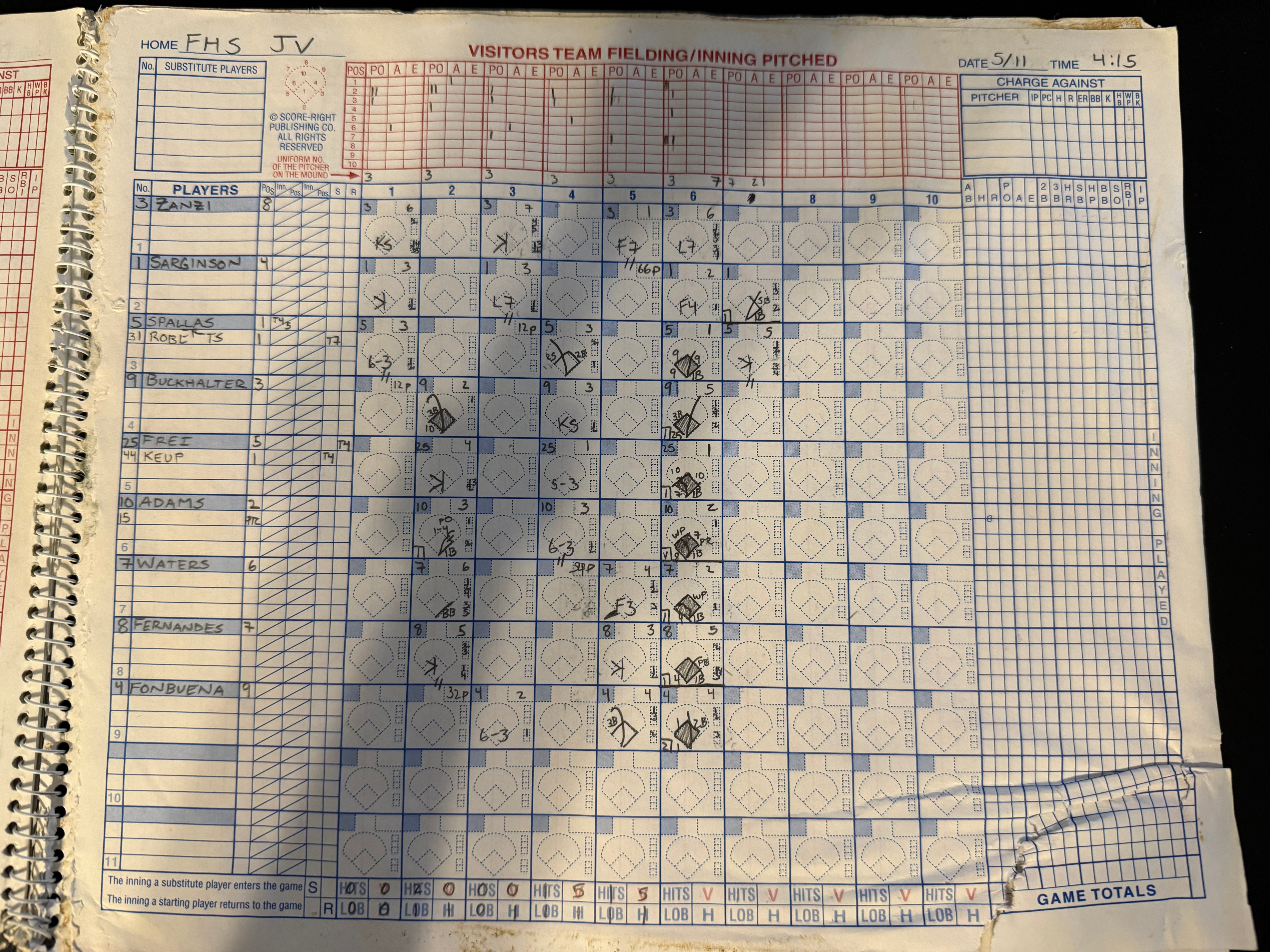
Here’s the JV game in which we clinched the championship to end the year:
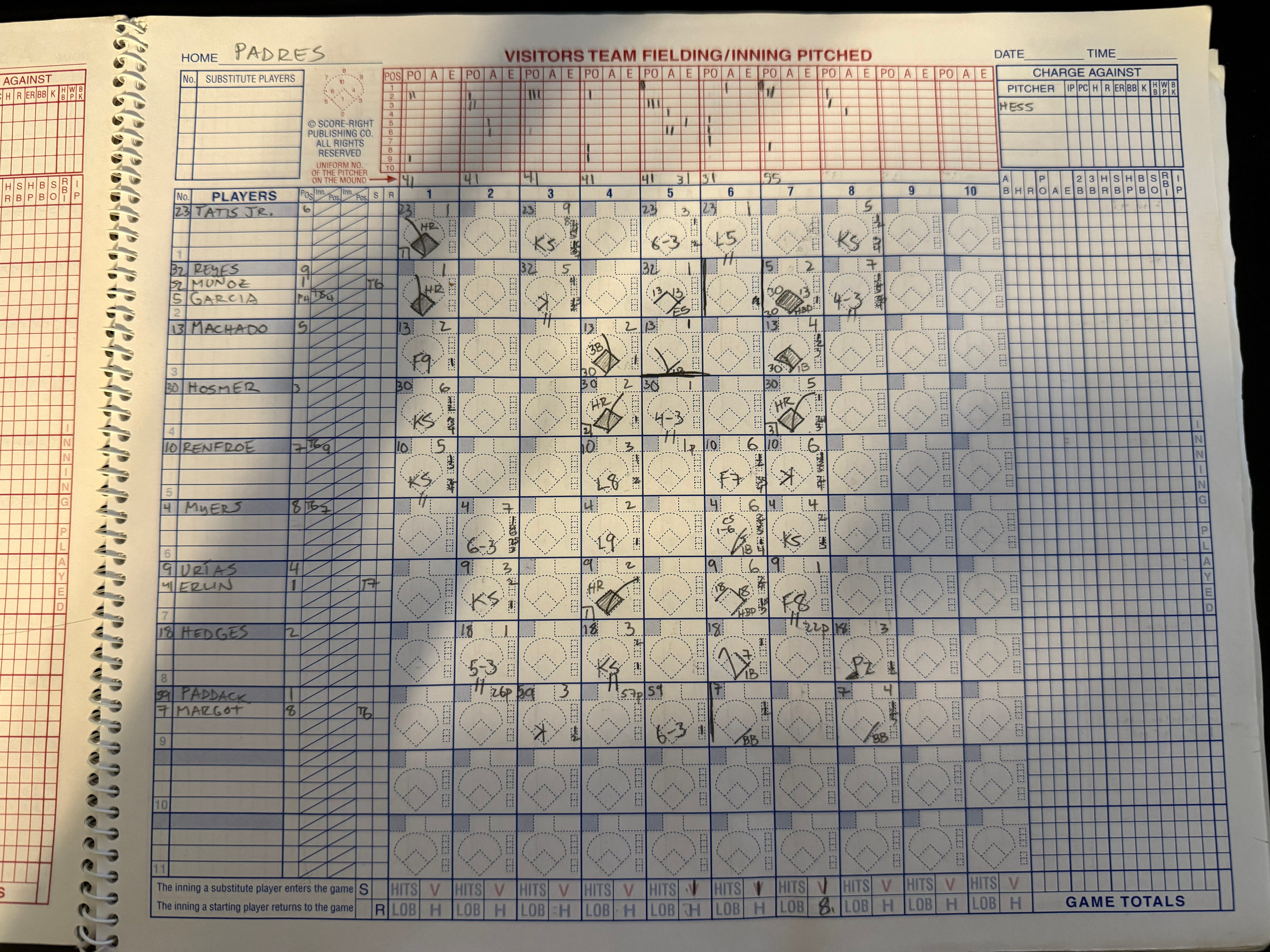
And here’s the Padres game Matt and I saw as part of his “bachelor’s party” in 2019:
My mom first taught me how to keep score, and we filled in our gaps together at a scorekeeping clinic led by a local league president, but I’ve added and modified my approach since then. Nate convinced me to change my strikeout denotation a few years back—his makes more sense—but other than swapping a professional book for my amateur replacement, I’m basically doing the same thing I have since first learning how.
The thing about keeping score like I do—with pitch counts and flight paths—is that it’s easy to become fastidious about it. My goal is to record the game exactly as it happens, down to the pitch, and walk away with an independently produced scorecard that perfectly replicates the official book. Achieving that goal requires attentiveness to every moment, which definitely adds to my enjoyment at the ballpark, but I won’t pretend it isn’t an intricate, technical exercise.
When I was younger, this focus was so automatic that I could do it while eating, conversing, and rattling off trivia. Watching baseball has long been considered a languorous activity because, unlike most sports, baseball has no clock to stimulate urgency. A single game can, theoretically, go on forever. That sort of rhythm leaves downtime amidst the action.
In 2023, the league decided that the very downtime that facilitated my scoring had bloated games and alienated fans, leading to a pitch clock. This drastically sped up the game, which has been a boon for fans in general, but it threatened my hobby. The pace of the game accelerated so much that I had to be extra vigilant and attentive, to the point where I began to worry scoring could cost me quality time with my company.
Intent on preventing that, I stopped keeping score for most of last season. After bringing my clipboard to my first A’s game in Sacramento that April, I traded a split focus for fully engaging with the person to my right. Yes, I still managed to get several memorable games down on paper—MacIver’s debut walk-off, Jasson Dominguez’s three-homer game, several Kurtz offensive extravaganzas—but mostly, I watched with nary a pencil in sight.
When this season arrived, I felt sharper and more accustomed to the pace, so for this spring and summer, I’ve toted my scorebook along. I’ve caught eight MLB games this year—six at home and two in Florida—and I’ve brought home eight scorecards tracking those eight games. Dividing my attention has, indeed, felt natural and comfortable each time.
Which brings me back to the scorecard I flashed at the very top.
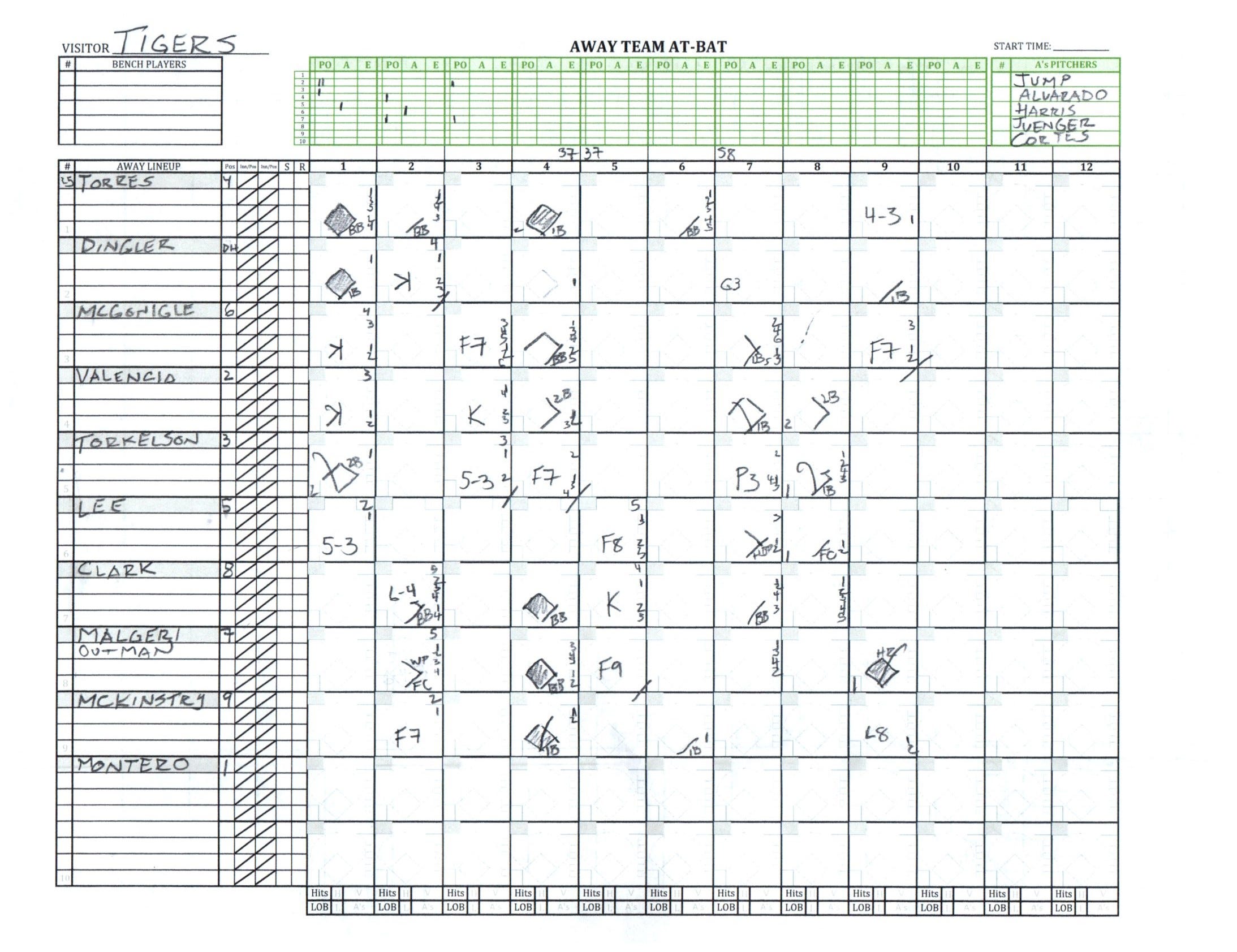
This is my scoring for the Detroit Tigers’ offense during their 11-0 thrashing of the home Athletics on Sunday, August 2, 2026.
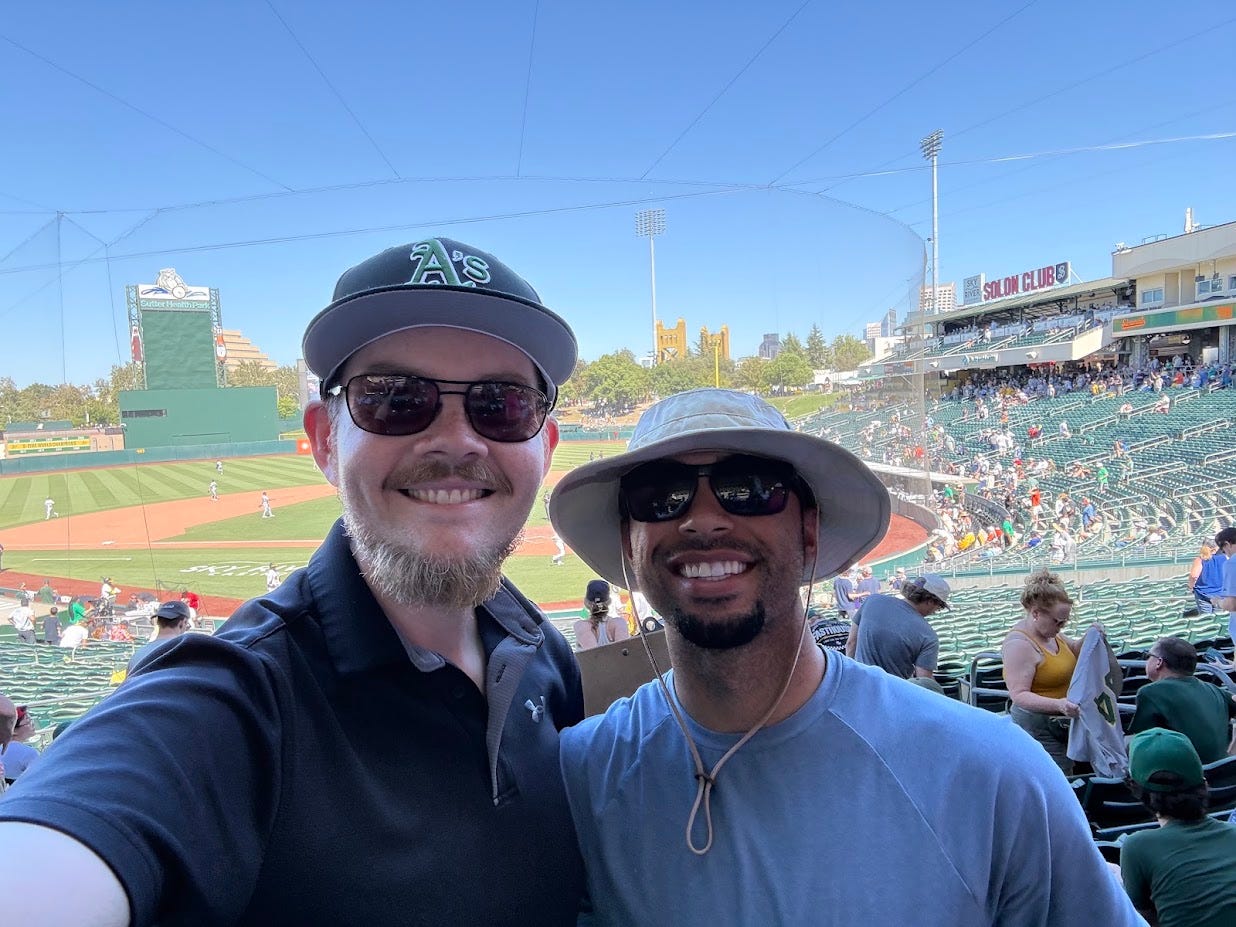
I attended this game with Isaiah, a physician’s assistant who I first met when he batted leadoff as a ninth grader on the final high school team I coached in 2012. Isaiah’s one of those consummate good people I’ve been fortunate to cross paths repeatedly across the years, a guy who’ll one day center an essay the same way Tyler and Layla have.
The Tigers-A’s game we attended did not promise scintillating baseball. The visiting team traded their star pitcher, Tarik Skubal, one night prior, and further significant subtractions were in the works. Detroit’s squad began 2026 with promise only to raise the white flag entering this matchup. The A’s were reeling as well, and they trotted out a lineup of backups and waiver claims around Soderstrom and Butler, neither of whom has been great this year.
Unlike a concert where the headliner will almost always do their thing with polish and energy, sports contests can become listless, anonymous affairs sometimes. Sunday was one of those days, particularly with the temperature exceeding 100° during an afternoon late in a doubly lost season. It wasn’t ideal, but it made sense.
Because Isaiah and I hadn’t gotten to just talk for a couple years, I didn’t initially plan to make a scorecard. Because I was bringing some empty water bottles to fill up in the park, though, I already had a security-approved clear plastic bag, so I printed one out and slipped it inside. Why not, right?
Upon arrival, we found our seats still baking in the sun, but I had on plenty of sunscreen, so we sat down. Outside of the National Anthem, the seventh-inning stretch, and two ABs during the fourth inning when we popped up to grab hot dogs from a concession stand ghost town, he and I sat in those seats watching the game from 12:10 pm until 4:18 pm when Enmanuel De Jesus mercifully struck out Henry Bolte to close things out. We talked while I kept score.
What did we talk about? Shit, what didn’t we talk about. We talked about life and work, relationships and time, Alicia Keys’ Broadway show Hell’s Kitchen that we’d both coincidentally watched the previous night, and music. We had discussions about AI and learning, about students and athletes today versus yesterday, and about the joint values of balance and sleep.
Inevitably, every tangent led us back to baseball, and sometimes that sent us down memory lane to tournaments, coaches, and players deep in our respective pasts, but other times we took our cues from the professionals playing before our eyes. We took umbrage when Soderstrom loafed after a catchable flyball and opened the floodgates, we debated the merits of robot umpires versus the ABS-assisted human system of the present, and remarked on the effect of losing on motivation, particularly when Jonah Heim looked dazed and defeated chasing down an egregious passed ball.
It wasn’t until Nate and I started driving to Oakland regularly in 2019 that I realized the level of social commitment a baseball game constitutes. Isaiah and I didn’t trace the Sacramento River or hitch a ride on BART to reach the East Bay, but our day together was still long. He pulled up to my house at 11:45 am, and we hugged and said our goodbyes at 4:45 pm. We spent five hours together in uninviting weather. Five hours is a long time under any sky.
But across those five hours, there was near zero lull in our conversation. Unlike the outgunned A’s, who inevitably wilted under the brutal sun, Isaiah and I were upbeat no matter where the conversation led us. This wasn’t the first time we’ve talked like this—we spent three hours at Jack’s Urban Eats one lunch ten years ago—but it was remarkably refreshing considering how much sweat clung to me even from within the shade.
At one point, Isaiah commented about our steady dialogue. We’d been trading baseball stories for several innings, and he noted how cool it was that we could exchange anecdotes from our diamond lives with no sign of stopping. He played NCAA baseball before an injury jumpstarted a complete turn toward academics, and I coached hundreds of games in the dugout and watched countless more from the stands, so his observation really landed with me. There really did seem to be a bottomless well of sports memories on the tips of our proverbial tongues.
His words inspired me to think about scorekeeping. For so many of the games we discussed, I held a scorebook on my lap. Transcribing the events of each one formed an inextricable part of those experiences. Although I called that trove of remembrance a well up above, reflection led me to a better representation: It’s like I have a massive scorebook in my head. Sitting with Isaiah, whose exploits appear on dozens of those pages, invited me to flip through book after book and resurrect the characters who initiated a functionally infinite sequence of dynamic athletic action. With the present game moving at a snail’s pace6, a part of me wondered if we might test his hypothesis in some sort of scorching slice of limbo.
It was at this point, during a miserable and interminable eighth inning, when I inspected my current scorecard. This page, like each of its predecessors, was destined for that bulging scorebook in my head, but I had been recording information automatically, unconsciously, my thoughts fully focused on listening and responding to Isaiah.
A loud crack of the bat paused me mid-sentence. We both watched rookie catcher Eduardo Valencia crush a double to deep left field, plating two Tiger teammates. After shaking my head, I looked down and moved my pencil to mark a 2B when I discovered a problem: Valencia shouldn’t have been batting!
Seriously, I initially assumed the historic franchise in the first base dugout must be wrong. I have such faith in my ability to keep score that I thought veteran manager A.J. Hinch had messed up. Not me.
Confused, I squinted at the scoreboard and found more mysteries. I had been tracking pitches thrown to right fielder Ben Malgeri, but supposedly Colt Keith was batting eighth. That made even less sense—when did Keith get here?—but no one else seemed bothered. It was like only I noticed.
Pausing our talk for the first time in hours, I inspected the prior innings and quickly found the issue: I’d never finished the sixth inning. After a leadoff single by Zach McKinstry, Gleyber Torres drew a walk, and then… the Tigers magically skipped ahead one frame so Dillon Dingler could ground out. What I had on my paper was atrocious. I’d lost track of the hitter, the inning, and the count, and all while missing several substitutions.
This is the first and only time I’ve ever gotten lost while keeping score. Upon further inspection, you can see how badly it went from the scoring. Detroit crossed home plate eleven times under the hot valley sun… except in my scorebook.
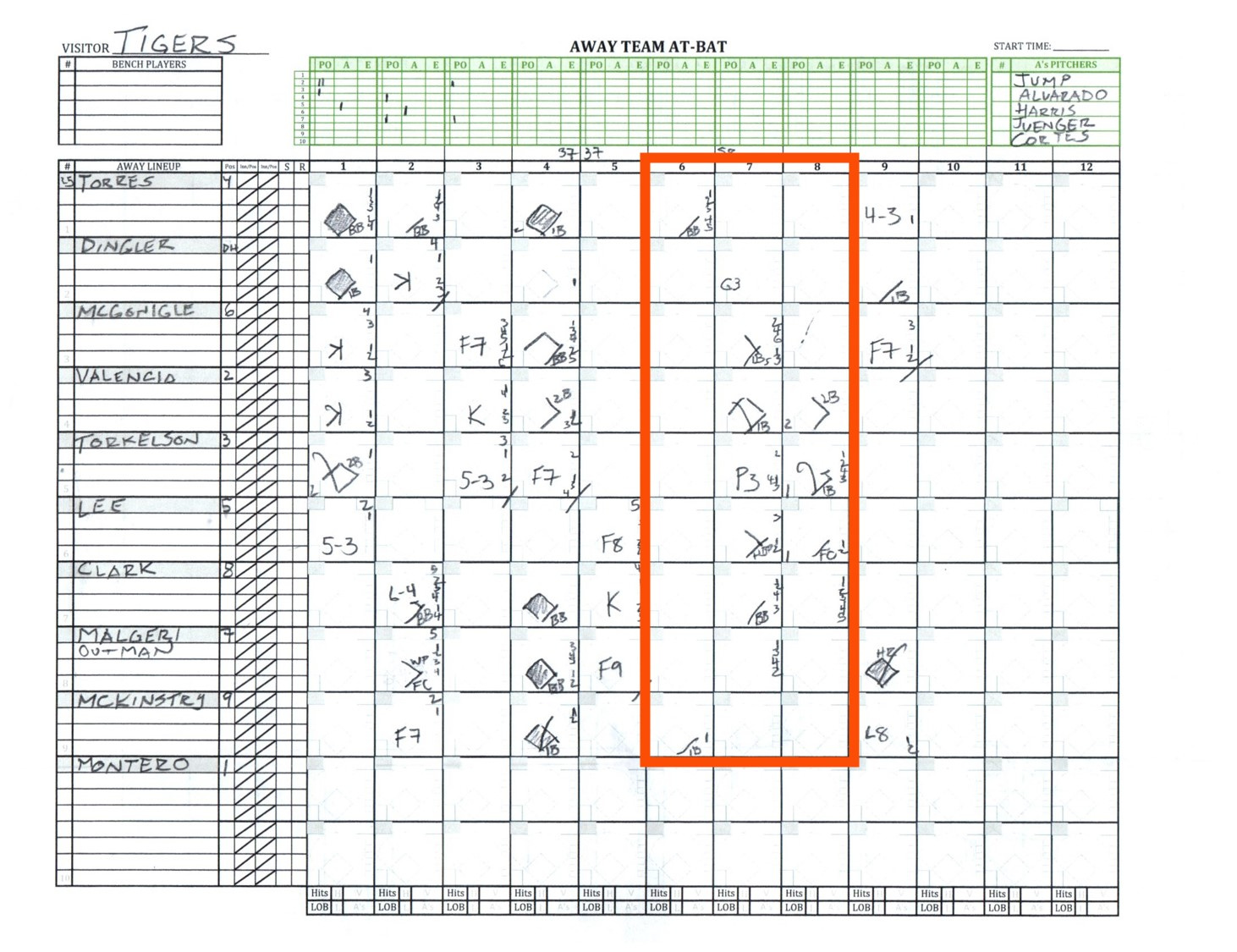
I whiffed on four runs. Four!
How could this happen??! To mess up royally while keeping book is akin to Tony Hawk forgetting how to kickflip or Julia Child struggling to debone a chicken. It just doesn’t happen. Scorekeeping is a huge part of my life, and a central pillar in my relationship with my favorite sport. I felt embarrassed.
But then Isaiah said something about Spencer Torkelson’s college years, and within seconds, that disorienting panic vanished. I responded. My shoulders relaxed. I added Valencia’s double. I filled in my best recollection of Torkelson’s plate appearance. After getting down the fielder’s choice that Hao-Yu Lee grounded into on 0-2, I did something I’ve never done before while at the ballpark.
I stopped actively keeping score and simply talked. For the rest of the game, I recorded outcomes and pitches here and there, but what went onto my scorecard became an afterthought. Honestly, it was less than an afterthought. I was talking with Isaiah at an A’s game, not keeping score.
And I couldn’t be happier! The game he and I saw was miserable, almost certainly the ugliest MLB contest I’ve ever watched live, yet I had as much fun as I have at any game this year. I left the game drenched in sweat, dehydrated, and with a balky back, but I also left it feeling closer to someone who was a bright spot at the end of my coaching career. Isaiah’s nearing his thirtieth birthday, and I’m incredibly proud of him, but I’m also just plain glad we had the opportunity to catch up, watch a ball game, and renew our friendship beyond the usual check-ins and occasional Diamond Day.
It was a wonderful day at Sutter Health Park.
*****
While I was losing track of the game in the sixth and seventh, one of the things Isaiah and I talked about was coaching baseball.
He said he’d missed me at the state playoffs this year, and I acknowledged that I hadn’t been eager to go out that week. I’d helped out at the Babe Ruth championship earlier that month, and when I did, I watched a coach who graduated one year before me jump into the arms of his thirteen-year-old son after he secured the final out. Their happiness left me thinking about “The Red Stealth”, but specifically about how coaching baseball as a teenager and twenty-something always felt like practice for coaching my eventual kids. That game didn’t kill my love of baseball or anything—duh—but it certainly recolored it for a bit.
What I loved about Sunday’s game with Isaiah was how warmly it pointed me back to those years of my life when baseball meant everything to me. My present, my passion, my purpose—everything wrapped around ninety-foot bases and spheres of stitched leather. Although I have seen plenty of ball since my coaching career finished, I’d never truly made peace with that faded trajectory from when I was growing up.
By watching with Isaiah, someone I’d coached when I was an adult, I found a little of that peace. Looking back at my life in baseball when I was actually out there, touching grass and barking instructions, felt different with him, perhaps because several of his stories were my stories, too. Those years aren’t defined by unfulfilled promise; they’re defined by people. I wouldn’t know Isaiah without fourteen years of coaching baseball. Our friendship wouldn’t exist.
Scorekeeping has been a perfect avenue to keep baseball alive in my heart beyond coaching. It’s literally what coaching looked like for me near the end, meaning every groundout and stolen base I mark grants me safe passage to a no-stakes version of the thing that centered my life. Scorekeeping casts me as an outsider in baseball, which is fine and necessary with my defective spine and time constraints, but that can feel a tad sobering sometimes, too.
That game with Isaiah, uneventful 11-0 drubbing though it was, felt like an invitation back in. Our relationship is part of the legacy from all those games that fill the scorebooks in my brain. I won’t ever raise my son into the air after winning a championship, but I have a feeling that more ballgames and conversations like ours will suit me well. Baseball is already central to several newer friendships, and I’d like to think it can provide an occasion to nourish older ones, like his and mine, well into the future.
And when it does, I will still carry a clipboard with a pencil and scorecard attached at the top. But scorekeeping will be a fun little hobby that plays second fiddle to the joy that is baseball still coursing through my veins. It will be central without being the center.
I love that I felt this way after a day at the park with Isaiah.
And I especially love that I felt this way after failing to keep score.
I had another topic penciled in for this week, but I really wanted to write something straightforward and fun (at least for me). This was an easy choice.
As a fun little addition, I found real-time game footage from a significant MLB game in 2024 and made a short video in which I keep score during one inning. The video is short (because the inning was), and it’s posted here on my new Intensely Specific YouTube channel. Feel free to check it out if you want to both see and feel the pace of keeping score as I do.

A kid who is 37 now… Yeah… I know.
If your brain went, Wait, no…. Isn’t it nine? The answer is No as of 2022, except when Shohei Ohtani pitches. (Baseball is complicated.)
There are seven ways to reach base and “win” an at-bat: hit, walk, hit-by-pitch, defensive error, fielder’s choice, dropped third strike, defensive interference.
This is a complicated twist for tie games that, as a kid, we called a “ghost runner”. It’s not important enough to discuss here, and its namesake (the commissioner) is an abominable face for the sport who can’t even pronounce the first overall pick’s name correctly, so I prefer not to talk about him, even though he’s orchestrated some positive additions to the sport.
The River Cats are a AAA team, which places them in the highest skill league of the minors. They play in Sacramento, at the same park where the A’s presently do.
An umpire injury plus the uniformly sluggish performance led to this, but I also tip my cap to the pitch clock altering my expectations. 3:13 was once a reasonably fast game, but it felt like trudging through Death Valley wearing snow boots today.
No posts
Comments
Nothing yet. Say the first thing.
Sign in to join the conversation.