
My brother insisted we go to the beach after leaving the Marlins game.
Although I agreed to the excursion, I was ambivalent. I wasn’t keen to lather on more sunscreen, and I preferred the one pair of running shoes I’d brought along to stay sand-free. I was good with calling it a day right there, with retreating to the hotel and finding a nice restaurant later, but Tom played his trump card.
“We’re in Miami,” he said flatly. “You have to go to the beach when you’re here.”
So it was that we walked along the shore on a Wednesday afternoon with the water a few dozen feet away. It was my first time seeing the Atlantic Ocean up close, and the water was blue and inviting, stretching beyond the horizon as though there was no Europe or Africa at all, only more water. But with greasy arms swinging with my tentative stride across the sand, I listened to the chattering tourists and the mechanical roll of the water with indifference.
My brother stopped and gazed out at the ocean with serene profundity. He took a deep breath with gusto as though the salt air that opens Taylor Swift’s “august” possessed some philosophically healing property.
“What do you think?” he asked, generously inviting me to christen a conversation.
Mimicking him, I inhaled a breath of my own, hoping to capture the intoxicating allure that had attractive couples buzzing and gaggles of children racing to and from the tide like touching it was too much, like they couldn’t take in all at once.
I told Tom the truth.
“I don’t know what I’m supposed to feel,” I said. “This does nothing for me.”
“You just look at it,” he said. He gestured toward the infinite turquoise. “You appreciate it.”
I squinted, frowned, and shrugged. “I don’t get it.”
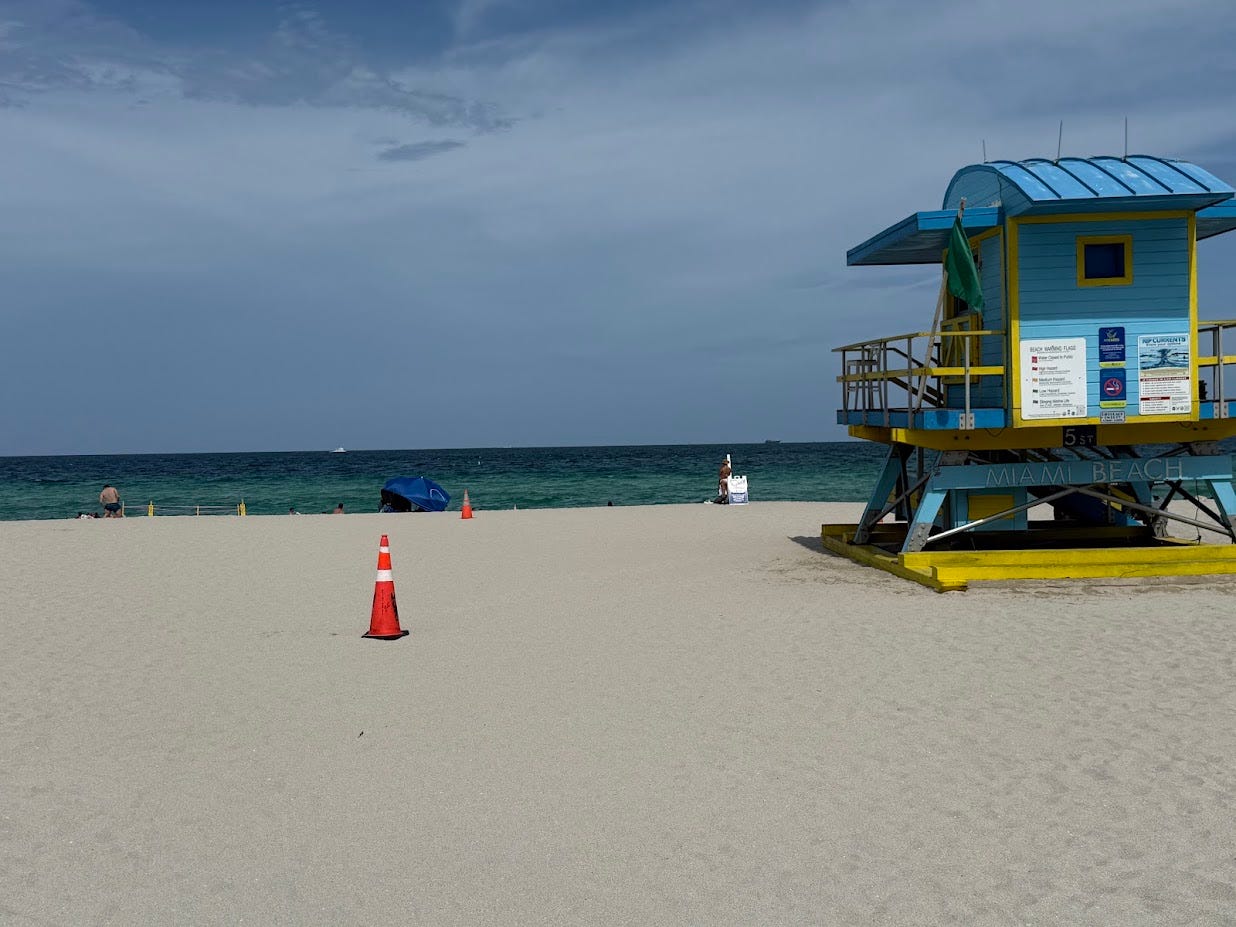
He shook his head with disappointment at my lack of reverence, and that was understandable. Tom has hiked mountains in Japan, and he’s driven across the country while trading one coast for a PhD program on the other. Evidently, he sees something in the ocean that proves elusive for me.
After issuing a disapproving “Hmph”, we continued our march through the sand, en route to a fancy restaurant with a strict dress code, followed by a few miles’ drive that would take almost an hour in bumper-to-bumper traffic. I was a good sport about all of it afterward—although I nixed the seafood place on principle; if I have to take off my hat, that isn’t my kind of place—but my brutal honesty at Miami Beach shattered any illusion my brother had that I might come alive on vacation. But what could I say?
I kinda think travel is bullshit.
*****
Nearly every person I read and know talks about travel like it’s a moral imperative.
I spent some time seeking specific quotes from authors I admire, but I stopped looking because I suspect there won’t be any smoking gun of a sentence that perfectly encapsulates their mindset. But as someone who doesn’t feel the thrill of getting away, boy howdy, can I tell I’m on the wrong side of the consensus here.
When these admirable people write about traveling, they extol its virtues like they’re selling a time-share. The view is always incredible, so to speak. You haven’t lived until you’ve spent two weekends a year in this cozy bungalow.
Travel opens your eyes, they tell me. New places rip us from the grimy grooves where we trap ourselves, granting us access to beauties and splendors beyond our tiny perimeters. You need to travel, the prevailing wisdom surmises, to see what you cannot otherwise see.
Travel builds empathy, they tell me. Evacuating our daily communities exposes us to new people with new perspectives, informing the sort of growth stunted by stationary stagnation. You need to travel, the prevailing wisdom reasons, to feel beyond your fingertips.
Travel recharges us, they tell me. To leave home is to dismount the fading horses we ride through mundanity, enabling us to pause the churn of living and truly unwind. You need to travel, the prevailing wisdom insists, to gain space from your usual stressors.
On principle, I can’t disagree with the thrust of imperatives like those. To argue against empathy or relaxation would render me a troll. These are all valid goals and objectives, and if traveling truly delivered them, I’d be a charter member of the Get Away Gang. But you won’t need to print me a membership card because these proclamations sound like platitudes to me, like propaganda in a slick brochure engineered by a smug ad exec who considers flings fine so long as the partner never knows. I don’t think these are reasonable outcomes for the sort of traveling most of us can afford.
That is to say, I don’t believe traveling automatically fosters growth. In the same way that walking through an art museum does not unlock artistic awe in every patron, tourism does not unlock a broadened scope in every vacationer. The go-to example for thinkers subverting the travel-as-enlightenment mantra is visiting the Mona Lisa, wherein the spectacle is less the 30-inch by 21-inch painting most of us can easily imagine and more the ways tourists regard the seminal work as a box to check off a list. Seeing the artwork doesn’t change anything except the number of photos on the camera roll and the ability, forever onward, to recount having seen it.
Granted, I’m a funny person to invoke a work of art as being anti-profound because I love art museums. When I’m with friends, I’ll chuckle and joke right and left, but I’m also prone to losing myself in thought while regarding paintings. I got in trouble at MOMA in Los Angeles for getting too close to a Picasso while marveling at the topography on its canvas, the artist’s thick globs of dried paint jutting outward and inspiring me to see depth in what otherwise appears as a flat image on a glass screen. My point, though, is that I got so much from having my eyes close to a Picasso while dozens of people dashed through the room snapping blurry photos like they were speed-running culture. It wasn’t the travel that engendered any epiphany but the traveler.
And that’s why I bristle when people wax on about the wisdom evoked on trips: because it violates my sensibilities to require travel to access inspiration. Matt and I hit the Crocker Art Museum last month, a place I park at regularly but never enter, yet exploring a measly few exhibits in there sparked tons of thought. We debated the uncanny valley looking at an unnerving sculpture in one room; another massive work prompted silent rumination about dementia and intellectual decay. In one of the final wings we walked, I noticed an unflattering self-portrait by a modern artist and actually found her on Instagram later that night. To express the magnitude of awe when I saw smiling photos of a perfectly attractive woman who paints herself as hideous merits an essay of its own as someone with body dysmorphic issues. And all this happened at a relatively humble gallery barely twenty minutes from my house.
Now, not everyone lives in a cultural hub as I do; I understand the privilege Sacramento begets. But my point isn’t about Crocker’s quality versus what you can visit where you live—it’s about perspective. I believe I took a lot from Crocker, not to mention that pair of MOMAs, because of how I approached them. I object to the idea that one needs to leave home to expand their mind. That I can write 4,000 words of reflection about a Power Ranger toy or warmly reconnect with an old rival thanks to a Jenny Nicholson YouTube video underlines that a person doesn’t need to get away to gain clarity or exercise empathy.
With all that said, I can at least entertain the position that travel is an additive endeavor. I’d argue it incorrectly attributes the source of the change, but if another person needs novelty to nourish their emotional organs, by all means, go! Perhaps they might return home afterward and discover domestic depth as I do, but that’s all fine.
Where I can’t be swayed, though, is the concept of travel as instant replenishment. Nothing about being in a new location puts me at ease or fosters a sense of serenity in my soul. Quite the contrary! Being away is chaos, plain and simple. Being away drives me up a wall.
Nothing demonstrates my psychological instability better than traveling. A firm routine calms my nerves; my brain doesn’t need to overheat preparing for twists and turns when I know the footpath by heart. I am an anxious person whose heart rate spikes over parking scarcity and whose imagination runs wild with gruesome death scenarios for every stretch along the freeway. Familiar terrain soothes the panic that thumps against my sternum. Repetition breeds confidence to overcome my blazing insecurity.
When I travel, all that gets thrown into internal pandemonium. Stress assails me from all directions, costs spiral out of control, and the need to do everything on the proverbial agenda turns time off into a displaced version of work where I worry just as often, but with the added clench of worrying somewhere I don’t recognize. And the inevitable errors I make in a random place won’t be met with the compassion my community extends me but with derision. In my experience, places crave tourists’ money but hate tourists, and while I do generously tip, I often sense a thin facade of patience painted over frustration among people I encounter. I never relax when I leave home; even when I do, I worry over whether I’m wasting energy dialing down the hotel A/C or annoying an overextended cleaning crew by requesting an extra towel.
To my heart, the traveler who raves about vacation calls from an entirely different zip code than I do. They rebuff the reflection and creativity at home that define my philosophy for living, and they flaunt their freedom from the anxiety that I’m always batting away. Were they living abroad for a month, immersing themselves in a new community and culture, that would be different—all the platitudes I poked at above strike me as feasible for that sort of trip. I would anticipate a high floor for transformation given five weeks in Thailand.
But few of us travel like that because few of us can travel like that. We have jobs that adhere to severe schedules, or we work jobs that don’t quite fund full-life upheavals younger travelers might pursue. More often, we make short jaunts to brand new places at ridiculous cost and adopt hyperbolic narratives about the value we ingested for our money. The “my kids must see the world” and “you haven’t lived without seeing Rome” people champion a wish-fulfillment fantasy, turning new horizons into manic pixie dream locales constructed for narrative transformation more than literal. That doesn’t hold up to scrutiny as anything but aspirational to me. I’ll say it again: I kinda think travel is bullshit. I do.
Which makes it really, really awkward for me because I’ve loved the last four times I’ve traveled.
*****
While walking with a neighbor this morning, I articulated the contradiction inherent to everything I’ve written thus far.
“I hate traveling,” I told her, “but I don’t mind taking trips.”
Leave it to the guy who would question Dr. Martin Luther King Jr.’s diction to quibble with wording, but I swear there’s a difference between those two. I have taken four trips since summer 2024, but I haven’t traveled—and I don’t plan to.
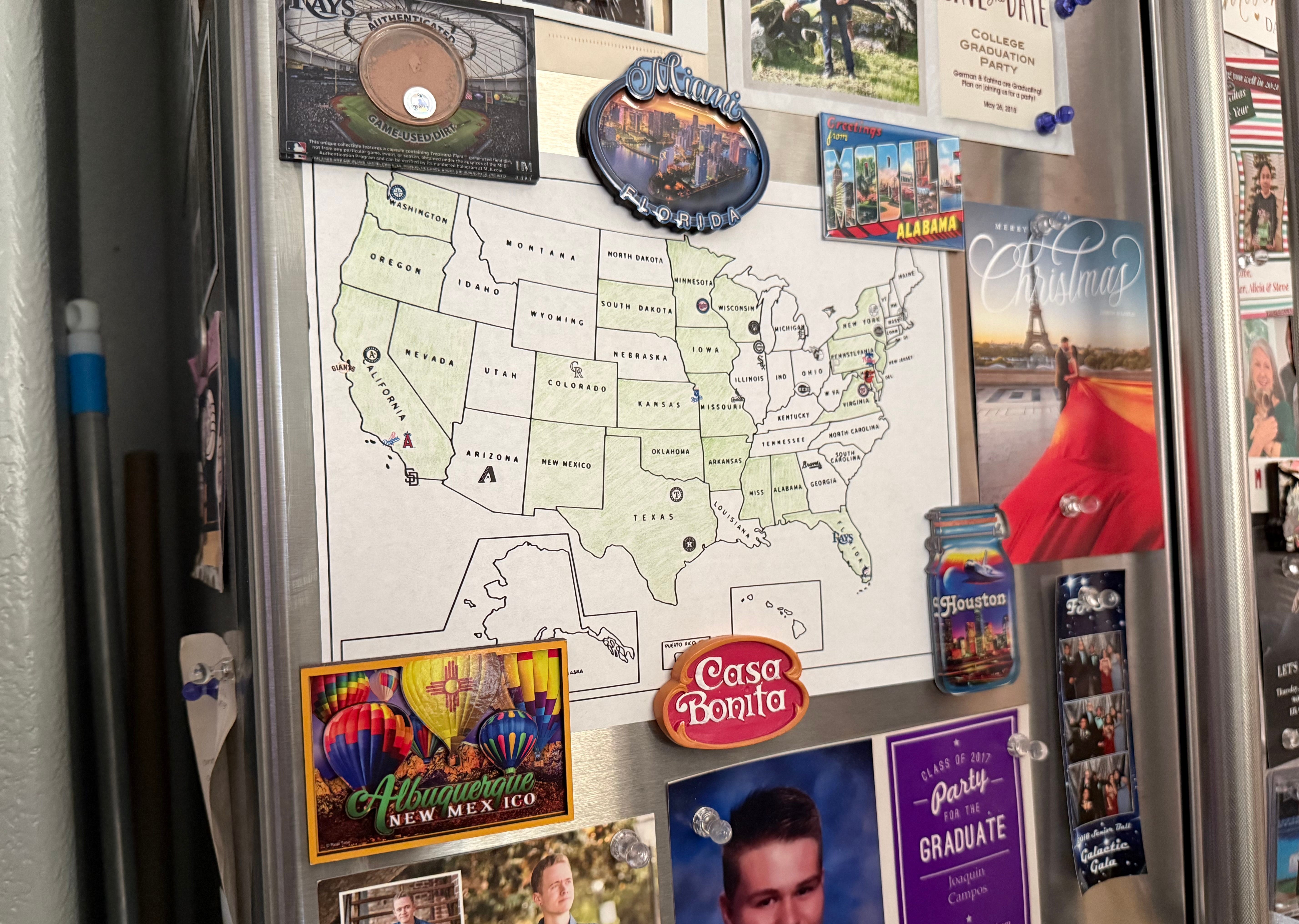
A trip crystallizes around a firm core of purpose. Trips have clear objectives that everything else about the experience gets built around. Matt and I flew to Denver to eat at Casa Bonita. I spent a day in Los Angeles to watch THEM perform. Albuquerque was for Morgann’s wedding. Florida and Alabama were for baseball and Omar’s nuptials, respectively.
When a trip features a clear kernel of justification, travel’s platitudes get thrown in the trunk. The vacation isn’t about maximizing hazy this or experiencing nebulous that but about meeting singular objectives. By attending the wedding or dining at the restaurant, the weary traveler establishes precise success criteria. Trips have checklists just like travel, but the former yields shorter lists set by the person rather than a glossy tome of attractions defined by the destination’s economically motivated tourism department.
If that sounds like a matter of semantics to you, fair enough, but those semantics isolate the part of travel that I loathe: the broad obligations set by strangers. When one travels, they must extract the essence of a place while present during an ephemeral engagement, and this is what turns me against getting away. Not to put my brother on blast, but I wasn’t keen to visit Miami Beach, and “You’re in Miami” didn’t sway me. I had no interest, and that vague notion of duty turned a natural activity into a chore. We outsourced our plans to the zeitgeist without considering what we were up to.
And I swear to you: my opposition was all about that framing. Had Tom said he wanted to see the beach, that he sees something special in the water, that would have reoriented me. I feel a duty to him that I don’t to a list of essential excursions generated by your neighborhood LLM. But the truth is: I don’t think he had one, either—he lives on the East Coast. He’s seen the Atlantic Ocean.
Maintaining agency over the to-do list makes trips into flexible endeavors ripe for customization to suit the specific vacationer’s mindset. Instead of leaving my interests and proclivities behind to collect the standard set of experiences, I can find ways to enjoy what I love within a new setting. On each of my four trips, I’ve seen at least one movie in theaters, a decision that I’ve had multiple people push back on. “You can see Toy Story 5 anywhere,” they lament.
Such a statement is true—the Pixar sequel continues to play at the Century 16 I frequent here in Elk Grove—but it also misses the point. I don’t find traveling relaxing, but I do find movie theaters soothing. My typical relaxation is almost always the silver screen, so why shouldn’t I escape to the AMC on Schillinger Road while I’m away from home for a little R and R?
See, when taking a trip instead of traveling, we are beholden to nothing except our central objective and ourselves, allowing everything surrounding the main course to become gravy. The story is not seeing the thing that everyone else sees and snaps for their Instagram, but elevating the little things that happen to you along the way.
For me, each trip burst with these moments. LA had the gracious bakery, a wild encounter with the band, and my rogue nostrils at MOMA. Denver had the pissed-off Lyft driver, the play about poop, and the knapsack sacrifice outside the arena. In New Mexico, I got a homeless man to a methadone clinic and walked where I shouldn’t have walked; in Alabama, I had a long conversation with a young clerk at Walmart at 10:00 pm, and I accidentally cosplayed as a food critic.
Those are all, individually, stories unique to me, and they do represent tiny things, but they became pillars of my trips because I wasn’t racing through them to get to the “real” stuff. Instead of returning home to shake my head over everything I missed, I get to marvel at the glass museum Tom found in Tampa and rave about the NHL game Matt and I caught. Those weren’t on the agenda, but we had room for them because we generated those agendas.
As a noted travel-hater, it astounds me that I find myself imagining future trips. The prospects of a visit to Cleveland’s Progressive Field became the sentimental core of an essay earlier this year, but that is only one such spot that could center a short jaunt elsewhere. I’ve been to fourteen1 of the thirty MLB stadiums, which leaves me sixteen more ballparks to see games at. Such shallow aspirations surely sound silly to some, but I’d rather score a game at Yankee Stadium after watching a movie in the morning than race through a historic city like I’m recreating National Treasure2.
Those humble, personal constructions for trips convince me to leave home far more effectively than smug platitudes about essential growth ever will.
And I suspect I’m not alone in that.
*****
If you boil down what I wrote in the previous section to its elements, I essentially credit language for enabling me to overcome my disinclination toward traveling.
That concept—of a trip being fundamentally different from travel—is one that I believe helped me. It feels very teacherly, honestly: I rebuilt the instruction with a narrower and clearer purpose that invited reluctant students to access otherwise off-putting curriculum. I adjusted my vocabulary, resequenced the lesson, and displaced my anxiety—that’s a win for sure. It enabled me to drive myself across multiple states while completely alone (and weather my stolen3 luggage) with only an unreliable car radio to reassure me without melting down. It worked.
The problem with the construction I’ve shared is that it reads like an answer. I write like I solved something here, like the guy who’s taken four short trips in three years has a meaningful contribution to the way we, as a society, approach travel.
Here’s the secret: I don’t! I don’t at all. If you want to read about our flawed perceptions around traveling, I’m the last person you should listen to. Go read “The Case Against Travel” by Agnes Callard. She understands the issues deeply and personally; this essay would have been stronger if it were merely a link to her story about the hollowness of falconry in Abu Dhabi. She cites Socrates and Ralph Waldo Emerson while I complain about pristine seawater. Her piece is great.
With that said, I do think that I brought something unique to the discourse. I began like Callard, thoroughly anti-travel and cynical about its value, but instead of doubling down, I went the other way: I stared at the Atlantic Ocean with slumped shoulders, but drew joy from Floridian ball parks, Mississippi movie theaters, and races to Walmart after dark. She doesn’t turn around on travel because she never dissects diction to reconfigure empty, platitudinous travel into purposeful, flexible trips like I did. To be honest, I’m proud of myself for pivoting that way. I’m genuinely glad that I read Callard’s work and felt down about the vacation I’d planned, but then had a great time anyway.
When I frame it that way, though, again, I sound heroic in a way I am decidedly not. It was an ordeal to override the intense anxiety I felt when my suitcase vanished, the rental car refused to start, and a storm dumped on the freeway. I found some thrills during favorite pastimes in novel places, but when each leg came to a close, I felt infinitely more excited because I was that much closer to going home. My last tastes in Tampa, Miami, and Mobile weren’t pride or achievement but relief. I couldn’t wait to arrive in Sacramento and resume my usual routines.
You’ll notice I haven’t written about my vacation that way, though. While my essay trashes travel at the outset, I’ve landed somewhere warmer as my metaphoric plane begins its final descent. What changed? Why did I emerge from a stressful week in the South that featured bouts of severe loneliness oddly uplifted?
The answer is silly, but so much of what I write about ultimately is, so I’ll just be honest.
Because of refrigerator magnets.
As stupid as it is to cede credit to overpriced airport mementos, I’m being sincere in my declaration. I felt down after traveling: jet-lagged, behind on a dozen projects, and still ruminating on that empty pew beside me. I wasn’t keen on going anywhere again any time soon. But everything turned with those magnets.
No matter how thoroughly you’ve explored the world, you’ll recognize the kind of magnet I’m describing. They’re kitschy little things made for old-school stainless steel refrigerators. They usually say the name of the city in bold print that foregrounds a photo or artistic depiction of some salient feature of that locale.
I didn’t consciously think about magnets at any point while out east. Truthfully, I never have. Magnets mark one of my favorite metaphors for friendship across time, and they helpfully hold up those holiday cards I cherish, but I never would have said I collect magnets—and trust me, I of 100,000+ sports cards know what collecting entails.
But I bought magnets from my three big stops in June. I found a silly magnet with a vial of Tropicana Field dirt4 in Tampa, and I bought a lovely skyline one of Miami at the airport. I didn’t fly out of Mobile, so I didn’t get to peruse their selection, but I found one online from a local vendor that I ordered automatically once I got home. I’m finishing the set, I told myself while paying.
What set, though? That’s the funniest thing—because there is, indeed, a set. When I went to hang the Floridian pair, I discovered little room on the front of my fridge. A beautiful hot air balloon-emblazoned rectangle from Albuquerque occupied the prime real estate on the left, a little above a magnetic mason jar from Houston holding up Joaquin’s grad photo. On the other side, I found a magnet from Casa Bonita, too, a perfect representation of my visit to Denver with Matt.
No, these tiny pieces weren’t intentionally acquired, and they don’t span my entire history of adult trips. I got nothing magnetic after my draft visit to New York, my two trips to LA, or my conference in Austin, so this is only a collection according to this piece I’m writing. But those facts obscure what’s important about the magnets I did acquire after visiting Florida, Alabama, and Mississippi.
Putting them up made me feel proud.
The feeling was akin to receiving belt loops, the Cub Scout merit badge equivalent. Each tiny metal trinket certified an experience designed to foster health, awareness, or growth. I was among the short list in my pack who earned every belt loop, and while those standards don’t seem notably high in hindsight, I definitely pushed myself to acquire those loops. I snorkeled for thirty minutes in the Boggs’ pool, I ran around the block with asthma, and yes, I visited new places so that I could acquire and proudly wear the corresponding loops. Those totems were carrots dangled before pudgy little me to get him chasing down novel experiences.
During scouts, I sought something small, but what I learned to pursue was satisfaction from stretching myself. Scouts demanded I do many things I wasn’t keen on or comfortable with, but the belt loops were enough to encourage action that didn’t appeal to me but that was definitely to my benefit.
The more I think about the magnets, the more I think I’m onto something real. In the same way I feel a surge of security when I glimpse Brady’s grad announcement or the photo of Layla and Daren dancing in Paris on my refrigerator, I likewise find some fortitude when one of the magnets catches my eye. At home, I am safely cocooned in my comfort zone, but those magnets point outward, to a wider, wilder world, and they remind me that no matter what my apprehensive brain claims, I can drive across unknown states, waltz into Waffle Houses in the middle of nowhere, and chat with strangers about missing underwear at all hours of the day.
You are capable, the magnets insist. You are capable of going places. I prefer that message to the one Big Travel bleats out at me. I need that encouragement far more than the hokey platitudes when I prepare to travel. The magnets work for me.
I’m already scoping out space to honor my next trip.
This was an odd piece because it starts out blisteringly pessimistic only to pivot hard at the midpoint, but that reflects my relationship with travel. I’m happy with where I’ve landed after that trip, though. I am serious when I say that I’m already thinking about future trips to states and stadiums I haven’t seen. That in itself is a hard 180 from where I was in June before leaving.

Technically, I’ve been to more than that because I’ve gone to games at three defunct stadiums—Candlestick Park in San Francisco, the Metrodome in Minneapolis, and, claro, Oakland Coliseum—but that’s neither here nor there.
As an unabashed fan of the Nicholas Cage movie, I should note it mostly takes place in Philadelphia and Washington, not New York. (Also, since it’s twice caught strays from the New York Times this week, can we please stop calling movies like National Treasure “bad”? “Silly” is appropriate, but “bad” feels wrong. A national paper should be better than that.)
“Stolen” is being dramatic, but my bag was taken by a person who wasn’t me at the airport. That she ate none of my Clif Bars suggests it was unintentional theft, but I will never know for sure…
Humorous, I’d argue, because Tropicana Field is a fully enclosed dome with a synthetic turf field. They do use actual dirt, though.
No posts
Comments
Nothing yet. Say the first thing.
Sign in to join the conversation.