
The closest analogue is the fitness app.
People articulate the goal cleanly. They will tell you, with care, that health is important. They will sign up. They will not show up to do the work. Not in numbers that build a business.
olllo lived in that category. The signals were there in the data before I let myself read them.
I built it to solve something I’d watched senior ICs hit for years: the 9pm panic of reconstructing six months of work the night before a self-review is due. Performance reviews that feel arbitrary because the calibration room can’t remember January. Compensation conversations that hinge on which three projects you happen to recall under pressure. The pitch was simple. Capture wins as they happen. Reflect weekly. Have the case file when you need it.
People said the problem was real. Every conversation. Every survey response. Every “yes, I would absolutely use that.”
The tool shipped. It worked. Almost nobody used it. I shut it down in March.
Four months. Solo. A Next.js web app, a React Native companion with voice capture, a multi-agent reflection flow that asked smarter questions over time, and the growth stack most solo products skip: waitlist, drip sequences, free-forever grants, two cohort designs. A versioned constitution file gating every PR. Forty-plus feature branches, each one specced, clarified, planned, tested, merged through CI.
The thing worked. That is not in dispute.
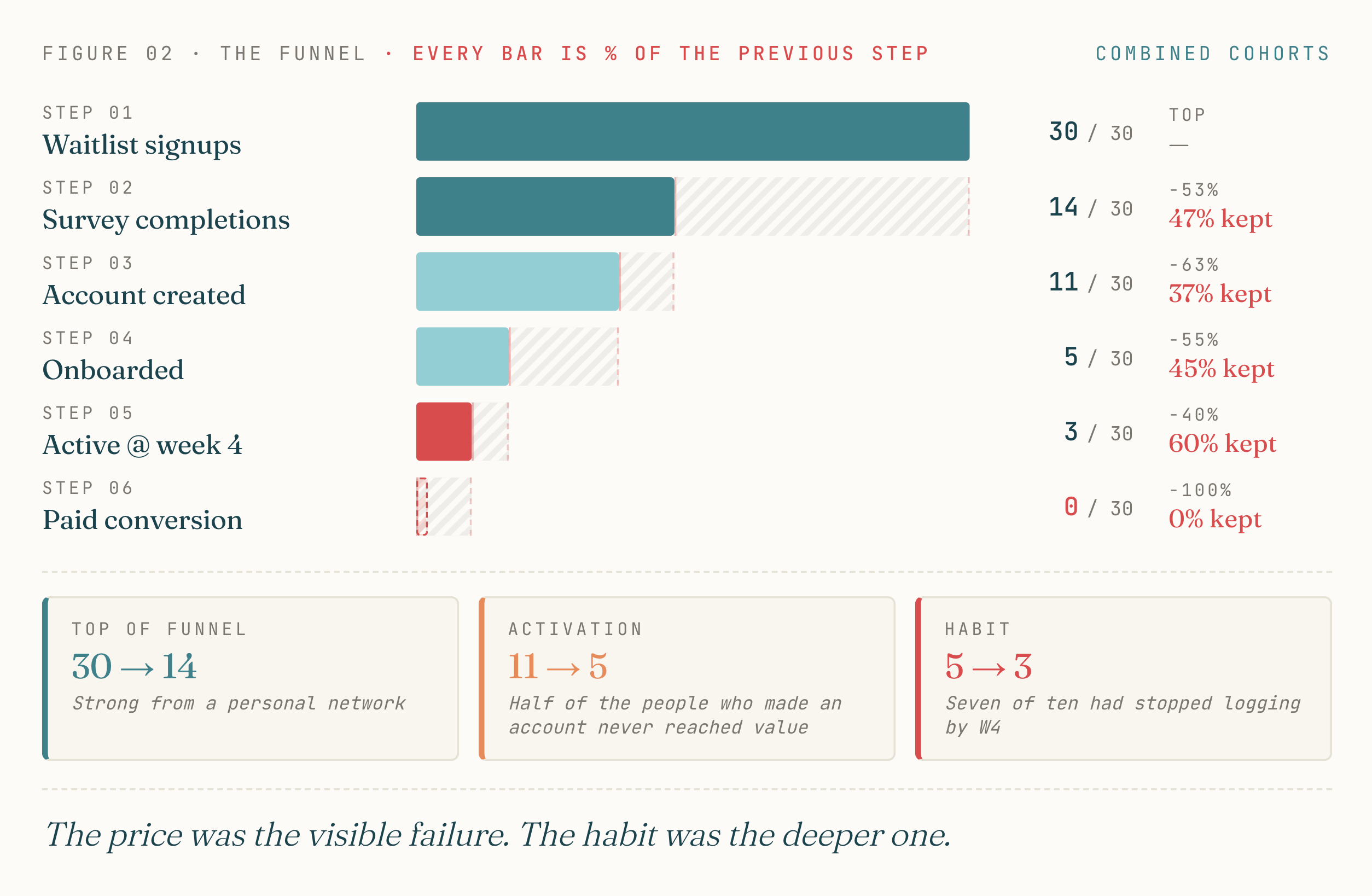
The waitlist had 30 people. Fourteen filled out a survey. That survey is where the story turns.
The respondents were not casual. Two-thirds were senior ICs at enterprise companies, with a band of mid-career-transition people layered in. The pain they named was clean and consistent across role levels. Six cited performance reviews specifically. Seven cited interviews.
What they said they wanted built rated highly everywhere: a searchable record of wins, a promotion-ready career story, weekly reflection prompts. No single feature dominated. They wanted all of it.
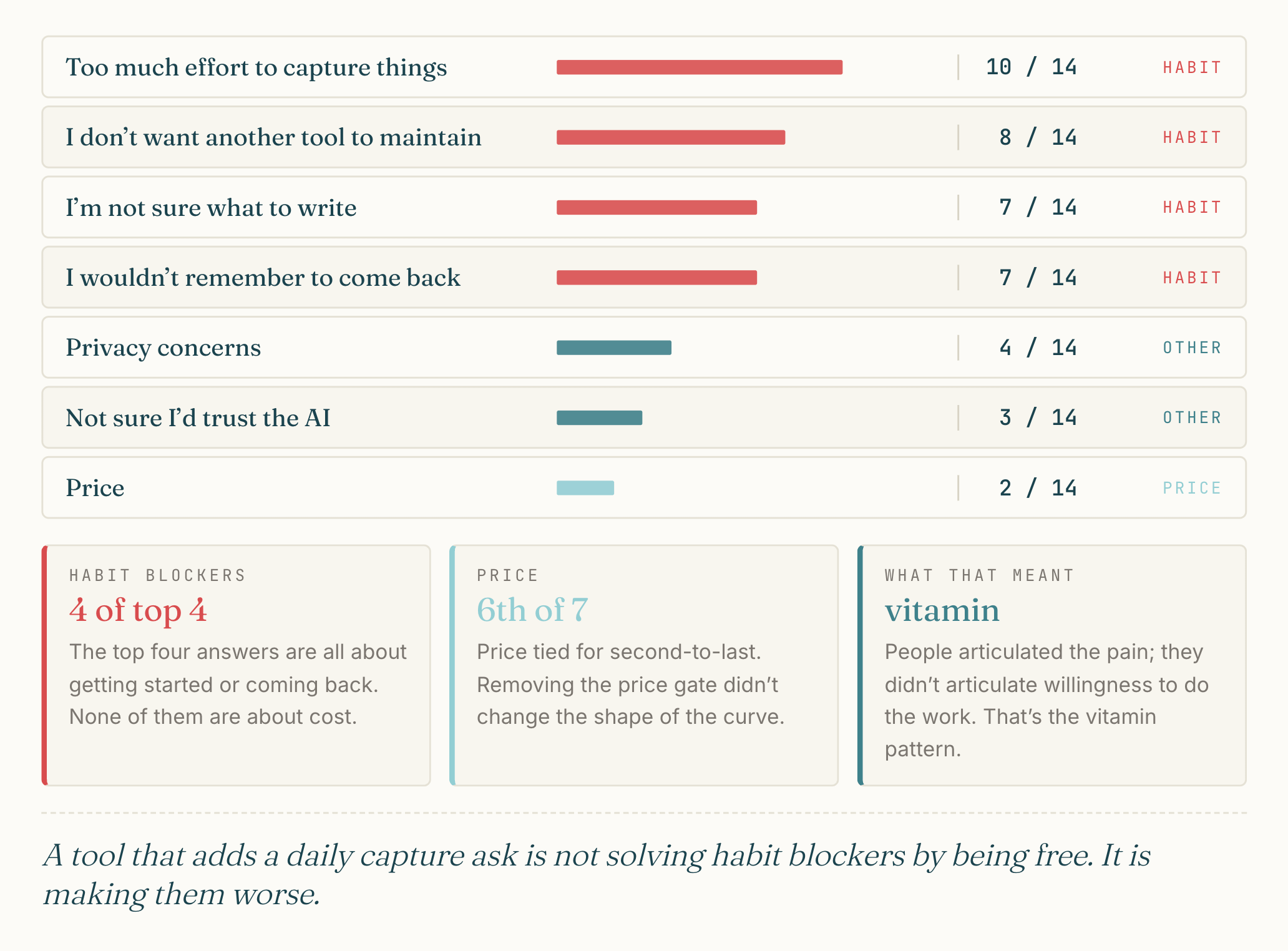
What they said would stop them is the section the post-mortem turns on. The top blockers, in order: too much effort to capture things, I don’t want another tool to maintain, I’m not sure what to write, I wouldn’t remember to come back.
Price was not in the top blockers. Habit was.
That should have been the entire post-mortem, written four months earlier. It wasn’t.
If you have ever run a survey on internal tooling, this shape is familiar. The team will articulate the gap cleanly. Contribution to the design system is too hard. The critique format is too loose. The career framework is unclear. The same survey will also tell you, often in the same section, the reasons the team will not adopt the fix once it ships: too much overhead, another doc to maintain, not sure how to participate. The signal is right there. We mostly read the first half and act on it.
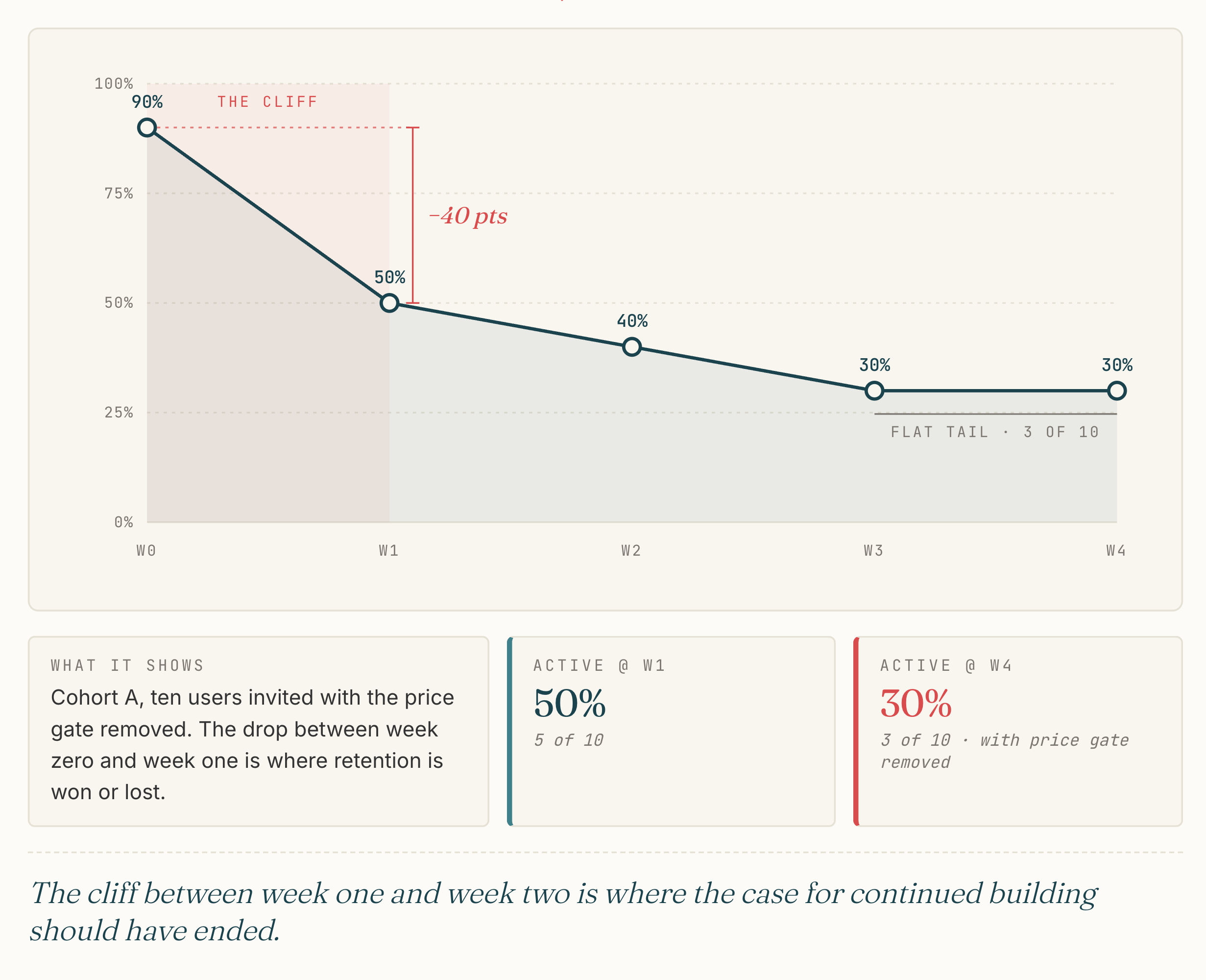
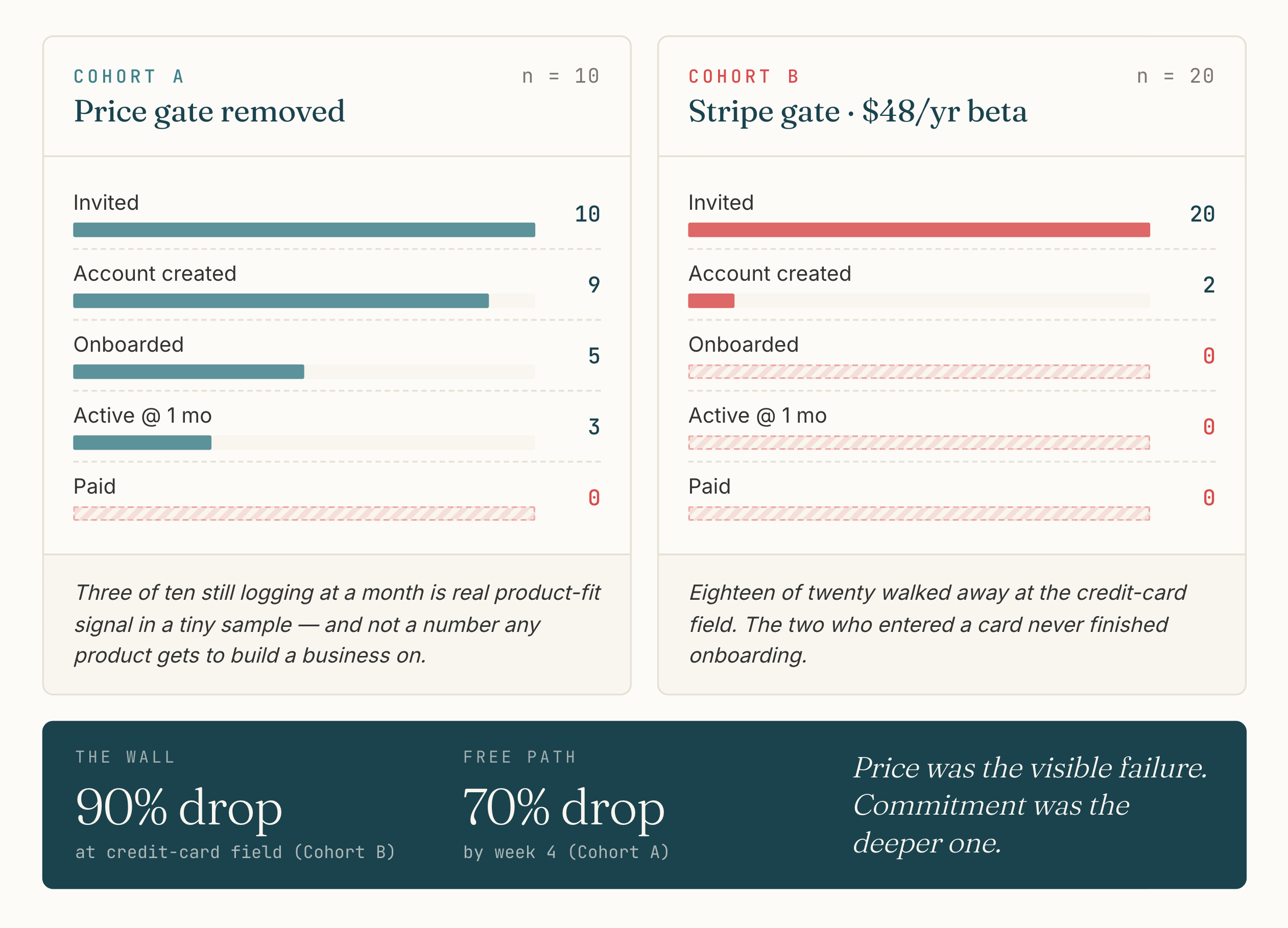
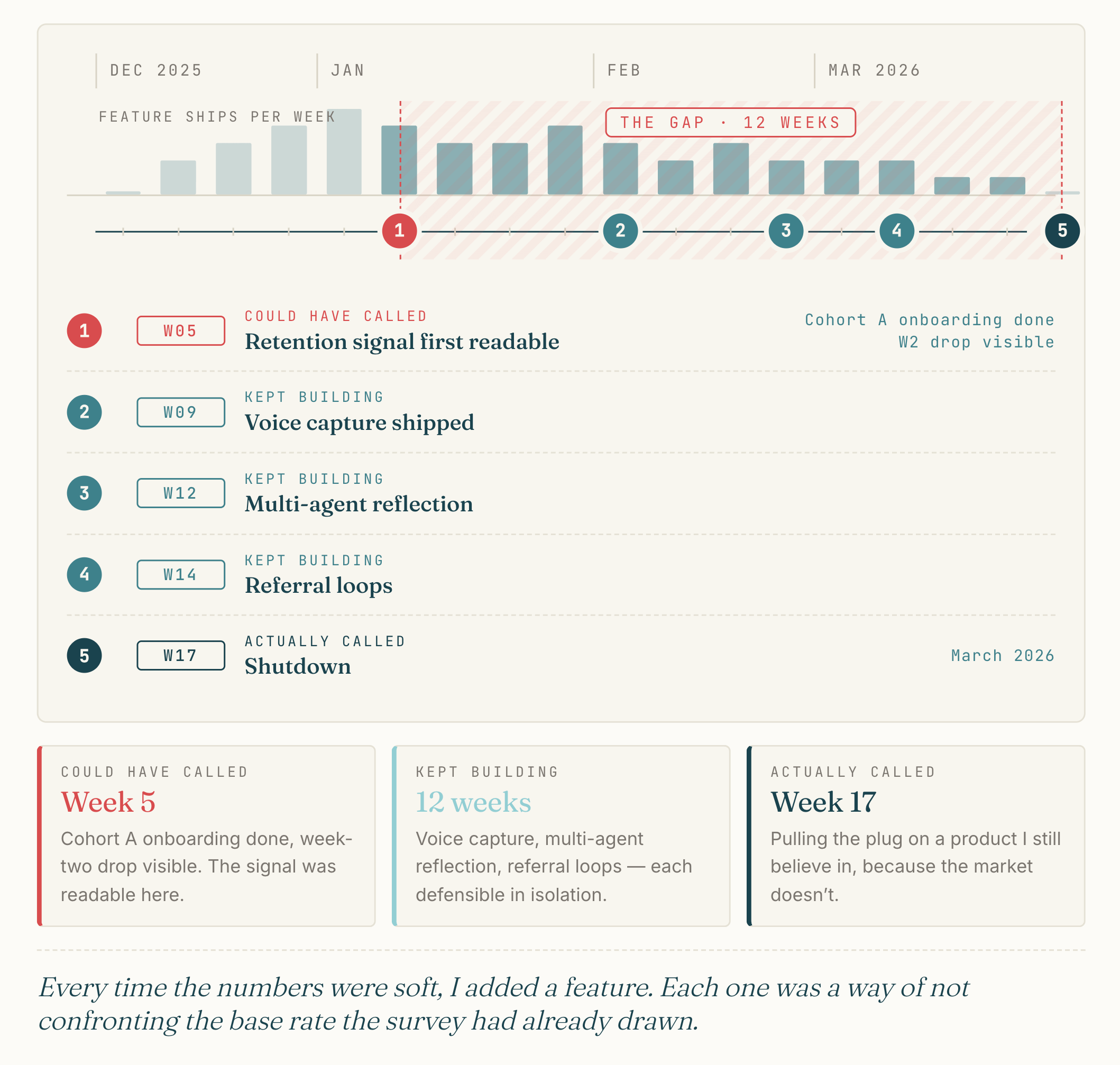
The cohort experiment confirmed what the survey had already said. I ran two invitation paths. Cohort B (twenty people, Stripe gate) collapsed at the credit-card field: eighteen of twenty walked. The two who entered a card never finished onboarding. Cohort A (ten people, no payment required) was the natural experiment. Half onboarded. Three of ten were still logging weekly a month in. Seven of ten had stopped logging by week four.
That is a real product-fit signal at small scale. It is not a number that builds a business.
You can see what was happening in the git history.
Every time the engagement numbers softened, I shipped a feature. Voice capture. Multi-agent reflection. Smarter weekly summaries. Referral mechanics. Each one was defensible in isolation. Each one was a way of not reading the sentence I had already written in my own notes: people identify it as a pain point to keep track of accomplishments and prep for 1:1s and reviews, but they don’t seem willing to invest in it.
That sentence is the whole story in two clauses. Acknowledgment without investment is the category-definition of a vitamin rather than a painkiller. People articulate the goal. They sign up. They don’t reliably show up to do the work. It is the shape of every fitness app, every weight-loss app, every nutrition tracker that ever closed its doors.
I wrote the sentence in month two. I shut olllo down in month four. The gap was not a failure of analysis. The data was clear the first time I read it. The gap was a failure of consequence: the willingness to act on what I already knew, before another two months of velocity made the closing harder.
Leaders make the same move on internal tools. The component library adoption number softens. The fix is a new contribution dashboard, a Slack reminder, a polish pass on the docs site, a contributor spotlight. Design critique attendance softens. The fix is a better template, a new facilitator, a clearer agenda. Each fix is defensible. None of them touch the thing that is actually wrong, which is upstream of the tool entirely.
The reflex is the tell. When the engagement signal goes soft, the discipline is to ask whether the underlying behavior can be moved by anything you can ship. Most of the time, the answer is no. Most of the time, we ship anyway.
Most orgs have at least one olllo. Not the accomplishment tracker. The pattern.
The design ops tool the team asks for in every retro and uses for two weeks. The contribution dashboard for the design system, validated in interviews and never opened. The token explorer, the Figma plugin, the consistency-score dashboard. The career framework, the levels doc, the calibration handbook. The weekly critique ritual that gets endorsed in retros and skipped on the calendar. The post-mortem template no one fills out. The internal handbook everyone wants written and nobody reads.
Each of these gets built or rolled out the same way olllo did. A leader hears the articulated pain. The team validates the idea in conversation. A working version ships. Adoption never comes. Then a year of small repairs.
The thing that is actually wrong is almost always upstream of the tool. Either the underlying behavior the tool requires (writing a daily win, filling out the critique form, updating the framework) does not have organic pull, or the organization is not asking for it loudly enough through the systems people actually pay attention to: performance, calibration, promotion criteria. A tool cannot manufacture organizational pull. It can amplify pull that exists. It can measure, very precisely, when pull does not.
The mistake I made on olllo is the same mistake leaders make on internal tools. We treat well-articulated pain as adjacent to willingness to show up. They are different signals. A survey will tell you the first. It will not tell you the second.
The version of this I want design leaders to hold onto is the measurement question.
Vitamin versus painkiller is not a survey question. You cannot ask people on a form whether they will form a habit. The honest answer is that they don’t know either. What they know is what hurts now and what they wish were better. Both are useful. Neither tells you whether they will change behavior to get the better version.
The signal that does tell you is behavioral, and it is small. The internal tool that gets used without a reminder. The process that runs when the senior person who proposed it is on vacation. The framework that comes up in a 1:1 nobody scheduled to discuss it. The Slack channel that stays alive after the launch announcement is buried. Those are painkiller signals. They are quiet, they are unambiguous, and they show up early if you are watching for them.
On olllo I was watching articulation. Survey depth. Conversation density. Waitlist signups. None of those were noise. They were the wrong instrument for the decision I was making. I needed the painkiller signal. I had the painkiller-shaped silence, and I was reading the vitamin-shaped enthusiasm.
The same mistake shows up reading review feedback as a tooling and process roadmap. People will tell you, with care, that the design system is hard to contribute to. They will not, in numbers that build a contribution culture, contribute. People will tell you the critique is too unstructured. They will not, in numbers that produce structured critique, fill out the template you wrote in response. Articulated pain is real. Willingness to invest is the question. You measure it with people, not with instrumentation.
The decision to stop is the part of this I’m most confident in.
In month three, I built the cohort experiment specifically to give myself a falsifiable shape for the next month. If the free cohort retained, the price-gate failure was the story. If the free cohort did not retain, price was the visible failure and habit was the deeper one. I committed to the test before I had the data. I shut it down a few weeks later, on the result.
Pre-committing the decision rule mattered. Without it, I am the founder who keeps shipping features because the user research keeps coming back warm. With it, I am a leader making a call against my own preference, on a signal I had read accurately months earlier and reread three more times than I needed to.
That, more than the codebase, more than the architecture, more than the growth stack, is what I’m taking into the next thing. The skill is not building. The skill is reading a soft signal early, naming it, building a test that will surface it cleanly, and being willing to act on the result when it lands. The same skill, mostly unchanged, is how a design leader greenlights or kills a tool, a process, or a ritual that has not yet shown organic pull.
A codebase I would hire the person who wrote it. A set of product decisions I can defend in detail. A sharper read on the gap between an interesting problem and a viable product. A clearer rule for what to do the next time the data is unambiguous and the temptation to ship one more feature is high.
The thing I want you to notice is not that olllo shipped. It’s that it stopped.
Read the entire case study on Hypoth.ai
No posts
Comments
Nothing yet. Say the first thing.
Sign in to join the conversation.