
This first appeared in the Hindustan Times on 01/03/26.
“A female elephant rubs against the white koothalam flowers,
That have blossomed on the dark green shrubs,
Looking like white herons perched on the verdant foliage,
Her skin is dotted by pollen of the flowers, as she grazes on the millets
Before sleeping sweetly.”
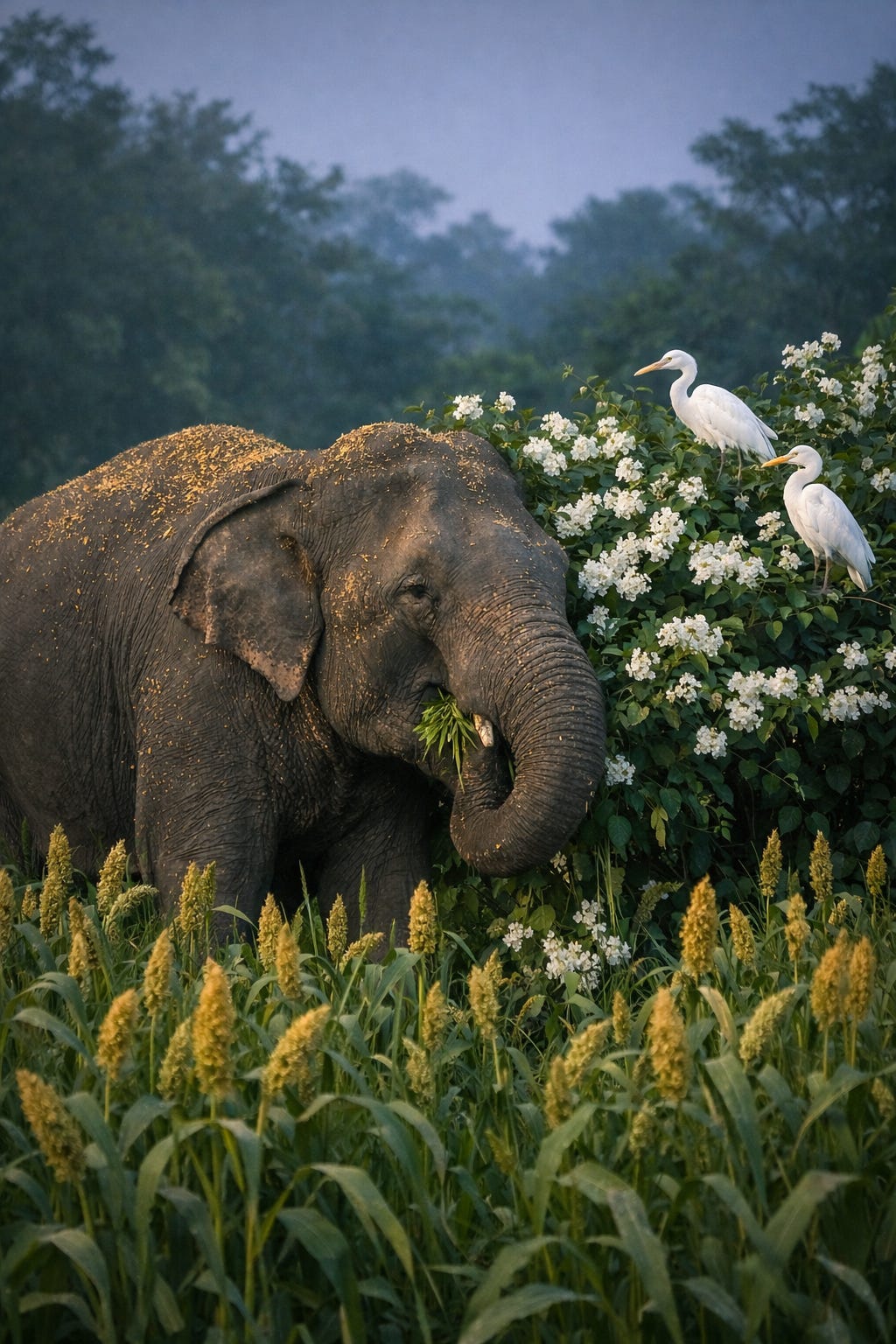
This poetry from the Sangam age, written about two thousand years ago provides lyrical evidence, that we – man and beast – have been eating millets for a long time. More proof comes from archaeobotanical studies in the Indus Valley digs, from the Vedas, from the epics and from poetry and cookbooks through the ages. Indeed, according to the Famine Commission Report, which came out after one of the worst famines to strike India, most Indians in the late 1800s still ate millets. As the report says “The millets and pulses … are hardy plants, and can bear a great deal of irregularity…Rice is more delicate, and perishes if the plants are either too deeply submerged, or their roots left dry for a very few days”. It adds that, barring West Bengal and Assam and the river deltas of the southern states, less than 5% of the India’s population ate rice, and the majority of cropland grew millets.
What happened?
I’ve explored the “why and how” of this change in my book, Watershed, but suffice to say, that while the British planted the idea that technology can reshape water resources (indigenous hydroengineering like the Kallanai tended to work with water resources) and encouraged such crop change with their cash taxes, perhaps the more dramatic change came with the Green Revolution.
Consider, in 1966–67, paddy was grown in less than 7 per cent of Punjab’s fields. Indigenous, drought-resistant varieties of gram and maize dominated in both acreage and production. Today, Punjab grows very little millet, and the vast expanse of its fields grow a wheat-rice dual crop. It’s not just Punjab. Across India, regions that once relied on resilient millets have shifted to water-intensive rice and wheat. Borewells enabled the transition, but a changed demand sealed the deal: specifically, the government procurement of rice and wheat. The result is stark — since 1970, India’s millet acreage has fallen by roughly half.
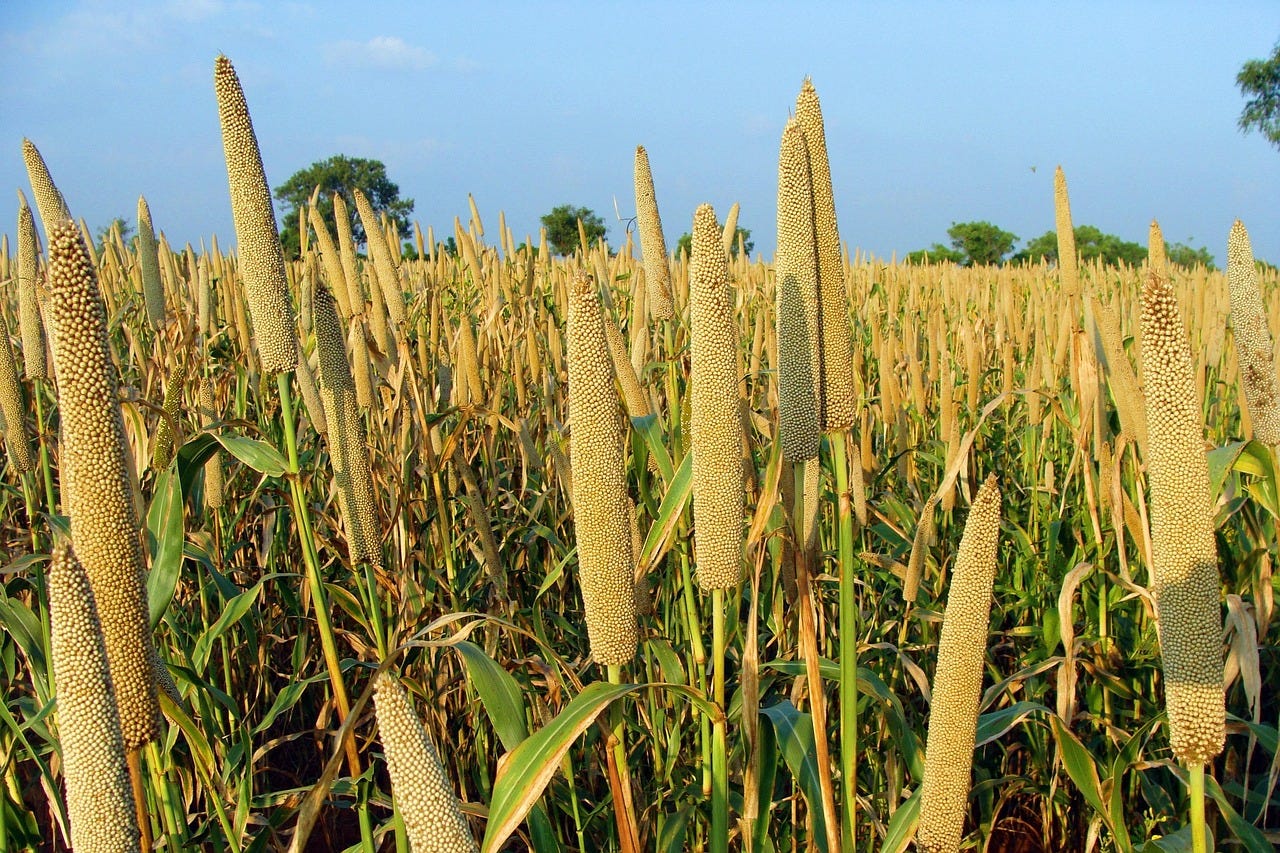
That’s a shame – because millets are just what the doctor ordered. For both personal and planetary health.
Just look at the numbers. 100 grams of uncooked milled rice provides mostly carbs along with a paltry 2.8 g of fibre and 7.9 g of protein; in contrast, a similar quantity of millets offers up to four times as much fibre with significantly more protein. The mineral story is even more telling. Finger millet provides an astonishing 50 times more calcium and 7 times as much magnesium as rice! Other millets offer between double to four times (or more) what rice offers in terms of calcium, magnesium, zinc and iron.
Study after study shows that consuming millets stabilizes blood sugar, reduces inflammation and oxidative stress, and reshapes the gut microbiome. That triad maps almost perfectly onto the cures for diseases now overwhelming India — type 2 diabetes, hypertension, fatty liver, cardiovascular disease. And indeed, studies show lipid lowering, blood pressure modulation, microbiome repair, and even anticancer signalling with diets including millets. In one experiment, diabetic rats fed a diet with 20% finger millet seed coat for six weeks showed significantly lower fasting glucose and HbA1c levels, improved kidney markers, healthier lipid profiles, and even reduced cataract formation compared to controls. Taken together, the findings suggest that finger millet seed coat modulates the biochemical pathways reducing diabetic complications.
It’s more than just fibre and minerals. Studies have shown that the polyphenols in millets have potent health benefits. For example, researchers raised 40 lab mice in identical conditions but with different diets: a control group on a standard diet; a cancer group given chemicals to induce inflammation-driven colorectal cancer and fed a standard diet; a cancer group fed millets; and a cancer group fed rice. They matched fibre levels in the standard diet and the millet diet to isolate the effect of the grain. After several weeks, the millet-fed mice developed fewer tumours and lived longer than the standard-diet cancer group. The poor rice-fed mice fared the worst. Further investigation revealed that the millets had reengineered the mice gut microbiome dampening the inflammatory environment in which colorectal cancer thrives.
Yes, that same gut biome that we explored last time is helped by millets. Kumar Sankaran, whose company Leucine Rich Bio was among the earliest in India to study the gut microbiome and has analysed more than 1.5 lakh samples, told me that microbial diversity in the gut is a key indicator of gut health. And that people who included millets in their diets had more diverse gut biomes.
In a country battling multiple inflammation-driven epidemics, not mainstreaming millets in public distribution is mind boggling.
Now, what about planetary health?
The way millets eat – the way they take carbon from the air into themselves – is what makes them so much more effective than rice or wheat in a warmer climate. The biochemistry is fascinating and critical, worthy of extended consideration, so let’s leave the details of that for another day. Instead, let us turn to a fascinating study in dry northern China, where researchers grew foxtail millets with different amounts of watering and found that not only did millets give more grain for every ounce of water it consumed (relative to rice or wheat), but that in hotter conditions, the plants more efficiently pulled moisture from the soil to fill their seeds.
So although on paper, millets can appear to have a water footprint comparable to — sometimes even higher than — rice, those comparisons pit irrigated rice grown on prime land against rainfed millets cultivated on marginal soils. It’s not a fair fight. In marginal lands, in arid regions, in hotter weather, the millet wins handily. And that’s exactly the kind of place where farmers have switched from millet to rice (or wheat), often because the borewell has made more water accessible. And because the water was (is) used unwisely, it is running out, and as the climate heats up, the yields are suffering.
It’s the classic story of the grasshopper and the ant, with a twist. Like the grasshopper, the farmers living in arid lands grew crops beyond their means, because that’s what got sold. Along the way, some exhausted their (groundwater) insurance. And now, winter, or rather warmer and more temperamental weather is here, and like the grasshopper they need to rely on another’s kindness. And that’s where the millet comes in.
The good news is that the government is beginning to include millets in public distribution, even though currently it remains a tiny drop in the ocean of grain procurement.
But the real bottleneck lies elsewhere. When I see health fads popularising quinoa, I confess I roll my eyes. Yes, quinoa is a nutritional powerhouse. But it originated in the Andes and likes cooler weather than that of India. Millets compare with quinoa nutritionally, and are ideally suited to Indian climes.
The bottleneck is not climate or economics; it is that most human of things: status. We gravitate towards the cool kids (rice and quinoa) and look down on the socially less cool-if-ever-so-worthy kids (millets). Historically, millets were the fare of vulnerable groups, and, in this class-torn society of ours, why would we eat what those who stood several rungs below us on the socio-economic ladder ate?
To paraphrase Morpheus from The Matrix, “Fate, it seems, is not without a sense of irony.”
So, in the spirit of putting my food where my words are, I began preparing and eating ragi (finger millet) kanji, or gruel. I’d been feeling a little unwell these past weeks and needed a pick-me-up. There was more than a touch of nostalgia in this action. Part of my mother’s family hails from Karnataka, meaning holidays featured ragi – or as we called it “Ragi Balls”. Since the family dog liked them too, my grandfather, who was not too concerned with his grandchildren, tenderly hand fed the dog, Moni, while I sat beside them on the red cement floor quietly eating my share.
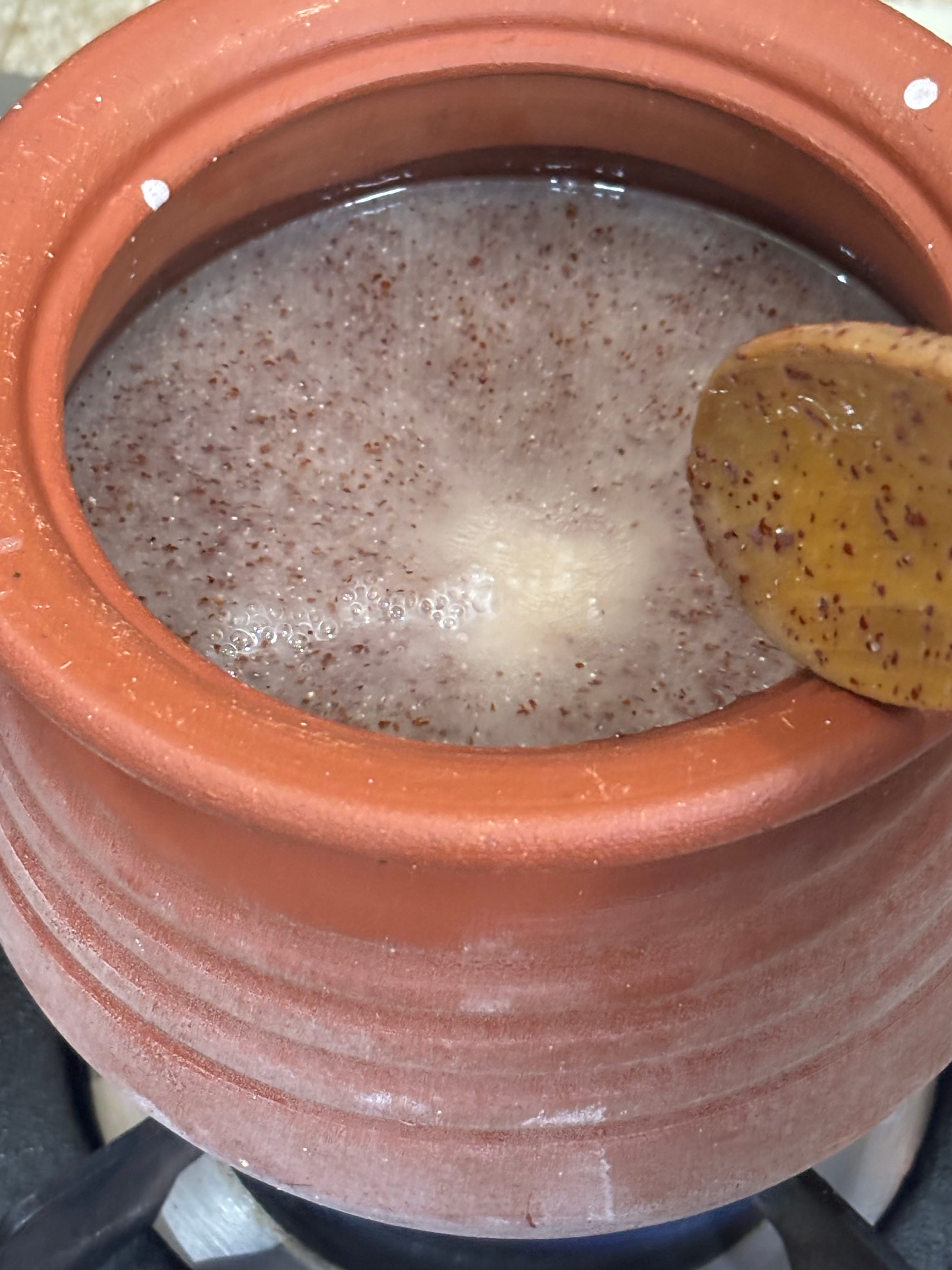
The grains had to be soaked overnight, before being ground. In the morning, I placed a few grains of rice in a mud pot with some water, and brought the water to a boil before adding the millet. Then came the part of stirring the pot continuously until the grain was cooked. I took the pot off the heat, covered it with a cloth, and walked away. A few hours later, I added tempering (curry leaves, mustard seeds, two red chillies and urad dhal in ghee), salt, a little curd, and then ate. It wasn’t like one of Getafix’s potions, and I didn’t jump up, and finish this article pronto. But it was soothing and gentle, and after some time, my headache eased a touch and after a day, my stomach settled and I felt better. The real proof, in a few weeks if I stick to this, will be to test if my gut biome has changed.
Thanks for reading Climate Trade-offs! This post is public so feel free to share it.
No posts
Comments
Nothing yet. Say the first thing.
Sign in to join the conversation.