
In a July 6 public records order, the Lane County District Attorney’s Office sided with Eugene School District 4J, denying my petitions and upholding the latest restrictions the district has imposed on my K-12 health curriculum review:
$108.95 hourly fee.
A supervisor who ends the session if they think I am transcribing.
A signed agreement to assume 4J’s liability if I violate copyright.
No access to the high school sex ed curriculum, per 4J’s interpretation of publisher’s terms and conditions.
Here is the first part of this story:
To recap: I wanted to analyze the logic of how gender identity is taught in local schools, so I requested to examine the health curriculum. 4J let me review it for a few hours before sending me an email that halted my sessions, told me I’d need to pay going forward, and blocked me from taking notes.
I wrote back the same day and asked the district how much they wanted to charge. They did not answer.
Five weeks later, I sent 4J an email threatening a lawsuit if they didn’t set a price within two days. I also demanded they finish my half-completed records requests and lift the note-taking ban.
4J responded two days later. They backed down from the note-taking ban and set their hourly fee: $109. They also told me I’d need to sign a hold-harmless agreement protecting them from copyright claims, and said they reserve the right to end sessions if I appear to be transcribing.
From their June 18 letter:
After supervising the materials review for several hours, the curricular administrator [Courtney Leonard] developed a concern that you appeared to be essentially transcribing the copyright protected materials, as you were seen to be rapidly typing while looking at a page, flip the page and continue typing in the same fashion. You indicated to the curricular administrator that you “got through” a certain grade level and would need at least 20 hours more time. Based on concerns that you were copying materials and the amount of additional time you requested, the public records office became reinvolved. At that time, the public records office informed you that it was developing a cost-estimate and informed you that note-taking would not be permitted.
I understand that, for whatever reason, 4J doesn’t want me to transcribe sections of the health curriculum. I am skeptical that Oregon public records law empowers them to stand behind me and block my inspection based on my typing speed.
[…] the curriculum from Children’s Health Market (The Great Body Shop) and Planned Parenthood, and the non-digital components of the Live Well curriculum are available for your viewing.
[…]
The district is prohibited from sharing all digital material components of Live Well […].
The entirety of the sex ed component of Live Well is digital, so 4J apparently blocks records-requesters from seeing the entire high school sex curriculum.
The publisher, Human Kinetics, sold me a digital copy for $29.
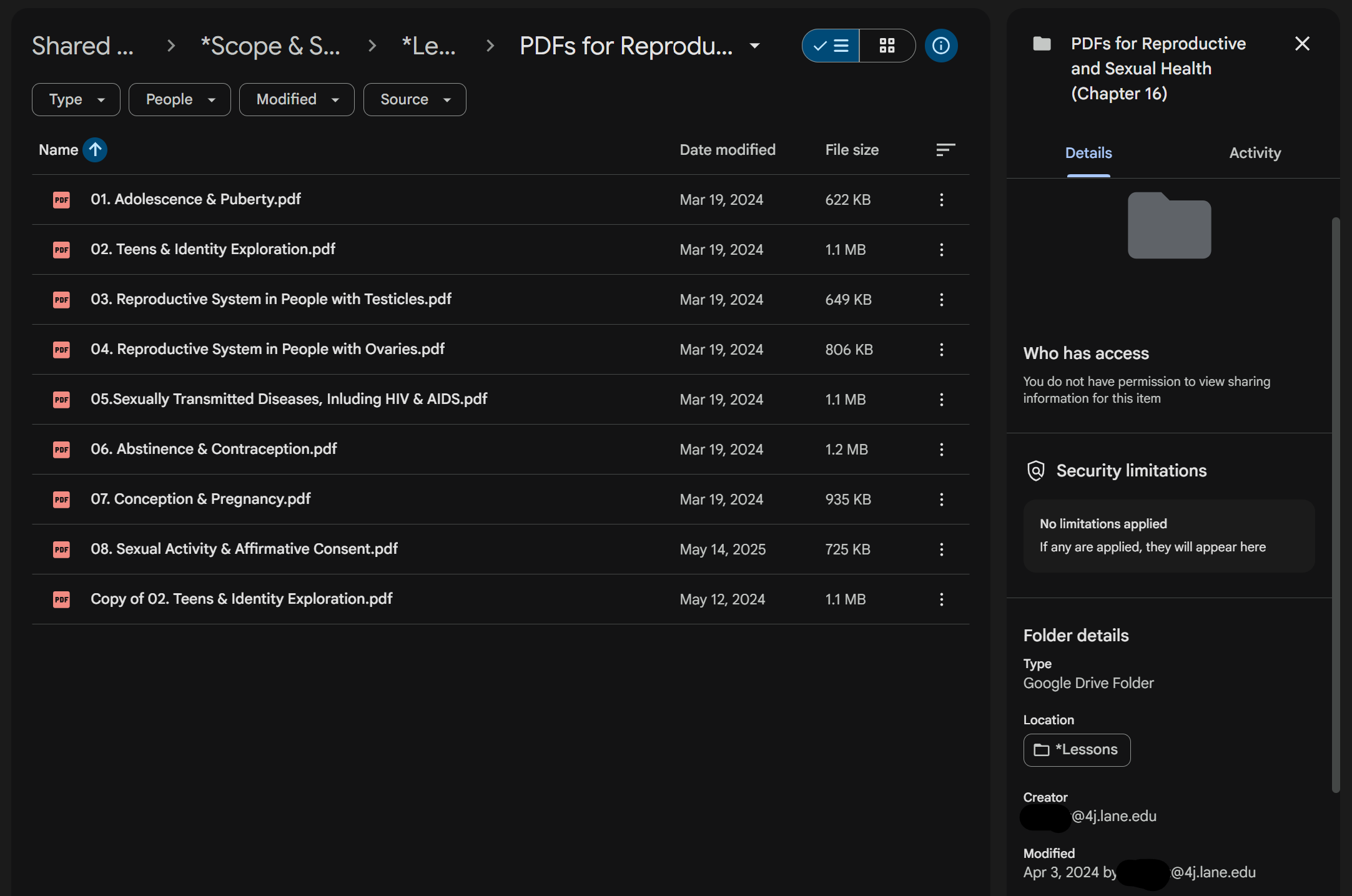
However, if you want to see it for free, 4J published a compliance report that includes a link to a public Google Drive folder containing a review copy of Live Well: Reproductive and Sexual Health. I assume this was not intentional.
[T]he district has reconsidered the limitation that prohibited you from taking any notes, and will lift that restriction. However, the district will continue to insist that you not make a reproduction of the materials. If the supervisor overseeing the inspection develops an objective reason to believe that you are reproducing the protected materials, as opposed to mere note-taking that appears consistent with the Fair Use doctrine, it will suspend the session and may notify the impacted publisher.
[…]
Due to the district’s concerns about its contributory liability, if you wish to take notes during a future viewing session, you will be expected to sign a statement holding the district harmless from and against claims by impacted copyright holders arising from your copying and use of copyrighted materials.
Finally, 4J lays out the cost of providing records and letting me read the curriculum.
District-created scope and sequence documents related to district adopted health curricula
$163.42
(Those are on Google Drive, too: K-5, Middle School, High School.)
Opt out notices, parent preview information
$163.42
Here’s the opt-out notice from their website. It doesn’t mention gender identity, but maybe the parent preview does. I am not curious enough to pay $163 to find out.
Preparation and review of nonexempt district-adopted health curriculum, including removal of exempt test questions and scoring keys.
$217.90 for materials preparation, and $108.95/hour for review
These conditions mean that I would have had to pay thousands of dollars to do my research and analysis in their office, or simply abandon the project, since the Great Body Shop teacher’s guides are not available to the public.
However, I was able to complete my research via other means. Here are the analysis videos I made:
In May, I’d filed another request asking 4J for “any District policy, guidance, memo, or internal communication, including emails, relied on to prohibit note-taking.”
On June 18, they denied my request on the basis that it asked 4J to perform “subjective analysis” of its own actions, which was “an impermissible use of the public records law.”
I sent two appeals to the Lane County District Attorney.
Petition 1 requested an order:
Requiring 4J to provide reasonable inspection facilities that permit typed memoranda and abstracts under ORS 192.318.
Prohibiting 4J from conditioning note-taking on a hold-harmless agreement, monitoring the substance or quantity of my notes, terminating access based on the perceived content of my notes, or threatening publisher notification as a condition of inspection.
Requiring 4J to permit inspection of all nonexempt physical and electronic health-curriculum materials.
Disallowing the $108.95 hourly supervision charge.
Granting a waiver or substantial reduction of the fees under ORS 192.324(5), because making the health-curriculum records available primarily benefits the general public; and, independently, under ORS 192.407, because 4J responded with undue delay.
Requiring 4J to disclose or permit inspection of every reasonably segregable nonexempt portion.
Requiring 4J to pay me the $200 penalty authorized by ORS 192.407.
Petition 2 asked the DA to order 4J to produce any records relied on for their initial full note-taking ban.
The DA’s office denied both petitions.
For each of my requests, I’m going to show you how Deputy District Attorney David Mintz responded, his citations, and why he is wrong.
The custodian of any public records, including public records maintained in machine readable or electronic form, unless otherwise expressly provided by statute, shall furnish proper and reasonable opportunities for inspection and examination of the records in the office of the custodian and reasonable facilities for making memoranda or abstracts therefrom […].
Records-requesters have a statutory right to take notes.
Mintz’s response:
A public body is entitled to require that an inspection of records be supervised. See Attorney General Public Records and Meetings Manual, p 16 (2024) (“[A] public body may adopt administrative measures to supervise original document review.”).
[…]
Here, the District has provided Mr. Karson a reasonable opportunity to inspect the nonexempt public records and to take notes on the records. Given the federal copyright and licensing restrictions discussed below, the District’s requirement that the inspection sessions be supervised is reasonable.
Let’s look at the context around the quote from the Attorney General’s Public Records and Meetings Manual that Mintz claims gives 4J the right to supervise my review sessions.
The section is called “Protective Rules”:
A public body is authorized to “adopt reasonable rules necessary for the protection of [its] records and to prevent interference with the regular discharge of [its] duties.”
When public bodies establish such rules, they should provide notice and opportunity for public comment so as to avoid the appearance of arbitrary action.
This did not happen. Instead, 4J has implemented a clearly improvised, sloppy, changing, post-hoc-rationalized supervision scheme, which Mintz now defends by pointing to a manual that instructs public bodies to avoid impeding public access.
A rule designed solely to make public access to records more difficult is not valid, while a rule carefully designed to prevent destruction of public records or to expedite staff identification of requested records is lawful.
I can’t prove that 4J is trying to make my access to the health curriculum more difficult, but neither 4J nor Mintz has cited concern about destruction.
The statutory right to inspect public records encompasses a right to examine original records, and inspection of originals ordinarily should be allowed if requested. But the right to inspect does not include a right to browse through file cabinets, file folders, or electronic files, and a public body may adopt administrative measures to supervise original document review.
That’s the full sentence Mintz quoted. It cautiously authorizes restrictions necessary to protect the records, but Mintz makes it sound like an endorsement of all supervision.
The word “original” is there because the sentence is about protecting original records, as opposed to copies, from destruction.
None of these actions are authorized by statute.
Mintz’s response regarding the hold-harmless agreement:
The more difficult question is whether it is reasonable for the District to require that Mr. Karson sign a ‘hold-harmless’ agreement prior to inspection sessions. It should be noted that the District Attorney does not have information before it regarding the specific language of any required agreement. However, it does not appear that the ‘hold-harmless’ agreement would require Mr. Karson to do anything other than agree to reasonable terms of inspection that are otherwise allowed under Oregon public records law, and that adhere to federal copyright law.
This is bewildering. Mintz first blesses the general idea of a hold-harmless agreement, and then he speculates, based on nothing, that its terms would be reasonable and lawful.
4J wrote to me:
[I]f you wish to take notes during a future viewing session, you will be expected to sign a statement holding the district harmless from and against claims by impacted copyright holders arising from your copying and use of copyrighted materials.
This means that if a publisher sues 4J, I pay for their losses.
That can’t be construed as “reasonable terms … otherwise allowed under Oregon public records law.” The law provides no mechanism for bodies to make requesters assume their liability.
Mintz’s response regarding 4J monitoring the substance or quantity of my notes, terminating access based on the perceived content of my notes, or threatening publisher notification as a condition of inspection:
Accordingly, under ORS 192.318, the District has provided a reasonable opportunity, subject to reasonable rules, to allow Mr. Karson to inspect the public records.
That’s it. He doesn’t explain where 4J derives the authority to enforce these restrictions. Instead, he simply points to ORS 192.318, which allows for “reasonable rules necessary for the protection of the records and to prevent interference with the regular discharge of duties of the custodian.”
This does not reach copyright concerns, and “reasonable rules” provides no authority for 4J’s supervision scheme.
In their June 18 letter, 4J established that the origin of its “contributory liability” concerns was Courtney Leonard’s attempt to figure out what I was typing:
[T]he curricular administrator developed a concern that you appeared to be essentially transcribing the copyright protected materials, as you were seen to be rapidly typing while looking at a page, flip the page and continue typing in the same fashion.
[…]
If the supervisor overseeing the inspection develops an objective reason to believe that you are reproducing the protected materials, as opposed to mere notetaking that appears consistent with the Fair Use doctrine, it will suspend the session and may notify the impacted publisher. Due to the district’s concerns about its contributory liability, if you wish to take notes during a future viewing session, you will be expected to sign a statement holding the district harmless from and against claims by impacted copyright holders arising from your copying and use of copyrighted materials.
Mintz doesn’t explain how 4J’s anxiety converts into authority to block my inspections based on my typing speed and the supervisor’s belief that my notes violate copyright.
By denying this request, Mintz—without any explanation—authorizes a government employee to stand over a journalist and control his research.
This request primarily concerns 4J’s refusal to let me read the high school sex ed curriculum, Live Well: Reproductive and Sexual Health. (The one they posted on Google Drive.)
Here is what I wrote in my petition to the DA’s office:
4J invokes 17 U.S.C. § 106 and ORS 192.355(8) to deny inspection of the digital Live Well materials and the Second Step curriculum.
The Oregon Department of Justice’s Public Records and Meetings Manual states that the Public Records Law does not authorize public bodies to violate federal copyright law, but that “a public body must permit a requester to inspect copyrighted materials,” and should only decline to make or allow copies without the owner’s consent. Copyright thus limits copying, not inspection.
Mintz’s response:
A public body is not required to provide copies of records for which another entity owns the copyright and when doing so would violate federal copyright law.
I don’t know why he is talking about copying. My request was to inspect the curriculum.
See Attorney General Public Records and Meetings Manual, Appendix A, p A-1 (2024); 17 U.S.C. § 106. A public body must allow such records to be inspected, but not copied, to comply with Oregon public records law and federal copyright law. Id.; ORS 192.355(8).
Okay, we’re heading in the right direction: copyright can’t block inspection. And then he writes:
A public body may exempt entirely from disclosure records that are copyright protected under federal law and for which the copyright holder has not, under terms of a contract, granted the public body permission to disclose.
This directly contradicts his previous sentence, which says that public bodies must allow inspection of copyrighted materials.
We are officially in la-la land here, where Mintz thinks (or is pretending to think) that book publishers need to give the purchaser permission to show the book to anyone in a contract.
Further, Mintz implies that 4J could withhold all of its curriculum materials from inspection, since they are all copyrighted. His use of the phrase “may exempt” seems to place disclosure entirely at 4J’s discretion.
Let’s look at his citations.
ORS 192.355(8) lists records exempt from disclosure:
Any public records or information the disclosure of which is prohibited by federal law or regulations.
This means public bodies can’t disclose public records when it would break the law. It doesn’t create any exemption on its own, since it requires some other law or regulation to block disclosure.
It is not a reference to copyright law. We know this because copyright law can’t block inspection.
He also cites a public records order:
Attorney General Public Records Order, July 23, 2025, Jamison (Oregon State Police not required to produce copyrighted records without permission from third party entity, Gallup Inc, when doing so was prohibited by federal copyright law).
What does Mintz mean by “produce” here? To disclose, or to copy?
Let’s take a look at Jamison.
The requester asked Oregon State Police to send him a copy of a Gallup survey. OSP denied his request. He appealed, and Deputy AG Lisa M. Udland ordered OSP to reproduce the survey with the copyrighted parts redacted.
Let’s follow Udland’s logic:
[T]he contract states that OSP and other purchasers may not “reproduce” or “distribute externally” to any third parties copies of contractor intellectual property without the permission of Gallup.
OSP’s contract with Gallup forbids copying.
Based on our review of the contract and the surveys at issue, we find that the Q12 questions on the surveys are copyrighted. Therefore, OSP may not reproduce them without permission from Gallup. 17 USC § 106(1); Attorney General’s Public Records & Meetings Manual A-1 (2024).1
Correct: you can’t freely reproduce copyrighted materials.
Udland’s citations:
17 USC § 106(1): “the owner of copyright under this title has the exclusive rights […] to reproduce the copyrighted work.”
Attorney General’s Public Records & Meetings Manual (A-1):
A public body must permit a requester to inspect copyrighted materials, but should not make copies or allow someone else to make copies of such materials without the copyright owner’s consent or on advice of legal counsel.
The law couldn’t be clearer. And yet, Udland writes:
Because disclosure of the survey questions is prohibited by federal law, they are exempt from public records disclosure.
No. Copyright law does not prohibit disclosure.
This single flawed sentence is the exact thing Mintz wants for his own order.
Jamison ends with:
For the foregoing reasons, we respectfully deny your petition in part and decline to order OSP to reproduce copyrighted material.
This is technically the correct conclusion, but had Jamison requested to inspect the records rather than asking for a copy, OSP would have had no basis for a denial.
Mintz continues:
Here, the District has made available for inspection all nonexempt, copyright protected responsive records.
[…]
The District has reached out to the relevant third-party publishers seeking permission to allow inspection of some of the protected materials, even when their contractual licensing agreements would otherwise prohibit it.
This implies that school curriculum publishers can simply shield their materials from inspection by public records requesters. That is incorrect.
The District has agreed to separate nonexempt materials from exempt materials to allow Mr. Karson to inspect all allowable responsive records.
This is circular. The question is whether Live Well: Reproductive and Sexual Health is exempt. Mintz settles the matter by declaring that whatever materials 4J refuses to show me are exempt.
In sum, the District has made available all nonexempt copyrighted materials for reasonable inspection, and the District is not required to disclose responsive records that are exempt due to federal copyright law and contractual licensing agreements.1 See ORS 192.355(8).
This is wrong. ORS 192.355(8) exempts “public records or information the disclosure of which is prohibited by federal law or regulations.” Not “contractual licensing agreements.” A licensing agreement can’t block disclosure of a public record.
Because the District has made available for inspection all nonexempt responsive records, the petition is denied with respect to the copyrighted materials.
4J itself has distinguished between inspection and copying. From its May 10 letter:
While the District may permit inspection of copyrighted materials, as you know, it may not permit copying or reproduction of those materials.
In my petition, I wrote:
4J has not shown that dedicated supervision is necessary or that $108.95 per hour reflects an actual cost reasonably incurred to make the records available.
Mintz’s response:
A public body is authorized to establish fees “reasonably calculated to reimburse the public body for the public body’s actual cost of making public records available.” ORS 192.324(4)(a). This includes actual costs for time spent supervising a person’s inspection of records. See Attorney General Public Records and Meetings Manual, p 17 (2024).
From the manual:
“Actual cost” may include a charge for the time spent by the public body’s staff in […] supervising a person’s inspection of original documents in order to protect the records.
So, yes, supervision is an actual cost when it’s necessary to protect the records.
Based on our earlier analysis of the protection section, we’ve established that monitoring my typing is not record protection.
In this instance, the District has established a reasonable fee for fulfilling Mr. Karson’s records requests. The District has shown the actual cost of making the public records available to Mr. Karson, which includes administrator supervision for inspection of nonexempt copyright-protected materials and the fees for compiling and redacting records.
Mintz does not explain why my supervisor must be an administrator-level staff member.
While Mintz does acknowledge that my petition “requests a waiver or reduction in fees under ORS 192.324(5),” he does not answer that request beyond the blanket denial.
4J wrote in their June 18 letter:
The district is prohibited from sharing all digital material components of Live Well, based on the terms of the HK Propel licensing agreement, a copy of which is enclosed.
Here’s the PDF that 4J says contains the licensing agreement (after the letter).
The PDF includes Live Well’s copyright page and the terms and conditions of its digital platform, HKPropel, which do reference a licensing agreement—but I don’t see any specific agreement with 4J.
From the terms and conditions:
[R]eproduction or distribution of the instructor ancillaries is not allowed
Reproduction or distribution of any student-facing components […] is not allowed
Thank you for buying an authorized edition of this work and for complying with copyright laws by not reproducing, scanning, or distributing any part of it in any form without written permission from the publisher.
These are restrictions on copying, not disclosure.
From 4J’s letter:
[…] Additionally, these materials are proprietary and have been submitted in confidence to the district, with the expectation – and agreement by the district – that the district will agree to the publisher’s terms. Based on ORS 192.355(4); 192.345(2); ORS 192.355(8)(records prohibited by federal law or regulations from being disclosed); and 17 USC 106, the district respectfully declines to share these materials.
That’s a lot of statutes. Surely one of them will explain why I can’t read the sex ed curriculum. Let’s check.
192.355(4) defines exempt confidential records:
Information submitted to a public body in confidence and not otherwise required by law to be submitted, where such information should reasonably be considered confidential, the public body has obliged itself in good faith not to disclose the information, and when the public interest would suffer by the disclosure.
From the Attorney General’s Public Records and Meetings Manual (p. 87):
There are no less than five conditions that must be met for the [confidential-submission] exemption to apply:
The informant must have submitted the information on the condition that it would be kept confidential.
The informant must not have been required by law to provide the information.
The information itself must be of a nature that reasonably should be kept confidential.
The public body must show that it has obliged itself in good faith not to disclose the information.
Disclosure of the information must cause harm to the public interest.
Does 4J think a digital textbook meets these conditions?
The manual’s examples (p. 89) of exempt confidential records include bank account numbers, tax returns, and employment references.
4J also invokes 192.345(2), which concerns trade secrets. That means information “which is known only to certain individuals within an organization […] and which gives its user an opportunity to obtain a business advantage over competitors who do not know or use it.”
The sex ed curriculum isn’t a trade secret.
And we have discussed ORS 192.355(8) already—it says records are exempt from disclosure if that disclosure would break federal law.
Presumably 4J thinks this connects to copyright law, because they then cite the entirety of 17 USC § 106. But, as you well know by now, copyright law can’t make public records exempt from disclosure.
In my petition to the DA, I wrote:
4J identifies test questions, scoring keys, proprietary content, and licensing restrictions, then withholds entire categories of records. Segregable portions must be disclosed or made available for inspection.
Mintz’s response:
In sum, the District has made available all nonexempt copyrighted materials for reasonable inspection, and the District is not required to disclose responsive records that are exempt due to federal copyright law and contractual licensing agreements.1
The footnote is where Mintz considers 4J’s additional exemption theories:
Alternatively, any remaining exempt records, which nonetheless are not directly at issue in Mr. Karson’s petition, could be deemed exempt from disclosure and inspection under ORS 192.355(4) (confidential submissions) or ORS 192.345(2) (trade secrets).
This is confusingly worded, but I’m taking the footnote to mean: in addition to the copyright and licensing-agreement justifications, 4J can invoke the confidential-submission and trade-secret exemptions to block my inspections.
I emailed Live Well’s publisher, Human Kinetics, and asked for a comment on 4J’s claim that the licensing agreement prohibits records requesters from inspecting the digital sex ed curriculum.
Across two emails, they wrote:
Any dissemination of these resources outside the school district must go through the Human Kinetics Permissions Department for approval.
[…]
When school districts ask us for a “community review” portal, we provide access to all the student-faced resources for their “community review” period.
Anyone, including the Public Records Requester, can go to the Human Kinetics website Human Kinetics and purchase our student textbooks.
[…]
We have no comment on the district’s interpretation of the licensing agreement.
I wrote: “4J’s delay warrants a $200 penalty under ORS 192.407.”
Mintz’s response:
The District responded to Mr. Karson’s request thoroughly, and given the nature of the request, any delay was reasonable.
It wasn’t reasonable, but I assume you are not as invested in my $200 prize as I am, so I’ll spare you the play-by-play.
In April, Courtney Leonard wrote in an email that I could not record a voice memo while inspecting the health curriculum:
Due to copyright laws and our contracted agreements with vendors, we can’t have any recordings. You are welcome to take written notes, yes.
Then, in their May 10 letter, 4J prohibited written notes:
Please also note that the curriculum materials you are requesting to inspect are protected by federal copyright law. While the District may permit inspection of copyrighted materials, as you know, it may not permit copying or reproduction of those materials. Accordingly, during any future inspection sessions, the District will not permit copying, photographing, scanning, recording, transcription, or note-taking of the materials. No recording devices, including phones, cameras, laptops, or written materials for note-taking, will be permitted during the inspection.
That day, I sent 4J a request for:
any District policy, guidance, memo, or internal communication, including emails, relied on to prohibit note-taking, transcription, or written materials during public inspection of these curricula, including any internal communications discussing, drafting, or approving the restrictions described in the District’s May 10, 2026 letter to Max Karson.
4J responded:
The public records law does not require agencies to answer questions or engage in subjective analysis. Your request number 2 is therefore an impermissible use of the public records law. The district is not willing to respond to questions about materials relied upon in making decisions or otherwise engage in a subjective analysis of searching for and making opinions about such documents.
In my appeal to the DA, I wrote:
The request seeks existing records, not an explanation. I ask the District Attorney to order 4J to conduct a reasonable search and produce any responsive nonexempt records, or state that the search located none.
Mintz’s Response:
The District is correct that a public body is not required to create new public records, disclose reasoning behind their actions, answer questions about records, or analyze their records. See Attorney General Public Records and Meetings Manual, p 6 (2024); Attorney General Public Records Order, May 26, 2005, Andrade. Because Mr. Karson’s request sought records the District “relied on” when responding to his initial public records request, the District is not obligated to fulfill this request. For this reason, the second petition is denied. 2
Mintz doesn’t explain how producing records the district “relied on” to ban note-taking involves any of those actions.
(He also mistakenly says I sought records pertaining to my earlier request and not the note-taking ban, but he did get it right in his background summary.)
The footnote:
Should Mr. Karson choose to reframe his request in a manner that seeks existing records, he may do so.
“Relied on” already seeks existing records, as shown by the examples I gave: “including any internal communications discussing, drafting, or approving the restrictions described in the District’s May 10, 2026 letter to Max Karson.”
Let’s check out Mintz’s citations.
From the Attorney General Public Records and Meetings Manual:
The Public Records Law does not require public bodies to create new public records.35 Nor does it require public bodies to disclose the reasoning behind their actions; answer questions about their records; analyze their records;36 or perform legal research in order to identify records that are responsive to a request.37
However, a public body is required to retrieve pre-existing information, which includes electronic data stored in databases.
4J said my request asked them to do “subjective analysis,” and Mintz cites the manual here to show that requests for analysis and research can be denied.
From footnotes 35 and 36:
E.g., Public Records Order, May 12, 2021, Fery (public body not required to create an investigatory report in response to a records request)
[…]
Letter of Advice to Jim Kenney, at 4–5, 1987 WL 278343 (OP-6126) (June 1, 1987) (public body was not required to use its computer program to analyze data).
There is quite a bit of daylight between records “relied on” and an investigatory report or data analysis.
Footnote 37 cites the same 2005 records order that Mintz did, Andrade, which was denied for requesting legal research.
Andrade asked the DMV to produce “the Oregon Law referenced on page 1, line 1 of a four page document * * * which requires all vehicles operated on the highways of Oregon, including ‘personal use’ vehicles, to be titled and registered.”
The order says:
The record then reprints relevant Oregon statutes […] . Your request to DMV was for disclosure of the “Oregon Law” referred to in the quoted sentence.
[…]
[T]he “Optional Titling Laws” record reprints relevant statutes and […] responding to your request would require DMV to interpret those statutes.
[…]
Because responding to your request would require DMV to answer questions about its record captioned “Optional Titling Laws” by engaging in legal research, something not required by the Public Records Law, we deny your petition.
I don’t get why this is an illustrative example of a request for legal research in the manual.
The problem is that the request can be framed in two ways: he’s asking about the law, yes, but he’s also asking how the “Optional Titling Laws” document was written. What statutes were used in drafting the text?
Perhaps if he’d specifically requested records used in drafting the document instead of asking for “the Oregon law referenced” in the first sentence, his petition would have been granted, but that seems nitpicky.
But Andrade isn’t the manual’s first example of an AG denial for legal research—Kane (2006) is. His request sought:
1. All documents in the possession of ODOT that support the claim of Metro Attorney Daniel B. Cooper […] to the Metro Council that someone at ODOT had told him (Cooper) that the Attorney General had approved use of Oregon [motor] vehicle and fuel taxes to help pay for the proposed two toll lanes on the Highway 217 freeway in Washington County.
This is very similar to my “relied-on” scope.
2. All documents, including Attorney General Opinions and Letters of Advice, correspondence and memoranda, pertaining to whether Oregon Constitution, Article IX, section 3a, fuel and vehicle taxes can or cannot be used for purposes not listed in said Article IX. section 3a.
And this is plainly legal research.
ODOT denied request 1 because it initially believed it had no responsive records, not because of the scope. The AG’s office spoke to ODOT and was told that responsive records had been found and would be provided to the requester, so the AG denied the request as moot. The scope was never contested by either ODOT or the AG.
Request 2 was denied for seeking legal research.
Kane doesn’t have the category blurriness of Andrade, and the split treatment of the requests draws a clear distinction between a request scoped to a documentary history and a request for an answer to a legal question.
In Kane, the author writes:
The determination that your request invites requires the exercise of legal judgment and thus would require us to engage in legal analysis not required by the Public Records Law.
My request for records 4J relied on for its note-taking ban does not require legal judgment—it’s a factual request concerning whatever documentary basis already exists.
“Used” is a defined category of public record in Oregon. ORS 192.311(5)(a) (emphasis mine):
“Public record” includes any writing that contains information relating to the conduct of the public’s business, including but not limited to court records, mortgages, and deed records, prepared, owned, used or retained by a public body regardless of physical form or characteristics.
This strongly implies that identification by use should be acceptable—and there is precedent for it.
Below are three examples of AG orders concerning requests scoped similarly to mine. The wording was accepted by both the public bodies and the AG except where noted:
Oregon AG Public Records Order, Ward (2019):
[…] the reason and supporting documentation for background check failure of Casey Ward in December 2018.
Oregon AG Public Records Order, Wilker (2023):
[…] all documents evidencing the grant process (or whatever process was used to make the award to Rose Community Development).
(Note: the AG denied the part of Wilker’s petition that asked for “OHCS to explain the basis for each record it withheld or redacted,” because this requested new documentation rather than existing records.)
Oregon AG Public Records Order, Kubat (2003):
all records considered by Bill Hennings PhD, pertinent [to] each of 2 assessments he made on Form SSA-2506-BK (9-2000).
And one Oregon Supreme Court case, American Civil Liberties Union v. City of Eugene, 360 Or 269 (2016):
‘all documents used by the Civilian Review Board in reviewing and deciding the May 30, 2008, [] Van Ornum Community Impact Case.[‘]
These examples show that use- and reasoning-based requests are permissible if the request seeks existing records.
However, if 4J believed “relied on” was poorly worded, the manual advises public bodies to work with the requester if the request is “misdirected” (B-10):
Upon receiving a records request, review the request to see if it is ambiguous, overly broad, or misdirected. If so, contact the requester for clarification.
4J did not contact me. In fact, they ignored this request (and a follow-up email) for five weeks, and didn’t respond until I threatened to sue them.
My request is plainly understandable, seeks existing records, and requires no legal research or analysis.
Mintz’s denial of my petition allows 4J to shield their documentary basis for a total note-taking ban from public view.
From the manual:
Oregon’s public records and meetings laws establish a simple expectation: that its government will be transparent to her people.
No posts
Comments
Nothing yet. Say the first thing.
Sign in to join the conversation.