
The pattern I see more than almost anything else:
Client runs a GI-MAP. Clears H. pylori, Candida, whatever was growing. Runs a mycotoxin profile, comes back positive. Does the mold protocol. Runs binders. Gets out of the moldy building or remediates. Cleans up the diet. Does the work.
Six months later they’re at 60-70%. Sleep is still off. Histamine reactions are still happening to beef, corn, spices, fragrances, wine, leftovers, fermented anything. Brain fog hasn’t fully cleared. Energy is better but not there.
This is not a protocol failure. The protocol worked. Something else is keeping them reactive.
I’ve seen this in 8,000+ cases in the last 15 years, and the pattern became impossible to ignore… mainly because I suffered like hell and no one could help me. I had to get super into this stuff to fix myself and get back to life.
A subset of these clients had already done everything right and a I found a common thread kept showing up in the ones who finally broke through. The bedroom environment was still active.
Before we get to the bedroom, we have to understand what mold does to the mast cells.
Mast cells are the immune system’s first responders. They sit at the interface of the body and the external environment - in skin, gut lining, airways, and the blood-brain barrier. When they detect a threat, they degranulate: releasing histamine, tryptase, prostaglandins, and a cascade of inflammatory mediators. This is adaptive in the short term. It’s the body doing exactly what it’s supposed to do.
The problem with chronic mold exposure is that it doesn’t just cause an acute reaction, it shifts the mast cells into a different baseline state.
Research from the Tufts team led by Dr. Theoharides showed that mycotoxins directly activate mast cells and drive neuroinflammation (PMID 29880330). Separately, studies on indoor microfungi showed that mold metabolites and volatile organic compounds can potentiate histamine release from human bronchoalveolar cells - in a lab setting, using actual human immune cells (PMID 8972692, PMID 9561390).
What this means clinically: the mold doesn’t just cause symptoms during exposure. It can prime the mast cells toward a lower activation threshold. Less stimulation needed to fire. Faster degranulation. More histamine released per trigger.
That primed mast cell doesn’t automatically reset when the mold is addressed. I wish it were that easy to just get away from it and get better, but I didn’t.
This is the part most practitioners miss.
Mast-cell activation isn’t just an IgE/allergen story. Research has shown that mast cells can be triggered by non-IgE physical stimuli (including pressure, temperature, vibration, light, and electromagnetic signals) through mechanisms independent of the classic allergen-IgE-FcεRI pathway.
Feel super weird, dizzy, itchy, spacey, brain fog after a roller coaster, vibration plate, sauna? Those all can trigger mast cell activation…
A 2012 study showed that physical stimuli (including mechanical stress and light exposure) activate mast-cell degranulation through TRPV2 channels, not IgE crosslinking (PMID 21574765). Clinical models of physical urticaria have confirmed for decades that mast cells in humans respond to cold, heat, pressure, and vibration with measurable mediator release - without any classic allergen involvement (PMID 7002977).
This opens a different question: if a client’s mast cells are already primed from mold exposure, what additional physical signals might be pulling the trigger nightly?
I want to be precise about the evidence here, because this is where I see a lot of over-claiming to get people freaked out online.
There are animal studies showing that exposure to power-frequency electromagnetic fields can alter mast-cell populations in skin and thyroid tissue. A study by Rajkovic et al. (2005) found altered mast-cell characteristics (including significantly higher mast-cell density in thyroid tissue) in male rats exposed to 50 Hz EMF (PMID 16263652). A follow-up study found that combined exposure to a common agricultural chemical and power-frequency EMF caused cutaneous mast-cell degranulation in peripubertal rats (PMID 20148244).
These are animal studies. I’m not going to tell you this is proven in humans, because it isn’t, but EMF was certainly a piece of my puzzle. An in vitro study using purified rat mast cells and ELF magnetic field exposure found no significant histamine release (PMID 9554697). The human evidence that EMF directly causes mast-cell histamine or tryptase release is not established. Not much money in doing that study.
In a client population whose mast cells are already primed from mycotoxin exposure, whose immune system is already running on a lower threshold - the animal evidence that EMF can interact with mast-cell biology is not nothing. And the clinical pattern I keep seeing when these clients finally address the bedroom environment is consistent enough that I can’t dismiss it.
I remember this client in Greece who literally couldn’t even use a computer because if she touched the keyboard her hands would “light on fire” with nerve pain. She eventually became less sensitive but that was a new one for me.
Here’s what makes this so difficult to break without addressing the bedroom.
Mast-cell tryptase (released with every degranulation event) can disrupt intestinal tight junctions. Research shows tryptase activates PAR2 receptors on colonocytes, reducing ZO-1 and occludin expression and increasing paracellular permeability (PMID 16027150). A separate study found that tryptase reduces junctional adhesion molecule-A (JAM-A) expression in intestinal epithelial cells directly linking mast-cell mediator release to the kind of barrier dysfunction seen in IBS and post-infectious gut conditions (PMID 23588236).
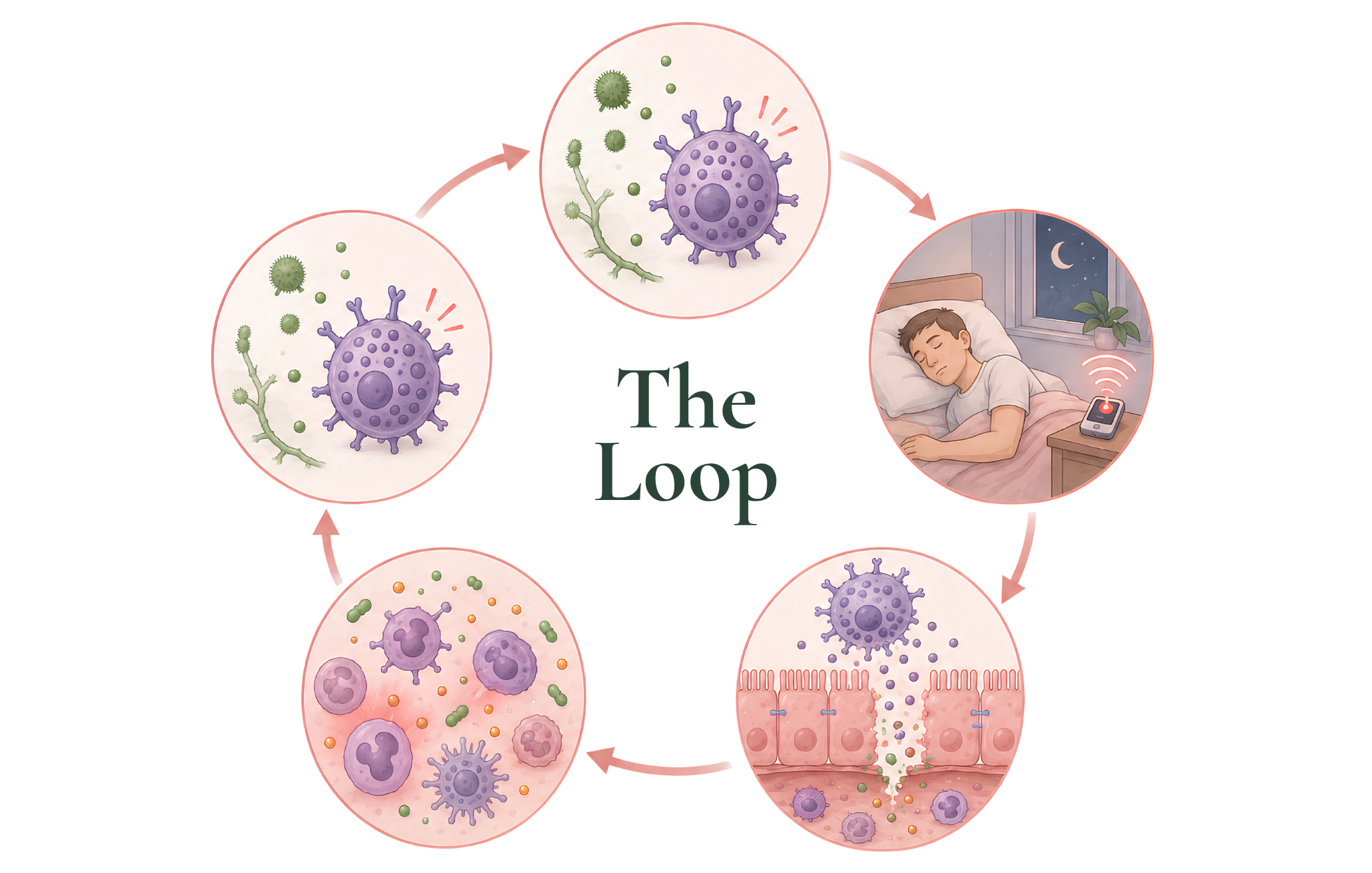
What this means for the stalled client:
Mast cells are primed from mold exposure - lower activation threshold
Something in the bedroom keeps pulling the trigger - 8 hours a night, at head level
Each firing event releases tryptase → gut tight junctions get disrupted → increased permeability → continued immune activation
The immune system stays in reactive mode → mycotoxin burden doesn’t fully clear
Mast cells stay primed → back to step one
Running more binders into this situation might help if mold is in the environment too and is acting like a MCAS trigger, but ultimately we gotta get the EMF down.
The mast-cell calcium biology connects here as well. Mast-cell exocytosis is calcium-dependent - accelerated calcium influx is necessary for the degranulation event (PMID 1869551). The canonical pathway for this is store-operated calcium entry via STIM1 and Orai1/CRAC channels. Any upstream signal that disrupts cellular calcium regulation can factor into this. How EMF specifically interacts with this pathway in mast cells is still an open research question.
Before I run another lab and add another supplement, I start asking the bedroom questions:
What’s on the other side of the wall behind your headboard?
Is there a smart meter on the exterior wall of your bedroom?
What does your sleep feel like when you travel - do you sleep better in a hotel or different city?
Do you feel worse in the bedroom than in other rooms?
When did the stall start - was there a major environmental change, move to a new house, sickness, or injection around that time?
The “better sleep when traveling” is helpful info. If someone consistently reports sleeping deeper in a hotel or at a family member’s house, that’s a clue worth investigating. The food is different, the stress is sometimes different but so is the electromagnetic and mold environment.
In my 1-on-1 and group functional medicine program, the bedroom environment is one of the things we assess when someone has cleared the primary layers and is still not fully there.
For paid subscribers: What I actually do in clinic - the testing sequence, what the bedroom sweep reveals most often in this population, which clients are most vulnerable, and the specific protocol I layer in when someone fits this pattern. Including the products I use personally in this exact scenario.
Comments
Nothing yet. Say the first thing.
Sign in to join the conversation.