
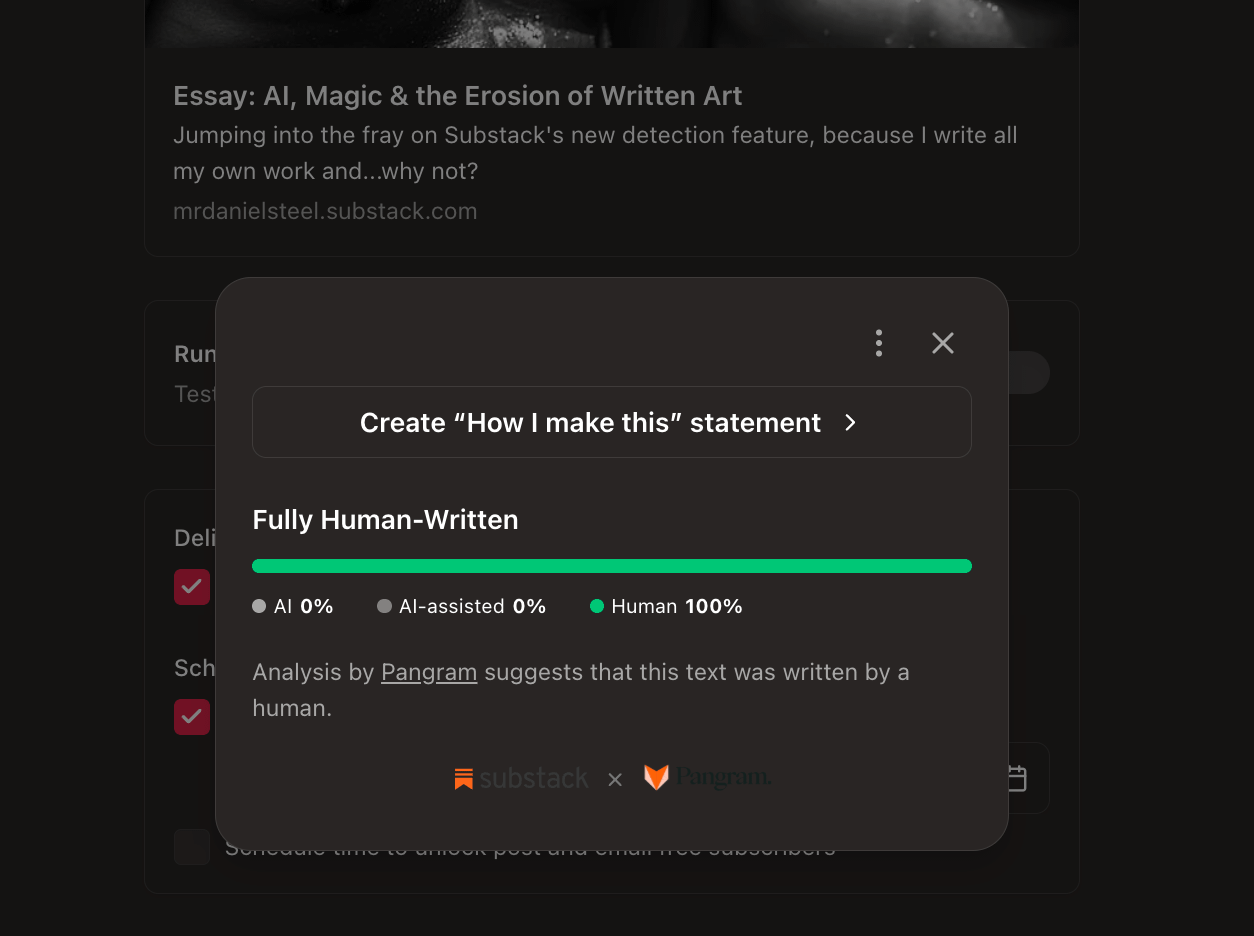
There has been a lot of chatter around these parts about AI after the debut of Substack’s new feature. As of July 21st, you can ask Substack to detect whether the content you’re reading was AI-generated or not.
This may be a new feature, but it is not a new discussion. In fact, it’s been going on for as long as I’ve been on Substack, and probably long before.
I’ve remained agnostic in the past, largely because there were no guardrails and no accountability. If Substack was the Wild West, why even bother?
Now, with an effort towards transparency (and almost a year of publishing), I’m inclined to engage.
I’ll start here.
I write all my own fiction.
I say this less to prove anything, but as a statement of principle.
As for this new feature, I welcome you to use it. I welcome you to check my work.
It’s been a long road. It took me 35 years to have the courage to write anything, and another 5 to stop hating my work long enough to release it into the world. I am proud of the years of effort, proud that I overcame all these obstacles.
And now, here I am.
After many fits and starts, I write without internal blocks. Sure, there are down periods, frustrating stretches, but finally I write without hating my words the moment they hit the page, without ripping it all to shreds before it can even take form.
Such was the state of affairs for a very long time.
Since then, some of what I have written has been…bad. Some of it has been great. There have been iterations of everything in between. There have been typos, grammatical errors, missed words. There has been poor punctuation, a sharp learning curve on the proper use of commas, em dashes, and semicolons, and, worst of all, weak prose.
But the work has gotten better because I worked at it.
And because you have all encouraged me from day one.
I was in Austin, TX, walking along the riverfront one morning last November when I got my first annual paid subscriber. It was a mere month or two in. I barely had any stories up on my page, maybe three or four. I had little faith this work would land. I was as green as could be. But when I got the notification that someone, somewhere wanted to read more, I cried.
I started this Substack to gain the confidence that maybe, just maybe, my work had actual value.
And someone, somewhere believed it did.
Since then, my audience has grown, and you have affirmed this belief generously with your comments, your likes, and your emails, time and time and time again.
When I am complimented on my work, it touches something very deep inside me because I know I made it, and it was a fight to get here.
I lived through the self-doubt and the agonizing and the negative voices, and I released it anyway. And some way, somehow, the concept and the sentiment in my head—in my heart—landed with you, too.
You felt the thing I felt, or some close amalgam.
We shared something.
That exchange—the very feeling that existed within me being conjured in you, the reader—is not only a creative exercise, but a spiritual one.
It is us making meaning together.
The prevailing notion among some is this: the tides are turning. AI is the future. Accept it. Get over it. Move on.
The first part is undeniably true. AI is where we are headed. You can see the very ways in which it has already taken hold. AI will be an unstoppable force that will unalterably change our lives.
But should we accept it? And if so, how?
At the fore of that question is honesty, which is arguably what is behind this feature.
There is something inherently dishonest about putting forth work you did not actually make as your own.
To me, that lie is worse than any of the AI slop that is generated and passed off as palatable garbage. And not all of it is bad. Some of it is actually quite good.
But how? How is it so good?
If you are going to make AI-generated work, acknowledge it. Own it. Say exactly what it is you are doing. Because, at the extreme, you are not a writer, exactly. You are…something else.
Those who are okay with AI wholeheartedly, without reservation, as it pertains to writing, have clearly never put in the time of making art, or they have given up.
It’s hard. It’s meant to be.
It’s laborious. It’s emotionally taxing. It requires summoning both the self-belief that your stories are worth telling, and the wherewithal to see those stories to fruition. It’s self-doubt, it’s neuroses, it’s questioning.
Making art changes your perspective.
It fosters in you the respect for anyone who makes things with their own hands or minds, good or bad. You are far less likely to ridicule the person who flails and falls on their face, because you, too, have flailed and fallen.
Making art takes guts.
Relying on AI significantly lowers the stakes. Suddenly, you have much less skin in the game. You’re not really being vulnerable or brave enough to put yourself on the line.
But making art isn’t just scary or exhausting.
It’s also magical. At its best, it’s capturing lightning in a bottle. It’s feeling the hit of inspiration. It’s riding that wave to something great that you didn’t even know you had in you. Creating my best work has felt like that.
Where did that come from? I wonder.
It, too, is a spiritual experience. You channel something from the greater universe through you.
That, in the end, is the payoff. It’s why we, as writers, come back to it every day.
What do we risk by AI overtaking our written art?
One need only look at the places where technology has already eroded creativity.
In my other career, I work in design, and I visit a fashion image library here in New York for inspiration. The collection is mostly magazines, but also books, from the last fifty or so years, culling the best of the best.
The founder stopped purchasing newly published printed matter—magazines, specifically—about 13 years ago.
Why?
Because, to her eye, the quality of images got so bad that they weren’t worth collecting. Digital photography, airbrushing, social media—all of it prioritized speed and ease over considered work, and it eroded quality for the entire industry.
I agree.
The best pictures from the past still land. The newest ones do not.
While there is a shift in our perception that comes with distance and time, a nostalgia that renders past work shiny and new again and reinforces its value, it’s not happening with work from the early 2010s.
It falls flat. It did then, and it does now. There has been notable decline.
That’s what we risk with generative AI.
It’s not that work won’t be made. It’s that the quality of what is produced will be so diluted that those who once put in the time to make great work simply won’t anymore.
It won’t be worth the effort, because it won’t be recognized as valuable by greater culture.
The founder said it plainly—we were in a golden age of image-making that lasted for about 80 years and we didn’t even know it.
And then it died.
We are perhaps on the cusp of that very same moment in fiction. The same is at risk with the written word.
How sad.
You can see the beginning of this erosion here, where the barriers to entry are low.
It’s the voice in prose that sounds like it could be anybody’s—vacant, anonymous. It’s the warmed-over analogies that are slick as they are empty.
It’s sameness.
That will change. AI will get better, more unstudied, looser. It will learn to have a personality, too.
How terrifying.
But that thing that makes a work truly great, that intangible, that magic—the how did that happen—will remain elusive.
It’s that sense of there having been a human being on the other side.
Studied readers, those who care, can tell the difference between the two. That I don’t doubt.
But will they keep looking for the gold as it becomes buried under everything else being churned out, all by people who wanted to be writers who haven’t the courage or wherewithal to actually put pen to paper and do it, or live through the vulnerability of putting their real selves and real work on the line?
I’d like to think so, but I’m not so sure.
This feature is an interesting test. It asks:
Do you have the courage to put out your own work?
If you can’t stomach putting out your own work, as flawed as it may be, can you own your choice to cut corners and make that known?
Do you at least have the courage to be honest?
Being subject to this new feature is, despite what people may think, far from obligatory. Creators can opt out. Some have and will.
But when one does, that says something, right?
Sure, Pangam (the software used to determine what is computer-generated and what is not) could interpret incorrectly, calling real work fake, but that seems more the exception than the rule. More often, it calls fake work real. It’s more favorable to those who game the system.
I will leave the detection feature on. I welcome you to check my work every time.
But that’s not where this story ends.
No, as always, the story of my relationship to AI is complex. My hands are not entirely clean.
I use generative AI for imagery, a choice I often question.
First, I worry that because the images look artificially created, readers will assume the prose is also. It’s a reasonable assumption, and I wouldn’t blame people for making it.
Second, I understand that, in some senses, creating an AI-generated image is no different from an AI-generated passage. By using it, am I also undermining creativity as a whole?
It is certainly cutting corners on work that others do professionally.
My justification is this.
I am a writer. Cover imagery is a requirement of the marketplace, an industry standard, not the meat of what I do. As I grow (and as my costs permit), I would far prefer to hire illustrators or creators to make work of a higher caliber. And the moment I can afford to pay others, I most certainly will. My work will be the better for it.
I dream of that kind of collaboration.
But, at present, I am not a customer that professional photographers are losing. I simply don’t have the resources.
And I wouldn’t blame those creators for using AI in the same way.
A professional photographer, an artist, who uses generative AI for his professional biography on his website, or for image captions, is permissible to me because that assistance comes not in making the work itself, but the collateral bringing that work to the market.
Some might argue that is hypocritical, and they may be right. I welcome those who disagree. I’m willing to be wrong.
I also have nothing to hide.
But, in the end, it hardly matters.
You, as the reader, have the choice to read whatever you like. You may not care how the sausage gets made, and that’s okay. I am not here to judge what you enjoy reading or what you connect with.
But when people ask why I paywall my content, or charge for it, it’s because it is the result of real, genuine labor, flaws and all.
It takes time. It’s a process. It’s maddening and beautiful and crazymaking. Sometimes I think I am insane to spend so much time doing it.
But then I stumble back to my computer, and I realize: I fought too hard to get here. I’m loving the ride too much. I’m too inspired. There is too much I want to make—actually make.
I wouldn’t have it any other way.
Comments
Nothing yet. Say the first thing.
Sign in to join the conversation.