
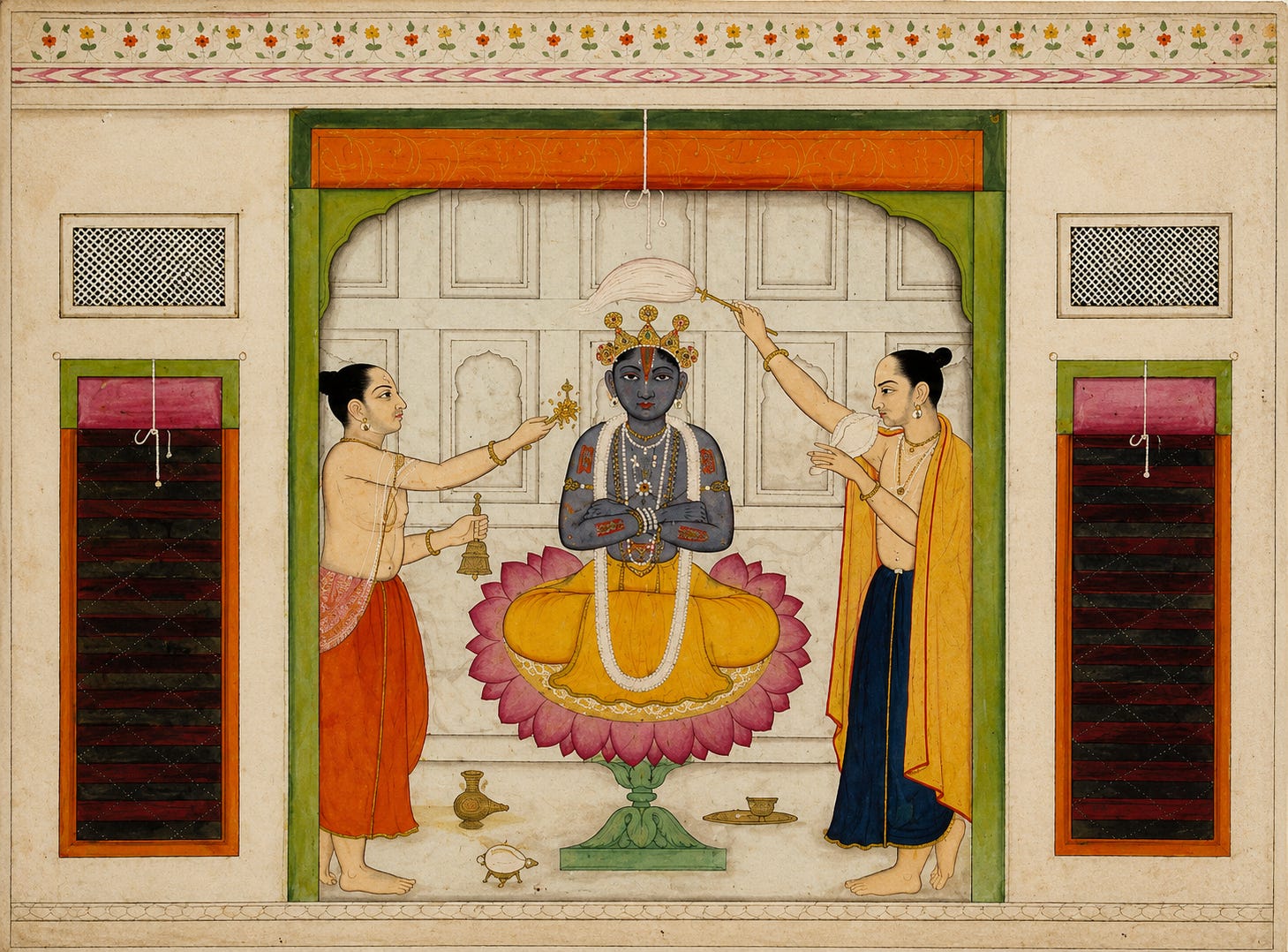
Somewhere near the end of the twelfth century, a poet in the east of India set the ten descents of Viṣṇu to music. Jayadeva’s Gītagovinda became one of the most beloved devotional poems in Sanskrit, and its opening song gives one verse to each avatāra, each divine descent, in turn. When it reaches the ninth, it addresses the Buddha:
“Moved by deep compassion, you condemn the Vedic way
That ordains animal slaughter in rites of sacrifice.
You take form as the enlightened Buddha, Krishna.
Triumph, Hari, Lord of the World!”
This is a Vaiṣṇava hymn praising Viṣṇu for condemning the Veda. It is worth pausing on how strange that is.
Now open the Agni Purāṇa, chapter sixteen, and meet the same figure in the same slot:
“Formerly in the war between gods and demons the former were defeated by the latter. Saying ‘Save us, Save us!’ they sought refuge with Iswara. Being incarnation of illusion and infatuation he was born as the son of Suddhodana. He infatuated the Daityas and made them relinquish the religion of the Veda. They then became followers of Buddha and induced others to forsake Vedic religion.”
It is the same tradition, and the same ninth slot right before Kalki, but the two Buddhas are opposites. In Jayadeva’s verse God comes down out of mercy for slaughtered animals. In the Agni Purāṇa God builds a weapon of mass apostasy and points it at the enemies of the gods, and the historical Buddha’s own father, Śuddhodana, gets written into the operation.
I cannot think of a clean parallel for this anywhere else in the history of religions, a tradition reaching out and placing the founder of its rival inside its own supreme god. This essay is about how that happened, and it draws almost entirely on the primary texts and on the handful of scholars who did the philological digging, Adalbert Gail above all, then Paul Hacker, Wendy Doniger, R. C. Hazra, John Holt, Edwin Bryant, Simon Brodbeck, Johannes Schneider.
The place to start is with an absence. The critical edition of the Mahābhārata, the text scholars reconstructed from hundreds of manuscripts, contains no Buddha avatāra, and no standard list of ten avatāras either. Bhandarkar noted this a century ago, and Simon Brodbeck’s recent survey of divine descent in the epic confirms it. The one place the epic corpus does register the Buddha’s religion is a Harivaṁśa passage about the end of the age, and there he is a symptom of decline, not a saviour: śūdras, men of the labouring order, wearing ochre robes, “who follow the Buddha of the Śākyas,” keeping their own dharma while the world runs down. The Buddha’s people are one more sign that the age is rotting, which is roughly where the Sakas sit in the same literature.
Kalki, by contrast, the epic already knows in full dress. Mārkaṇḍeya’s prophecy hands him his name, Kalki Viṣṇuyaśas the brahmin, his war on the barbarians, his restoration of the golden age. That ordering is the interesting part, and Doniger states the consequence flatly: the Buddha avatāra “may well have been inspired by the Kalkin avatar.” The tenth chair was filled before the ninth was built. So when the Buddha does finally arrive in the lists, he takes a seat directly in front of a Kalki who had been waiting there for centuries, and in several of the older lists he simply occupies the slot that used to belong to Kṛṣṇa.
One epic manuscript tradition breaks the silence. The southern Kumbhakonam edition of the Śānti Parvan carries a verse: “Matsya, Kūrma, Varāha, Narasiṁha, then Vāmana, Rāma, Rāma and Rāma, Buddha, Kalki: these are the ten.” No other major edition has it. The fuller interpolation around that verse, in Doniger’s summary, already carries the whole program: “At the beginning of the Kali Age, Visnu will become the Buddha, son of Suddhodana, and he will be a bald preacher who will speak in the Magadha dialect and delude men. All men will become bald and take the ochre robe, and priests will cease to offer oblations or recite the Vedas.”
Nobody sat down and invented this doctrine in one piece; it was put together over centuries, and in 1969 Adalbert Gail traced the assembly through four steps that still hold up. It begins in sorcery. In the old Raji myth the gods lose heaven to the sons of the king Raji, and Bṛhaspati, their guru, wins it back not by force but by ritual crime: he “daily offered a sorcery sacrifice to confuse the minds of Raji’s sons,” until they became “brahmin haters, abandoned the dharma, and acted contrary to Vedic prescriptions,” at which point Indra could kill them. There is no heresy here yet. There is only black magic worked through the fire, a way of making your enemy abandon his own defences.
The second step turns the spell into a book. In a Harivaṁśa insertion Bṛhaspati composes “a treatise of nāstika doctrine, utterly hostile to dharma.” Nāstika is the tradition’s word for a Veda denier. The Matsya Purāṇa names what he wrote: Bṛhaspati, “the knower of the Veda, promulgated the Jina doctrine foreign to the Veda,” Jina being the Jain teacher. So by this stage the weapon is no longer a rite performed over a fire, it is a whole religion, drafted by the gods’ own chaplain, and whoever takes it up loses the protection of the Veda.
The third step is the one everything afterward depends on, and it sits in the third book of the Viṣṇu Purāṇa. The setting is a war the gods have been losing. The demons keep their svadharma, their proper duty, and perform Vedic worship, and the text says plainly that as long as they do this they cannot be killed. Viṣṇu’s answer is to emit from his own body a being called Māyāmoha, delusion made out of māyā, out of divine illusion. Māyāmoha goes to the demons naked, as a Jain teacher. Then he changes into red robes and starts saying things like “understand that this all is nothing but consciousness,” which any reader in the fifth century would have heard as the talk of a Buddhist monk. The demons drop the Veda. In Doniger’s rendering of what follows, “the gods attacked them and killed them.” H. H. Wilson, who translated the Purāṇa in 1840, gave the moral of the episode in a sentence I have not been able to improve on:
“The armour of religion, which had formerly protected the Daityas, had been discarded by them and upon its abandonment followed their destruction.”
Two details of this episode are easy to read past, and both matter. Māyāmoha is a phantom, emitted for one job, and the text never calls him an avatāra. And nobody in the Viṣṇu Purāṇa worships him. The fullest telling of the delusion story treats the deluder as a tool.
The promotion comes in the Bhāgavata Purāṇa, probably the most influential Vaiṣṇava book ever written. Its first canto announces:
“Then, at the onset of the Kali age, he will be born, for the deluding of the enemies of the gods, as the son of Ajana, named Buddha, among the Kīkaṭas.”
Kīkaṭa is the Gayā country, where Siddhārtha Gautama sat under his tree. The father’s name comes down unstably, Ajana in some editions and Añjana in others, a small wobble on which, as we will see, the Gauḍīyas later hung a whole doctrine. The Bhāgavata repeats the Buddha in two more of its avatāra catalogues, and the Pāñcarātra ritual manuals, the Sāttvata Saṁhitā and the Lakṣmī Tantra, boil the entire biography down to one epithet, mohana, the bewilderer.
Gail pointed out that the tradition had promoted a deception once before. Mohinī, the enchantress Viṣṇu becomes to cheat the demons out of the nectar of immortality, is a passing trick in the Viṣṇu Purāṇa and a numbered avatāra in the Bhāgavata. The precedent was there. A delusion that worked could end up in the list.
On the dating, the scholars simply do not agree, and I would rather show the disagreement than average it. One piece of background first, from Paul Hacker’s study of the avatāra idea itself: the word is late. Older texts call Viṣṇu’s appearances prādurbhāva, manifestations. Avatāra, descent, only settles in as the standard term around the sixth century, so the word and the ninth seat are roughly the same age.
R. C. Hazra, whose 1940 study of Purāṇic strata is still the grid everyone argues inside, put the Viṣṇu Purāṇa very early, in the late third or early fourth century. An early date left no room for the Māyāmoha chapters, so he cut them loose and called them a later insertion. Doniger preferred the fifth century and called the Purāṇa “the first text to describe the Buddha avatar.” Gail argued for the sixth, and then made the move I keep coming back to whenever I reread his monograph. Suppose, with Hazra, that the episode were a late insertion. A late forger would have written it to give a backstory to the Buddha avatāra his readers already knew. But this episode knows no Buddha avatāra. Māyāmoha carries no list number and gets no worship, and a forger writing after the promotion would not have left those out. The episode is old, Gail concluded, precisely because it has not heard of the doctrine it was later used to explain.
From there his chain runs in order. The Viṣṇu Purāṇa carries the preparatory myth in the sixth century. The first datable daśāvatāra list with the Buddha in it, the canonical ten descents, is carved in Pallava country late in the seventh, in wording that is essentially the Kumbhakonam verse quoted above. The Bhāgavata follows around the middle of the eighth, with the Buddha seated in three of its lists.
Then there is the witness nobody counted until recently, and he changes the arithmetic. The philologist Johannes Schneider has shown that Bhavya, a Buddhist doxographer writing between roughly 500 and 570, already reports the Vaiṣṇava ten in his Tarkajvālā, with the Buddha standing ninth. So the earliest firmly datable list of ten avatāras containing the Buddha comes down to us from the rival’s own pen, a full century before the Pallava inscription. Buddhist scholars had catalogued their own annexation almost before the annexing texts circulated, and Schneider notes that this leaves the older datings of the doctrine’s rise looking too late.
The chain has one more loose link, and honesty requires showing it. Edwin Bryant has argued from the Vaikuṇṭha Perumāḷ temple at Kāñcīpuram, built around 770, whose relief panels follow the Bhāgavata’s narrative sequence, that the Bhāgavata must be considerably older than the eighth century, perhaps Gupta era. If Bryant is right, the last link of Gail’s chain moves back in time, and the Bhāgavata’s Buddha verses with it. The question is live. But the floor is now firm: by the middle of the sixth century the ten with the Buddha ninth existed, and even the Buddhists knew it. Everything earlier is inference from texts that resist dating.
Set the theology beside the throne room now, because the timing of the doctrine follows the timing of political power more closely than is comfortable.
The historian Ronald Inden documented a transformation in Indian kingship: before the eighth century, the Buddha functioned as the empire’s supreme deity, and a king claimed imperial status through grand donations to the monasteries and the installation of the Buddha in a stūpa. Then, in Inden’s words quoted by John Holt, “this pattern changed in the eighth century. The Buddha was replaced as the supreme, imperial deity by one of the Hindu gods.” The dynasties that made the switch were the Karkoṭas in Kashmir, the Gurjara Pratīhāras at Kanyākubja, the Rāṣṭrakūṭas in the Deccan, and the Pallavas in the south. The one great exception: the Pālas of eastern India, in the Buddha’s own homeland, who kept him imperial.
Now set that date against the doctrine. In the same century the Buddha loses his throne as the imperial god, he is, by Holt’s count, declared an avatāra of Viṣṇu in at least four Purāṇas, and inscriptions at Mahabalipuram, in Pallava country, name him the ninth of Viṣṇu’s ten. The court circle that produced the first datable Buddha daśāvatāra inscription is the same one that built the Vaikuṇṭha Perumāḷ temple. Holt reads the coincidence without any romance about it: the avatāra doctrine “was an apt and convenient means to give space to the Buddha, or better, to put the Buddha in his Brahmanical place.” Behind that, drawing on P. V. Kane, he sees a double move, absorb the thing that had become religious common sense and subordinate the institution that had taught it. The ninth avatāra was a tool of kingship first. Its reputation as a gesture of tolerance came much later, and from other people.
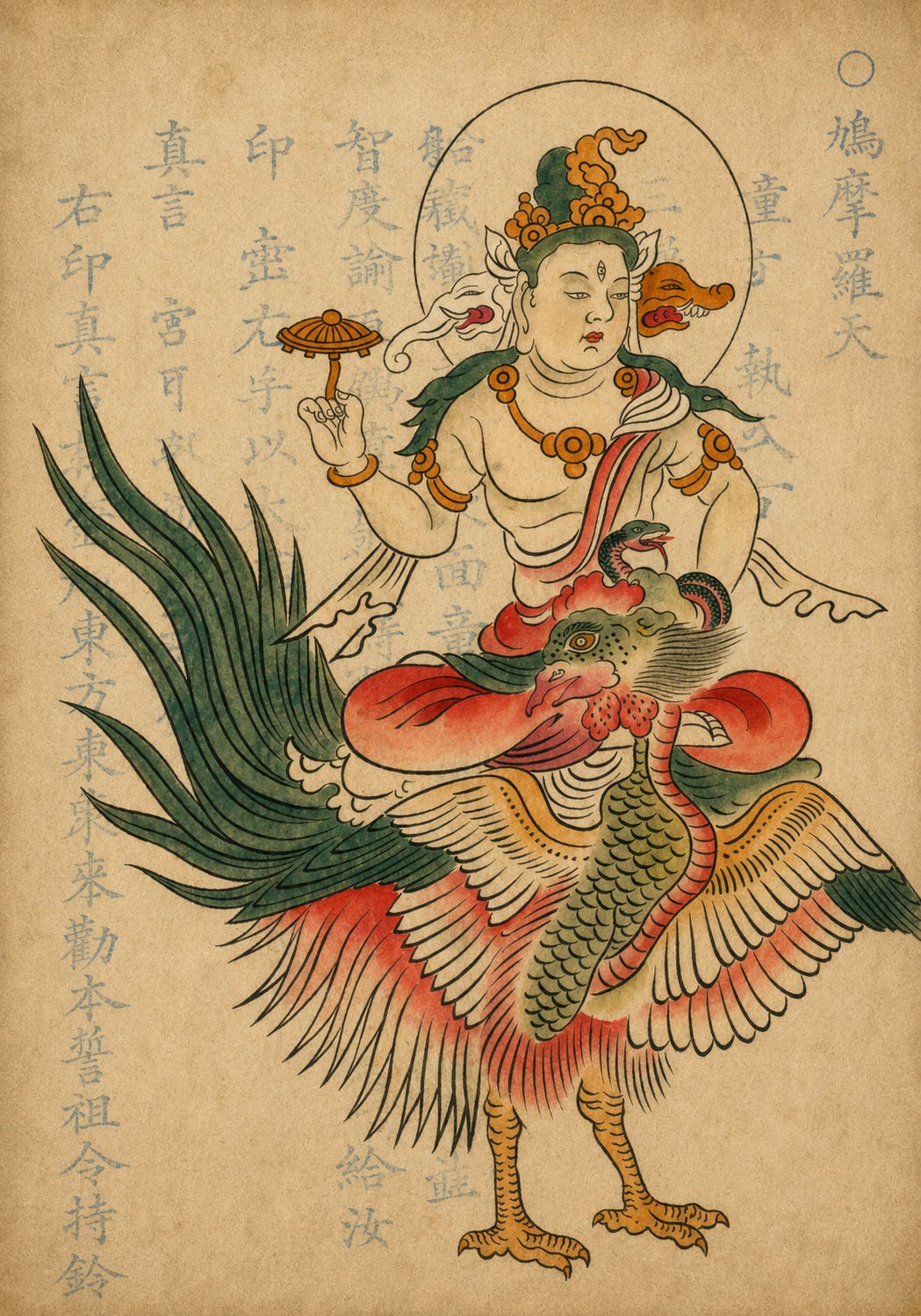
Once he was installed, the deluder Buddha was put to work, and the texts are not shy about the work he does.
The Padma Purāṇa uses him as a siege engine. In its version of the destruction of the demons’ Triple City, Śiva gives the credit for victory to a softening operation that came first: “The glorious one, taking up the form of Buddha, deluded his enemies. Those who were deluded by that teaching gave up all religious practices. (These) enemies of gods were killed by me with Visnu’s missile.” The delusion has to come before the weapon, because the armour of religion has to be talked off a demon before anything can land on him.
The same Purāṇa then carries the operation forward into the history of philosophy itself, in one of the most consequential polemical passages Hinduism produced. Śiva tells Pārvatī: “Visnu of the form of Buddha proclaimed the false Buddhist doctrine... for the destruction of the demons. The doctrine of Maya (illusion) is a wicked doctrine and said to be pseudo-Buddhist. I myself, of the form of a brahmana, proclaimed it in Kali (age).” The “doctrine of Māyā” is Advaita Vedānta, and the tradition has always taken that brahmin to be Śaṅkara. The charge is pracchanna bauddha, Buddhism in disguise, and the theology here is startling: Śaṅkara’s philosophy is being framed as the second phase of the same divine deception, the deluder’s campaign carried on by other means. Rival schools would spend the next several centuries throwing that accusation at the Advaitins.
Even the liturgy kept the memory of the job. A medieval formula of homage runs: “namo Buddhāya śuddhāya daitya dānava mohine,” adoration to the Enlightened One, the Pure One, who deluded the daityas and the dānavas, the two great demon clans. The homage and the accusation share a single line.
Later texts stretch the operation in both directions of time. The Bhaviṣya Purāṇa historicizes it without ceremony: “the god Visnu became born as Gautama, the Sakyamuni, and taught the Buddhist dharma for ten years... the path of the Vedas was destroyed and all men became Buddhists.” The Śiva Purāṇa, meanwhile, gives the deluder his orders in advance. Once the Triple City has fallen, Viṣṇu tells the man of delusion: “After spreading the dharma of darkness and destroying the Triple City, go to the wilderness and maintain your svadharma there until the beginning of the Kali Age. Then reveal your dharma and cause your disciples to spread it.” The heresy is being scheduled ages ahead of its own arrival, its founder held in reserve until the appointed time.
Then something strange happens inside the texts, and Gail gave it an unimprovable name: der Bock wird zum Gärtner gemacht, the goat is made the gardener.
The Bhāgavata, in its great protective litany, prays: “may Buddha protect from derangement by the heretic hosts.” The Garuḍa Purāṇa echoes it: “may Buddha protect from the mass of heretics.” The avatāra whose one job had been to manufacture heretics is now being asked to defend the faithful against them. Gail’s explanation is mechanical rather than mystical: sitting next to Kalki in the list, the Buddha absorbed his neighbour’s protective role. The Padma’s litany manages both directions at once, praising the Buddha who “deludes the wicked” and “has preserved the meaning of the Vedas.”
The portrait softens along with the function. The Agni Purāṇa, the same text whose delusion narrative opened this essay, prescribes his image for worship: fair, lotus seated, long eared, “the calmness of the heart within should be made to reflect in his countenance, as he is the bestower of all blessings, and the protector of all beings from evils and harms.” The Matsya Purāṇa goes further and produces a third Buddha altogether, neither deluder nor yet compassionate: ninth in a list of sacrificial avatāras, “of Divine splendour, with His Eyes as beautiful as lotus,” born “for the establishment of righteousness and the destruction of Asuras, through asceticism,” with Vyāsa himself as officiating priest. This Buddha has been Vedicized so thoroughly that even his priest is a sage of the Brahmanical tradition.
Last of all comes the compassionate Buddha. The Padma Purāṇa’s Kriyāyogasāra salutes “that Buddha who, seeing the killing of beasts, censured the Vedas with compassion.” The Devībhāgavata honours the descent “in order to stop the slaughter of animals.” The eleventh century Kashmiri poet Kṣemendra retells the Buddha’s whole life as a straight heroic story, drawn from the Buddhist tradition itself. This warm lineage is the one Jayadeva inherits when he sings the verse this essay began with.
There is a disagreement about when this warmth sets in, and I find it a revealing one. Doniger points to Kashmir, where sympathetic treatments of the Buddha turn up already in the tenth and eleventh centuries, at a time when Buddhism was still a living presence there and Kṣemendra was at work. Holt puts the real flowering later, in the twelfth and thirteenth centuries, by which point Buddhism was institutionally dead across India and praising it cost a Hindu nothing. My own sense is that they are describing two phases of one thing. In Kashmir the respect is paid while the neighbour is still alive to see it; by Jayadeva’s time the praise is being sung over a grave.
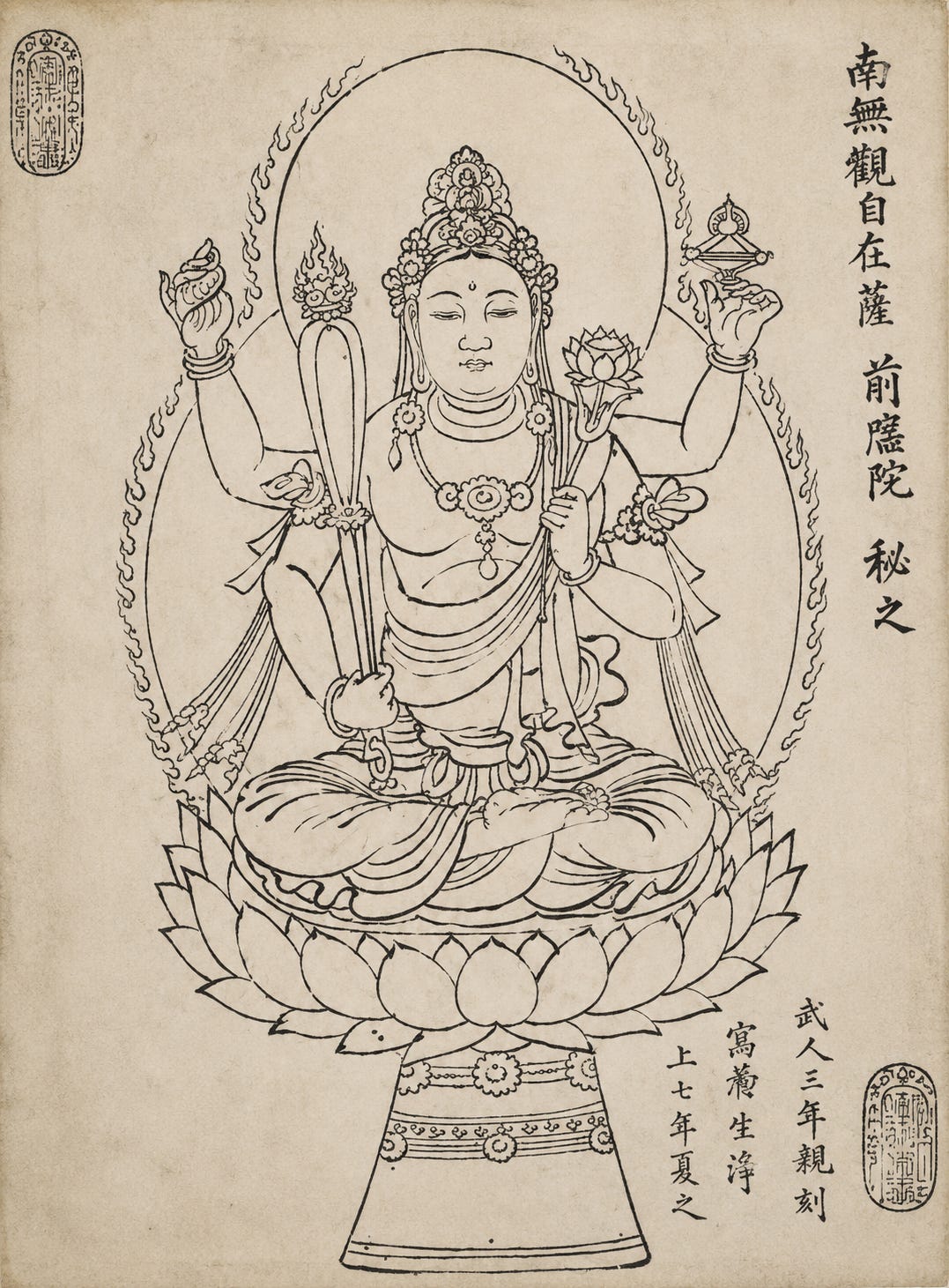
Put the question to the living Vaiṣṇava schools and they answer three different ways. That they cannot agree is itself part of the evidence.
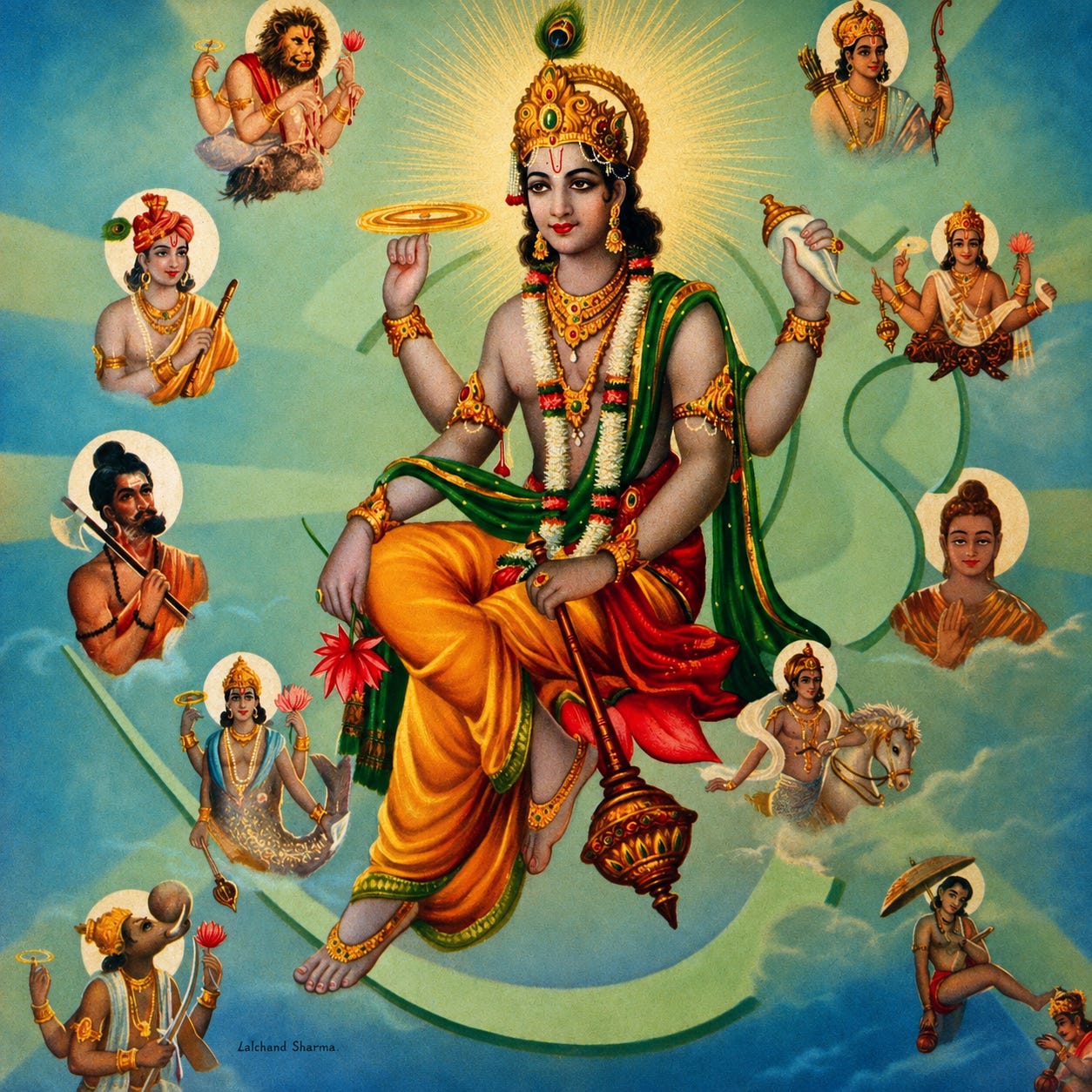
The Śrī Vaiṣṇavas, the school of Rāmānuja, whose great shrine at Śrīraṅgam contains a sanctum for the ten avatāras, never admitted the Buddha at all. Vedānta Deśika’s Daśāvatāra Stotra, composed at that very shrine, runs Matsya, Kūrma, Varāha, Nṛsiṁha, Vāmana, Paraśurāma, Rāma, Balarāma, Kṛṣṇa, Kalki. Balarāma eighth, Kṛṣṇa ninth, no Buddha anywhere. The icon set of the Śrīraṅgam sanctum matches the poem. And this is the same Deśika whose Śatadūṣaṇī calls the faithful to war against the pracchanna bauddhas, the crypto Buddhists, by which he means the Advaitins. His school kept the insult and refused the incarnation.
The Gauḍīyas, the school of Caitanya, accepted him, and their greatest modern voice states the old doctrine without blinking. Prabhupāda’s commentary on the Bhāgavata verse explains that the Buddha’s denial of the Veda “is an act of camouflage by the Lord.” But acceptance created a problem the school solved with surgery: the avatāra Buddha, son of Añjanā (there is the Bhāgavata’s wobbling name again), born at Gayā, is declared a different person from the historical Śākyamuni, son of Māyādevī, born at Kapilavastu. Two Buddhas, one divine and adorable, one human and mistaken. The Gauḍīya tradition credits the underlying framework, a plurality of Buddhas across the cosmic ages, to Jīva Gosvāmī, though the attribution rests on Prabhupāda’s report and Jīva’s own wording remains to be verified from his Sanskrit; what is certain is that the two Buddhas solution was already being improvised by Sir William Jones in 1790, when he noticed the contradiction between Jayadeva’s praise and the Bhāgavata’s demonology and, in Doniger’s phrase, proposed “a bold but indefensible example of dualistic ‘splitting.’”
Madhva’s Dvaita school took the deflationary road. His Bhāgavata Tātparya glosses the Buddha verse through a Brahmāṇḍa Purāṇa citation in which Viṣṇu merely poses as the child of a demon named Jina in order to delude demons with talk of nonviolence. An operation, then, and hardly an object of worship. Madhva otherwise spent his energies documenting, chapter and verse, the old charge that Advaita is Buddhism in disguise. The school’s later champion Vyāsatīrtha finished the job with what Doniger calls the final blow to any positive reading: “Buddha himself is an incarnation of God, and yet he deceived the people by false teaching.” Being God’s own descent, in this theology, tells you nothing about whether he was telling the truth.
So Rāmānuja’s school kept the Buddha out of the list and kept his name as an insult for its enemies. Caitanya’s school let him in and then split him in two so the adorable one could be quarantined from the historical one. Madhva’s school admitted that the descent had happened and denied that it deserved any devotion. A Vaiṣṇava’s position on the ninth avatāra was, in practice, a way of telling which lineage of initiation he had come up through.
A single text could not always hold to one position either. The Varāha Purāṇa lists the Buddha ninth in its fourth chapter, where the ten descents are called “steps for those who wish to attain the vision” of Viṣṇu. Eleven chapters later its Hymn of Ten Incarnations drops him and reaches ten by counting Rāma four separate times. Then chapter one hundred thirteen names him yet again. The book could not decide what to do with him any more than the schools could.
Helmuth von Glasenapp, whom Gail quotes with approval, called the whole business an attempt “to annex Buddhism peacefully for Hinduism.” Annexation seems to me the exact word, because of what the arrangement did and did not include. The Buddha kept his name in the list. Everything else, the prestige, the antiquity, the claim on men’s reverence, went to Viṣṇu, and no cult of the adopted Buddha ever grew up inside the tradition that adopted him. Māyāmoha’s demons had at least been handed a doctrine to hold; the promoted Buddha was handed a rank. Holt, in the book he pointedly titled The Buddhist Viṣṇu, sums up the outcome without decoration: “cultic veneration of the Buddha within Hinduism is virtually absent.”
Paul Hacker, who spent years studying how Hindu traditions deal with rival claims, called this move inclusivism. You do not refute the rival system. You declare it a lower stage of your own, and near the end of his life Hacker put the point sourly: what looks to the European like tolerance, he wrote, is almost always inclusivism. A religion filing its rival’s founder as a junior form of its own god is about as pure a case of what he meant as there will ever be.
Not everyone inside the tradition was easy about the stratagem, and the unease got written into scripture. The Tamil Kāñcippurāṇam brings the Buddha to Kāñcī along with Nārada, the two of them worn down by guilt for the delusion they had spread, and it hands Śiva the verdict:
“The sin of teaching false doctrine can be expiated only after many millions of aeons. Even in order to help the gods it is a heinous sin to destroy someone’s faith in Siva.”
So the god on whose side the operation ran is made, in the tradition’s own book, to rule it a sin. That is a guilty conscience, recorded by the guilty party.
The Buddhists did not simply absorb all this either. Bhavya had catalogued the doctrine back in the sixth century, and a later commentator, Prajñāvarman, worked out the counter move: Viṣṇu became the Buddha, he suggested, to do penance for all the killing he had done as Rāma. The avatāra is real in this account, but he has come down to apologize, and the apology lands on the very mythology that had drafted him.
The doctrine kept moving after the Purāṇas were done with it. Radhakrishnan and the modern reformers turned its polarity clean around, recasting the Buddha as the avatāra who descended to purify Hinduism of its bloody rites, a reading that, as Holt points out, reverses more or less everything the Purāṇas actually say. Modern India completed the reclamation by making him a bhūmiputra, a son of the soil. And the discomfort never quite died. Gail noticed that the Poona critical edition of the Mahābhārata prints Kṛṣṇa where the Kumbhakonam edition’s ten avatāra verse reads Buddha, and permitted himself the observation that some Indian philologists too are subject to “dogmatic prejudgments that congeal into textual falsifications.” I checked what can be checked. In the critical edition’s supplementary passages the verse stands as star passage 835 to the Śānti Parvan, and its printed line runs “rāmo rāmaś ca rāmaś ca kṛṣṇaḥ kalkī ca te daśa”: Kṛṣṇa in the ninth seat. The Kumbhakonam edition and the seventh century Mahabalipuram inscription both read buddhaḥ in that seat. Whether the editors recorded the Buddha reading in their variant notes, or silently followed other manuscripts, only the printed page in Poona can settle, so Gail’s darkest interpretation stays unproven. The discrepancy itself is now verified. And as a parable of the whole subject it is almost too perfect: a tradition that put the Buddha into its god, and then found a way to print Kṛṣṇa over his name.
The last word belongs to a painting. At the Viṣṇu shrine of Devinuvara, on the southern tip of Sri Lanka, Buddhist temple artists in the 1950s painted the ten avatāras of Viṣṇu on the walls, with the Buddha standing ninth. A Buddhist temple, honouring the god who once descended to delude the Buddhists, by including the Buddha in his retinue. The annexation, in the end, ran both ways.
Sources:
Adalbert Gail, Buddha als Avatāra Viṣṇus (1969).
Wendy Doniger, The Origins of Evil in Hindu Mythology (1976).
John Holt, The Buddhist Viṣṇu (2004).
Paul Hacker, Kleine Schriften (1978).
R. C. Hazra, Studies in the Purāṇic Records (1940).
Johannes Schneider, his 2015 article on Bhavya.
Edwin Bryant, on the date of the Bhāgavata and the Kāñcī temple.
Simon Brodbeck, Divine Descent and the Four World-Ages in the Mahābhārata.
No posts
Comments
Nothing yet. Say the first thing.
Sign in to join the conversation.