
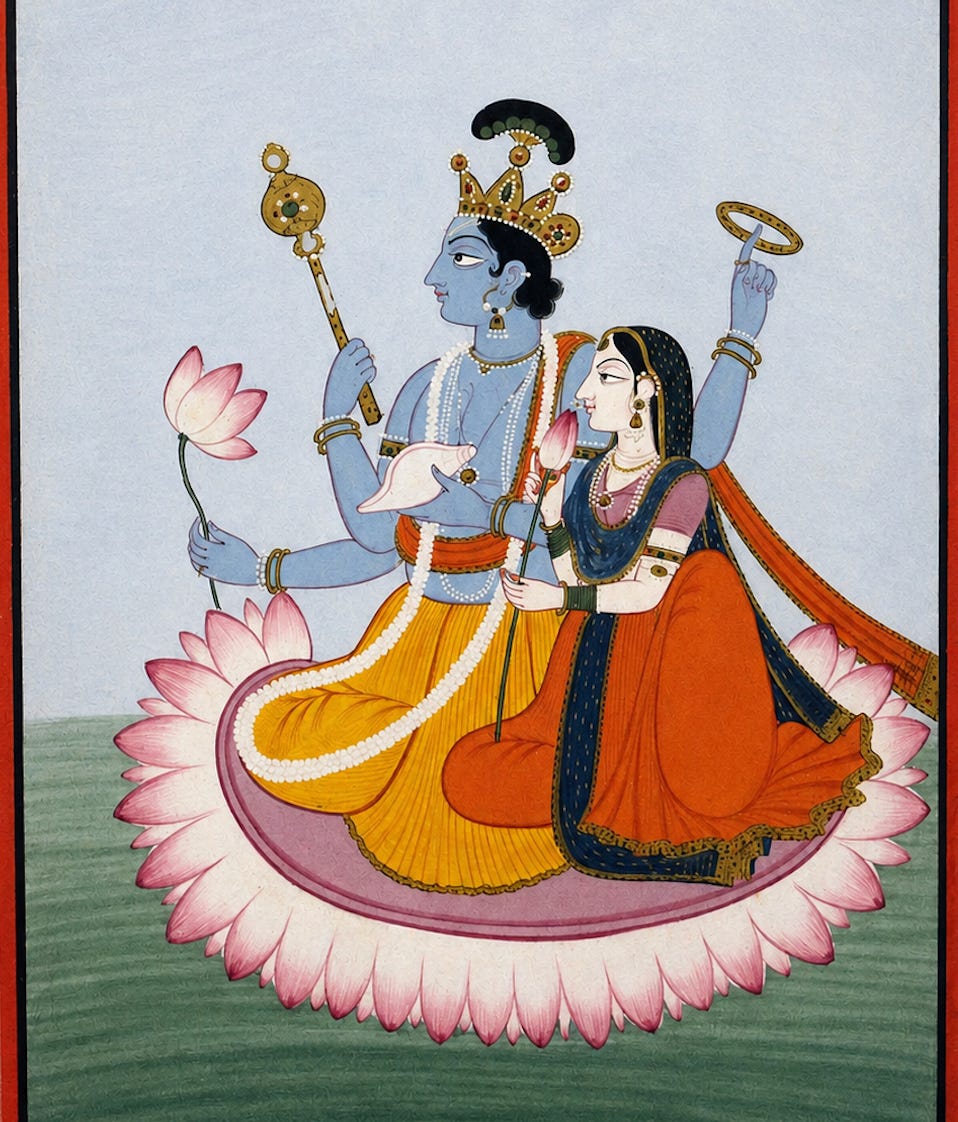
Open the Ṛgveda, the oldest large body of poetry in any Indo-European language, and you meet a god who measured out the universe in three strides:
“Now shall I proclaim the heroic deeds of Viṣṇu, who measured out the earthly realms, who propped up the higher seat, having stridden out three times, the wide ranging one.”
The Ṛgveda took shape in the river country of the Punjab across the early second millennium BCE, centuries before Homer, over a thousand years before the Buddha and before the oldest verse of the Hebrew Bible. Its hymns are not all of one age. The fullest telling of the three strides, the one above, belongs to the first of the ten books, which is among the later strata. But the deed itself is older than the hymn that celebrates it: the strides are already there in the family books, Maṇḍalas six and seven, the bedrock core of the collection. This is not a late embellishment on Viṣṇu. It is the oldest thing we know about him. And the god who paces them out is worshipped this morning, under the same name, by something close to a billion people. Few gods anywhere have been called by name, without a break, for so long.
And yet, by the count, Viṣṇu is almost no one in that oldest book. Five or six hymns out of more than a thousand, and a scatter of passing mentions. The handbooks write him down as “minor” and move on. But open a Vedic ritual text only a little younger and you find the same god set at the very summit of the pantheon: agnir vai devānām avamo viṣṇuḥ paramas, tadantareṇa sarvā anyā devatāḥ, “Agni is the lowest of the gods, Viṣṇu the highest, and all the rest stand in between.” Barely counted in one breath, and crowned in the next. A minor deity is not spoken of that way. Something has been mismeasured.
That mismeasurement is what this primer is about. The usual story explains it by chronology:
Viṣṇu rose late, a small solar deity of the early Veda who climbed, somehow and against the odds, to the head of the gods.
Vaiṣṇavism, the religion built on him, was a late assembly, brahmanised and systematised in the last few centuries BCE.
A god older than the alphabet, filed under “rose to prominence late.”
That story, I think, mistakes one question for three. “When did Vaiṣṇavism begin?” has three different answers, depending on what you mean by it.
There is the deity. Viṣṇu is a late Bronze Age god, and he has what look like cousins across the Indo-European world, a silent striding god among the Norse who takes one enormous step at the end of time, a far-seeing judge among the Iranians, kin that would make him an inheritance rather than an invention. By the close of the Vedic period, in any case, he is no minor anything; he has become the sacrifice itself, the act on which the standing of the cosmos depends.
There is the worship of him as the supreme God, cut into stone, by an Indian king and by a foreign convert alike, two thousand years ago and more.
And there is the system: the metaphysics of emanation, the fixed roll of ten incarnations, the wedding of the goddess to the god, the warring schools of philosophy. That part really is late, the work of roughly 200 BCE to 500 CE and after.
The standard story takes the youngest of the three and lets its lateness stand for the whole. It dates the religion by the date of its system, and a god first hymned a thousand years before the Buddha ends up written off as a child of late antiquity. One line carries the whole correction: systematization is not origin. The system is late. The god and the worship are not.
Two things keep this from being merely my assertion. The first is that you need not take it from any single school, and the schools here agree on almost nothing. The Victorian philologists called him a faded sun; the Dutch structuralists, the cosmic centre; the Marxist historians, a tribal cult dressed up by priests; the traditional theologians, the eternal absolute. They cannot all be right, and they spend their footnotes saying so. But on the few points this argument rests on, they converge, and a claim that colonial philology, Hindu theology, and Indian Marxism all underwrite is not the artefact of any one of their biases. The second is a mechanism hiding in plain sight. Viṣṇu did not rise from nothing in the middle Vedic period. He rose with the priesthood whose god he had always been, and the rise left a fingerprint you can count.
A word on method. The genuinely late things, I grant up front. The cowherd Kṛṣṇa of the butter and the flute, the goddess Rādhā, the consort at Viṣṇu’s side, the full theology of the descents: these are late, and I will say so each time they appear.
So, the three ages in turn, beginning with the god.
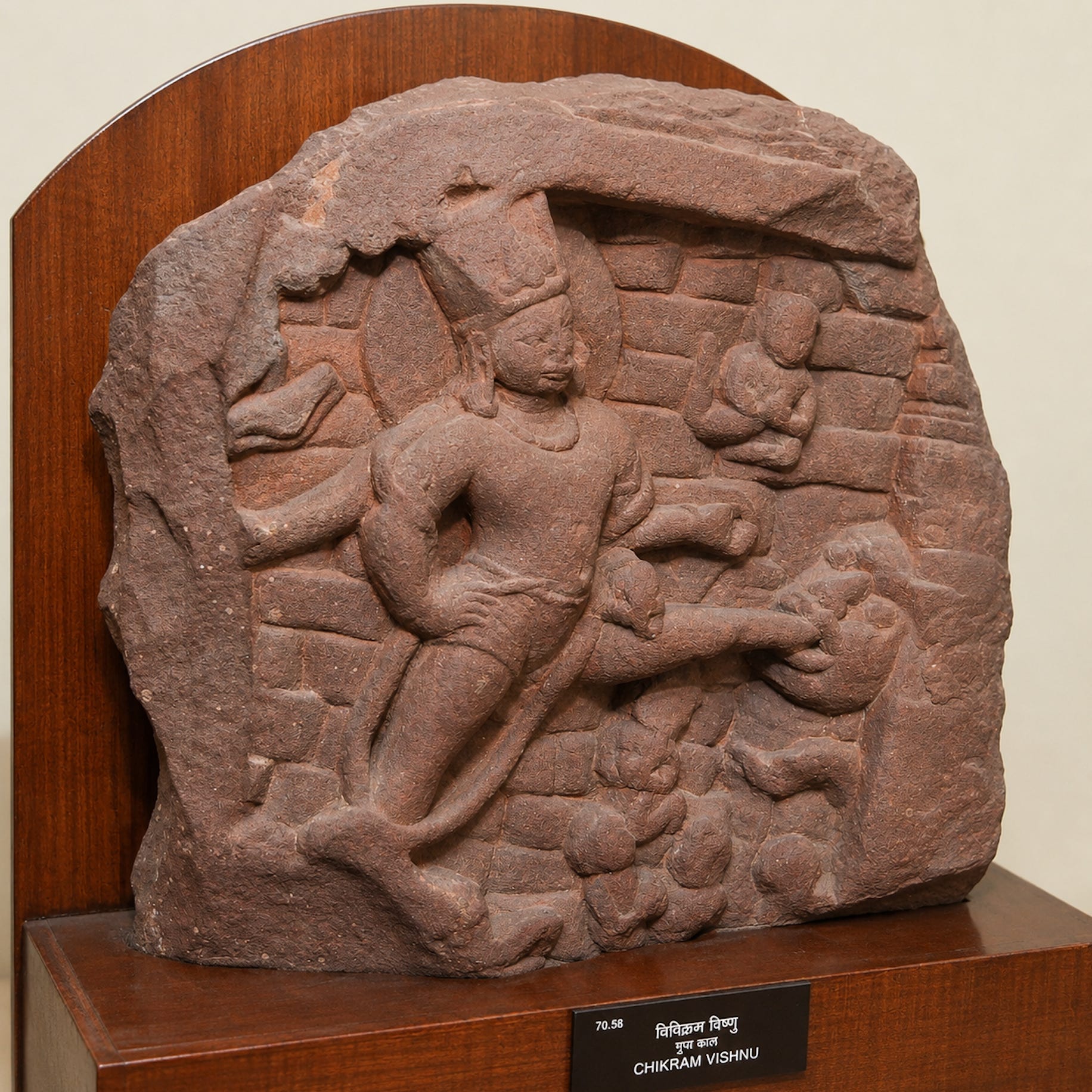
Open the Ṛgveda, the oldest layer of Indian religious poetry, composed in the late Bronze Age somewhere in the centuries around 1500 to 1200 BCE. Of its 1,028 hymns, only five or six are addressed to Viṣṇu alone. By raw frequency he is a modest presence. Indra, the warrior king who breaks the dragon and releases the waters, holds something like 250 hymns. Agni, the sacred fire, around 200. Counting the name across the whole collection gives about 113 occurrences, most of them passing references inside hymns to other gods.
The Victorian philologists who first catalogued the Vedic pantheon read those numbers in the obvious way. Arthur Macdonell, whose Vedic Mythology of 1898 is still a standard reference, opened his section on the god with the verdict that has stuck: “the main characteristic of the nature of Viṣṇu, a minor deity in the Ṛgveda, is his three steps.” His three strides, Macdonell decided, were the daily or yearly course of the sun, and “Viṣṇu probably is a personification of the activity of the sun.” Indra, he noted, “is the only deity most closely associated with him.”
That is the baseline, and it is fair. If you count hymns, Viṣṇu is not in the front rank of the Ṛgveda, and his most visible Vedic trait can be read, plausibly, as solar.
But the date matters, and it is the first thing the standard story skips past. A god who already has his own hymns in the late Bronze Age, a signature cosmic deed, and a named paradise is not a beginner. He is an inherited figure of a tradition older than nearly every religion still practised on earth. Three thousand years ago, someone was already singing to him by name.
Now look at the content, which carries more weight than the count.
The defining deed of the Ṛgvedic Viṣṇu is the three strides. In three vast steps he paces out the cosmos and makes the room in which living things can exist. Its fullest telling is the hundred and fifty-fourth hymn of the first book, six verses by the poet Dīrghatamas, though the same act is sung in the older family books as well. It opens:
“Now shall I proclaim the heroic deeds of Viṣṇu, who measured out the earthly realms, who propped up the higher seat, having stridden out three times, the wide ranging one.”
And it tells you what the strides are for:
“In this way Viṣṇu will be praised for his heroic deed, he who is like a fearsome wild beast, living in the mountains and roaming wherever it wants, in whose three wide strides dwell all living beings.”
That is world-building work. Before the strides there is no measured space; after them there are three worlds, earth, midspace, and heaven, each wide enough for its inhabitants. The sun crosses the sky every day, but the sun does not build the room the sky encloses. In this poetry, Viṣṇu does. His standing epithets say it: urugāya and urukrama, the wide going, the wide striding one, and the verb for striding across the worlds is reserved almost entirely for him.
Then comes the third step, and here the later religion is already visible in outline. Two of Viṣṇu’s strides are within mortal reach; the third, his highest, lies beyond it. The hymns call it the paramaṃ padam, the highest footstep, and they describe it as a place of honey and light, the goal the singer longs to reach. The 154th hymn again:
“Might I reach that dear cattle pen of his, where men seeking the gods find elation, for exactly that is the bond to the wide striding one, the wellspring of honey in the highest step of Viṣṇu.”
And in the 22nd hymn, the line that the whole later tradition would hang upon:
“That is the highest footstep of Viṣṇu. The patrons always behold it, stretched out like the eye in heaven.”
Tad viṣṇoḥ paramaṃ padam. The American Vedicist E. W. Hopkins, a careful and unsentimental reader, called this the earliest Indian image of a heaven of the blessed, the home of departed souls, and the Indian scholar R. N. Dandekar followed him. In other words, the destination that classical Vaiṣṇavism names Vaikuṇṭha, the paradise of the liberated, is already present in the Ṛgveda in rudimentary form: honey, light, the goal of the soul’s journey. Centuries later the Kaṭha Upaniṣad would quote that exact phrase, the highest step of Viṣṇu, as the end of the spiritual road. The seed of the Vaiṣṇava heaven is Bronze Age.
I want to be fair about the relationships too, including where they cut against me. In the Ṛgveda Viṣṇu is most often Indra’s companion, and the junior of the two. When Indra braces to kill Vṛtra and free the imprisoned waters, he turns to his ally:
“Comrade Viṣṇu, stride out widely. Heaven, grant a place for the mace to prop apart. We two will smite Vṛtra, we two will give leave to the rivers.”
Viṣṇu makes the space, Indra strikes the blow. The later tradition will turn this completely around, subordinating Indra to a cosmic Viṣṇu. That inversion is real growth, and I will not pretend it was finished in 1200 BCE. It was not.
But notice what already clings to him besides the strides. His name most likely comes from the root meaning to pervade, to penetrate, to be active throughout, which is why the Purāṇas would later gloss it as “the one who enters or pervades everything.” He is invoked to protect the embryo and to grant offspring. He is called ghṛtayoni, ghee wombed, lodged in the clarified butter that the Vedic texts treat as the life sap of the universe. The great Dutch Indologist Jan Gonda devoted a whole monograph, Aspects of Early Viṣṇuism, to drawing this out: alongside the solar strider there is, from the very start, a Viṣṇu bound up with fertility, with the sustaining of life, with food itself. That is the seed of his classical office as the preserver, the maintainer of the worlds, and it is Vedic, not a Puranic afterthought.
The modern study of this god began in the nineteenth century, and so did most of the confusion about his age.
The first European Vedicists worked under the spell of solar mythology and what Max Müller called henotheism, the habit of the Vedic poets of exalting whatever god they happened to be addressing as if he were supreme. Müller treated this as “an unconscious urge towards monotheism,” a stage on the way to higher religion. Within that scheme Viṣṇu was slotted as one solar deity among several, and the three strides were read as sunrise, zenith, and sunset, the reading Macdonell inherited and codified. Hermann Oldenberg dissented even then, holding that “every definite trace of solar character is lacking” and that Viṣṇu was from the beginning simply a traverser of wide space. So the solar reading was never unanimous, and much of the “minor god” verdict rests on it.
A second strand of nineteenth century scholarship reached for a non Aryan or specifically Dravidian origin for the deities that did not fit the Indra centred warrior pantheon. The name Nārāyaṇa, which becomes central to our story, was a favourite target. One school derived it from Dravidian roots, nār meaning water and ayana a resting place, so that Nārāyaṇa would be “the one who lies on the waters,” the cosmic sleeper.
I take the case against that reading from Suvira Jaiswal, and since she will be the most quoted scholar in these pages, let me say who she is. Her 1967 book, The Origin and Development of Vaiṣṇavism, is the standard academic history of how the cult formed, written from the materialist school of D. D. Kosambi and R. S. Sharma, which treats religion as a by-product of social and economic life and dates that formation to roughly 200 BCE to 500 CE. She is, for most of this essay, the scholar with the most professional reason to call Viṣṇu young. Which is why it matters that, again and again, she ends up calling him old.
On the Dravidian etymology she is firmly sceptical. She notes that the theory “does not explain how nir was changed into nar, involving the substitution of the vowel i by a,” and that the watery reading was itself the epic poet’s invention, since “the poet of the Mahābhārata seems to have taken particular delight in inventing fanciful derivations of the names of the deities.” The Dravidian origin of Viṣṇu and Nārāyaṇa is part of the history of the question rather than a settled result, and I flag it because it still circulates.
The most consequential framing, though, came from the missionary scholars, and it is the root of the “late and borrowed” picture. Horace Hayman Wilson, lecturing at Oxford in 1840, was candid that one studied Hindu religion in order, in his words, “to confute the falsities of Hinduism” and win Hindus to Christianity. In that climate the German Indologist Albrecht Weber and others advanced, in the 1870s, the theory that the bhakti of Kṛṣṇa, the devotion of loving surrender, had been borrowed from Christianity, carried east by Nestorian missionaries. Whatever the intent, the effect was to make the whole devotional tradition look late and derivative by construction.
It was Indian scholars who took this apart, and they did it with the very evidence we have been handling. R. G. Bhandarkar in 1913, R. P. Chanda working from the archaeology in 1920, and H. C. Raychaudhuri in 1921 used the inscriptions, Pāṇini, and Megasthenes to push the cult back into the centuries BCE and to sever it from any Christian source. Jaiswal, writing decades later from the opposite end of the ideological spectrum, records the outcome flatly: the Christian origin theory “is now abandoned altogether on chronological grounds.” The “recent and borrowed” picture was refuted long ago, inside the scholarship. It survives mostly in the popular afterglow, and in the looser kind of textbook.
If the solar minimizers were one camp, there has always been another, and it includes some of the most serious Vedicists of the last century.
The Dutch scholar F. B. J. Kuiper argued, in his work on Vedic cosmogony, that the hymn count badly understates the god. In the Veda, he wrote, Viṣṇu “must have been a central figure, of greater importance than Indra himself,” because his third stride represents the transcendent totality that reconciles being and non being, the whole that stands above the cosmos rather than inside it. Gonda, citing the earlier judgment of Sten Konow, put it more cautiously but to the same end: in his Vedic form “the seeds were already present from which a great god could develop.” And A. B. Keith, no sentimentalist, warned that the relative prominence of the gods “is not necessarily fully brought out” by the Ṛgveda, “the range of interests of which was not very wide.” The hymnal was the work of a warrior and priestly elite. It records what they cared about. A deity beloved of women, of cultivators, of the unlettered, would be under reported by the very nature of the text. Silence in the Ṛgveda is not absence in the world.
The most striking modern contribution to this side of the argument is also the most concrete, and it comes from the contemporary scholar who writes under the name Manasataramgini. He simply counted. He tallied the occurrences of the name Viṣṇu across the entire span of Vedic literature, text by text, and the pattern is hard to unsee. In the Ṛgveda the name appears about 113 times. Then look at the Yajurveda, the Veda of the priest who performs the physical acts of the sacrifice, the adhvaryu: in its core collections the count leaps to 175 in the Taittirīya Saṃhitā, 197 in the Kāṭha, 233 in the Maitrāyaṇī, and 223 in the Śatapatha Brāhmaṇa. In the Sāmaveda, the Veda of chant, he stays scarce, around 22. These are his own tallies rather than figures from a published concordance, and the exact numbers would move a little with the method of counting.
That pattern is not noise, and it is not a quirk of text size. It tells you something the hymn count hides. The Vedic priesthood was not one body but several lineages, each with its own collection and its own ritual role, and Viṣṇu was always the special deity of one of them, the ādhvaryava tradition of the Yajurveda, the tradition of physical ritual action. His apparent rise across the middle Vedic period, on this reading, is really the rise of that priestly tradition to dominance, carrying its god up with it. Manasataramgini puts the whole thing under a single Vedic sentence that we will meet again in a moment: yajño vai viṣṇuḥ, the sacrifice is Viṣṇu. The deity who owns the sacrifice rises with the priesthood of the sacrifice.
He adds another piece, easy to check. There is the deity-pair, the devatā dvandva, called Agnāviṣṇū, Agni-and-Viṣṇu, absent from the Ṛgveda but routine in the Yajurveda and the Brāhmaṇas, and it always sets Viṣṇu last, in the slot of supremacy. That ordering is the structure behind the line this essay opened with, the Aitareya Brāhmaṇa’s “Agni the lowest, Viṣṇu the highest, all the rest in between.” It is no flourish. It is the ritual hierarchy, written down, in the very period when Viṣṇu is supposed to have been a nobody.
And there is the deep background, the part that reaches back toward the steppe, where I want to be candid that the ground gets softer. The contemporary scholar Manasataramgini reconstructs Viṣṇu as an inherited Indo-European deity, older than the Indo-Aryans, by setting him beside possible cousins in the other branches. One Vedic detail is solid and suggestive: in a hymn Indra urges Viṣṇu to stride vitaram, “wider,” and that same root for wideness has been read into the name of the Norse Víðarr, the silent god, strongest after Thor, who plants his great shoe to tear open the jaws of the Fenris wolf at Ragnarök and survives into the world reborn. Further out he points to the Iranian Rashnu, the far seeing judge who rides at Mithra’s right hand as the Vedic Viṣṇu stands close to Mitra, and, more speculatively still, the Celtic thunderer Taranis. This is a comparison, not a proof, and not every link will survive scrutiny; the etymology of Víðarr is itself disputed, and the Celtic parallel is the thinnest of the three. But the argument runs the same way as everything else around it. A god who can even plausibly be set beside Germanic and Iranian counterparts looks less like an Indian invention of the iron age than like an inheritance carried in from much deeper time.
There is independent confirmation that the Vedic gods are this old, from an unexpected quarter. In the fourteenth century BCE, far to the west of India, a treaty was sworn between the Hittites and a kingdom called Mitanni in northern Syria, and the gods called to witness it, inscribed at Boğazköy, are unmistakably the gods of the Veda: Indara, Mitra, the two Nāsatya, and Uruwana, that is Indra, Mitra, the Aśvins, and Varuṇa. Paul Thieme argued that these names are specifically Indo-Aryan, not generic Indo-Iranian, which means a recognizably Vedic pantheon was being invoked, in the Near East, before or around the time the Ṛgveda itself was being composed in India. The Indologist Hermann Jacobi went so far as to say the Mitannians were already worshipping the Vedic gods in full perfection in the fourteenth century. Edwin Bryant, whose survey of the whole Indo-Aryan question is the most balanced we have, treats this as among the firmest pegs for dating the Ṛgveda to “around the middle of the second millennium.” I should be honest about one thing: Viṣṇu is not among the four Mitanni names, which are the sovereignty and warrior gods, Mitra, Varuṇa, Indra, the Aśvins. The Mitanni tablets do not prove the antiquity of Viṣṇu specifically. What they prove is that the Vedic pantheon he belongs to was already old and already abroad in the Bronze Age, which is the frame within which his own Ṛgvedic hymns, his Indo-European cousins, and his cosmic strides have to be read. He is an old god among old gods, not a latecomer to a young religion.
Here is the hinge the whole development turns on, and the evidence is unusually clean.
In the ritual prose of the Yajurveda and the Brāhmaṇas, Viṣṇu stops being one god among many and simply becomes the sacrifice. Yajño vai viṣṇuḥ, say the Śatapatha Brāhmaṇa and, earlier, the Taittirīya Saṃhitā: the sacrifice is Viṣṇu. The equation is so routine that Griffith, Englishing the White Yajurveda, gives up explaining it and just glosses the pronoun at the altar verses: “thee,” he notes, means “Viṣṇu, that is, the sacrifice.” To a modern reader that lands as dry ritual bookkeeping. To the men who wrote the Brāhmaṇas it was the largest claim a sentence could carry. For them the sacrifice was the axis of the cosmos, the act that kept the worlds from sliding back into nothing, and to call a god the sacrifice was to set him at the centre of everything without troubling to write him a single new hymn. A marginal god does not get fused with the one act that holds the universe up.
This is why the count and the formula say the same thing from two directions. By the late Vedic period Viṣṇu already holds the function that classical Vaiṣṇavism will later universalize. He is the cosmic maintainer, identified with the act that sustains the world. The Śatapatha Brāhmaṇa even makes him, in one passage, equal in size to the sacrifice, and identifies him with food, the all supporting. Macdonell, no friend of the maximal reading, conceded that “a special feature of the Brāhmaṇas is the constant identification of Viṣṇu with the sacrifice.”
The strides follow the same path from poetry into rite. In the Yajurveda the worshipper himself paces out three steps, the viṣṇu krama, identifying his own body with Viṣṇu measuring the worlds. The text he speaks as he steps is plain about it: “O Viṣṇu, stride thou widely forth, give ample room for our abode. Drink butter, homed in butter. Still speed on the sacrifice’s lord.” The Bronze Age hymn has become a thing the priest does with his feet. The Atharvaveda, meanwhile, keeps the god in the household register, invoked over the ghee and, above all, for the making of a child: “Let Viṣṇu form and mould the womb, let Tvaṣṭar duly shape the forms, Prajāpati infuse the stream, and Dhātar lay for thee the germ.” This is the homely, life giving Viṣṇu, the shaper of the womb, the god of the embryo, exactly the side that the warrior poets of the Ṛgveda had little reason to record and that the household priests of the Atharvan kept alive. The god runs continuously through all four Vedas, and across the three priestly traditions, gaining weight as he goes. By the close of the Vedic period he is already the god who is the sacrifice, and the god whose highest step is where the soul wants to end up. No later age had to discover him.
One more Vedic image bridges the strider of the hymns and the cosmic God of the temples, and it shows how little of the later theology was invented from nothing. It is the image of the navel.
In the ritual thought of the Brāhmaṇas the sacrifice is not only the axis of the cosmos but its centre, its navel. The Ṛgveda already says it, in the great riddle hymn: “the altar is the extreme limit of the earth, the sacrifice the navel of all existence.” And the navel, the Śatapatha Brāhmaṇa adds, “means the centre, and the centre is safe from danger.” Now recall that in these same texts Viṣṇu is the sacrifice. The god who is the sacrifice is, by the same logic, the navel of the world.
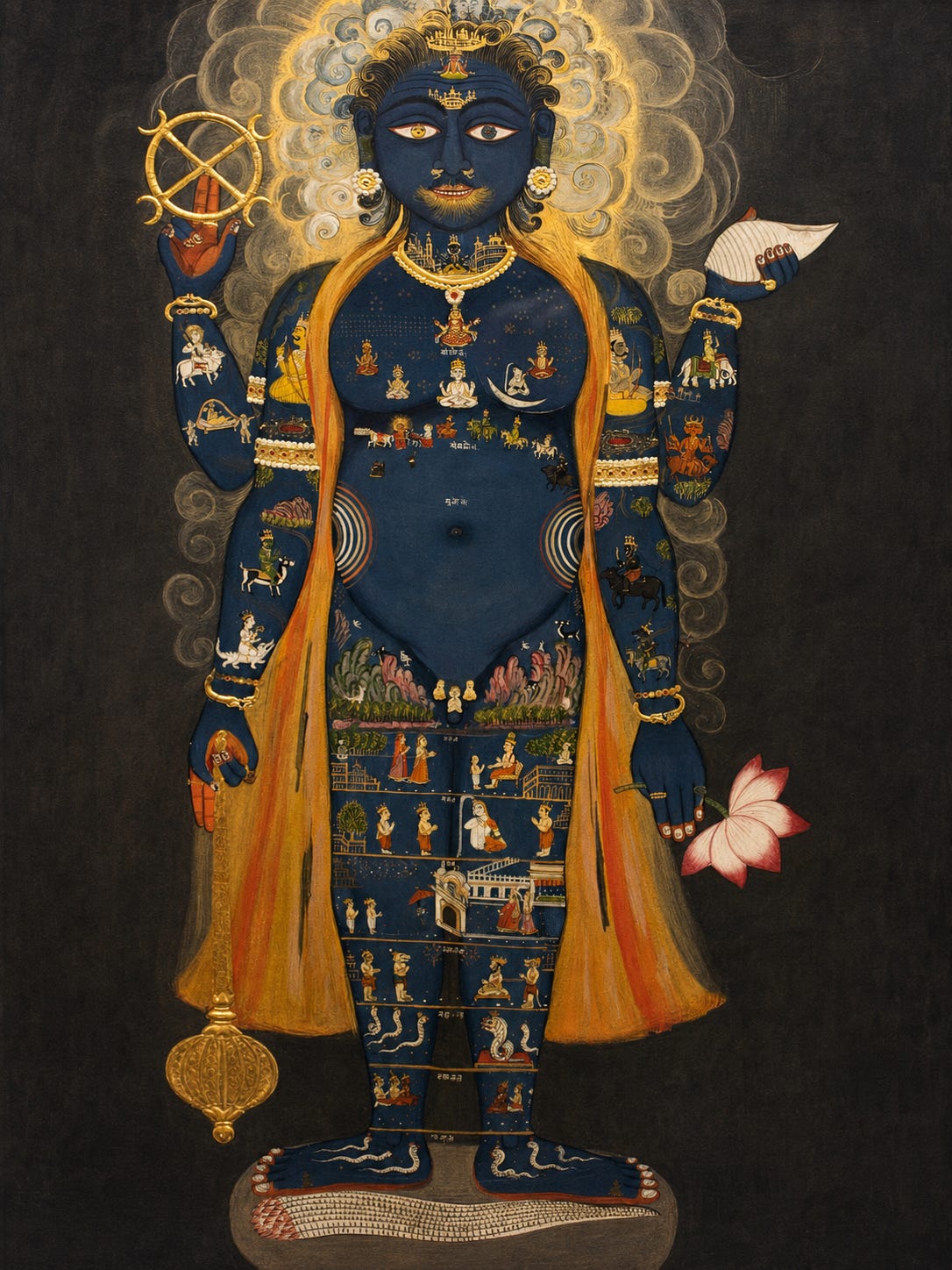
Gonda traced this idea across the whole Vedic and post Vedic literature, and the trail leads straight to one of the most familiar images in all of Hinduism. The navel is where life begins. A mother goddess of fertility broods over the navel of the earth, as the Greeks set their omphalos stone in the temple at Delphi. The cosmic pillar, the skambha of the Atharvaveda, rises from the centre and links earth to heaven, and the sacrificial post, the yūpa, which the texts say belongs to Viṣṇu “because Viṣṇu is the sacrifice,” is that pillar in wood, the axis of the world and the ladder by which the sacrificer climbs to the sky. The hymn of the All Maker, Viśvakarman, already speaks of the One “fixed upon the navel of the Unborn, on which all existence is established.” And out of all this comes the picture every Hindu child knows: Viṣṇu asleep on the cosmic serpent in the ocean of dissolution, and from his navel a lotus rising, and seated on the lotus the four faced Brahmā, beginning the world again. The god’s title for this is Padmanābha, the lotus naveled one. Gonda’s conclusion: the lotus from the navel “clearly forebodes the well known conception of later times,” for the navel of Viṣṇu is “the centre of the universe, the source of existence,” and it is no accident that the deity who came to occupy that centre was Viṣṇu, “who in Vedic times was the sacrifice.”
This is the same cosmic centrality that Kuiper reached from a different direction when he called Viṣṇu more important than Indra, the totality that stands above the dual cosmos. Two of the most careful readers of the Veda, one working from the strides and the other from the navel, arrive at the same place. And Gonda’s whole book closes on the word that names it. The essence of the god, he decided after weighing every aspect, is pervasiveness: “the actual penetration of the provinces of the universe must indeed be considered a central feature,” the name itself coming from the root to pervade. The strider strides because he pervades, and a pervader is, of necessity, everywhere at the centre.
To follow the story forward we have to bring in a second name, because the supreme God of classical Vaiṣṇavism is carried, in the earliest texts, as much by the name Nārāyaṇa as by the name Viṣṇu. This is one of the most important and least appreciated facts in the whole subject, and it sharpens the antiquity argument rather than weakening it.
Nārāyaṇa is, on the face of it, a non Vedic deity. He does not appear in the Ṛgveda at all. He enters the record in the Śatapatha Brāhmaṇa, the great ritual prose of the White Yajurveda, and he enters already cosmic. In one passage he sends forth the classes of gods, the Vasus, Rudras, and Ādityas, through the three daily pressings of the sacrifice, and then, by performing a five day rite called the pañcarātra sattra, “gained superiority over all beings and became identical with all beings.” His litany, the text says, is the Puruṣa Sūkta, the hymn of the cosmic Person whose body becomes the universe. From his first appearance, then, Nārāyaṇa is identified with Puruṣa, the thousand headed primeval Man of Ṛgveda 10.90. Jaiswal draws the conclusion: “already at the time of the composition of the Śatapatha Brāhmaṇa Nārāyaṇa was a deity of considerable eminence.”
The standard etymology she settles on, after rejecting the Dravidian one, derives the name from nara plus ayana, the goal or resting place where men go, so that Nārāyaṇa is the collective entity of Man, with Nara as the individual. It is this collective Man sense that generates the famous epic pairing of Nara and Nārāyaṇa, the twin sages, later read as Arjuna and Kṛṣṇa.
Here Jaiswal makes her boldest and strangest claim, the kind of thing popular accounts skip. The five day rite that Nārāyaṇa performs in the Śatapatha, the pañcarātra sattra, was, in the older stratum of the text, the Puruṣamedha, the human sacrifice. And since medha means food, Puruṣamedha means, literally, human food. Reading Nārāyaṇa as the collectivity of Man, Jaiswal traces the deity to a tribal institution of human sacrifice, a man killed for the good and the food of the whole community, only later turned symbolic. In her words, the Śatapatha passage “undoubtedly discloses Nārāyaṇa’s connection with the institution of human sacrifice,” and “if Nārāyaṇa signified the collectivity of man, it was for the good of the whole tribe that a human being was killed, originally to provide food for the entire community of men, and later for ritual purposes.”
She finds the survival of this in a ritual that the manuals still describe, the Nārāyaṇa bali, an offering to Nārāyaṇa performed for those who die an unnatural death, by suicide or violence, for the uncremated, and for those guilty of the five great sins. She reads it as “a remnant of some earlier ritual in which human beings were unnaturally put to death in honour of Nārāyaṇa.” And she sets it against its twin, the Viṣṇu bali, a rite performed in the eighth month of pregnancy to secure an easy delivery, a fertility rite. The two never blur in the texts, and the contrast tells her something about origins: Nārāyaṇa carries the memory of human sacrifice, Viṣṇu the memory of fertility, two originally distinct figures who would later fuse.
This theme has a striking afterlife in the Vaiṣṇava scriptures themselves, where the tradition turns against the very practice its oldest stratum may remember. In the Bhāgavata Purāṇa, in the chapter that describes the hells, the human sacrificers are consigned to torment, and the punishment is a perfect reversal:
“There are men and women in this world who sacrifice human beings, and then eat their victims’ flesh. Those who perform such sacrifices are taken after death to the abode of Yamarāja, where their victims, having taken the form of Rākṣasas, cut them to pieces with sharpened swords. Just as in this world the man eaters drank their victims’ blood, dancing and singing in jubilation, their victims now enjoy drinking the blood of the sacrificers and celebrating in the same way.”
The Sanskrit names the act puruṣa medhena yajante, “they worship by human sacrifice.” Whatever the deep origin of Nārāyaṇa, the developed Vaiṣṇava tradition damns the literal rite to hell. The seed and the flower can be very far apart.
How did this non Vedic cosmic Person become Viṣṇu? Jaiswal and the historians of the Bharatiya Vidya Bhavan school reconstruct a two step absorption, and the steps matter for the dating.
Nārāyaṇa was identified first with Prajāpati Brahmā, the creator, which makes sense, since both are cosmic Persons associated with the Puruṣa and with creation. Crucially, the animal forms that would later become Viṣṇu’s avatāras, the fish, the tortoise, the boar, are in the Brāhmaṇas the forms of Prajāpati, not of Viṣṇu. Only afterward was Nārāyaṇa identified with Viṣṇu, by which time Brahmā is demoted to the subordinate who sprouts from Viṣṇu’s navel. The Taittirīya Āraṇyaka seals the threefold identity in a single formula of meditation that any Vaiṣṇava can still recite:
nārāyaṇāya vidmahe vāsudevāya dhīmahi tan no viṣṇuḥ prachodayāt
“We contemplate Nārāyaṇa, we meditate on Vāsudeva, may Viṣṇu impel us.” Three names, one deity. R. C. Majumdar, the nationalist historian who edited the vast History and Culture of the Indian People, notes that this formula “regards Nārāyaṇa, Vāsudeva and Viṣṇu as one and the same deity,” and that the Mahābhārata, telling the same story, calls the supreme god Nārāyaṇa far more often than it calls him Viṣṇu. The name that would win in the end, Vaiṣṇava, the Viṣṇu name, was at this stage the rarer of the two. The dominance of the Viṣṇu element, as Jaiswal puts it, “is a later development, and in the beginning Nārāyaṇa was the deity par excellence.”
This is the honest complication I promised, and it makes the case stronger, not weaker. The supreme God theology of Vaiṣṇavism, the cosmic Person, the all pervader, the object of surrender, attaches in the earliest texts to Nārāyaṇa, who is non Vedic but Brāhmaṇa old and identified from the start with the Puruṣa. The Vedic Viṣṇu, the strider with the honey heaven, is the partner he fuses with. What we call Vaiṣṇavism is the confluence of more than one ancient river, the Vedic Viṣṇu, the cosmic Nārāyaṇa, and, as we will see next, the heroic Vāsudeva. All three are old. You can point to each one separately and date it deep.
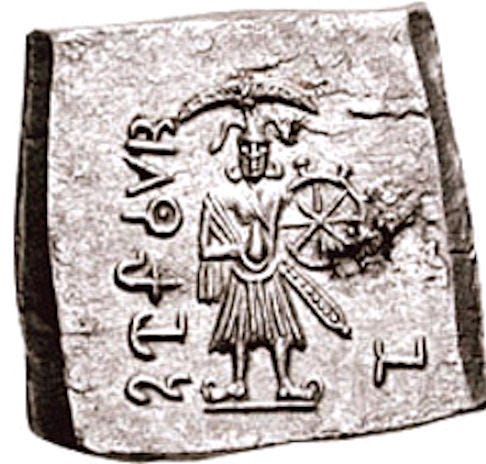
That completes the first age, the deity, with its three converging streams of Vedic Viṣṇu, cosmic Nārāyaṇa, and the third we turn to now. The second age is the worship, and it gathers around that third stream: Vāsudeva, the hero god of the Vṛṣṇi clan, the figure who would become Kṛṣṇa, and the one a Greek ambassador would soon put on a pillar as “the god of gods.” His cult is the best attested of the three in the last centuries BCE, and it is the matrix in which the words Bhāgavata and bhakti are first carved into stone.
The starting point for modern work on this is H. C. Raychaudhuri’s thesis, which Jaiswal summarizes and endorses: “Vāsudeva Kṛṣṇa, a hero of the Sāttvata sect of the Yādavas, was apotheosised first by his clansmen who imparted his worship to others.” A real man, or at least a legendary clan hero, deified by his own people, the Sātvatas, and then exported. Bhandarkar, two generations earlier, had already concluded from the evidence that this worship “must have originated long before the establishment of the Maurya dynasty,” that is, well before 320 BCE.
The witnesses line up across the fourth and third centuries. Pāṇini, the grammarian, perhaps in the fifth or fourth century BCE, frames a rule about a word for “one whose object of devotion is Vāsudeva,” and Patañjali, commenting on it around 150 BCE, glosses Vāsudeva as the name not of a warrior but of “the honourable one,” the god. Megasthenes, the Greek envoy to the Mauryan court around 300 BCE, reported that the people he called the Sourasenoi, the Śūrasena Yādavas of the Mathurā region, “held Herakles in especial honour,” and there is wide, though not universal, agreement that this Herakles is Vāsudeva Kṛṣṇa. Jaiswal, characteristically, reads the phrase against the maximalists: the words “especial honour,” she says, “clearly indicate that Kṛṣṇa was still a minor divinity, far from being the supreme god,” in 300 BCE. Even read at its most cautious, the witness puts an organized cult of the hero god at Mathurā around 300 BCE.
There is also an older, more uncertain thread. A Kṛṣṇa appears in the Ṛgveda itself, a dark skinned figure defeated by Indra on the river Aṃśumatī, the Jamna, and Jaiswal takes the name to “indicate a non Aryan genesis.” And the Chāndogya Upaniṣad, perhaps in the seventh or sixth century BCE, names a “Kṛṣṇa son of Devakī,” pupil of the sage Ghora Āṅgirasa. Edwin Bryant, who has surveyed this evidence as carefully as anyone, calls the Chāndogya reference “plausible but still questionable,” plausible because it gives Kṛṣṇa his mother’s name, Devakī, questionable because nothing later connects him with the sage Ghora. He leaves it open. But he then lays out a chain of references that is much harder to wave away, and the cumulative weight of it is the real argument. Follow the links. Yāska’s Nirukta, around the fifth century BCE, alludes to the Syamantaka jewel, a motif from a well known Kṛṣṇa story. Pāṇini, in the same period, frames his rule about the devotee of Vāsudeva and names the very clans of the Kṛṣṇa legend, the Andhakas and Vṛṣṇis. The Baudhāyana Dharma Sūtra invokes Viṣṇu under a string of twelve names, Keśava, Govinda, Dāmodara, names that “reveal an awareness of several stories that are fully developed in later texts.” The Buddhist Niddesa, in the Pali canon, speaks “somewhat derogatorily of those devoted to Vāsudeva and Baladeva,” and a hostile witness who bothers to sneer is a witness to a cult worth sneering at. And the gāyatrī of the Mahānārāyaṇa Upaniṣad fuses the three names, Nārāyaṇa, Vāsudeva, Viṣṇu, in one breath, while, Bryant notes, “the same mantra appears in the much earlier Yajur Veda without mentioning Vāsudeva,” letting us watch the hero’s name being threaded into an older Vedic formula. From Pāṇini to the Heliodoros pillar the testimony is continuous, and Bryant’s conclusion is the sober one: the worship of the divine Vāsudeva “had already developed deep roots” by the time a Greek bowed to it.
Four inscriptions, cut between roughly the second century BCE and the first CE, settle the matter. Together they establish, beyond reasonable doubt, an organized, named, image worshipping cult of Vāsudeva in the centuries BCE.
The most striking of them was raised by a man who was not even an Indian. Around 113 BCE, on the road outside Vidiśā, a Greek named Heliodoros, son of Dion, an ambassador of the Indo-Greek king Antialkidas, set up a tall stone pillar crowned with Garuḍa, the eagle that carries Viṣṇu, and on it he carved this:
“This Garuḍa standard of Vāsudeva, the god of gods, was set up here by Heliodora the Bhāgavata, son of Dion, a man of Takṣaśilā, the Greek ambassador who came from the great king Antialkidas to king Kāśīputra Bhāgabhadra the saviour, prospering in the fourteenth year of his reign.”
A second inscription on the shaft adds three steps that lead to heaven, self restraint, charity, and vigilance, so he knew the ethics as well as the name. A foreign diplomat, two thousand years ago, calling himself a Bhāgavata and raising a standard to Vāsudeva as “the god of gods.” It was on the strength of this and the inscriptions beside it that Bhandarkar called the early evidence “irrefragable” and judged the worship of Vāsudeva “as old as Pāṇini.”
The Ghosundi inscription of the first century BCE, near Nagari in Rajasthan, records a Bhāgavata king named Sarvatāta, who had performed a horse sacrifice, building a stone enclosure of worship, a Nārāyaṇa vāṭikā, for the gods Saṃkarṣaṇa and Vāsudeva, whom it calls sarveśvara, the lords of all, the undefeated. Two things matter here. The pairing of Saṃkarṣaṇa with Vāsudeva, and the placing of their shrine inside a Nārāyaṇa enclosure, which already hints at the fusion of the hero cult with the cosmic Nārāyaṇa, in stone, in the first century BCE.
The Nānāghāṭ cave inscription of about the same date, set up by the Sātavāhana queen Nāganikā, opens its invocation with a row of gods, “Dharma, Indra, Saṃkarṣaṇa, Vāsudeva, the Moon, the Sun, and the four guardians of the quarters.” The hero pair has entered the formal, royal, almost Vedic invocation.
And the Mora well inscription near Mathurā, of the first century CE, records a woman named Toṣā setting up, in a stone shrine, the images of “the holy five heroes of the Vṛṣṇis,” the bhāgavataṃ pañcavīrāṇām, meant for worship. Stone images, in a temple, of the deified Vṛṣṇi heroes, by the first century CE. The image cult is not a medieval development.
That phrase, the five heroes of the Vṛṣṇis, opens a window onto something older and stranger than the tidy theology that came later, and it is one of the richest parts of Jaiswal’s book.
Before Vāsudeva became the supreme God, he was one of a group of deified clansmen, and Jaiswal argues that the oldest layer of the Vṛṣṇi cult was centred not on a male hero at all but on a goddess. Her name was Ekānaṃśā, the sister of Vāsudeva and Baladeva, “the black goddess,” whom Jaiswal identifies as “the tribal goddess of the Vṛṣṇis.” Her case is detailed: a Kuṣāṇa relief from Mathurā shows the goddess standing between Balarāma and Keśava, and as late as the sixth century the astronomer Varāhamihira still prescribes flanking her image with the two brothers. From this she draws a striking conclusion: “the cult of Ekānaṃśā is much older than that of Baladeva and Vāsudeva, who appeared in the beginning simply as associate male gods of the more important female divinity; but with the changeover of social conditions, from a matriarchal to a patriarchal state, the goddess lost her importance and the male gods received greater prominence.” The scaffolding she hangs this on, a primeval matriarchy giving way to patriarchy, is a nineteenth century evolutionary scheme that anthropology has long since set aside, and it is the weakest timber in her case. But the observation underneath it does not depend on the scheme: the goddess is demonstrably there early, flanked by the two brothers, and she demonstrably fades. The brothers, in this reading, began as the goddess’s attendants and ended as gods in their own right, while she faded into Subhadrā, the sister at Jagannātha Purī, or was absorbed into Durgā and Śrī.
The elder brother, Saṃkarṣaṇa Baladeva, is himself a study in absorption. Jaiswal traces him to a serpent cult and an agrarian one at once. He is mentioned first in the Arthaśāstra, where spies disguised as his ascetic devotees drug an enemy’s cowherds, and “his predilection towards strong drinks was known.” His weapons are the plough and the pestle, the tools of farming. His very name means the act of ploughing or furrowing. He is “an incarnation of Śeṣanāga,” the cosmic serpent, and a snake comes out of his mouth at his death. “If we dissociate the nāga element from the character of Saṃkarṣaṇa Baladeva,” Jaiswal writes, “hardly anything distinctive remains.” Megasthenes, she suggests, glimpsed him as a kind of Dionysos, the god who “first yoked oxen to the plough,” and Arrian’s note that this Indian Dionysos was older than Herakles by fifteen generations she reads as a memory that Saṃkarṣaṇa, the elder brother, was felt to be the older god. The later theology would invert this too, demoting “the elder brother to the subordinate, anomalous position of a mere emanatory form of the supreme god Vāsudeva.”
Out of this cluster of clan heroes the developed Bhāgavata theology built its most distinctive doctrine, the vyūhas, the four emanations. Jaiswal states the full cosmogony:
“the supreme god bhagavat in his transcendental highest form Vāsudeva creates from himself the vyūha Saṃkarṣaṇa and prakṛti, the primeval matter. From the association of Saṃkarṣaṇa and prakṛti arise the vyūha Pradyumna and manas, the cosmic mind; and from the association of these two emanate the vyūha Aniruddha and ahaṃkāra, cosmic self consciousness.”
Vāsudeva, Saṃkarṣaṇa, Pradyumna, Aniruddha, four deified Vṛṣṇi kinsmen turned into a metaphysics of the unfolding of God into the world. And here the dating is precise and agreed, because it is the very thing that tells us the system is later than the cult. Bhandarkar pointed out long ago that the Bhagavad Gītā “contains no allusion to the vyūhas,” so the Gītā predates the doctrine, and that the first century BCE inscriptions know only Vāsudeva and Saṃkarṣaṇa, “so that the system of four vyūhas was not fully developed up to that time.” Jaiswal puts the developed vyūha theology in the third or fourth century CE. The twenty four forms of Viṣṇu are later still; Jaiswal goes so far as to derive them from the twenty four Jain Tīrthaṅkaras, though that particular link is her own conjecture, and most would read the shared number as coincidence rather than borrowing.
It is the same split as before. The worship of Vāsudeva is pre Mauryan; the four fold metaphysics that explains him is of the Gupta age. Hold those two apart and most of the paradoxes in the subject go away.
The literary home of this theology is a long and strange section of the Mahābhārata called the Nārāyaṇīya, set into the great didactic book, the Śānti Parva, and there the epic openly theorizes a one God religion. Bhīṣma tells of a far northern land beyond the ocean of milk, Śvetadvīpa, the White Island, whose inhabitants are “radiant as the moon and devoted to Nārāyaṇa.” The decisive phrase, in Bibek Debroy’s translation, is exact and astonishing for a text of two thousand years ago: “those men, who live in Śvetadvīpa, worship one person alone.” They are ekāntins, men of single minded, exclusive devotion; “they are devoid of senses, they do not eat, their eyes do not blink”; and “they knew about the beneficial rituals of pañcarātra.” This is exclusive, single-God devotion, named and located and equipped with a ritual system, inside the epic, a long way from the vague henotheism the Veda is usually reduced to.
The God they worship is defined in the same section in terms that gather every thread of this essay. He is the cosmic Person beyond the principles of the philosophers: “he is beyond the twenty four principles and is known as the twenty fifth. He is known as Vāsudeva, the eternal supreme soul.” He is the source and end of all: “everything in the universe, mobile and immobile, is generated from me. Those who are devoted to me enter me and are emancipated.” And he unfolds himself in the four forms the Bhāgavatas worshipped, the vyūhas: from him comes Saṃkarṣaṇa, from Saṃkarṣaṇa Pradyumna, from Pradyumna Aniruddha, and from Aniruddha the lotus born Brahmā who makes the world. The cosmic Nārāyaṇa, the Vṛṣṇi Vāsudeva, the four fold God of the Bhāgavata cult, and the exclusive devotion of the white islanders are all one doctrine here, the doctrine the epic calls the Sātvata way, to be told, it warns, only to a devotee.
The epic also knows that this is a contested claim, and it stages the contest. At the great royal sacrifice in the Sabhā Parva, when Bhīṣma directs that the first honour of the assembly be given to Kṛṣṇa, a king named Śiśupāla rises to object, and his objection is precisely the rationalist, status conscious one a modern sceptic might make. Kṛṣṇa, he says, “is not even a king,” “not a sacrificial priest, or a preceptor”; to honour him above crowned kings is mere favouritism, “like a dog that has found an offering of sacrificial ghee and consumes it in private.” We have seen, he sneers, “what Vāsudeva is. We have seen everything exactly as it is.” It is the voice of the man who counts only what can be counted. And the answer Bhīṣma gives is the answer of this whole tradition: “the entire universe and everything are established in Vāsudeva. The worlds owe their origin to Kṛṣṇa, and in him are they dissolved. Since he does not know that Kṛṣṇa is always everywhere, this Śiśupāla is only a child.” The argument over whether the cowherd’s kinsman is also the ground of the world is not a modern invention. The epic has it out, in the hall, before the war.
Now the concession I promised, made in full, because the argument is strong enough to carry it and because hiding it would be dishonest.
The Kṛṣṇa most people picture first, the butter thief of Vṛndāvana, the flute player, the lover of the cowherd girls, the gopīs, is not the oldest Kṛṣṇa. He is, in Jaiswal’s careful reconstruction, a later graft, “largely the result of his identification and amalgamation with the worship of some youthful god of the Ābhīra tribe,” a pastoral herding people of the early centuries CE. The Jain accounts of Kṛṣṇa, she notes, “show no knowledge of a pastoral and infant god Kṛṣṇa,” and the Padma Purāṇa has Viṣṇu announce that he will be born among the Ābhīras. The erotic element, the dance with the gopīs, “appears to have been largely responsible” for the introduction of the amorous material, reflecting “the exigencies of a nomadic life” that “required a greater freedom of sexes.” R. C. Majumdar, no minimizer of Hindu antiquity, reached the same verdict independently: this stratum “did not form part of the original creed.”
And Rādhā, the beloved of the later devotional imagination, is later still, essentially absent from the early sources altogether, a figure of the medieval bhakti efflorescence that runs through the Tamil Āḻvārs and, later, Bengal.
One honest qualification runs the other way, and it belongs here because it fits the same pattern as everything else. Already in the Ṛgveda, in the very hymn of the three strides, Viṣṇu is called gopā, the herdsman: trīṇi padā vi cakrame viṣṇur gopā adābhyaḥ, which Griffith renders “Viṣṇu, the Guardian, he whom none deceiveth, made three steps.” The word means, literally, a keeper of cattle, and Sāyaṇa glosses it here as the protector of all the worlds, the guardian who cannot be deceived. This is not yet the boy with the butter and the flute. But the cattle keeping coloring is on Viṣṇu from the beginning, of a piece with the god of the embryo and the ghee we met in Part One, and when a cowherd god finally rose to the centre of the religion he turned out to be a form of Viṣṇu and no one else. Even the cowherd has a Vedic seed. What is genuinely late is the romance grown around him, the gopīs and the butter and Rādhā, not the herdsman himself.
So the romantic Kṛṣṇa really is young. Saying so costs the case nothing. The Vāsudeva whom Heliodoros worshipped around 113 BCE was the warrior god, the kinsman hero, the Bhāgavata’s “god of gods,” not the cowherd of Vṛndāvana. The antiquity I am defending is the antiquity of that god, and of the Vedic Viṣṇu and the cosmic Nārāyaṇa he merged with, not of every later flower on the tree.
One more stream completes the classical figure, the goddess Śrī Lakṣmī, and her history is a small model of the whole.
She begins as two goddesses, Śrī and Lakṣmī, fertility and fortune, merged by the time of the Brāhmaṇas. The earliest hymn to her, the Śrī Sūkta, is a supplement attached to the Ṛgveda. Jaiswal, and a line of German scholars before her, read her original character as a pre Aryan goddess of fertility and vegetation: she is “moist,” “ever nourished,” “abounding in cow dung,” “born through the mire,” and her oldest images, the Gaja Lakṣmī type with the goddess on a lotus flanked by elephants, go back to the second and first centuries BCE at Bharhut and Sanchi. For most of her early life she is independent, “worshipped in her own right quite unallied with any sectarian cult,” and where she does attach to a male god it is first to Indra, or to Kubera the lord of wealth, or to Kārttikeya, not to Viṣṇu.
Her marriage to Viṣṇu is a Gupta age event, and Jaiswal dates it with unusual sharpness: “the goddess was united with the god towards the beginning of the Gupta period,” in “the third or fourth centuries A.D.” The verses of the Śrī Sūkta that link her to Viṣṇu, she notes, “are very late interpolations, certainly post Gupta.” The Gupta inscriptions are the first to call Viṣṇu the permanent abode of Lakṣmī. The lotus, her emblem, is the last of the four attributes to be added to Viṣṇu’s hands, and Jaiswal reads its arrival as the sign of her absorption. By the sixth century the Ahirbudhnya Saṃhitā has made her his śakti, his power.
The divine couple at the centre of later Vaiṣṇavism is an ancient, independent goddess married to the god in the Gupta age: old goddess, old god, late marriage.
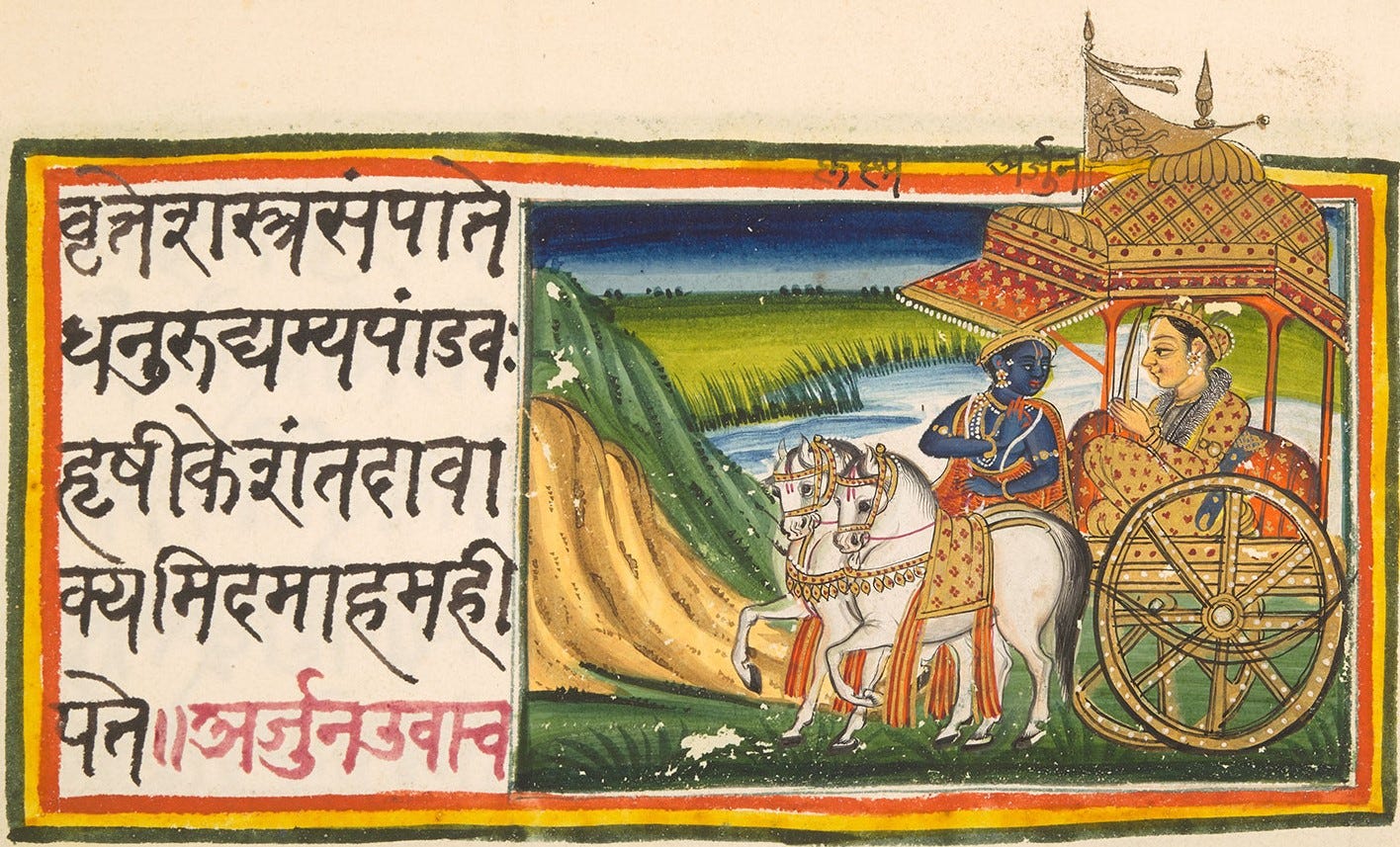
No account of Viṣṇu can skip the text in which the whole theology speaks in the first person, the Bhagavad Gītā, the seven hundred verses set into the sixth book of the Mahābhārata in which Kṛṣṇa, on the field of Kurukṣetra, reveals himself to Arjuna as God. It is, in Jaiswal’s words, “a Bhāgavata document,” and it is where the doctrine of devotion “finds its first clear exposition.”
There is a subtlety here that most readers miss, and it ties the Gītā straight back into the argument of Part Two. The God of the Gītā names himself in several registers, and he treats both Viṣṇu and Vāsudeva as instances rather than as his own name. In the tenth chapter, listing the forms in which he is supreme, he says ādityānām ahaṃ viṣṇuḥ, “among the Ādityas I am Viṣṇu,” and vṛṣṇīnāṃ vāsudevo ‘smi, “of the Vṛṣṇis I am Vāsudeva.” He stands behind both names. Jaiswal draws the natural inference, that the supreme speaker of the Gītā is the cosmic Nārāyaṇa, the bhagavat, into whom both the Vedic Viṣṇu and the Vṛṣṇi Vāsudeva are being gathered. The text is even called, in tradition, the Nārāyaṇīya Gītā, and the Buddhist writer Āryadeva, around the end of the second century CE, attributes its verses to Nārāyaṇa. The Gītā is the literary act of fusion itself, the moment the three rivers are declared to be one water.
The Gītā is also where the doctrine of the avatāra, the descent of God into the world, receives its classic statement, in the fourth chapter:
yadā yadā hi dharmasya glānir bhavati bhārata abhyutthānam adharmasya tadātmānaṃ sṛjāmy aham paritrāṇāya sādhūnāṃ vināśāya ca duṣkṛtām dharma saṃsthāpanārthāya sambhavāmi yuge yuge
“Whenever there is a withering of dharma, Bhārata, and a rising up of adharma, then I send forth myself. For the protection of the good and the destruction of evildoers, to set dharma firmly in place, I come into being age after age.”
Two things here matter. First, the verb. As the philologists point out, the word avatāra itself, the descent, is not yet used here. The Gītā says sambhavāmi, I come into being, sṛjāmi, I send forth. The noun “avatāra” is a later coinage; the Gītā and the Nārāyaṇīya speak of births and appearances, prādurbhāva. The technical doctrine is later than the idea. Second, the priority of purpose. The line puts the protection of the good first and the destruction of the wicked second, an ordering the later theologians, as we will see, made into a principle.
The Gītā knows, and says, that a God who walks the earth as a man will be taken for one. “The deluded despise Me,” Kṛṣṇa says, “clad in human form, not knowing My higher being as the great Lord of beings” (9.11). It is a remarkable verse, because it is the theological mirror image of the modern historian’s question. The scholar asks whether Kṛṣṇa was a man who was later raised to God; the Gītā answers that he is God who came down as a man and was mistaken, by the dull, for less. Whichever way you read the history, the text itself is built around exactly that paradox, the supreme being in a human body, “than whom nothing higher exists,” yet driving another man’s chariot. “On Me all this universe is strung,” he says in the same breath, “like pearls on a thread” (7.7).
And the Gītā ends on the note that the whole later tradition would build into its central doctrine. After all the paths, the knowledge and the works and the meditation, the last word is surrender: “Abandoning all duties, take refuge in Me alone. I shall liberate you from all evils; do not grieve” (18.66). This single verse, the caramaśloka or final verse, becomes the seed of prapatti, the doctrine of self surrender that Rāmānuja, a thousand years later, would make the path open to everyone, of every caste and either sex. The road from the Bronze Age strider runs through this line.
And the Gītā is where the god shows what he is. In the eleventh chapter Arjuna asks to see the divine form behind the friend and charioteer, and Kṛṣṇa grants it, first giving him the divine eye to see with, then unveiling the viśvarūpa, the universal form, the whole cosmos blazing in a single body. “If a thousand suns should rise all at once in the sky,” the text says, “such splendour would resemble the brightness of that Great Self.” It is the Puruṣa of the Ṛgveda, the thousand headed Person whose body is the universe, made visible to one terrified man, and at its heart is the most chilling self definition in the poem: kālo ‘smi, “I am Time, the mighty cause of world destruction, who has come forth to annihilate the worlds.”
Two details of this vision matter for the argument of this whole essay. First, when Arjuna, overwhelmed, cries out, he does not call the form Kṛṣṇa. He calls it Viṣṇu. “I find neither courage nor tranquillity, O Viṣṇu,” he says (11.24), and again, “your terrible rays blaze forth, O Viṣṇu” (11.30). At the climax of the revelation the friend and the cosmic God are named as one, and the name is the Vedic one. Second, when Arjuna has had enough of the terror and asks for the familiar shape back, he asks for an icon: “I desire to see you wearing a crown, armed with a club, discus in hand. Become that four armed form” (11.46). The crown, the mace, the discus: this is the temple Viṣṇu, the four armed image of the Gupta sculptors, requested by name inside a text of the last centuries BCE. Jaiswal notes that the universal form “appears to have been originally associated with Nārāyaṇa,” its prototype the vision of the whole world inside the deity’s body in an older episode of the epic, when the sage Mārkaṇḍeya is swallowed by the cosmic child on the waters. The Gītā gathers the Vedic Puruṣa, the cosmic Nārāyaṇa, the temple icon, and the Vṛṣṇi hero into one revelation, and lets a trembling man name them all Viṣṇu.
Finally, the Gītā is the charter of bhakti, devotion, the path it commends above sacrifice and above austere knowledge: give me your mind, your offering, your reverence, and you will come to me. The later tradition would build everything on this. And it is over the origin of this one word that the modern schools divide most sharply, in a way that shows cleanly how method drives conclusion.
The dominant Indian historiography of the twentieth century, the materialist tradition of D. D. Kosambi, R. S. Sharma, and Jaiswal, derives bhakti not from feeling but from economics. Jaiswal’s etymology is the load bearing move of her whole reconstruction, and here it is in full:
“The terms bhagavat, bhakta, bhakti and Bhāgavata are derived from the root bhaj, which in its earliest use in the Vedic literature means to divide, distribute, allot, share with, or partake of. It is never used in the sense of to adore, or to serve, which is the usual meaning of the verb in later works. Similarly bhaga in the Ṛgveda meant wealth, share, a lucky share.”
On this reading, bhagavat, the one later worshipped as the Blessed Lord, originally meant simply the possessor of wealth, the tribal collective that owned the common goods; bhakti meant a share of that wealth; and bhakta, the devotee, originally meant the member who received his portion, which is why, she notes, the word bhakta still means a meal, and in agricultural society came to mean boiled rice. Devotion, in this account, begins as the distribution of food. The earliest religious sense, she adds, is “material and concrete,” and the early Vaiṣṇava inscriptions confirm the flavour: the Traikūṭaka kings describe themselves as “the hired labourers of the bhagavat,” and the relationship of god and devotee is “that of the master and the slave.” Loving, ecstatic devotion, she insists, comes later, with the Tamil Āḻvārs and later still with Bengal.
Against this stands the traditional theological reading, given its fullest modern statement by S. M. Srinivasa Chari, writing from inside the Śrī Vaiṣṇava school. Chari derives bhakti from the same root bhaj but in its other sense, to serve, to be devoted, and glosses it as snehapūrvam anudhyānam, “unceasing meditation suffused with love.” For him devotion is not a social residue but the central spiritual discipline, and its roots are Upaniṣadic. The two readings of one word, the economic and the devotional, mark the deepest fault line in the whole field, and we will come back to what it tells us. For now it is enough to note that both schools agree the Gītā is where the doctrine of bhakti receives its first clear exposition, in the last centuries BCE.
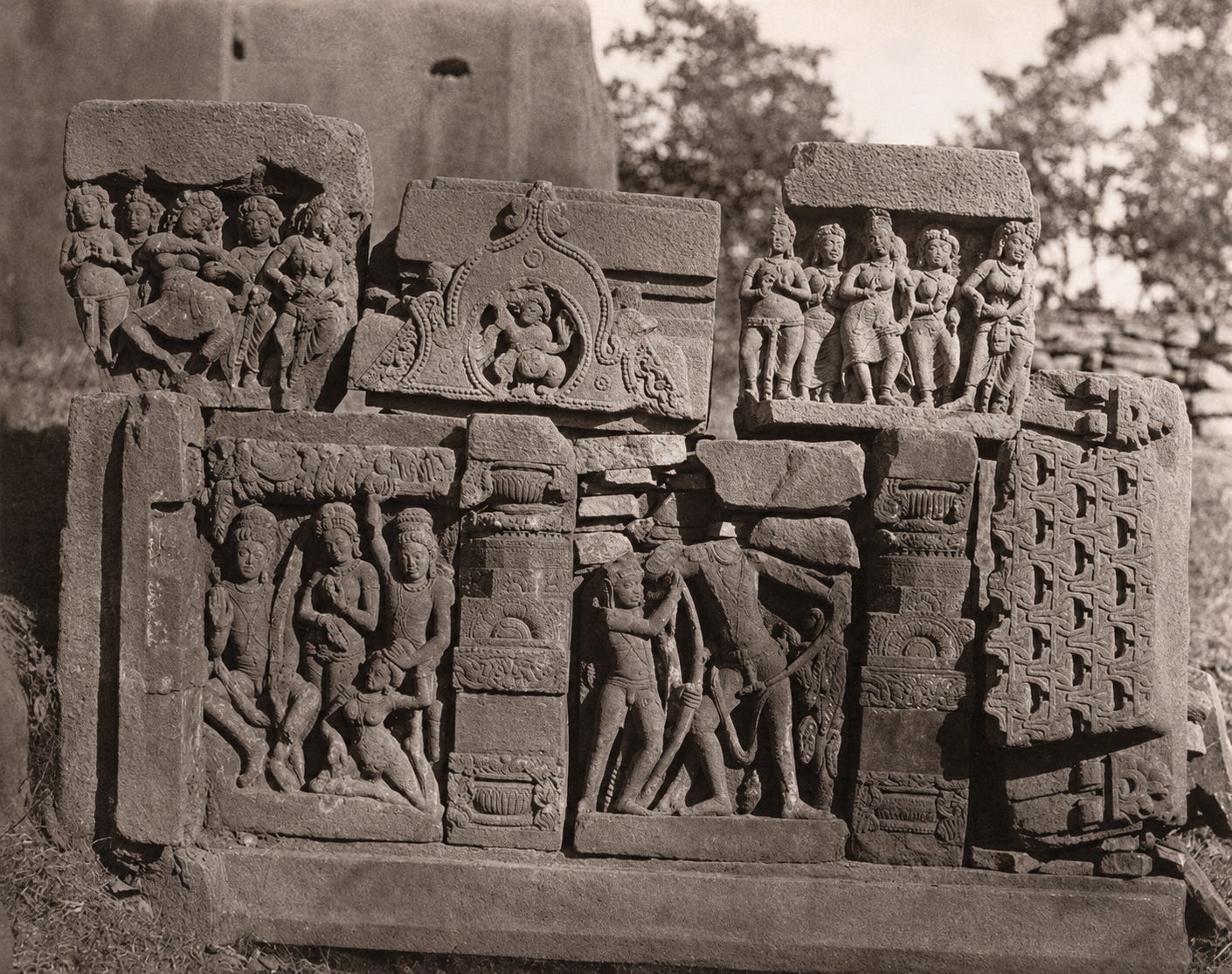
With the avatāras we reach the third age, the system, the part of all this that really is late. The daśāvatāra, the ten descents of Viṣṇu, is its showcase: fish, tortoise, boar, man lion, dwarf, axe wielding Rāma, Rāma of Ayodhyā, Kṛṣṇa, the Buddha, and the rider yet to come. And yet even in this last layer the same trick is at work. The fixed list is late; several of the figures on it are not. Some are Vedic, older than almost anything else in the religion. Some are cosmogonic acts annexed from another god. Some are deified men. One is a hostile takeover of a rival faith. Go through them one at a time and you watch Vaiṣṇavism build itself.
First, the doctrine. Jaiswal locates the engine of the whole theory in the fusion we have already traced: “the theory of incarnation seems to have evolved with the identification of bhagavat Nārāyaṇa with the hero god Vāsudeva Kṛṣṇa, who thus came to be looked upon as the human incarnation of the former.” The model, in other words, was Kṛṣṇa. Once one human form of God was admitted, the others followed.
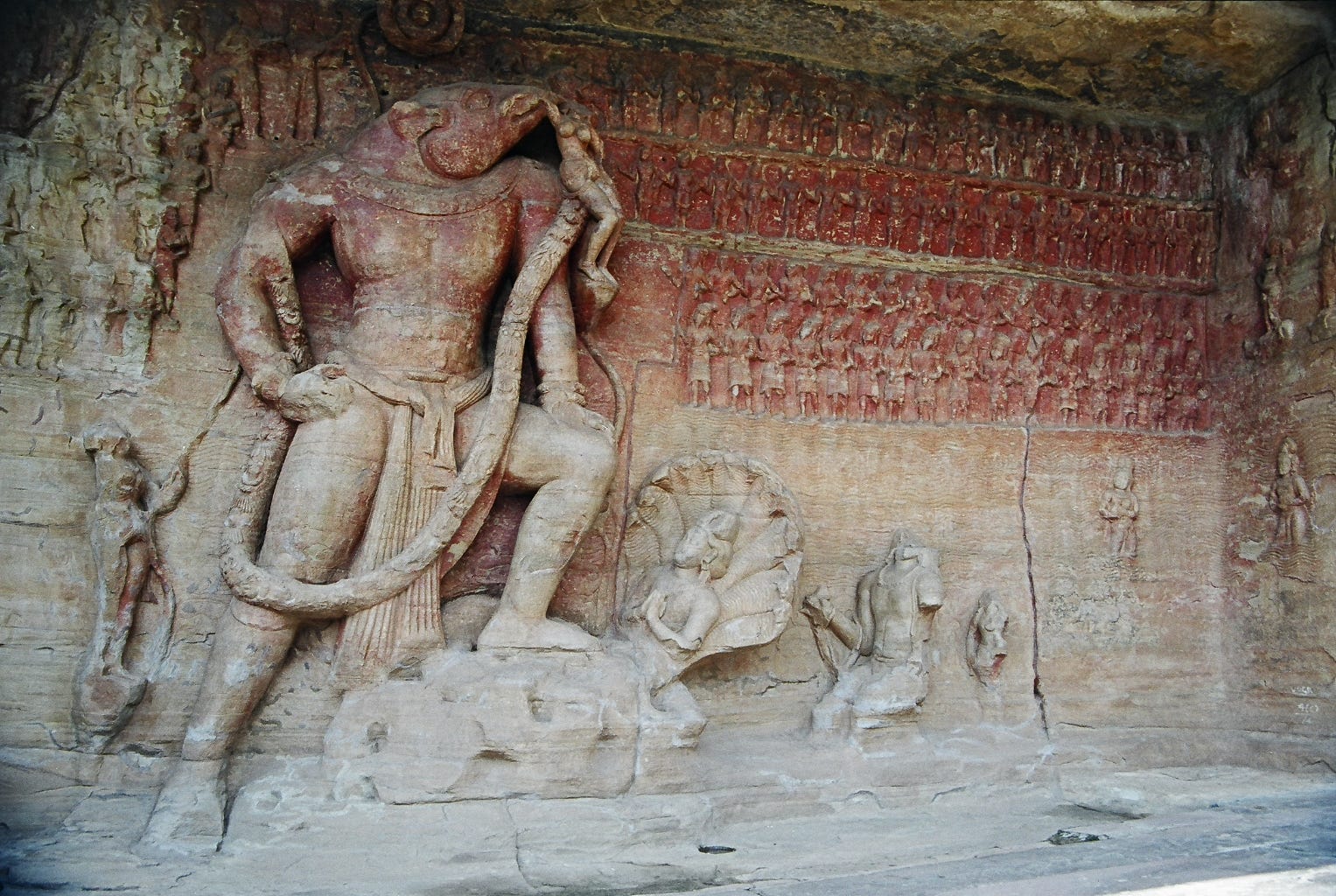
She and Bhandarkar agree, against the popular impression, that the famous ten are a late and unstable aggregation. The earliest list, in the Nārāyaṇīya section of the Mahābhārata, gives only four to six: in Bhandarkar’s reading of the text, “Varāha, Narasiṃha, the oppressor of Bali, Rāma of the Bhṛgu race, Rāma Dāśarathi, and he who will come for the destruction of Kaṃsa.” There is no fish, no tortoise, no Buddha, no Kalki in that oldest nucleus. The verse that lists the ten, Jaiswal notes, “is now proved to be a late interpolation.” The number grew over time, four to six to ten to, in the Bhāgavata Purāṇa, twenty two and even twenty four, and in the Pāñcarātra Sāttvata Saṃhitā, thirty nine. The standard ten, she observes, “did not find general acceptance much before the eighth century A.D.” The avatāra list is less an ancient creed than a roster that kept growing as the religion absorbed new gods.
A philological detail underlines the point. The very word avatāra, the descent, “is not used in early works.” The Gītā, the Nārāyaṇīya, and the Harivaṃśa speak of births, appearances, manifestations, prādurbhāva. The noun came after the idea. Jaiswal also stresses, and this matters for a reader of Indian history, that the doctrine was shaped in dialogue with Buddhism: “in this form the doctrine appears to have been considerably influenced by the Buddhist concept of the former Buddhas, whose prime attribute is compassion,” a concept with “chronological priority,” since “some of the former Buddhas are known to have been worshipped as early as the third century B.C.” The endless incarnations of Viṣṇu are modelled, in part, on the endless prior Buddhas.
Against all this stands the theologian’s view, and both belong in the picture. Chari, from inside the tradition, insists the descents are “not illusory manifestations but real,” that God takes them “out of His own free will,” not under the compulsion of karma, and that “His body in the avatāra stage is constituted of śuddha sattva, the pure spiritual substance,” so that the deity is never defiled by the world he enters. The purpose, he says, drawing the order straight from the Gītā, is twofold but unequal: “the protection of the ardent devotees and the destruction of the evil forces,” with protection primary and destruction “incidental,” since evil “can be carried out by God through His will without an incarnation.” Where the historian sees a roster of absorbed cults, the theologian sees the free self manifestation of the one God. Both readings will help us understand the individual descents.
A fish warns Manu of a coming flood, is reared until it is huge, and tows his boat to safety; in the Puranic retelling it also recovers the stolen Vedas. The flood story is among the oldest in the world, with its Mesopotamian cousins in Utnapishtim and Ziusudra, and the Indian version is textually very old: it is told in the Śatapatha Brāhmaṇa, around 800 to 600 BCE. But, and this is the recurring surprise, the fish there is not Viṣṇu. As Jaiswal notes, in the Mahābhārata the fish that saves Manu and the tortoise that supports the earth are mentioned “but it does not connect them with Viṣṇu. In the Brāhmaṇas, both figure as forms of Prajāpati, the creator god; and it appears that they were originally totems of some tribes.” Matsya becomes a descent of Viṣṇu only in the Puranic layer. Chari, tellingly, leaves the fish out of his Pāñcarātra list of thirty nine; it reaches the canonical ten from the Vedic and Puranic stream, not from the theological one.
Viṣṇu becomes a tortoise to serve as the pivot under Mount Mandara when the gods and demons churn the ocean for the nectar of immortality. Again the figure is old and again it begins elsewhere. In the Śatapatha Brāhmaṇa and the Taittirīya Saṃhitā the cosmogonic tortoise is Prajāpati, the creator, identified with Kaśyapa; the older Vedic image of the earth resting on a tortoise’s back is simply repurposed. Chari cites the Taittirīya Āraṇyaka for “the avatāra of Viṣṇu as tortoise,” but, as with the fish, Kūrma is absent from his thirty nine. The churning of the ocean, with the tortoise at its base, becomes a Viṣṇu story only in the epics and Purāṇas.
A boar dives into the cosmic waters and lifts the drowned earth on his tusks. This is the clearest case of all, the textbook example of a cosmogonic act annexed from Prajāpati. In the Taittirīya Saṃhitā, “Prajāpati, who was roaming as the wind, acquires the form of a cosmogonic boar lifting the earth goddess from the primeval waters.” The Śatapatha names the boar Emūṣa, echoing a Ṛgvedic epithet. The earth raising boar is Prajāpati’s deed, and only later, in the Purāṇas, is it transferred wholesale to Viṣṇu, with the demon Hiraṇyākṣa added as an antagonist. Here the historians and the theologians nearly touch: Varāha is one of the genuinely old figures, and Chari keeps him, at number sixteen, in his Pāñcarātra thirty nine. Jaiswal adds the sociological reading that runs through her whole treatment: “It is probable that the boar was a totem of some powerful non Aryan tribe undergoing brahmanisation in the age represented by the Brāhmaṇas.” The boar’s stronghold was the Vindhya country, and it was the most popular of all the descents in the Gupta age; the Hūṇa king Toramāṇa endowed a temple to “Nārāyaṇa who has the form of a boar” around the year 500.
To kill the demon Hiraṇyakaśipu, whom a boon protects from death by man or beast, by day or night, indoors or out, and to save the demon’s devout son Prahlāda, Viṣṇu bursts from a pillar at twilight as a being neither man nor lion and tears him open on a threshold, in neither category of the boon. This one is genuinely late. “With the exception of a late passage of the Taittirīya Āraṇyaka,” Jaiswal writes, “there is no reference to the god Narasiṃha in the Vedic literature.” She reads him as “originally a dreadful god,” a local terror of the Punjab to be propitiated, absorbed into Viṣṇu only in the early centuries CE, and scholars have long noticed that the plot of the boon outwitted is the old Vedic story of Indra killing Namuci, transferred to Viṣṇu. Chari ranks Narasiṃha seventeenth in his thirty nine and places him in the first age of the world; for the theologian he is the protector of the devotee Prahlāda, the descent that proves God comes for the sake of love before the sake of destruction.
A small Brahmin approaches the generous demon king Bali, begs three paces of land, and then swells to cosmic size, striding over earth and heaven and, with his third step on Bali’s head, pressing the demon down to the underworld. This is the oldest descent of all, and the reason is now familiar: it is the Ṛgvedic Viṣṇu himself, the strider of the three steps, turned into a story. Chari is explicit and correct: “the repeated statements in the Ṛgveda about the three strides refer to the Trivikrama avatāra of the Vedic period.” The Aitareya Brāhmaṇa has the three strides; the Śatapatha already calls Viṣṇu a dwarf, vāmana, in the passage Eggeling and Muir flagged as “the germ of the Dwarf Incarnation.” Everything that is distinctively Vedic about Viṣṇu, the measuring of the worlds, the making of room, the third step beyond mortal sight, is here. The dwarf disguise and the demon Bali are the later narrative scaffolding around an act that is three thousand years old. Jaiswal notes that the Bali story may even preserve “the suppression of a cult of Bali,” since the demon king himself received a kind of worship, remembered to this day in the Kerala festival of Onam, where Bali is the beloved king and Viṣṇu the trickster who displaced him.
A Brahmin warrior, son of Jamadagni, avenges his father by exterminating the warrior caste “twenty one times.” He is not Vedic, and he is not, at first, divine. He appears in the Mahābhārata as a warrior Brahmin “with no divine or avatāra status,” and his identification with Viṣṇu “occurs only once” in the epic. Jaiswal reads him as a sectarian fabrication: “the apotheosis of Bhārgava Rāma, better known as Paraśurāma, was the work of the Bhṛgu Brahmins, the redactors of the Mahābhārata,” who “evolved between the second and the fourth century A.D.” his legends of glory and humiliation. Chari, revealingly, classes him not as a full descent but as an āveśāvatāra, a possession incarnation, “in whom God pervaded his body,” a partial and lesser mode. A descent that even the tradition ranks as second tier, and that the historians read as a caste charter dressed up as theology.
The prince of Ayodhyā, exiled, whose wife Sītā is carried off by Rāvaṇa of Laṅkā, whom he then destroys, the very pattern of dharma. His epic, the Vālmīki Rāmāyaṇa, has a long compositional history, and the deifying material is concentrated, the philologists agree, in the first and last books, the Bāla and Uttara Kāṇḍas, “generally regarded as later additions made presumably in the second century A.D.” In the older core Rāma is, as the consensus puts it, “more human than divine,” and in the Pāli Dasaratha Jātaka he is a Bodhisattva, with Sītā as his sister become wife and no abduction at all, “the most primitive feature of the Rāma legends available to us.” Jaiswal’s verdict is exact: there is nothing to show that Rāma Dāśarathi was adored as an incarnation of Viṣṇu in the centuries BCE, “but he was certainly worshipped as such in the Gupta period.” She even recovers an older Sītā beneath the queen, the furrow goddess of the agricultural rites, “the goddess of the farmers,” once flanked, like Ekānaṃśā, by two brother gods. Chari, by contrast, ranks Rāma among the two pūrṇa or perfect descents, “perfect ideal human beings symbolising the very dharma,” whose special gift was “to reveal the secret of śaraṇāgati,” self surrender, as the path to God. The historian dates the deification to the Gupta age; the theologian reads the perfected man as the eternal God. Both are looking at the same prince.
We have already met him as the Vṛṣṇi hero, the Bhāgavata’s god, the speaker of the Gītā, and the figure onto whom the late Ābhīra cowherd was grafted. In the logic of the avatāra doctrine he is not one descent among ten but the first and the model, the human form of God whose success generated the whole theory. Bhandarkar’s sharpest observation belongs here: even in the Gītā, “the identification of Vāsudeva with Nārāyaṇa had not taken place, nor had his being an incarnation of Viṣṇu come to be acknowledged.” Kṛṣṇa’s own status as an avatāra of Viṣṇu is itself a development; he begins as a god in his own right, the hero of the Sātvatas, and is folded into Viṣṇu rather than budding from him. For Chari he is the supreme pūrṇa descent, in the deepest Śrī Vaiṣṇava reading the very Para Vāsudeva come down in full.
There is a final twist here, and it shows how alive this material stayed. In the Mahābhārata, the Harivaṃśa, and the Viṣṇu Purāṇa, Kṛṣṇa is without question an incarnation of the transcendent Viṣṇu. But the Bhāgavata Purāṇa quietly turns it around. Where the other descents are called partial, a portion or a ray of God, of Kṛṣṇa alone it says kṛṣṇas tu bhagavān svayam, “but Kṛṣṇa is God himself.” Bryant notes that this half line “becomes something of a mahāvākya,” a great utterance, for the Kṛṣṇa sects, and that the sixteenth century theologians, Vallabha and Caitanya, took it to its logical end and held that it is “not Kṛṣṇa who is an incarnation of Viṣṇu but Viṣṇu who is a partial manifestation of Kṛṣṇa.” The cowherd who began as the junior partner ends up swallowing the senior. A tradition that can flip its own hierarchy and keep going for centuries is not something brittle or freshly bolted together.
The ninth descent is the showpiece of the whole syncretic machinery, and also the place where two of the traditions in our corpus openly disagree. In the standard Puranic list Viṣṇu is born as the Buddha, and in the orthodox framing he does it in order to delude the impious into abandoning the Vedas, so that they can be destroyed, a backhanded canonization of the rival founder as a deliberate divine deception. The identification is firmly datable: Hindus came to regard the Buddha as a descent of Viṣṇu only between about 450 and the sixth century CE, first in the Viṣṇu Purāṇa. Jaiswal, against the cynical reading, argues that the move was not a brahmin trick but a popular rapprochement, that “the identification of the Buddha with Nārāyaṇa was not the result of a clever machination on the part of the brāhmaṇas,” noting that the Buddhist Lalitavistara itself already calls the Buddha Nārāyaṇa and Mahāpuruṣa.
And here is a detail that says everything about how constructed the famous ten really are. In the Śrī Vaiṣṇava tradition that Chari represents, the ninth descent is not the Buddha at all. Chari’s list of ten names, in the ninth slot, Balarāma, the elder brother, and omits the Buddha entirely. The Buddha had to be inserted into the popular list around the sixth century, displacing Balarāma, and a major theological school never accepted the substitution. The “canonical ten” are canonical only by sect and by century. There is no fixed, eternal, agreed list, and the fact that one tradition worships Balarāma where another worships the Buddha in the same numbered slot is the proof.
The tenth descent has not happened. At the end of the present dark age, the Kali Yuga, Viṣṇu will be born as Kalki, a Brahmin of the village of Śambhala, and ride out on a white horse with a blazing sword to destroy the wicked and restore the age of truth. The figure is in the Mahābhārata’s forest book and elaborated in the Purāṇas. Jaiswal suggests his conception “may have been inspired by the idea of Maitreya, the Buddha of the future,” and that in the Purāṇas he becomes “the symbol of the ultimate triumph of brahmanism.” Chari lists him, at number thirty eight of the thirty nine, as “the form of Viṣṇu riding over a horse, yet to take place at the end of the Kali yuga,” whose purpose is “re establishing the lost dharma.” A future descent is a useful thing for a religion to keep in reserve, and it has been claimed by more than one ambitious man across the centuries.
Step back from the individual stories and a clear shape appears, and it is the shape of the whole essay in miniature. The fish, the tortoise, and the boar are cosmogonic acts of Prajāpati, the creator, annexed to Viṣṇu in the Puranic period; the man lion and the axe Rāma are late absorptions of fierce local or sectarian gods, the one carrying the old Indra and Namuci plot, the other a caste charter; the dwarf alone was always Viṣṇu’s, the Ṛgvedic strider in narrative dress; Rāma and Kṛṣṇa are deified heroes, the human descents that drove the doctrine; the Buddha is a sixth century polemical annexation that one major school never accepted; and Kalki is the apocalypse held in reserve. The ten are not a single ancient revelation. They are the sediment of a religion absorbing the gods around it across two thousand years, with the oldest layer, the dwarf, reaching back to the Bronze Age strider with whom we began.
The story does not stop at the Gupta temples. If the first thousand years of Viṣṇu’s history is the slow fusion of the Vedic strider, the cosmic Nārāyaṇa, and the Vṛṣṇi hero, the next thousand is the long flowering of devotion to the god they became. It is here that the bhakti the colonial scholars wanted to credit to Christianity actually unfolds, out of entirely Indian roots, into the religion a third of India still practises. Bhandarkar’s 1913 book remains the clearest map of it, and most of what follows is his.
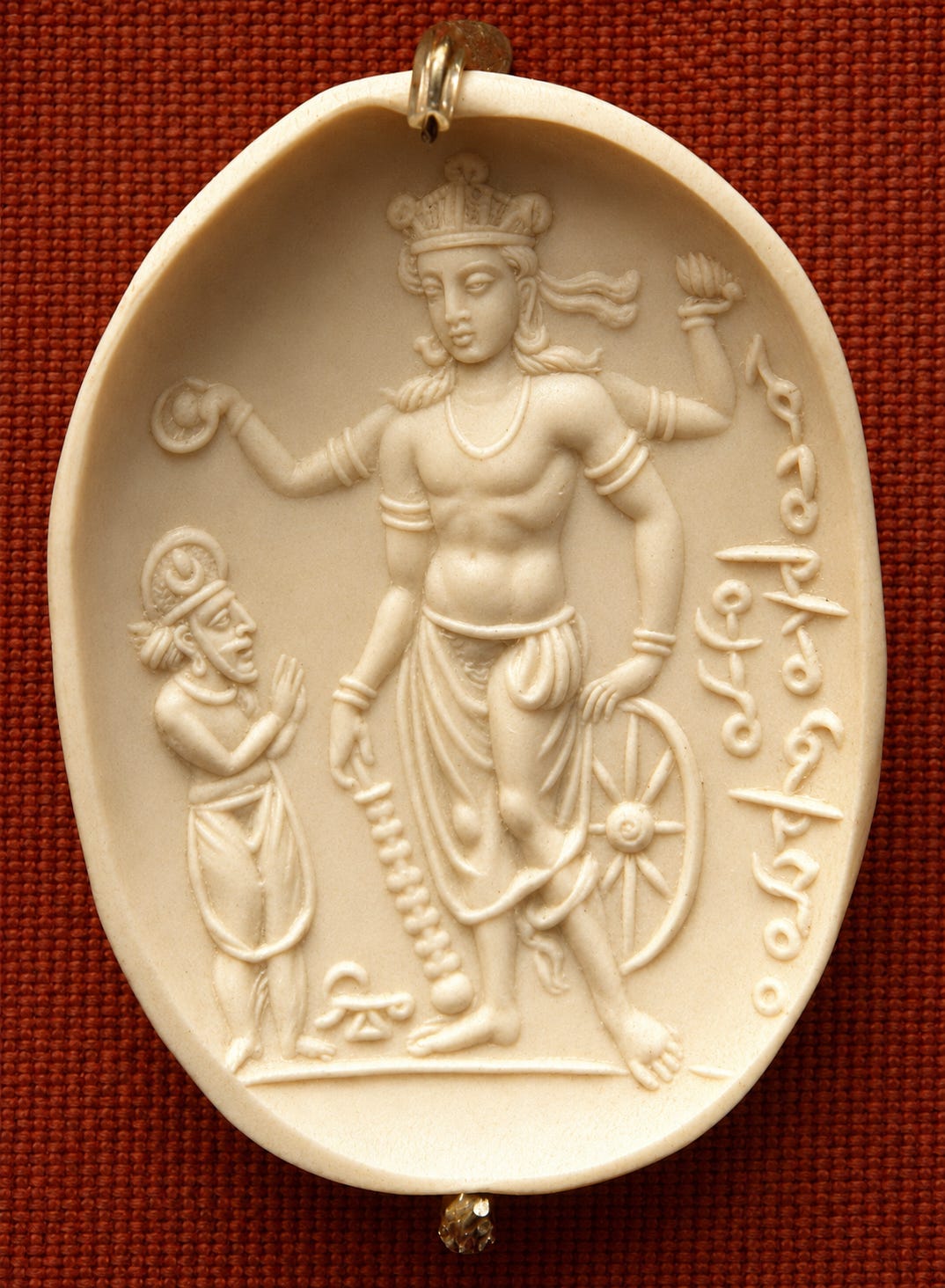
Bhandarkar begins with a psychological observation that organizes everything. Of the two Vedic gods who survived into supreme status, Viṣṇu and Rudra-Śiva, the one is approached through love and the other through fear. “What contributed to the formation of Vaiṣṇavism,” he writes, “were the appearances and occurrences which excited love, admiration and a spirit of worship; while in Rudra-Śaivism the sentiment of fear is at the bottom.” And he puts it in a single sentence that is hard to improve on: “in India the god that is loved is Viṣṇu-Nārāyaṇa-Vāsudeva-Kṛṣṇa, while the god that is feared is Rudra-Śiva.” Vaiṣṇavism is, at its core, the religion of the God who came down to be loved.
The word for that love, bhakti, is older than its later passion. Bhandarkar’s philology is careful: the term “in the sense of love is not to be found except in a verse” of the Śvetāśvatara Upaniṣad, and even in Rāmānuja’s hands “Bhakti means constant meditation and corresponds to the Upāsana of the Upaniṣads.” The word “etymologically signifies resorting to and then loving the thing resorted to.” The thing came before the word: the love of the soul for the Supreme “was an idea implied and often expressed by the word priya, dear, in the Upaniṣad period.” Devotion grew out of the Upaniṣads, not out of any foreign import.
The emotional flood begins in the Tamil south, with the poet saints called the Āḻvārs, “those immersed in God,” twelve of them, whom Bhandarkar redates from the fantastic traditional figures to “about the fifth or sixth century” and after, though current scholarship tends to place the group a little later, across roughly the sixth to ninth centuries. Their Tamil hymns, gathered into the four thousand verses of the Nālāyira Divya Prabandham, are “considered as very sacred and spoken of as the Vaiṣṇava Veda.” Here, for the first time, God is sung to in the language of the people and in the accents of helpless love, and the songs drove Buddhism and Jainism out of the Tamil country. Vasudha Narayanan, in Bryant’s sourcebook, makes the point that for this tradition the Tamil hymns stand beside the Sanskrit Veda as a second revelation, the ubhaya Vedānta, the dual scripture.
The Āḻvārs supplied the feeling; the Ācāryas supplied the philosophy, and they did it under pressure. By the eighth century the great Advaitin Śaṅkara had taught that the world is illusion and the personal God a lower truth dissolved, at the summit, into an attributeless absolute. To a religion built on love between a real soul and a real God, this was, in Bhandarkar’s words, “considered as destructive of the Bhakti.” The whole later history of Vaiṣṇava thought is the building of theologies that could hold devotion and metaphysics together against Śaṅkara’s world-illusion.
The line begins with Nāthamuni, who gathered the Āḻvār hymns, and his successor Yāmuna, who, unable “to maintain the doctrine of Bhakti in the face of the theory of Advaita,” directed his own successor to answer Śaṅkara on his own ground, in a commentary on the Brahma Sūtras. That successor was Rāmānuja, born by the traditional reckoning around 1017, who lived and taught at Śrīraṅgam, was persecuted by a Śaiva Chola king, and built the system called Viśiṣṭādvaita, qualified non dualism. Its elegance is that it makes the world and the souls real without making them separate from God: “the individual soul and the insensate world are the attributes of the Supreme Soul. They constitute his body, just as the body and the indwelling soul constitute the human being.” God is one, but a one with a real body of real souls, loved and loving. Rāmānuja’s bhakti, Bhandarkar notes, “is reduced to the form of a continuous meditation,” the disciplined upāsanā of the Upaniṣads, and to it he joined prapatti, self surrender, the throwing of oneself on God’s grace, which “can be practised by all orders, including Śūdras.” His followers later split over how that grace works, the famous quarrel of the monkey and the cat: does the soul cling to God as a baby monkey grips its mother, with some effort of its own, or does God seize the soul as a cat carries its kitten, by grace alone. It is a real theological fault line, and it is the kind a religion only develops when it has been thinking hard about love for a very long time.
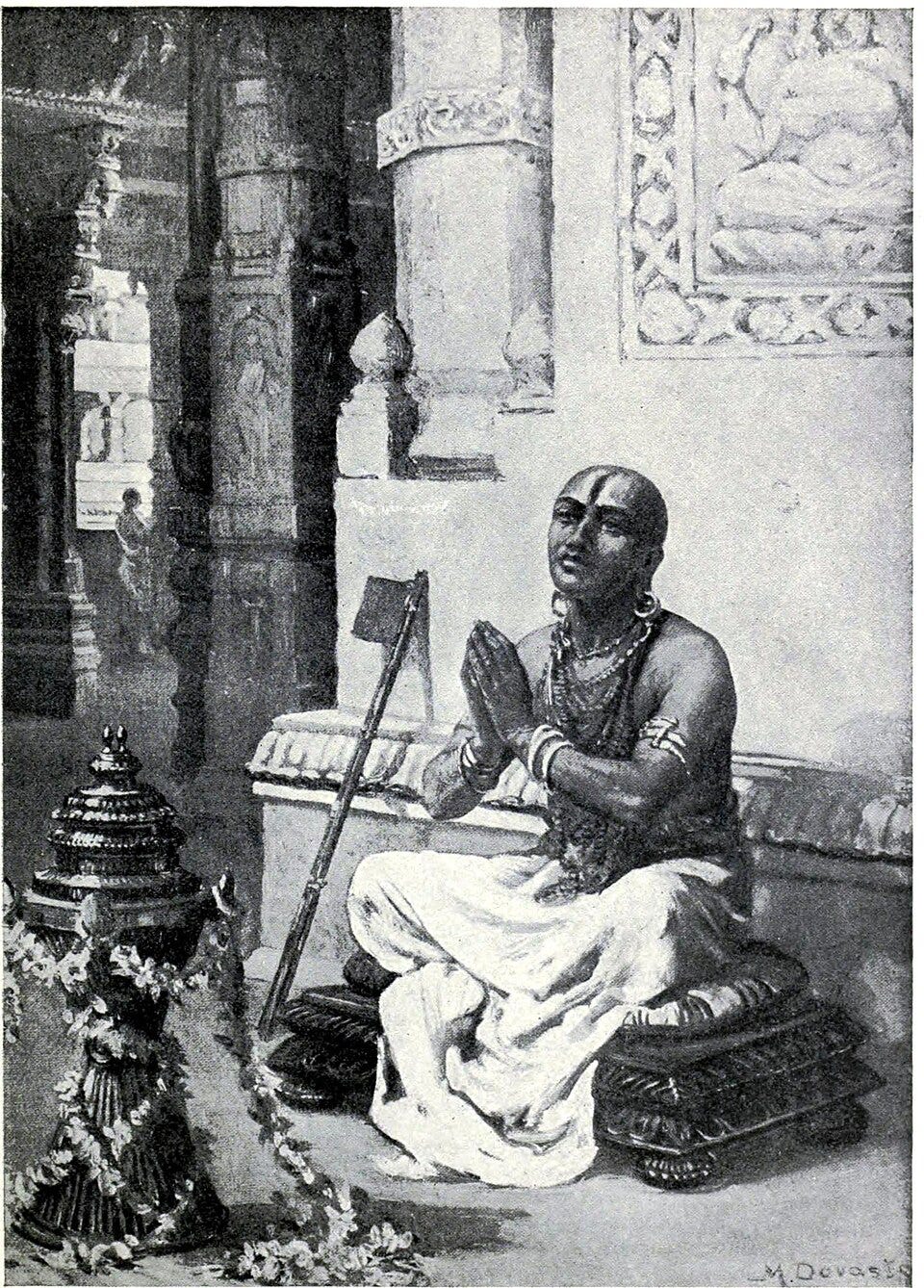
After Rāmānuja the schools multiply, each giving a different answer to the same question of how the soul and God are one and not one. Madhva, in the thirteenth century, found even Rāmānuja too monist and taught outright dualism, Dvaita, with five eternal and unbridgeable distinctions between God, souls, and matter; his supreme name is mostly Viṣṇu, and Bhandarkar notes that in his hands “the Gopāla-Kṛṣṇa element seems to be entirely absent,” the religion swung back from the cowherd toward the cosmic God. Nimbārka taught identity in difference and gave Kṛṣṇa and his beloved Rādhā an “almost exclusive prominence.” Rāmānanda carried the movement north into the vernacular, worshipping Rāma and Sītā and making “no distinction between Brāhmaṇas and members of the degraded castes,” and from his circle came Kabīr, the Muslim weaver who preached a stark imageless monotheism with the name of Rāma, and, later, Tulsīdās, whose Hindi Rāmcaritmānas became the Bible of the north. Vallabha, around 1500, built the path of the divine child, Puṣṭimārga, the way of grace, around the boy Kṛṣṇa of Braj, with daily temple worship that wakes, bathes, dresses, feeds, and cradles the god as an infant. And in Bengal, his contemporary Caitanya took the emotional road to its end, teaching that the highest love, when it reaches its peak, “constitutes itself into Rādhā,” and losing himself in the ecstatic chanting of the divine names.
Here the honest historian has to mark a late arrival, because it bears directly on the antiquity argument. Rādhā, the beloved who dominates the later imagination, is a genuinely late creation. She “is not mentioned by name in the Harivaṃśa, Viṣṇu Purāṇa and the Bhāgavata,” the very texts that tell the cowherd Kṛṣṇa’s story. She emerges fully only around the sixteenth century, in the Nārada Pāñcarātra and the theologies of Nimbārka, Vallabha, and Caitanya, spun out of a hint in the Bhāgavata’s account of the one favoured gopī. Bhandarkar, a Victorian reformer, disapproved, calling her elevation “a degrading element.” You need not share his disapproval to accept his chronology. The romantic theology of Rādhā and Kṛṣṇa is medieval. It is the furthest flower on the tree, and nobody should mistake it for the root.
Two thousand years of this, and the centre still does not move. The religion never stops elaborating: the Tamil hymns, the six rival Vedāntas, the boy of Braj, the saint of Bengal, the Maratha poets of the sober god Viṭṭhala who “discarded Rādhā-Kṛṣṇaism” for a purer devotion. And yet, as Bhandarkar says, through all of it “Vāsudeva as the name of the Supreme Being stands in the background of all,” and the spiritual core is “essentially derived from the Bhagavadgītā.” The bhakti that a missionary scholar in 1840 wanted to credit to Christianity is, when you actually trace it, the flowering of a devotion whose first clear statement is the Gītā, whose vocabulary is Upaniṣadic, and whose object is the Vedic Viṣṇu. It grew from inside, over three thousand years, from a Bronze Age root.
We have followed the god through his three ages: the Bronze Age deity, the worship of the last centuries BCE, the late system. The evidence for the first two has been laid out along the way, in the hymns and the inscriptions, and I will not relist it here. Two things remain, and they are the two I promised at the start: to show that the argument does not depend on me, and to ask how the opposite impression ever became the default.
The strongest form of the argument does not lean on any single school. It rests on the points where schools that agree on nothing else converge, because those are the claims that no ideological lens can be accused of manufacturing.
There are at least four such points. First, that Viṣṇu’s identification with the sacrifice, yajño vai viṣṇuḥ, is the hinge of his rise: the colonial Macdonell notes it, the structuralist Gonda builds on it, the materialist Jaiswal cites it, the traditionalist Chari claims it as Vedic, and the comparativist Manasataramgini turns it into a measurable curve. Second, that the Heliodoros pillar proves a foreigner-attested cult of Vāsudeva in the second century BCE: Bhandarkar, Jaiswal, Majumdar, and Chari all build on it. Third, that the developed system, the vyūha metaphysics and the fixed list of descents, is a later crystallization; even Chari, the eternalist, concedes that the vyūha doctrine is a Pāñcarātra development absent from the Gītā. Fourth, that the oldest descents, the dwarf and the boar, sit in the late Vedic Brāhmaṇa layer, which Macdonell, Keith, the epigraphist D. C. Sircar, and Manasataramgini all grant.
And the device that makes these land hardest is to let each concession come from the school least inclined to give it. The Marxist Jaiswal, whose whole book places the formation of Vaiṣṇavism in the last centuries BCE and the first CE, nonetheless writes of Ṛgvedic Viṣṇu that “even in the Ṛgvedic age he was considered to be a great god,” and “he may have been more popular among the masses whose ideas and inclinations are not recorded in the Vedas.” She even sides with Gonda’s pervasion reading over the old solar one. The author of the standard “late” book concedes the seed and the argument from silence in a single breath. The traditional theologian Chari, who would prefer everything eternal, concedes that the vyūha is later. The nationalist Majumdar, who defends Hindu antiquity at every turn, concedes that the cowherd Kṛṣṇa is late. Each admission is worth more for coming from the witness with the most reason to withhold it.
If the evidence runs this way, why is the reverse the default? The answer is partly about the lenses through which the question has been asked, and naming them is the point.
The simplest distortion is the hymn count itself. To call Viṣṇu “minor” because he has few Ṛgvedic hymns quietly carries a second claim, that he was therefore unimportant. The first does not entail the second, and the scholars who know the text best say so.
The deeper distortion is older and uglier, and we met it earlier: the missionary scholarship of the nineteenth century, Wilson studying Hinduism to refute it, Weber deriving Kṛṣṇa devotion from Christianity, a framing built to make the tradition look late and borrowed. That theory was dismantled a century ago by Bhandarkar, Chanda, and Raychaudhuri, using the very inscriptions we have been reading, and even Jaiswal records that it is now abandoned. It survives in the popular afterglow, not in the scholarship.
The most respectable and most influential distortion is the modern one, and it is subtle because it is not a mistake so much as a choice. The dominant school of twentieth century Indian history, the materialist tradition of Kosambi, Sharma, and Jaiswal, reads religion as a reflex of social and economic life. Its instinct is to foreground what can be dated and attached to a social formation, so it trains its attention on the period when the cult was systematized, brahmanized, given temples and texts and a settled theology, the last centuries BCE and the first CE, and it leaves the undatable Vedic root in shadow. We saw the method at its purest in the etymology of bhakti, where devotion is traced to the sharing out of tribal food, and in the reading of every Vaiṣṇava element as an originally separate tribal or totemic cult, the boar a pig totem, Narasiṃha a dreadful Punjab god, Saṃkarṣaṇa a serpent of the furrows, Śrī a fertility goddess, the cowherd Kṛṣṇa an Ābhīra deity, all absorbed into a brahmanical synthesis. This is a powerful method, and it has produced real knowledge. But a method is a lens, and no lens is neutral. One built to illuminate the datable synthesis will show you the datable synthesis, and then the synthesis starts to look like an origin.
And underneath all three distortions lies the single confusion this essay began with. Systematization is not origin. The lateness of the system, the vyūha metaphysics, the fixed ten, the divine marriage, the schools, is not in dispute; even Chari, from the opposite extreme, grants it. What is in dispute is only whether the system is the same thing as the beginning. The frequency reading, the colonial frame, and the materialist lens all, in their different ways, answer yes. The evidence answers no.
Let me be precise about the claim, because precision is the whole point, and because the careless version of this argument does real damage to the careful one.
Keep the scholarly date for the system. The four fold emanation, the canonical ten, the divine couple, the great temples of the Gupta age and after, all of that really is the work of roughly 200 BCE to 500 CE and later. No honest case requires moving it, and the careful gopī romance, the consort goddess, the Buddha in the ninth slot, the systematic theology of the descents, all of it is genuinely young.
What has to change is the slide from there to the impression that Viṣṇu and the devotion to him are correspondingly recent. They are not. The deity is Bronze Age, the organized worship is more than two thousand years old, and only the system is late. To date the religion from the age of its theology is to date the Nile from the year of its first dam. The river was already running, for a very long time, before anyone built the thing we can put a date on.
Return, at the end, to Heliodoros and his pillar. The Greek who knelt to Vāsudeva around 113 BCE was not present at a birth. He was a latecomer to something already ancient, systematic enough to have an ethics he could quote, confident enough to draw a convert from across the Hellenistic world. He could become a Bhāgavata because the tradition he joined had not begun in his century, or anywhere near it.
And the pillar is still there. It stands on the riverbank near Vidiśā, and the fishing communities along the water still smear it with vermilion and call it Khamba Baba, the pillar-saint, and pray to it for the birth of a son. A Greek ambassador’s column to “the god of gods,” two thousand years on, is still a place where Indians come to worship. That is the real span of the thing. Follow it back as far as the evidence runs and you do not reach a beginning two thousand years ago. You reach a Bronze Age poet singing of the god who paced out the world in three strides and kept a wellspring of honey in his highest heaven, the god whose footstep the wise have always watched, stretched out like the eye in the sky.
The tradition kept the threads, even when it forgot it was keeping them. When the Mahābhārata wanted to name the supreme God, it gave him a thousand names, and the litany of the thousand, still chanted every day in Vaiṣṇava homes, opens with two of them: viśvaṃ viṣṇur vaṣaṭkāraḥ. The universe. Viṣṇu. The ritual call. In the first breath of his own thousand named hymn the god is the all, the pervader, and the cry of the sacrifice. Those are the two things this essay has followed from the Bronze Age forward: the one who strides through everything, and the one who is the rite that holds everything together. Both names are older than the religion is usually said to be.
This is not a recent religion. It is one of the oldest objects of continuous human devotion that we can actually name and date, and it is long past time our standard account of it said so.
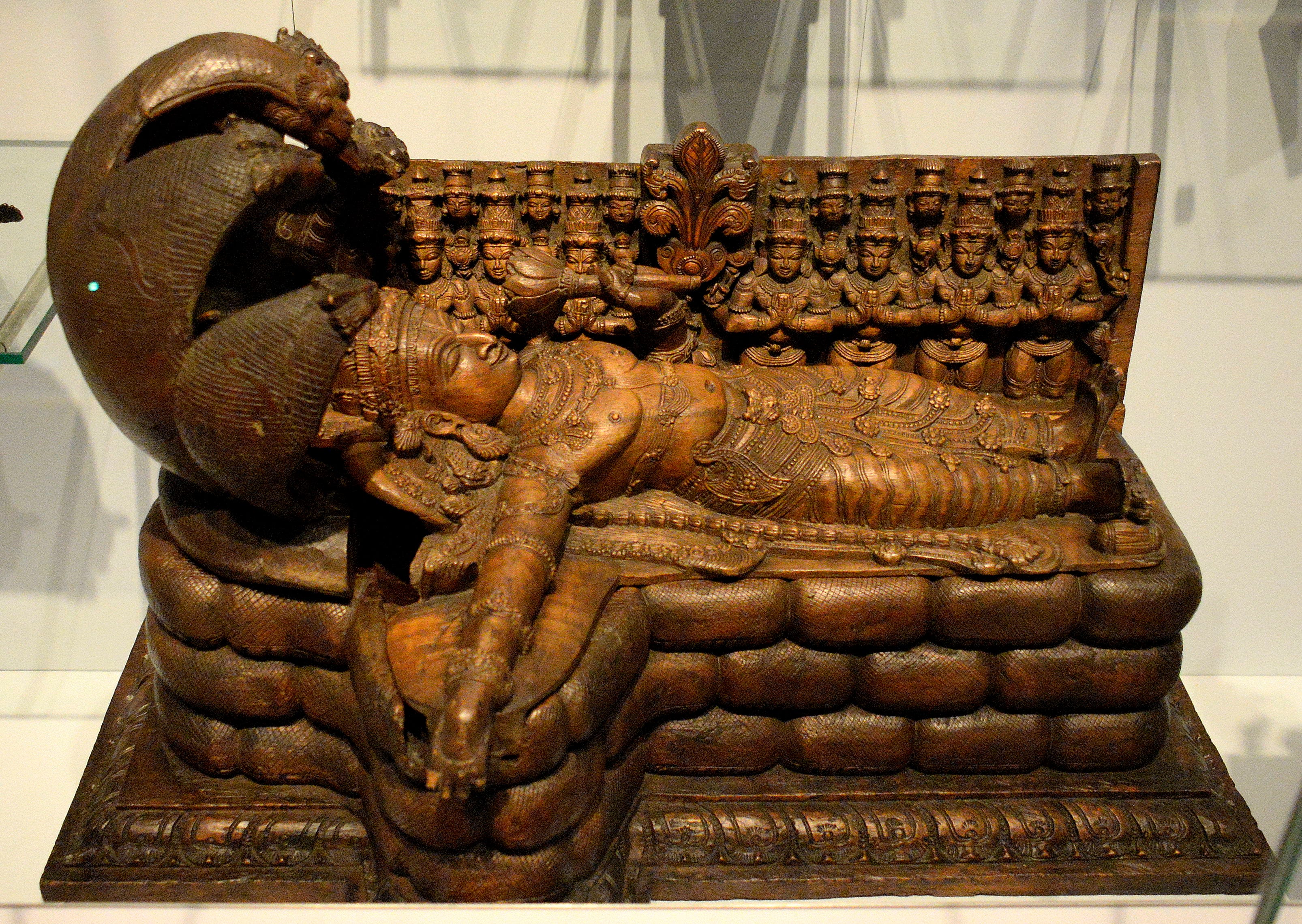
Primary texts
Ṛgveda, trans. Stephanie Jamison and Joel Brereton. Especially 1.154, 1.155, and 1.22 (the three strides and the highest step), 7.99 and 7.100, the Vṛtra alliance verse 8.100.12, the Puruṣa Sūkta 10.90, and the riddle hymn 1.164 (the navel of existence).
White Yajurveda (Vājasaneyi Saṃhitā), Sāmaveda, and Atharvaveda, trans. R. T. H. Griffith. For “Viṣṇu, that is, the sacrifice,” the Viṣṇu stride rite, the “loftiest place of Viṣṇu,” and the womb shaping charm (Atharvaveda 5.25).
Śatapatha Brāhmaṇa, trans. Julius Eggeling. For “the sacrifice is Viṣṇu,” the dwarf, Nārāyaṇa, and the Puruṣamedha.
Taittirīya Saṃhitā, trans. A. B. Keith. For the dwarf, the boar, and Prajāpati.
Aitareya Brāhmaṇa. For “Agni is the lowest, Viṣṇu the highest.”
Bhagavad Gītā, Winthrop Sargeant’s word by word edition. Chapters 4, 7, 9, 10, 11, and 18.
Mahābhārata, trans. Bibek Debroy (unabridged). The Nārāyaṇīya and the Śvetadvīpa episode (Śānti Parva), the Śiśupāla scene (Sabhā Parva), the Nara-Nārāyaṇa formula, and the Viṣṇu-sahasranāma (Anuśāsana Parva).
Bhāgavata Purāṇa. 5.26.31 (the hell of the human sacrificers) and 1.3.28 (kṛṣṇas tu bhagavān svayam).
Inscriptions in D. C. Sircar, Select Inscriptions Bearing on Indian History and Civilization. The Besnagar (Heliodoros), Ghosundi, Nānāghāṭ, and Mora records.
Scholarship
A. A. Macdonell, Vedic Mythology.
Jan Gonda, Aspects of Early Viṣṇuism — the strides, the sacrifice, the navel and Padmanābha, the avatāras, kingship, Śrī, and the pervasiveness thesis.
F. B. J. Kuiper, Ancient Indian Cosmogony.
R. N. Dandekar, Vedic Mythological Tracts.
R. G. Bhandarkar, Vaiṣṇavism, Śaivism and Minor Religious Systems — the three stream model, the bhakti philology, the Āḻvārs and Ācāryas from Rāmānuja to Caitanya, the loved Viṣṇu and feared Śiva, and the late making of Rādhā.
Suvira Jaiswal, The Origin and Development of Vaiṣṇavism.
Edwin Bryant (ed.), Krishna: A Sourcebook; and Bryant, The Quest for the Origins of Vedic Culture — the early Vāsudeva chain, the Bhāgavata reversal, and the Mitanni evidence.
R. C. Majumdar and others, The History and Culture of the Indian People (the Vedic Age, the Age of Imperial Unity, the Classical Age, the Age of Imperial Kanauj); and Majumdar’s Ancient India.
S. M. Srinivasa Chari, Vaiṣṇavism: Its Philosophy, Theology and Religious Discipline.
Doris Srinivasan, Many Heads, Arms and Eyes.
J. N. Banerjea, The Development of Hindu Iconography.
Manasataramgini, “The roots of Vaiṣṇavam: a view from the numerology of Vedic texts.”
Colonial framing (Part One): H. H. Wilson and A. Weber, as reported and refuted by Bhandarkar, R. P. Chanda, and H. C. Raychaudhuri, and summarized by Jaiswal in her opening chapter.
No posts
Comments
Nothing yet. Say the first thing.
Sign in to join the conversation.