

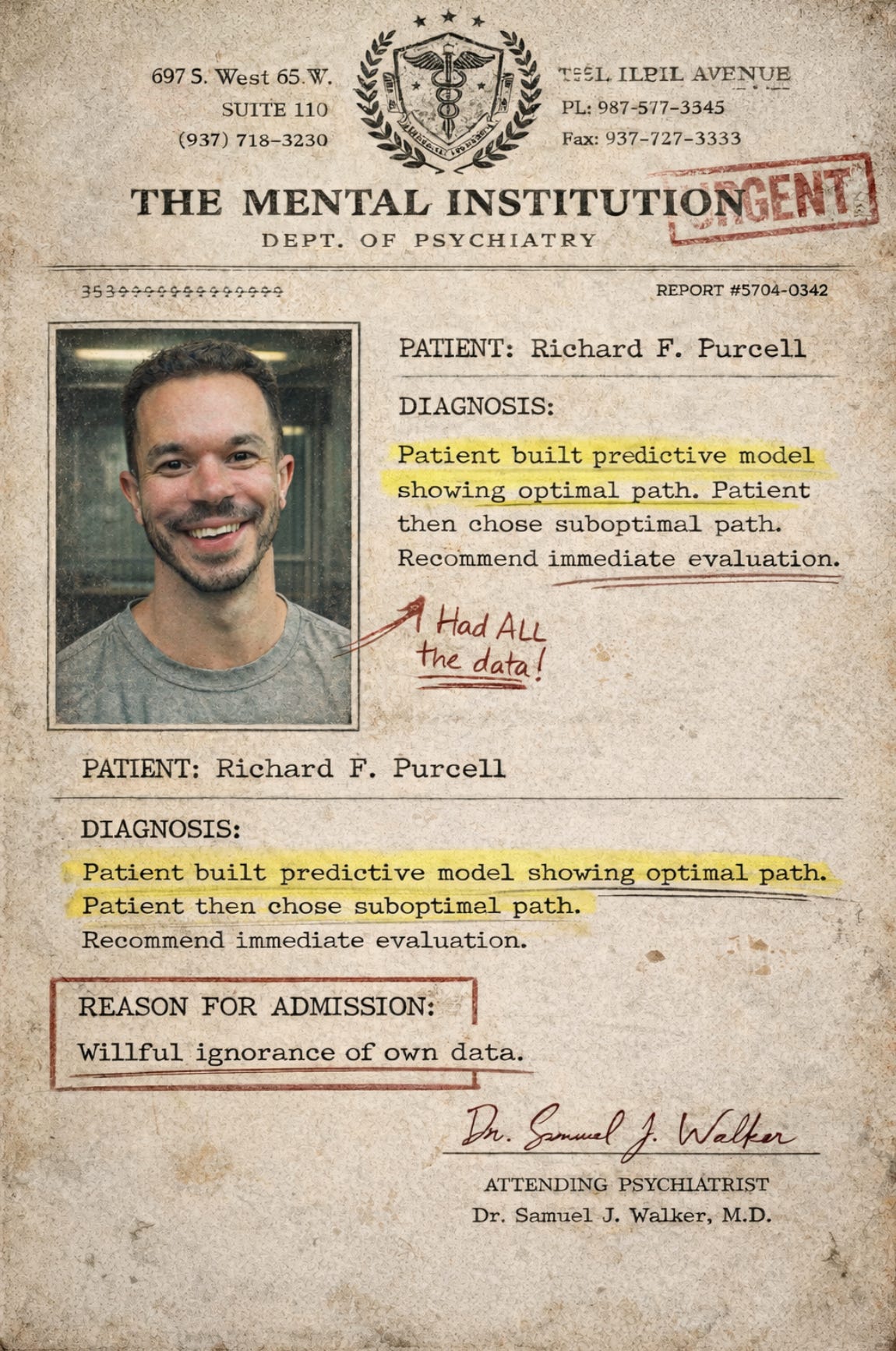
Both times, the model told me exactly which market would convert best. Both times, I ignored it.
The first time, it cost me 6 months fighting cultural resistance from leadership.
The second time, it cost me 6 months chasing the wrong market due to pipeline pressure.
This is the story of how I learned that choosing markets is the most important decision you’ll make, and most people get it wrong for the dumbest reasons.
I joined a Series A startup as the first sales hire. The company had origins in progressive politics.
My job was to expand into commercial enterprises and build repeatability.
The opportunity: Our tech could be applied to 20+ industries.
The challenge: We were a company with origins in progressive politics. Some markets felt off-brand.
This was before ChatGPT existed. Just Google Sheets and judgment.
I built a scoring model to rank 12+ industries across 10 criteria:
Market size
Market concentration
Growth rate
Competitive density
Tech adoption speed
Regulatory complexity
Sales cycle length
Etc
I weighted each criterion based on what mattered most.
I ran the math.
Results:
Casinos ranked #1.
Sports and live entertainment ranked #3.
The hypothesis was strong. Casinos had everything we needed:
Fragmented market (easier to close multiple deals quickly vs 4 major professional sports teams)
High-tech adoption
Short sales cycles (they care about one thing: making money)
I presented casinos to our CEO and leadership team.
The pushback was immediate and fierce.
“We’re a progressive company. Casinos are conservative. It will damage our brand reputation. Employees will be upset. This goes against our values.”
Leadership wanted sports and live entertainment instead. It felt safer. More aligned with our culture.
I had to ask the hard question: Are we building a business or a non-profit?
VCs invested for hyper growth. They wanted $10M ARR, not brand purity.
But I didn’t have the leverage I needed. We agreed to start with sports and live entertainment first.
The pitch: “We can sell to casinos WITHOUT promoting gambling. Use cases focused on event attendance, VIP hospitality, bringing high-value customers back to the property for non-gambling reasons like concerts or dinner reservations.”
This maintained brand values while unlocking the best market.
Leadership agreed.
We started selling into Casinos.
Within 6 months in casinos:
Casinos vs Sports:
Close rate: 20% vs 10%
Deal size: $60K vs $25K
Sales cycle: 60 days vs 90+ days
Product customization: Low vs High
Casinos converted 2X better with 40% larger deals and 30% shorter cycles.
The playbook I built scaled to 2 other AEs who replicated the success.
But again, it took 6 months longer than it should have.
I had just joined an enterprise AI startup as the first sales hire.
The gift: Our tech could be applied to 20+ industries.
The curse: We had a limited runway, 5 employees, and competitors who were a few steps behind us.
I couldn’t afford to guess wrong.
We had 2 inconclusive pilots in property insurance. Leadership wanted to double down on that market because it was low-hanging fruit from our existing network.
But I needed to figure out which industry to prioritize from first principles.
I re-built the same scoring model as before and scored 12+ verticals.
Results:
Pharma: 4.225 out of 5
Manufacturing: 4.0
Insurance: 3.5
Insurance ranked 6th out of 12. Not first. Not second. Sixth.
Leadership pressure was intense. “We have an existing pipeline in insurance. We need to close deals now.”
Pipeline is not strategy.
But I didn’t push back hard enough. I chose insurance because it felt like the path of least resistance, while also diversifying risk by selling into Manufacturing at the same time.
I finally had enough data to compare insurance to manufacturing (where I had been running a few pilots on the side).
Insurance vs Manufacturing:
1st to 2nd meeting conversion: 25% vs 50%
Sales cycle: 90 days vs 60 days
Pilot conversion: 25% vs 75%
Manufacturing converted 3X better with 30% shorter cycles.
I had wasted 6 months because I was myopic. Staring at what was in front of me (existing pipeline) instead of stepping back to 10,000 feet (what the model predicted).
The cost was real. We burned runway on low-probability bets. We missed windows in manufacturing while competitors moved in.
Eventually, we officially pivoted to manufacturing.
But it took 6 months longer than it should have.
Two different companies. Two different reasons for ignoring the model.
First time: Cultural resistance. “Casinos don’t align with our values.”
Second time: Pipeline pressure. “We need to close deals now. Insurance has existing pipeline.”
Both times, I wasted 6 months.
Both times, the model was right.
Both times, I let short-term thinking (close deals fast, stay culturally comfortable) override long-term strategy (choose the market with the best unit economics).
#1: Build the model before you start selling
Don’t wait until you have 6 months of bad data to realize you’re in the wrong market.
Build the industry ranking model on day one. Score markets on criteria that matter for YOUR business at YOUR stage.
For a seed-stage company with limited runway: Sales cycle length and close rate matter more than market size.
For a Series B company with product-market fit: Market size and expansion potential matter more than initial deal size.
Weight your criteria accordingly.
#2: Existing pipeline tells you what you CAN sell, not what you SHOULD sell
This is the most important lesson.
Just because you have 5 conversations in progress doesn’t mean that market will convert at 20%. It might convert at 10% while another market converts at 50%.
Pipeline creates momentum and momentum creates bias. Pipeline velocity makes you feel productive. But if those deals are taking 90 days to close at 10% conversion, you’re burning runway on low-probability bets.
You’ll convince yourself that “we’re close” or “we just need one more meeting” when the model is screaming that you’re in a 25% conversion market and there’s a 75% conversion market next door.
#3: Time kills all deals. Competitors don’t wait.
While I was grinding through 90-day sales cycles in insurance, competitors were closing manufacturing deals in 60 days. By the time I pivoted, they had relationships I had to compete against.
You miss windows in better markets while competitors move in. Closing one $25K deal in sports felt good. But if I had started with casinos, I would have closed four $60K deals in the same timeframe.
#4: Leading indicators predict retention, not just acquisition
Pipeline velocity and acquisition rates tell you how fast you can close deals. But they don’t tell you if those customers will stick around.
Insurance had slower acquisition AND lower retention because product customization was high. Manufacturing had faster acquisition AND higher retention because the use case was more repeatable.
The model predicted both. My gut only saw the pipeline in front of me.
#5: Cultural fit matters, but revenue fit matters more
Leadership was right to care about brand values. But they were wrong to let it override market selection entirely.
The compromise (non-gambling use cases) gave us both. We protected brand reputation while unlocking the best market.
If your leadership team is resisting a market because of culture, find the use cases that satisfy both culture AND conversion. But don’t let cultural comfort kill your business.
#6: Leadership needs to decide: Business or non-profit?
This is the hard conversation nobody wants to have.
VCs invest for returns. They want hyper growth. They want $10M ARR, not mission alignment.
If your leadership team prioritizes values over velocity, that’s fine. But you’re building a non-profit, not a venture-backed business. Be honest about what you’re building and fund it accordingly.
When you can’t explain why you’re prioritizing THIS market over THAT market with numbers, your board starts questioning your judgment. “Why are we in insurance?” “I don’t know, we had some pipeline there” is not a compelling answer.
#7: When you’re myopic, you optimize for what’s in front of you
Both times I ignored the model, I was staring at what was directly in front of me: existing pipeline in insurance, cultural comfort in sports.
I wasn’t stepping back to 10,000 feet to see the full landscape.
The model forces you to zoom out. It forces you to compare markets on objective criteria instead of subjective momentum.
Build the model. Trust the model. Then execute with conviction.
I’m currently looking for a W2 role where I can apply these lessons at scale.
I’ve built go-to-market from scratch at 5 consecutive companies, 4 of which had exits. I’m an operationally minded revenue leader focused on scaling one sale into many in the most efficient way possible by optimizing the business around insights from high-value customers, and growing profitably without bloating headcount or the tech stack.
I’m looking for either a mature vertical SaaS company where I can replicate this pattern or a large company that needs someone to scale a new initiative or product line.
If you’re hiring for a revenue leadership role or know someone who is, send me a message on Linkedin.
No posts
Comments
Nothing yet. Say the first thing.
Sign in to join the conversation.