
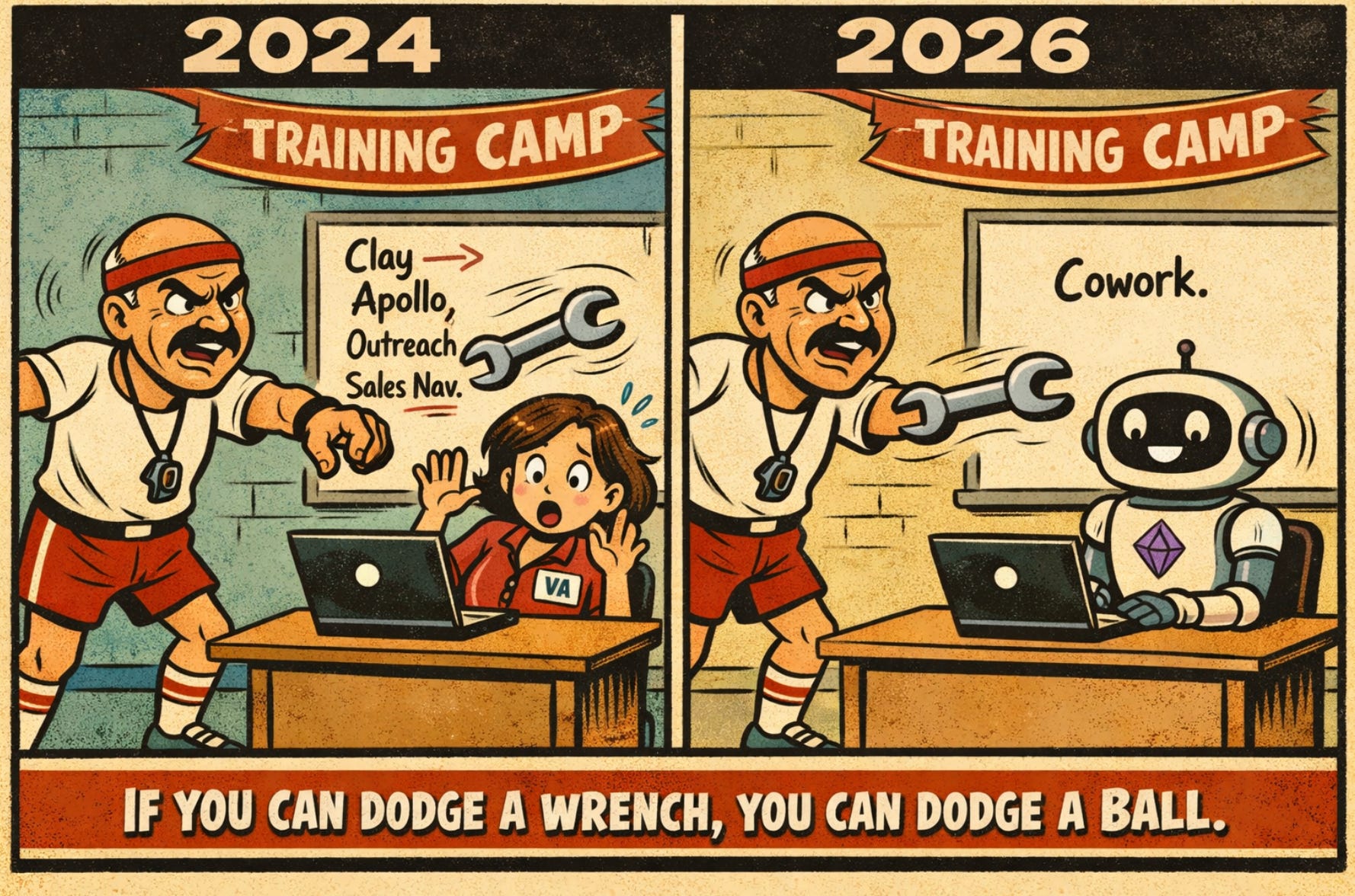
In April 2023, I posted on LinkedIn that “Virtual Assistant + ChatGPT + saturated channels = decline of the SDR function.” I caught heat for that, but 3 years later…..was I wrong??
In January 2024, I wrote a 7-part series called #GTMadmin about hiring a Virtual Assistant before another sales rep. The hero of that series was the VA I hired through Athena. It took 2-3 months of hands-on training to upskill her into a GTM admin capable of running Sales Nav, Clay, Apollo, ChatGPT, and our entire outbound motion end-to-end.
By March 2024, she was running our day-to-day. By June 2024, she taught herself Python after I taught her ChatGPT. She built the backend of our product. She became Head of Operations. The student became the master.
Two years later, I do all of the VA’s old work in a single Claude Cowork conversation thread. By myself ….and in about 45 minutes.
I shut down MoxieGTM because the business model wasn’t sustainable. The same Claude that lets me run the old playbook in 45 minutes is the same Claude that made my own GTM tech company unviable. I am living the disruption I’ve been writing about.
If you already know how to train a human VA, you already know how to train an AI agent. The skills transfer 1:1.
Document the process, correct mistakes in real time, and be patient.
Tie the work to revenue...not just activity.
You have to treat the machine like a junior employee with infinite patience.
My 2024 stack:
Athena VA = ~$3,000/mo
Clay = $920/mo
Apollo and Sales Nav and Outreach and data scraping tools = ~$1,000/mo
= ~$5,000/mo
My 2026 stack:
Claude Max, Cowork, and Code = $200/mo
The Swarm 🔆 and LGM = ~$200/mo
= ~$400/mo
92% cost reduction with the same output, faster cycles, and no tab switching.
I replaced that $920/mo Clay subscription with a $30/mo Claude API workflow for a client. I wrote the full how-to in “How to cancel your Clay subscription.” 15 minutes to set up for a non-technical operator.
In 2024 I wrote that you should hire a sales admin before you hire a sales rep.
Use this same logic in 2026. Before you renew Clay, before you onboard another GTM Engineer, before you bolt another point solution onto your CRM . . . open Claude Cowork and ask the agent to do the thing first. Nine times out of ten, the agent already does 80% of what your $1,000/mo tool does. The other 20%, you can use The Swarm for data enrichment and relationship data.
Agent first. Tool second. Headcount third. That should be the default ordering in 2026. Reverse it, and you’re burning cash on a shrinking market.
The GTM tech graveyard is growing fast.
Pocus sold to Apollo for “undisclosed” terms (“undisclosed” = no bragging rights).
Drift went from a $1B valuation to being acquired by Salesloft for ~$500M.
11x reportedly had ~$3M in real ARR after raising $74M and lying about a much higher ARR number.
6sense is doing layoff rounds every few months.
ZoomInfo lost 92% of its peak market value.
The market has a structural differentiation problem.
The only moats left are unique datasets nobody else can access and networks (partnerships, warm intros, referrals, customer base, audiences, real relationships).
Almost everything else can be built with AI at near-zero marginal cost. I wrote about this in detail in “How to Fire your GTM Engineer.”
If your stack doesn’t fall into one of those two buckets, the agent can probably replace it.
Most people use AI agents like a search engine. One question, one answer, close the tab. That is vending-machine behavior… not training.
When I trained my VA, I wrote step-by-step Loom videos and Google Docs for every task. Boolean searches in Sales Nav, ICP qualification rules, Apollo sequence setup, CRM hygiene, Reply routing, Inbox triage, and Calendar holds.
I uploaded those exact same docs to Claude Cowork. The agent ingested 2 years of training material in 90 seconds, then started executing the playbook better than I could remember it.
If you don’t have process docs, your problem isn’t AI. Your problem is that you never figured out your process. The act of writing the docs IS the training, for both the agent and you.
The shift from sifting through data to find answers to having a conversation with your data to find answers is what makes this feel different from every other “AI tool” launch.
No more tabs, no dashboards, no new logins. Just one conversation thread and you’re off to the races.
The same 5 skills, but with a different student.
#1 List building. Teach the agent your ICP, your boolean logic, and your data sources. Plug in The Swarm for relationship overlap. Plug in Sales Nav via Cowork for live scrapes. My VA took 4 weeks to get this right. Claude took 4 minutes.
#2 Data validation. Teach it to spot bad emails, fake titles, ghost accounts, and recycled dummy data. Give it the same rules you’d give a junior researcher on their first day.
#3 Outbound in your voice. Feed it 10-20 of your best-performing emails and LinkedIn posts. Tell it to mimic the tone, not parrot the content. Most people quit after the first 3 outputs sound like AI slop. That’s the wrong instinct. Correct it. Show it 3 more examples. Watch it lock in. This part requires the same patience you’d give a new hire during their first week on outbound.
#4 Content creation. Your published posts are the training set. Your unpublished drafts are the feedback loop. Upload your past LinkedIn archive as a CSV, and the agent will capture your voice in a single prompt.
#5 Inbox and calendar management. Connect Gmail and Google Calendar via Cowork. Let it triage, correct it once or twice, and move on. I recently watched Claude organize 1,000+ files across my Downloads folder and Google Drive in 10 minutes by scanning every single document, not just file names.
If you can teach a 22-year-old in the Philippines to do these 5 things, you can teach Claude to do them in a fraction of the time.
In 2024 I recommended hiring a part-time VA before committing to full-time. Pressure-test the workload, document the steps, and reduce the risk.
The same rule applies.
Start with one workflow. List building, warm intro mapping, or LinkedIn engagement triage. Pick the one that’s the most painful, most repeatable, and most documented part of your day.
Run that one workflow with Claude for 2 weeks, measure the time saved, and then stack the next one on top.
People who try to automate their entire GTM motion in one weekend fail for the same reason people who hire 5 VAs at once fail. Too much surface area and not enough training reps.
When I paid my VA a flat hourly fee, she gravitated toward calendar management and market research. Tasks that felt productive but didn’t move pipeline. When I switched her to a flat rate plus 5% rev-share on all revenue generated by the business, she became a completely different operator. She became hyper-focused on closed/won. She started bringing new ideas every week for generating revenue. She deprioritized everything else on her own.
You can’t pay an agent in cash, so you have to design the workflow to get the same result. That means making revenue-generating tasks the only ones the agent gets to run. No “let me explore what’s possible.” No interesting research projects that go nowhere. Every conversation thread should start with one question . . . what is the revenue impact of this task?
If you can’t answer that question, don’t delegate it to the agent. Same rule I had for my VA.
My VA taught herself Python after I taught her ChatGPT. She built the backend of our product. She now has an army of students who learn from her.
Claude follows the same arc, but compressed into about 2 hours instead of 2 years. In the first week, you’re constantly correcting the agent. In the second week, the agent starts correcting you. By day 30, it’s surfacing patterns in your data that you would have missed entirely.
The right response is to keep delegating harder problems. The agent’s ceiling is your ability to articulate the next problem worth solving.
There are no bad students. Only bad teachers.
If your agent hallucinates, you didn’t give it enough context. If it goes off-task, you didn’t define the goal sharply enough. If it produces generic copy, you didn’t train it on your voice.
Bad VA? You blame the teacher.
Bad agent? You blame the teacher.
This has always been true, and it hasn’t changed just because the student is a machine.
Two things changed between training my VA in 2024 and training Claude in 2026.
#1 The feedback loop is 100x faster. My VA took 2-3 months to ramp. Claude takes 2-3 hours. Every correction sticks immediately and compounds across every future conversation thread.
#2 The marginal cost is near zero. I can run 10 parallel campaigns in Cowork at the same monthly cost as running 1. My VA could only run one campaign at a time and only during her work hours.
This isn’t about “AI agents replace VAs”.
This is about AI replacing tasks, not people (credit to Taft Love for that framing). The VA doesn’t get fired. The VA gets upskilled into the operator who trains the agent. That’s exactly what happened to my VA. She went from VA to Head of Operations because she learned how to manage the tools, not just use them.
A few things AI agents still can’t do as well as a human VA in 2026.
#1 Cold calls at scale. Voice agents are getting close, but I’m not running production cold-call campaigns through them yet.
#2 Unstructured, nuanced judgment calls. “Is this prospect actually a fit even though the title doesn’t match?” A human subject matter expert still wins here…..for now.
#3 Showing up in person. Sending the warm intro thank-you note. Bumping into a prospect at a conference. Being genuinely curious about a stranger’s kid’s soccer game. Agents can’t fake that and shouldn’t try.
If your GTM motion depends heavily on those 3 things, keep your VA. Just train them on Claude instead of Clay.
#1 Cancel one tool. Pick the one with the lowest usage-to-cost ratio.
#2 Open Claude Cowork. Upload your existing process docs. If you don’t have any, start writing them this week. The act of writing them is the actual training.
#3 Pick one workflow. Run it end-to-end with the agent. Measure the time saved against your baseline.
#4 Tell me how it went.
The bottleneck was never the code; it was knowing how to ask the right questions. A RevOps leader who understands pipeline mechanics and uses Claude to write the SQL will out-build a Python dev who doesn’t understand why some customers spend more and stay longer.
Domain expertise beats syntax knowledge. If you spent 10 years learning how to delegate to humans, those skills transfer 1:1 to delegating to agents.
Original #GTMadmin LinkedIn series (Jan-Jun 2024, 7 parts):
Part 1: NEW RULE - Hire a sales admin before you hire a sales rep (Jan 12, 2024)
Part 3: How to get a 4X ROI from your sales admin (Jan 17, 2024)
Part 4: How to up-skill a VA into a sales admin / 5 skills (Jan 23, 2024)
Part 5: How to compensate your GTM/sales admin (Feb 8, 2024)
Part 6: Hire a Part-Time VA before a Full-Time one (Mar 26, 2024)
Other LinkedIn posts referenced:
“Virtual assistant + ChatGPT + saturated channels = decline of SDR function” (Apr 21, 2023)
“A GTM leader, a Virtual Assistant, and ChatGPT walk into a bar” (Jan 1, 2024)
Substack posts referenced:
No posts
Comments
Nothing yet. Say the first thing.
Sign in to join the conversation.