
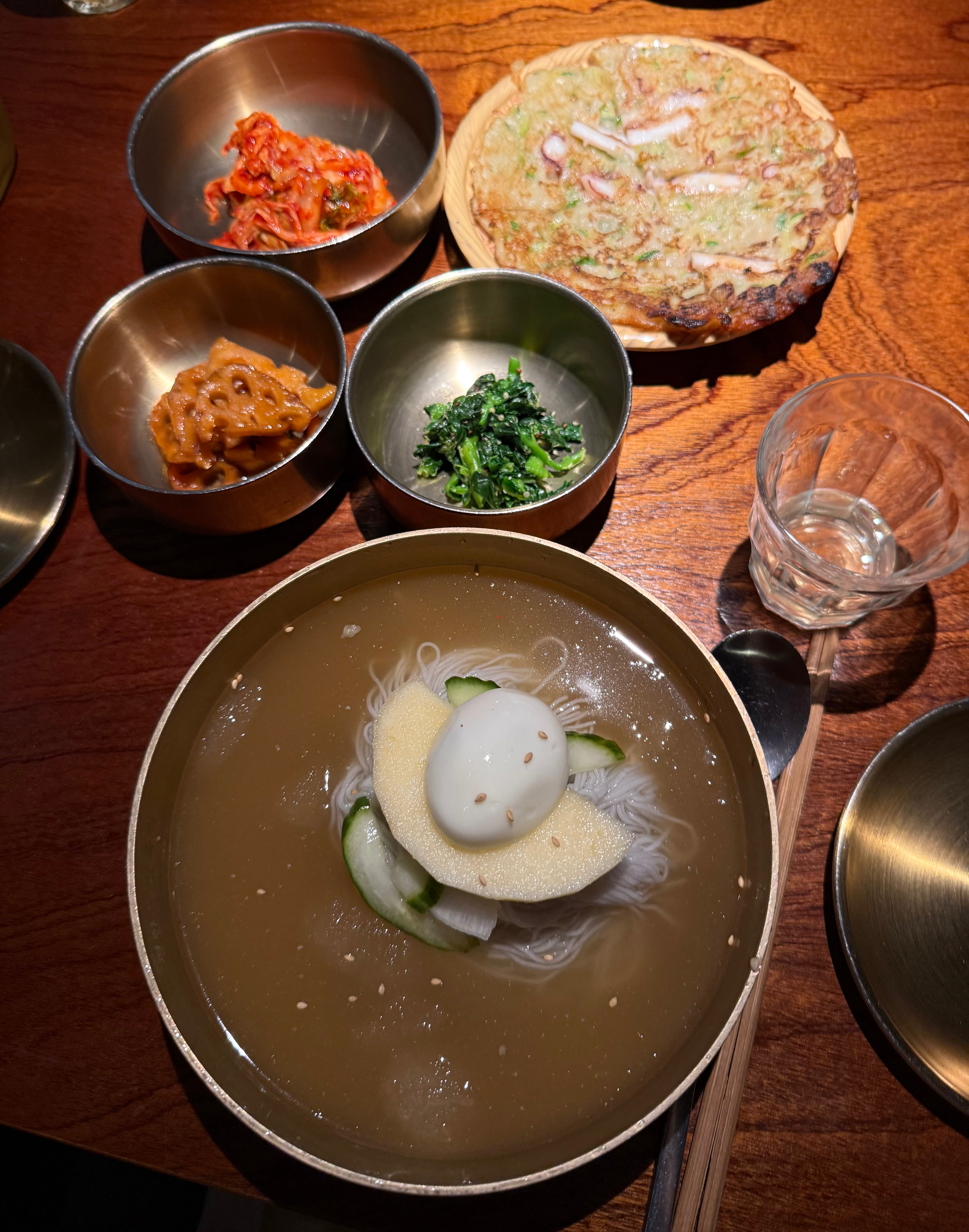
When it hits 100 degrees, naengmyun is the one correct meal. Maybe it’ll even come out of a slushy machine.
Speaking of noodles: I caught up with Lucio Castro’s Drunken Noodles, a small, lovely thing, at IFC. They’re also playing the new Mary Oliver doc.
If you want a July 4th movie, I’d go with an experimental Western at Anthology, or my perennial pick: De Palma’s Blow Out at momi, but also blessedly available on Tubi.
Veronica and I talked about our A24 book and sexy movies with Vanity Fair.
I wrote something about The Drama months ago and missed the moment to publish it at least twice. Several people told me it wasn't too late, including Teddy Kim, who just ran his own take in this week's Feed Me.
So, here's mine.
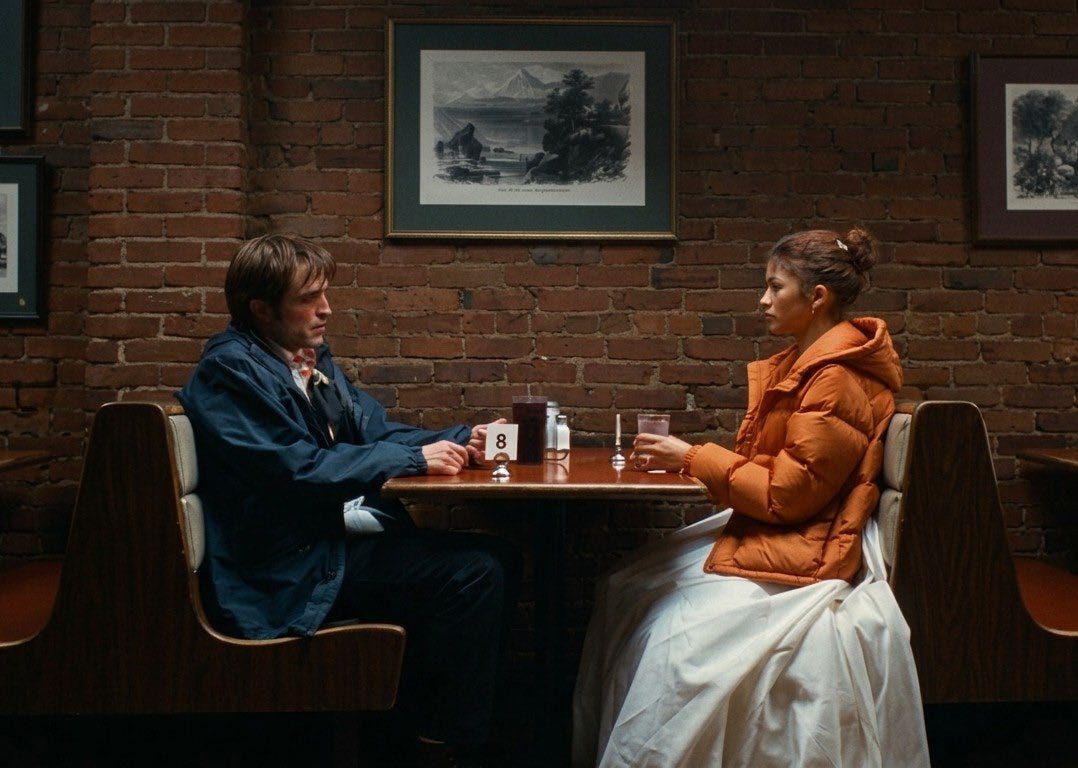
Kudos to the A24 marketing team, who have lately inveigled all of us with the suggestive power of a well-cut trailer. The preview for The Drama arrived in a perfect bow of faux intrigue, showcasing a happy couple whose love we know will be torn apart. Based on those two minutes, more than one person I know preemptively compared Borgli’s wedding picture to Baumbach’s Marriage Story, which we all know it wasn’t—because Marriage Story is a straightforward drama and Baumbach is a director who cherishes his characters and builds his films from accumulated observations. Borgli is something of an edgelord who writes characters as impervious ciphers.
Here they are placeholders for an argument the film is too impatient or flippant to actually make good on. A bit like Materialists last year, the conversation surrounding The Drama is of much greater interest than the film itself, which is an underimagined schematic of moral peril rendered in a blandly tasteful sheen. The two are also connected by an appearance by Zoe Winters: the assault victim in Celing Song’s movie and the wedding photographer in Borgli’s.
The Drama opens on a coffee-shop meet-cute: Robert Pattinson’s Charlie, bluffing familiarity with a book he’s never read (and never does) as a pretext to strike up a conversation with Zendaya’s Emma. From there, the relationship is largely compressed into flashback, sketched in as Charlie drafts his wedding speech. I mostly forgave the film’s thinness of detail, like the utter un-livedinness of their Boston-based literary/arts-adjacent lives, and the always related question of how they afford such an apartment, because the editing is clean and the rhythm is assured, and if nothing else, or, above all else, our central couple holds the eye. Also, it’s obvious that Borgli is hurrying to get us there. (Upon rewatch, the whole prelude felt a lot more slipshod.)
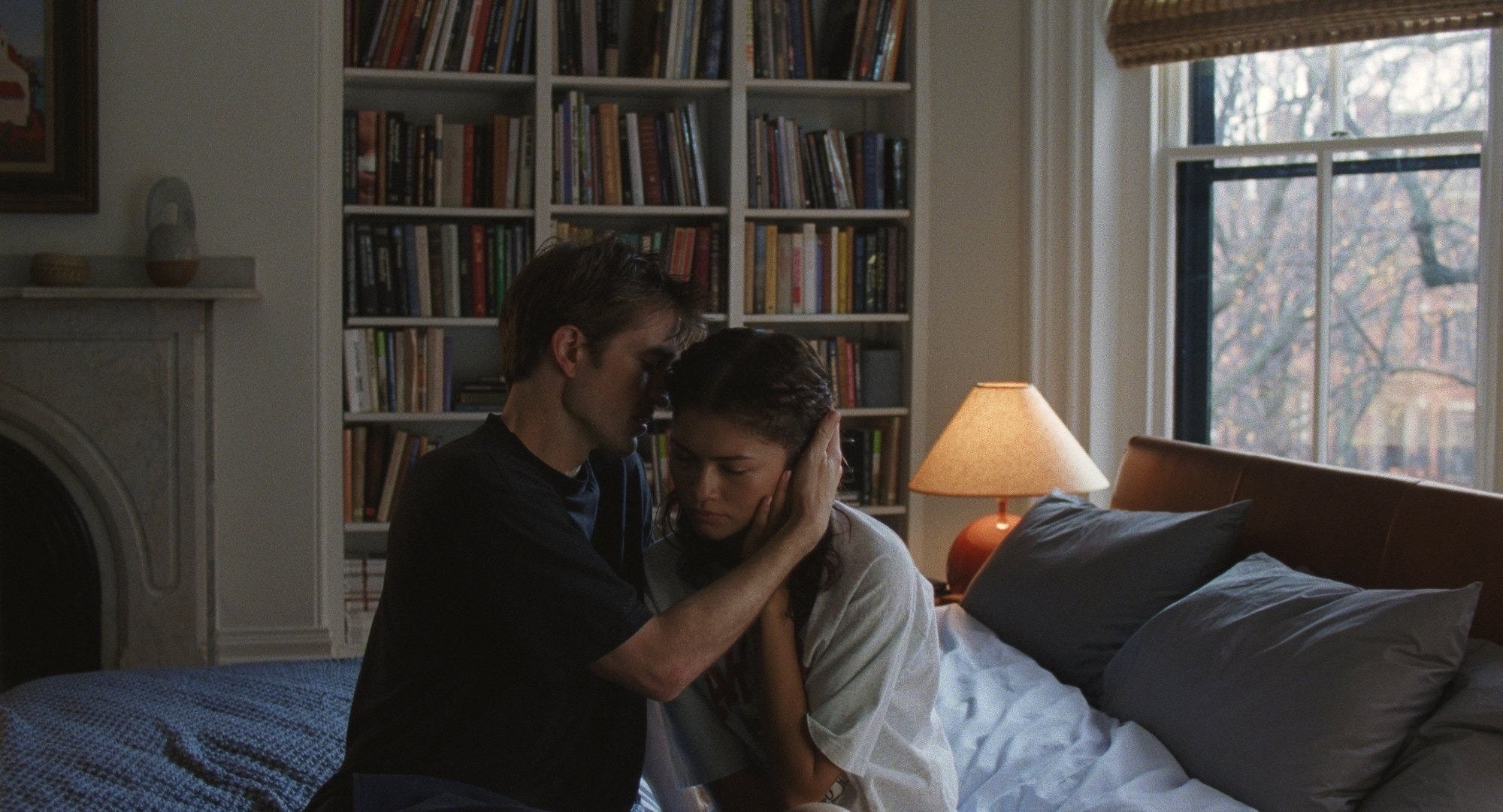
If you don’t know by now, the central and supposed twist of the film is, in fact, its premise. Emma and Charlie are about to get married, and during a menu tasting (conducted the week before the wedding, seems like cutting it awfully close?) they get a little tipsy and play a game of “What’s the worst thing you’ve ever done.” The characters, one by one, make their juicy disclosures: Alana Haim’s character locked a cognitively impaired little boy in a trailer in the woods; Mamoudou Athie’s, in a moment of panic, once used an ex-girlfriend as a human shield against a rabid dog, one-upping the guy in Force Majeure. Robert Pattinson’s Charlie bullied a classmate so severely that they had to switch school districts and leave town. Zendaya, meanwhile, almost “did a school shooting,” a confession that stops everyone dead in their tracks (and a grammatical construction that comfortably allows for the audience’s uncomfortable laughs), leading to Charlie’s vigorous unraveling. Not enough time is spent on all the terrible things these people did. (As someone who has lived through their share of adolescent cruelty, I am still largely skeptical of the redemption of former bullies.) These ugly semi-drunken confessions should dilate the film’s moral space, as windows into social judgment and norms, but instead of peering into each one, Borgli zooms in on the single thing Zendaya’s character did not do, investing that absence with a theatrical weight.
The film offers a small-talk, small-plates dilemma to debate over drinks afterward—except there’s really nothing to debate, because the film has already decided all the answers for us. It’s a thought experiment, a hypothetical moral quandary, useful mostly as a launchpad for discussing what we’re willing to let slide in a partner’s past, the limits and thresholds of our empathy. *Maybe it’s because I’m just coming off Our Hero, Balthazar, which, spoiler, has a potential school shooter in it, that I arrived at The Drama with considerable sympathy toward troubled kids who’ve had thoughts of violence flicker across their minds, and thus Emma. She isn't entirely unlike the teenager in Our Hero, Balthazar. Her transformation on the logic that someone else got to it first (a shooting, albeit at the mall), redirecting both the spectacle and the attention she had craved, is perversely plausible. The event that eclipses her also, ironically, becomes the first thing that makes her visible to her peers—they befriend her and console her because she may have been friends with one of the victims. This is one of the film's few psychologically convincing ideas, suggesting that the fantasy of violence can dissipate once the underlying emotional need has been displaced, but it barely registers in the trollish whole of a film.
The aborted school shooting—which improbably resurfaces just before the wedding—quickly becomes Emma's defining characteristic, at least in Charlie's unraveling imagination and, by extension, in the film itself. Yet nothing about the adult Emma suggests the person Charlie suddenly fears. She carries herself with an almost studied composure; she seems psychologically settled, not remotely the volatile figure onto whom he projects his panic. Given how little interiority he affords Emma as a character, it follows that the film has little interest in the broader racial implications of asking the audience to imagine a Black woman as a would-be school shooter—something the film brings up explicitly but does not sit with meaningfully.
The positive audience response to the movie speaks less to its power than to the atrophied state of the romantic comedy/drama. We are starving for romantic plots and for beautiful people torn apart and returned to each other’s arms, and no one is giving them to us. The Drama merely reflects those cravings—for a convincing love story, for moral puzzles that invite judgment, for performances that can be pulled out and argued over—without satisfying a single one.
For my column at CULTURED, I do a little behind-the-scenes dispatch on whatever new movie has planted the most Easter eggs, the visual and narrative crumbs a director leaves for people paying attention. This is a fool’s errand with, say, the new Colleen Hoover adaptation, but it is almost pleasurable with something like The Drama, which they weren’t interested in covering.
The bitchy dance instructor helping the couple with their wedding day performance is dancer and choreographer Celia Rowlson Hall, whose jazz-handsing work also appears in The Testament of Ann Lee.
The song about school shootings mentioned in the movie is “I Don’t Like Mondays” by the Boomtown Rats.
The Louis Malle film invoked to explain Emma’s sudden conversion on guns is Lacombe, Lucien, about a French teenager rejected by the Resistance who drifts into collaboration with the Nazis. It’s excellent.
Another Scandinavian movie that detonates a family gathering with a perfectly timed revelation: Thomas Vinterberg’s The Celebration, which remains one of the gold standards. If you don’t know what the “twist” is, don’t spoil it for yourself. Synopsis: A wealthy family convenes for a patriarch’s 60th birthday, and a secret emerges that permanently alters the evening.
It’s streaming on MUBI, and you can get 30 days free here https://mubi.com/en/elissa. I am actually somehow not being paid to tell you this, but I should be!
Another Scandinavian movie encircling school-shooting anxieties. In 2005, Vinterberg directed Dear Wendy, from a script by Lars von Trier, starring Jamie Bell, Alison Pill, and Mark Webber. Bell plays the leader of a group of outcasts who form a quasi-cult around firearms, naming them, mythologizing them, and obsessively studying ballistics and the physics of ricochets and exit wounds while pledging never to put anything to use.
The film was dismissed at the time as a misfire, made in extremely bad taste. I watched it for the first time this year and found the failed satire a fascinating artifact of a moment when gun fetishism still seemed weird enough to caricature and not just a sad fact of life. I don’t think it was ever distributed in the U.S., but you can find it online in less-than-perfect form.
Force Majeure (2014) is still a relevant watch, the quintessential and only movie about Alpine divorce: Ruben Ostlund’s film pays close attention to the changes in a relationship and charts the aftermath when one partner learns something that acutely changes their perception of the other.
Comments
Nothing yet. Say the first thing.
Sign in to join the conversation.