
Dumplin’ was released on Netflix in 2018 at the height of the body-positivity movement, and I thought it was as lovely as Julie Murphy’s book that it was adapted from. It takes place at the end of the summer and the beginning of the school year, and while it deals with body shaming and grief, it’s still a movie full of joy. One of the most joyful parts about it is its use of Dolly Parton’s music and how the country star shaped the plot of the story. It might seem unusual to revisit this film; it didn’t gain much prevalence to begin with. However, it feels incredibly relevant. At the time, it felt like we were heading toward a place of acceptance in society, but not even ten years later we’ve changed directions.
It’s not an exaggeration to say that women in Hollywood are withering away, and it is devastating to watch. I don’t want to call anyone out by name because I don’t think it’s fair to pin it on one or two specific people when it’s obviously a societal and cultural issue that needs to be addressed. There’s been a lot of comparisons to the last time eating disorders were running rampant in Hollywood in the mid to late 2000s, and I think these comparisons are completely valid. With all the ways social media has caused harm, I think one of the positives is that these days people can speak out in ways they weren’t able to in the 2000s. I know that’s controversial because a lot of people have interpreted it as criticism, but I don’t think this is something that we should sit back and pretend isn’t happening, especially when so many of these stars look like they’re on the brink of death.
I was also happy to see that Riverdale actor (and allegedly Mr. Fantasy?) KJ Apa recently spoke about his own experience with eating disorders. I know it’s the women in Hollywood right now who look sick, but we’re also living in an era of “gym bros,” and I don’t want to turn a blind eye to the fact that often the workout-obsessed men are also counting every calorie and might not even realize their quest to be fit and healthy is its own form of an eating disorder. It really puts into perspective how this is something that can affect anyone. Without further ado, let’s dive into Dumplin’.
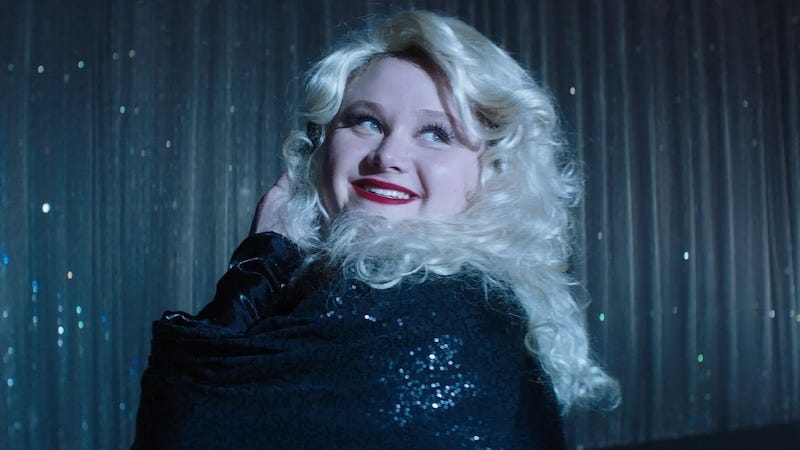
Dumplin’ begins with a supercut of Willowdean’s childhood with her Aunt Lucy. She paints her aunt, who passed away six months before the events of the film, like an angel who taught her self-acceptance through Dolly Parton’s music and many famous quotes. In just these few minutes, we learn how special Lucy was and how much of an impact she made on Willowdean’s life. It reminds me of those social media memes and videos mocking the “dead wife montage” film trope. However, we love these montages because it’s exactly the way we remember our own loved ones when they pass away. For better or for worse, our memories often are a supercut of their best moments.
Even in Aunt Lucy’s absence, she guides Willowdean throughout the film. What Willowdean learns, and it’s something I think we could all take away from Dumplin’, is that when someone leaves our lives, they don’t take everything they taught us with them. Those lessons stay with us for the rest of our lives. The movie revolves around what Aunt Lucy taught Willowdean about being proud of who she is. It’s only when Willowdean and her mother Rosie process their grief that they can see that Aunt Lucy’s spirit is all around them and everything they learned from her is still within them.
“As far as I’m concerned, a swimsuit body is a body with a swimsuit on it,”-Willowdean, Dumplin’.
We meet Rosie about 10 minutes into the film, and her first line is “I can’t be late, Dumplin’. I am the guest of honor, so will you please go upstairs and put on that floral dress that I got you for Mimi’s wedding? And can we run a brush through that hair?” It’s in this one line that we learn how much Rosie differs from her sister Lucy. During the Lucy montage, there’s a scene where a group of boys tease Willowdean for her weight. Going back to the current state of Hollywood, I always found it interesting how quick people are to call out overweight people for being “fat” and unhealthy, but those same people can’t see that a certain level of thinness is just as unhealthy and, in many cases, more detrimental.
Lucy’s response to the fat shaming says a lot about her values: “Pay them no mind, Willowdean; the world is filled with people that are gonna try to tell you who you are, but that’s for you to decide, you hear me?” Lucy didn’t value appearances; she valued character. It would probably be my initial thought to tell Willowdean that there’s nothing wrong with her appearance and that she’s beautiful no matter what weight she is. But I respect that Aunt Lucy went even deeper, teaching Willowdean that life is not about your external appearance, but about living your truth.
Then there’s Rosie, a former beauty queen and the woman behind the Miss Teen Bluebonnet Pageant, who is preoccupied with appearances and projects that onto her daughter. The world can do a lot of damage to someone’s self-esteem, but I think the real harm comes from inside the house, literally. As a child, Willowdean had her aunt to empower her, so the words of other kids couldn’t hurt her as much. Sadly, her mother’s attitude contradicted that, and once Lucy was gone, it became harder for her to drown out Rosie’s words and attitudes. Had Rosie been as encouraging as Aunt Lucy, Willowdean would have been a lot more confident.
At the Miss Teen Sweetwater Pageant, Willowdean watches from backstage as her mother announces the winner and looks at her with a pride she never looks at her own daughter with. Director Anne Fletcher and cinematographer Elliot Davis linger the camera on Willowdean’s face long enough for us to see just how much this breaks her heart. She resents her mother, but that doesn’t cancel out the fact that, like every child, she longs for her approval. Seeing another girl get that so effortlessly, just because she fits her mother’s beauty standard, is agonizing.
Willowdean decides that as a form of protest, she and her friend Elle will enter the Miss Teen Bluebonnet Pageant. Her mother knows instantly she’s doing this out of spite, not because she has a sudden desire to be a beauty queen. What her mother doesn’t initially know is that Willowdean decides to sign up after finding a sign-up sheet from 1993 that her Aunt Lucy never finished filling out. Willowdean is doing the pageant to honor Lucy. Willowdean believes her mother is embarrassed of her doing the pageant because she doesn’t look like the stereotypical pageant girl, but that’s her point. She despises pageants for reinforcing beauty standards and making young girls preoccupied with what they look like instead of what’s within them; the latter is what Aunt Lucy told her matters most.
From what we learn about Rosie, she does come across as the main antagonist and her daughter’s biggest bully. However, Dumplin’ dives beneath the surface of why Rosie is so harsh toward her daughter, and that’s what makes the movie so genuine. Because the truth is abuse is a cycle, and critical people are only ever mimicking the way they were treated. We learn that Rosie was overweight when she was younger, but she lost the weight before high school. That’s when she became a pageant queen. But even after losing the weight, she was never able to shed the shame she carried from her former life. Her daughter is her biggest trigger because seeing someone who is comfortable in their own body reminds her of all the ways she hasn’t accepted herself. Even as a thin person, she still struggles with her body image, constantly dieting so she can squeeze into pageant dresses and nearly having a breakdown at the end of the film when her annual pageant dress won’t zip up.
There are layers to Rosie, and while she’s initially eager to move on from Lucy’s death, we later learn this is just a coping mechanism. Along with her own trauma and the stress of the upcoming pageant, Rosie’s also dealing with the grief of losing her sister; someone she never really seemed to understand the way Willowdean did. Facing her death means facing the fact that she never really got to know her while she was here. The good news is, by the end of the film, she has a better relationship with Willowdean and is more open to getting to know who she really is. Since so much of Willowdean is made up of Aunt Lucy, by healing their relationship, it’s also bringing Rosie and Lucy closer together. As much as the film is about body image and self-empowerment, it is also a story about the complex mother-daughter relationship, not so different from films like Lady Bird. That storyline is timeless, and it’s always satisfying to see the characters find compassion for each other in the end.
The thing about that is, it can’t just be Rosie who has to be open-minded toward her daughter, but Willowdean has to be open-minded toward her mother too. I agree with Willowdean’s opinion on beauty pageants, but I also understand that for some people that really is their passion. From their perspective, it’s more than just what they look like, but their love for performing and being on stage in front of an audience; that’s why the talent portion is such a big deal. As a theater fan, from this point of view, I can see how it resembles Broadway, and I could never hate on someone for wanting to perform on stage because I love being one of their audience members so much.
That’s one of the best parts about Dumplin’; it doesn’t point the finger or shame anyone; it explores multiple perspectives and validates all of them. We learn this mainly through one of the girls Willowdean unintentionally inspires to join the pageant. While Willowdean tells Millie, “I’m not the Joan of Arc of fat girls,” Millie is inspired by Willowdean to be in the pageant too. Millie is also bullied for her weight at school, but her personality is vastly different from Willowdean’s. She’s bubbly, excitable, and maybe a little naive. But if she weren’t that way, she wouldn’t have won the pageant in the end.
While Willowdean’s protest plot centers on calling out the pageant world for discrimination and basically making a mockery of it, Millie just wants to end the exclusivity. It’s her self-assurance and vocal abilities that win her first prize. However, by the time of the pageant, Willowdean also finds herself enjoying it. One of my favorite parts is when she and her friend Elle walk out during the swimsuit portion in bathing suits that say “every body is a swimsuit body.” This was so cheesy to watch in 2026, but at the time it was a common phrase people said to protest the idea that you should have to lose weight in order to look good for the summer. I also think we need to move away from being so turned off by things that are cheesy because they’re often the things that are true. I stand by embracing being cringey instead of always running away from it.
“Willowdean Dixon, I think you’re beautiful. To hell with anyone else who’s ever made you feel less than that,”-Bo, Dumplin’.
But Willowdean’s story doesn’t begin or end with the beauty pageant or her relationship to her mother, because there’s a side plot love story in the film as well, and it’s equally as powerful as everything else. Willowdean has a genuine connection with her diner coworker Bo, who goes to a local private school. In Willowdean’s eyes, he’s better off with someone like Becka, a pageant girl her mom does dress alterations for, because Becka fits the female beauty standard in the way Bo fits the male beauty standard.
But Bo sees beyond appearances, just like Aunt Lucy did, and he’s especially drawn to Willowdean because he thinks she doesn’t care what other people think. When he kisses her in the back of his pickup truck, she can no longer deny that he’s interested in her. Sadly, her insecurities get in the way, and she has a hard time accepting that someone like Bo would find her attractive. They both make very valid points in their argument. Bo is offended that Willowdean thinks he’d be so shallow as to judge her for her weight instead of liking her for who she is.
But Willowdean has lived in a world where she grew up being picked on for her weight by boys just like him and lived under constant criticism from her mother. I’m sure Willowdean is also used to boys being embarrassed to be attracted to her because of her size, as I know this is something that happens in the real world. I’m glad Bo reassures Willowdean that he likes her, but I wish he would have been more understanding of Willowdean’s perspective and insecurities. But like every good movie, all’s well that ends well, and Willowdean’s journey to confidence ends with her finally accepting that she is lovable and desirable exactly as she is.
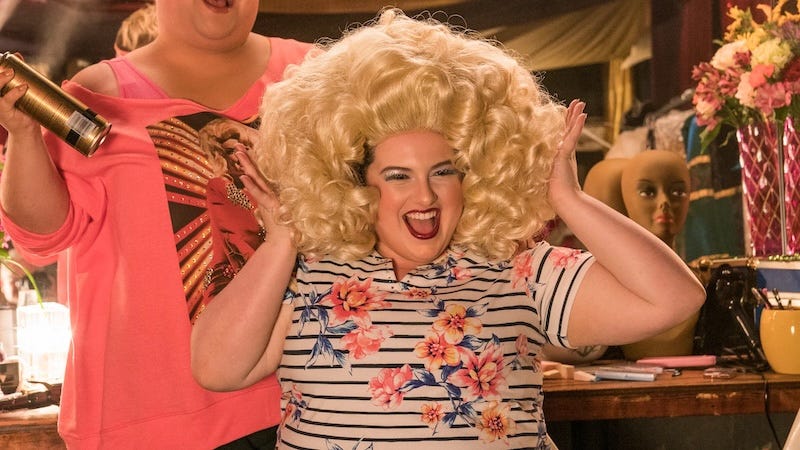
I remembered Dumplin’ using Dolly Parton’s music, but I didn’t remember how much the singer played into the plot of the film. It might sound kind of random for Dolly to be at the center of this movie, but it actually makes a lot of sense given how Dolly embodies love, acceptance, and kindness. I went to Dollywood last June, and when I wrote about the trip in my Tennessee newsletter, I said, “Dolly Parton is a universally beloved celebrity because in a world where so many people in positions of power are greedy and corrupt, Dolly has always used her platform to do good and spread love.” That’s exactly why she was the perfect muse for Aunt Lucy and Willowdean.
At the Dolly Parton drag show, Willowdean learns from the security and drag queens how beloved her aunt was at the club, and because they loved Aunt Lucy, they’re especially welcoming and accommodating to Willowdean. It’s here that she gains her confidence to follow through with the pageant after a pep talk from one of the drag queens, who tells her how much Lucy gave him the confidence to go on stage every night. He then recites a quote from Lucy that gives Willowdean the confidence she needs to follow through with the pageant: “Go big or go home, but either way, do it in a red pair of shoes.”
There’s always been an interesting and sometimes critiqued dynamic between women and gay men, but Dumplin’ is a great example of how we often uplift each other. I think it’s mainly based on two groups of people who have been cast out in society coming together to inspire each other. As a plus-size woman, Aunt Lucy never really fit into society the same way a gay man or drag queen doesn’t. But rather than let the world taint them, they chose to turn their hurt into love so that the people around them would have it easier than they did; I think that’s the way to be in life. It’s different than how Rosie handled her pain, but I think that’s what made Aunt Lucy so special. It’s a unique ability that not everyone has.
The drag show also helps Willowdean understand the beauty pageant world better because drag shows are pageants in their own right, and no one’s ever shamed a drag queen for loving to put on a show; that’s just what they do. It’s also how Willowdean comes up with the idea to incorporate Dolly Parton’s music into her magic show for the talent portion of the pageant. After all, Dolly is the heart of the film, and the characters’ outlet for connecting with Aunt Lucy and keeping her spirit alive.
Comments
Nothing yet. Say the first thing.
Sign in to join the conversation.