
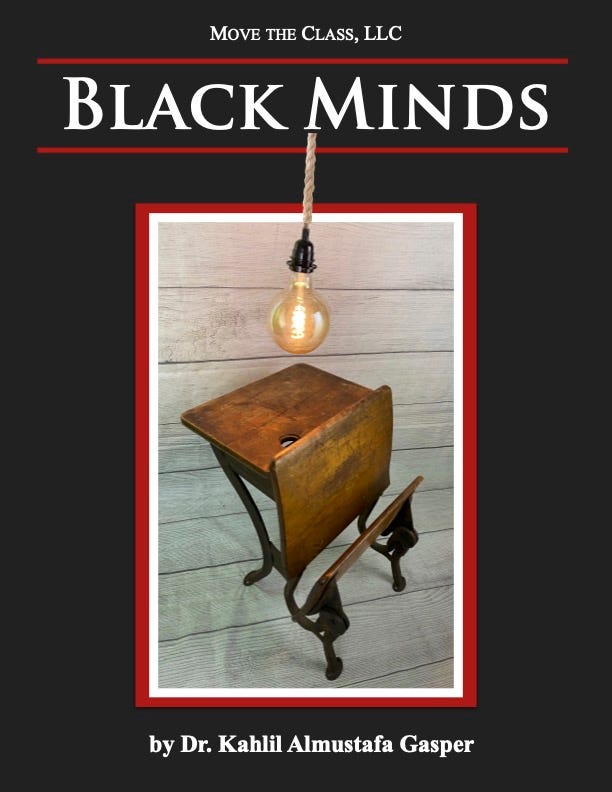
Verse I. Enslavement Era
Criminalizing education was key to enslavement.
You could be killed for reading. It was a legal arrangement.
Each state instated laws to keep blacks in chains.
Doctrines adopted that locked the basic knowledge away.
A systematic process so black folks wouldn't rebel.
Cause if we started to think, well, then their system would fail.
So if you caught teaching then you’d be taught bleeding.
Could lose a hand, could lose a man, the law required beatings.
They passed laws that outlawed mental instruction.
It was cultural erasure, mental destruction.
They read bibles to fill Black minds with White saviors.
Use Black bodies to make paper through Black labor.
There were free blacks. They built schools. They had hope.
But when Black voices speak up they hang ropes.
Our story is a lesson for this nation we living in.
Without education you cannot be a citizen.
Verse II. Civil Rights Era
The next chapter in our story is the Civil Rights era.
Blacks fight for basic rights. Whites fight back with terror.
1954, Brown wins versus Education.
But no federal plan and white folks wasn’t integrating.
Blacks face discrimination every county in this nation.
White mobs spit in their faces when they meet their destinations.
They tried to block Little Rock Nine, busses and churches got bombed.
White hatred aimed at Little Girls but Ruby Bridges sun shined.
Equality the topic of priority?
Angela and Malcolm questioned white superiority.
The problem never separation, couldn’t fix with integration,
Bussing babies far away to teachers teaching books that hate them.
Black minds understand it, made a plan to move to planet,
Black knowledge co-opted when it's not taken for granted.
The Brain Drain disconnects scholars from their roots.
None of this is on the test, so you’ll have to seek the truth.
DIALOGUE QUESTION: How does this historical perspective challenge dominant narratives about the larger state of education for Black people in the United States?
REFERENCES
Baldwin, J. in “Foreword to The Chasm: The Life and Death of a Great Experiment in Ghetto Education, by Robert Campbell (Boston: Houghton Mifflin, 1974), xvii.
Brown v. Board of Education, 347 U.S. 483 (1954).
Carmichael, S., & Hamilton, C. V. (1967). Black power: The politics of liberation in America.
Civil Rights Act of 1964 § 7, 42 U.S.C. § 2000e et seq (1964).
Hilliard, A. G. (1995). The Maroon Within Us: Selected Essays on African American Community Socialization. Baltimore, MD: Black Classic Press.
Hoover, M., Lewis, B., Sherrod-Ali, G., Ferguson, I., Green, R., Ellis, B., M’chawe, B., Anderson, S., & Harrington, A. (2002). Reparation and Education. Panel discussion at the Reparations Teach-In. New York, NY.
Isaacs, C. S. (2014). Inside Ocean Hill Brownsville: A Teacher’s Education (1968-69). Albany, New York: Excelsior Editions. 364 pages.
Johns, D. & Jones-Castro, A. (2016). Editorial: Education is the Civil Right. NBC News. Retrieved from: http://www.nbcnews.com/news/nbcblk/editorial-education-civil-right-n606356.
McCarthy, M. M., Cambron-McCabe N. H., & Eckes S. E. (2014). Public school law: Teachers’ and students’ rights. Pearson.
McCoy, R. (1968). The year of the dragon. Boston, MS: Harvard University, Graduate School of Education, Office of Metropolitan Educational Collaboration.
Movement for Black Lives. (2017). Community Control. In Platform. Retrieved from https://policy.m4bl.org/community-control/.
National Negro Convention. (1832). “Conventional Address” from proceedings from African Americans Convene for Their Second National Convention. Retrieved from http://college.cengage.com/history/ayers_primary_sources/african_americans_national_convention.htm
Sizemore, B. (2008). Walking in circle: the black struggle for school reform. Chicago, IL: Third World Press.
U.S. Const. amend. XIV.
Williams, H. A. (2005). Self-taught: African American education in slavery and freedom. Chapel Hill: University of North Carolina Press.
No posts
Comments
Nothing yet. Say the first thing.
Sign in to join the conversation.