
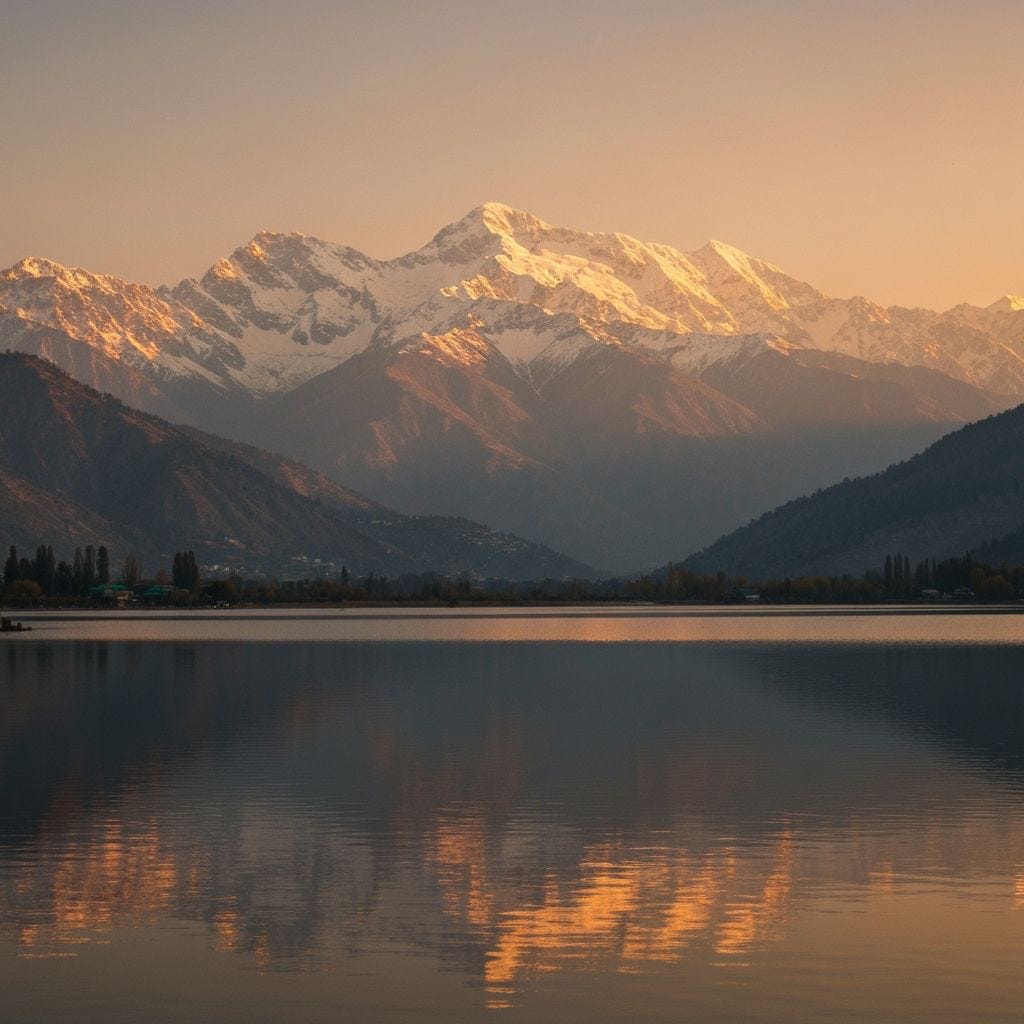
Kashmir Shaivism represents one of the most sophisticated non-dual philosophical systems to emerge from ancient India. Flourishing in the Kashmir Valley between the 8th and 12th centuries CE, this tradition synthesized tantric practice, profound metaphysics, and direct experiential insight into a comprehensive path to Self-realization.
At its heart lies the revolutionary teaching of Pratyabhijñā—the “philosophy of recognition”— which holds that liberation is not something to be achieved through years of practice, but rather the simple recognition of one’s true nature as Paramashiva, the absolute consciousness that manifests as the entire universe.
“You are not a drop in the ocean. You are the entire ocean in a drop.”
— Kashmir Shaivite teaching
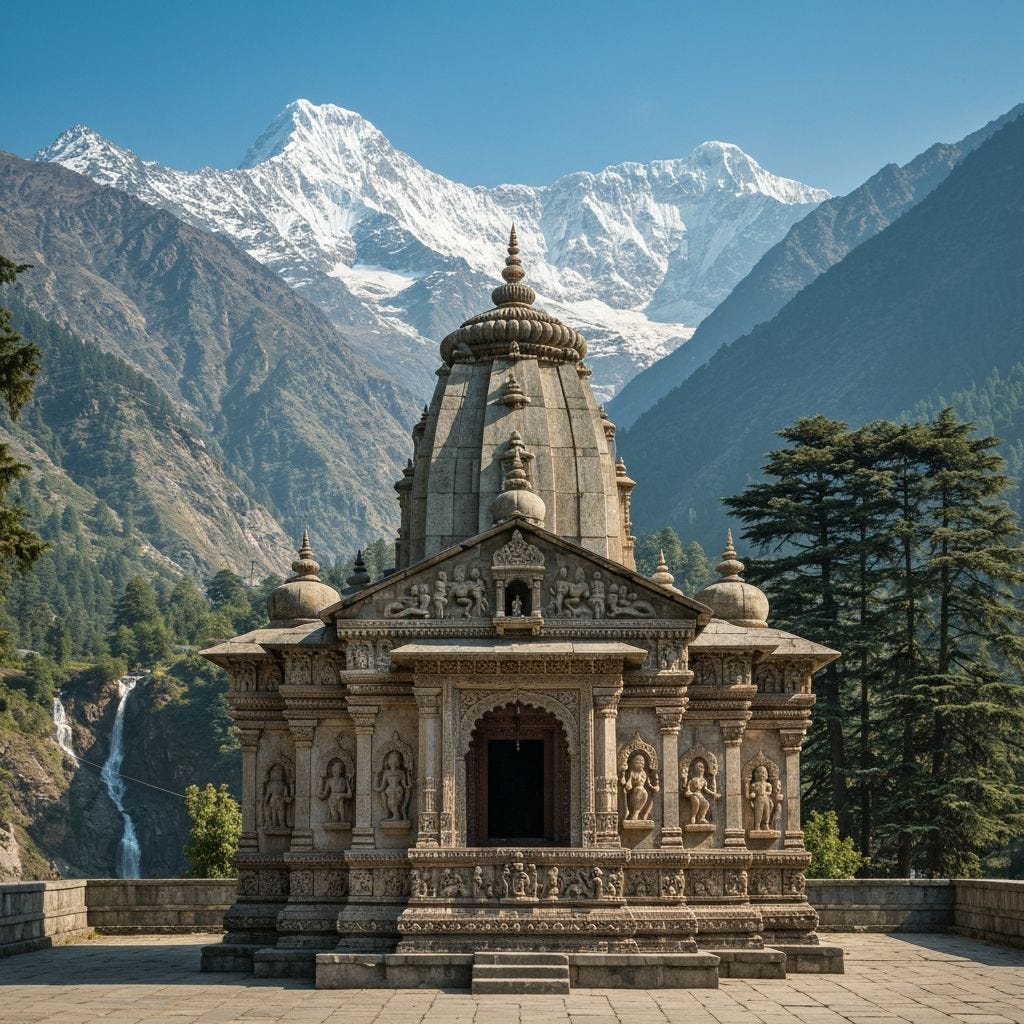
Abhinavagupta was a polymathic philosopher, mystic, and aesthetician who lived in Kashmir during its golden age. His masterworks, including the Tantrāloka and Parātriśikā-Vivaraṇa, synthesized the entire Kashmir Shaivite tradition into a comprehensive philosophical system.
“The supreme light of consciousness illumines everything, being itself illumined by nothing else. It is the light of lights, the pure light, the self-luminous light.”
— Tantrāloka
“The universe is not different from consciousness. It appears as though it were different, but this appearance is the play of consciousness itself.”
— Īśvara Pratyabhijñā Vimarśinī
“When the yogi realizes that everything is consciousness, then even the perception of duality becomes an experience of non-dual awareness.”
— Tantrāloka
“The bliss of aesthetic experience is nothing other than the bliss of the Self, tasted through the medium of art. In that moment, the experiencer transcends the limitations of individual consciousness and touches universal awareness.”
— Abhinavabhāratī (Commentary on Nāṭyaśāstra)
“This recognition is not a new attainment but the remembrance of what has always been true.”
— Abhinavagupta on Pratyabhijñā
“Spanda is the heartbeat of Shiva, the creative throb that brings forth all manifestation while remaining forever untouched.”
— Teaching on Spanda
Spanda: The dynamic vibration of consciousness that gives rise to the universe
Pratyabhijñā: Recognition of one’s true nature as Shiva consciousness
Svātantrya: The absolute freedom of consciousness to manifest in infinite forms
Vimarśa: The self-reflective awareness that characterizes consciousness
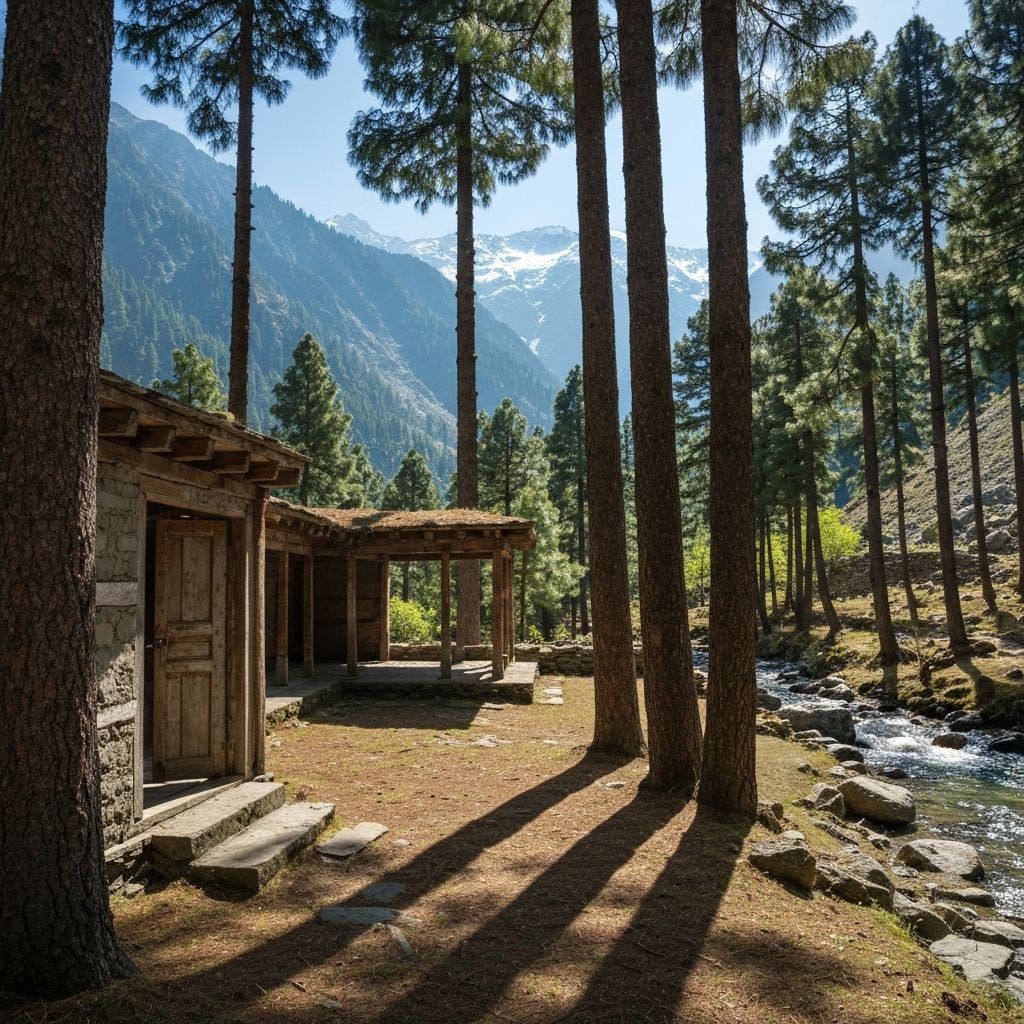
Revered as the last master in an unbroken lineage of Kashmir Shaivism, Swami Lakshmanjoo dedicated his life to preserving and transmitting this ancient wisdom. His translations and commentaries made these profound teachings accessible to Western audiences for the first time.
“Kashmir Shaivism is not something to be learned intellectually. It is to be experienced. It is the experience of your own Self, your own divine nature.”
— Swami Lakshmanjoo
“The real practice of Kashmir Shaivism is to remain aware of your own nature in each and every breath. This awareness is not concentration—it is relaxation into your own being.”
— Swami Lakshmanjoo
“In Kashmir Shaivism, everything is Shiva. The world is not an illusion to be rejected, but the divine play to be recognized and embraced as the manifestation of consciousness.”
— Swami Lakshmanjoo
“God consciousness is just being aware of your own self. Just being aware—not thinking, just being. This is the supreme state.”
— Swami Lakshmanjoo
“When you understand that this whole universe is existing in your consciousness, not you in the universe, then you are established in your real nature.”
— Swami Lakshmanjoo
“These aphorisms are not mere words to be intellectually understood. They are living keys that unlock the door to direct experience of one’s divine nature.”
— Swami Lakshmanjoo on the Shiva Sutras
“The Śiva Sūtras are not just ancient texts—they are living transmission. When you contemplate these sutras with an open heart, they open you to the same direct recognition that the ancient sages experienced.”
— Swami Lakshmanjoo
“Kashmir Shaivism and Dzogchen are like two mountain peaks of the same Himalayan range—seemingly separate when viewed from below, yet part of the same vast truth when seen from above.”
— Swami Lakshmanjoo, in conversation about Tibetan Buddhism
“In Kashmir Shaivism, we don’t create something new. We simply recognize what we have always been. This recognition can happen in an instant.”
— Swami Lakshmanjoo
“Whether you call it Shiva consciousness or Buddha nature, whether you speak of Pratyabhijñā or Rigpa—these are different fingers pointing at the same moon. The wise see the moon, not the finger.”
— Swami Lakshmanjoo
“Kashmir is not just a place on a map. It is a state of consciousness. When you truly understand Kashmir Shaivism, wherever you are becomes Kashmir—because you recognize that you are always dwelling in the heart of Shiva, which is everywhere and nowhere, transcendent yet utterly present.”
— Swami Lakshmanjoo
Awareness without effort: The practice is simply remaining aware of awareness itself
World-affirming spirituality: Unlike some traditions, Kashmir Shaivism embraces the manifest world as divine
Immediate recognition: Liberation is not a future attainment but present recognition
Integration of all paths: All spiritual practices lead to the same ultimate realization
According to tradition, the Śiva Sūtras were revealed to the sage Vasugupta in a dream, directing him to a rock on Mahādeva mountain near Srinagar, Kashmir. Upon the rock were inscribed these 77 cryptic aphorisms containing the essence of Kashmir Shaivite philosophy.
The sutras are divided into three sections: Śāmbhavopāya (Divine Means), Śāktopāya (Empowered Means), and Āṇavopāya (Individual Means), each representing different approaches to Self-realization appropriate for different practitioners.
The direct path where mere recognition leads to liberation. This is the highest teaching for those of exceptional capacity.
1. Chaitanyam ātmā
Consciousness is the Self
The foundational teaching: your essential nature is pure consciousness, not the body or mind.
2. Jñānam bandhaḥ
Limited knowledge is bondage
Identification with limited concepts and thoughts creates the illusion of separation from the infinite.
3. Yoni-vargaḥ kalā-śarīram
The aggregate of creative powers constitutes the body
What we call the body-mind is actually a constellation of divine creative energies.
7. Jāgrat svapna suṣupta bhede turyābhoga sambhavaḥ
The experience of the fourth state arises through distinguishing waking, dreaming, and deep sleep
By recognizing the witness consciousness present in all three states, one discovers the transcendent fourth state (turya).
10. Vītarāga-samaḥ
One who is free from attachment is like space
Liberation means becoming like space—untouched, all-pervading, and free.
Using the power of focused awareness and contemplation. The mind itself becomes the tool of liberation.
1. Cittam mantraḥ
The mind is mantra
Every thought is a vibration of divine consciousness, a sacred formula of the Self.
4. Garbhaḥ
The womb
The body is understood as a matrix or womb of creative consciousness.
5. Vīra samvit
Heroic consciousness
The realized yogi experiences themselves as the heroic consciousness that pervades all existence.
7. Mātṛkā-cakra sambodhaḥ
Awakening the circle of the matrix of sounds
Understanding that all letters, words, and sounds emerge from and return to primordial consciousness.
Using meditation, mantras, and practices to gradually purify consciousness and realize one’s true nature.
5. Vitarka ātmajñānam
Reasoning leads to knowledge of the Self
Proper contemplation and discrimination reveal one’s true nature.
9. Nartaka ātmā
The Self is the dancer
The supreme consciousness dances as the entire universe, and you are that dancer.
12. Tadāruḍha-prāmitteḥ
Having ascended to that state, one becomes the measure of reality
The realized being becomes the standard by which all reality is measured, for they are one with universal consciousness.
27. Śarīra vṛttir vratam
The activity of the body is the observance
Every action performed with awareness becomes a sacred practice, a vow of recognition.
The profound parallels between Kashmir Shaivism and Dzogchen, the “Great Perfection” teaching of Tibetan Buddhism, have long fascinated scholars and practitioners. Both traditions emerged in the Himalayan region, both emphasize direct recognition of one’s true nature, and both point to an innate perfection that needs only to be recognized, not achieved.
The philosophy of recognition teaches that liberation comes through recognizing one’s identity with Paramashiva, the absolute consciousness.
“This recognition is not a new attainment but the remembrance of what has always been true.” — Abhinavagupta
Rigpa, often translated as “pure awareness,” is the direct recognition of the nature of mind—primordially pure and naturally luminous.
“Rigpa is not something created through meditation. It is the ever-present nature of awareness itself.” — Dzogchen teaching
Spanda is the divine vibration or pulsation of consciousness from which the entire universe emerges and into which it dissolves.
“Spanda is the heartbeat of Shiva, the creative throb that brings forth all manifestation while remaining forever untouched.” — Spanda Kārikās
Tsal refers to the creative energy or expressive power of rigpa—the dynamic aspect of awareness that manifests as the play of phenomena.
“The manifestations of tsal are like rainbow lights arising from a crystal— inseparable from their source yet appearing distinct.” — Dzogchen teaching
Both traditions point to a non-dual reality where consciousness and its contents, awareness and manifestation, are ultimately inseparable. There is no fundamental division between subject and object, mind and matter, samsara and nirvana.
“The universe is not separate from consciousness but is consciousness itself in its creative self-expression.”
— Kashmir Shaivism
“From the beginning, all phenomena are the pure display of the nature of mind, like reflections in a mirror—appearing yet having no inherent existence.”
— Dzogchen
While both traditions acknowledge graduated paths, they emphasize a direct approach where liberation is not achieved through years of effort but through immediate recognition of what is already present.
“In Kashmir Shaivism, we don’t create something new. We simply recognize what we have always been. This recognition can happen in an instant.”
— Swami Lakshmanjoo
“The view of Dzogchen is that buddhahood is not something to be attained through gradual purification. It is to be recognized as the primordial nature of mind itself, present from the very beginning.”
— Dzogchen teaching
The geographical proximity of Kashmir and Tibet, separated only by the high Himalayan passes, facilitated centuries of cultural and spiritual exchange. Buddhist teachings from India traveled through Kashmir to Tibet, while Tibetan masters sometimes studied in Kashmir.
Some scholars suggest that the early Dzogchen teachings that appeared in Tibet in the 8th century may have been influenced by the non-dual Shaivite traditions flourishing in Kashmir during the same period. While definitive historical proof is elusive, the philosophical parallels are striking.
Swami Lakshmanjoo himself acknowledged the deep affinity between these traditions, noting that they arose from the same Himalayan soil and pointed to the same ultimate reality, though expressed through different cultural and linguistic frameworks.
The Kashmir Valley, cradled in the embrace of the mighty Himalayas, has been revered for millennia as one of the most sacred landscapes on Earth. Persian poets called it “Paradise on Earth,” and for the mystics and sages of Kashmir Shaivism, every feature of this land— from the serene lakes to the towering peaks—was seen as a manifestation of divine consciousness.
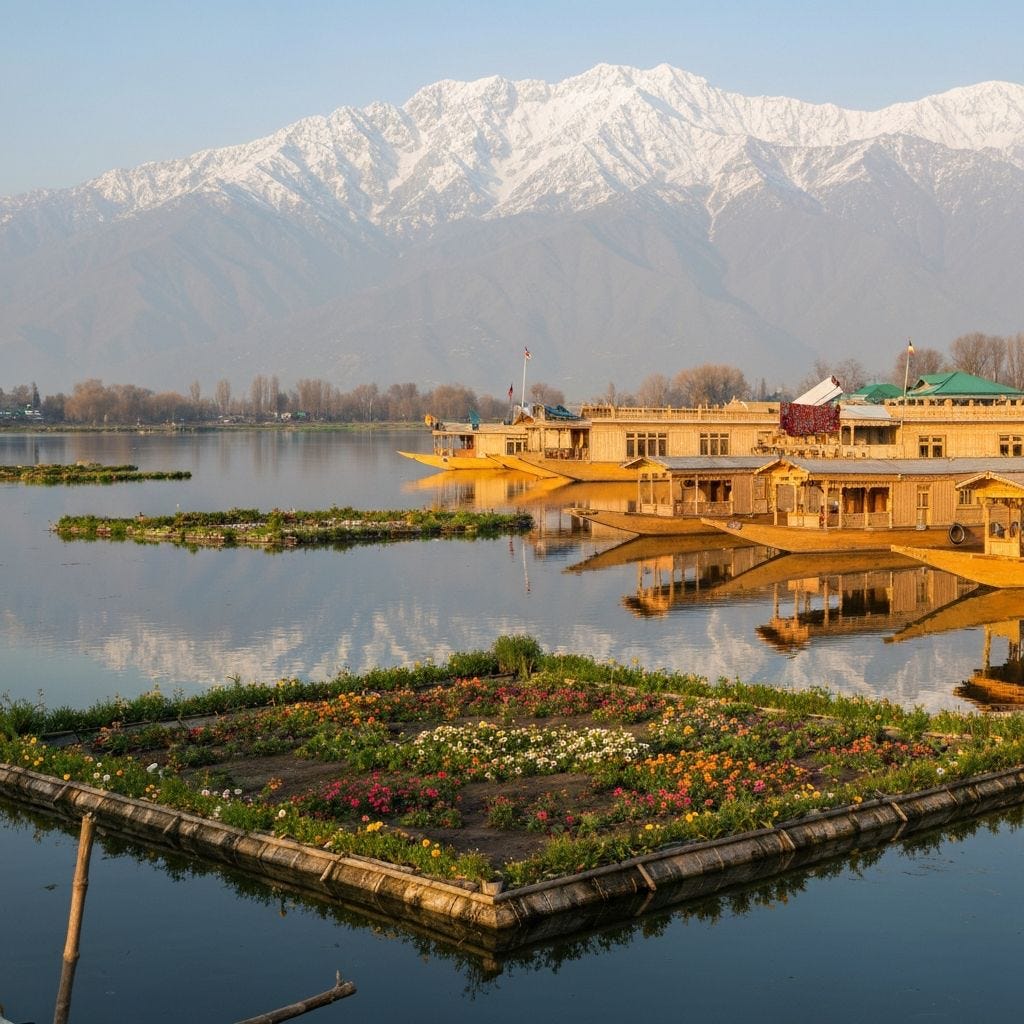
The jewel of Srinagar, Dal Lake stretches like a liquid mirror reflecting the Zabarwan mountains. Its still waters have witnessed centuries of spiritual practice, and its famous houseboats have sheltered countless seekers.
“Like consciousness itself, the lake reflects all appearances while remaining essentially pure and unchanged.”
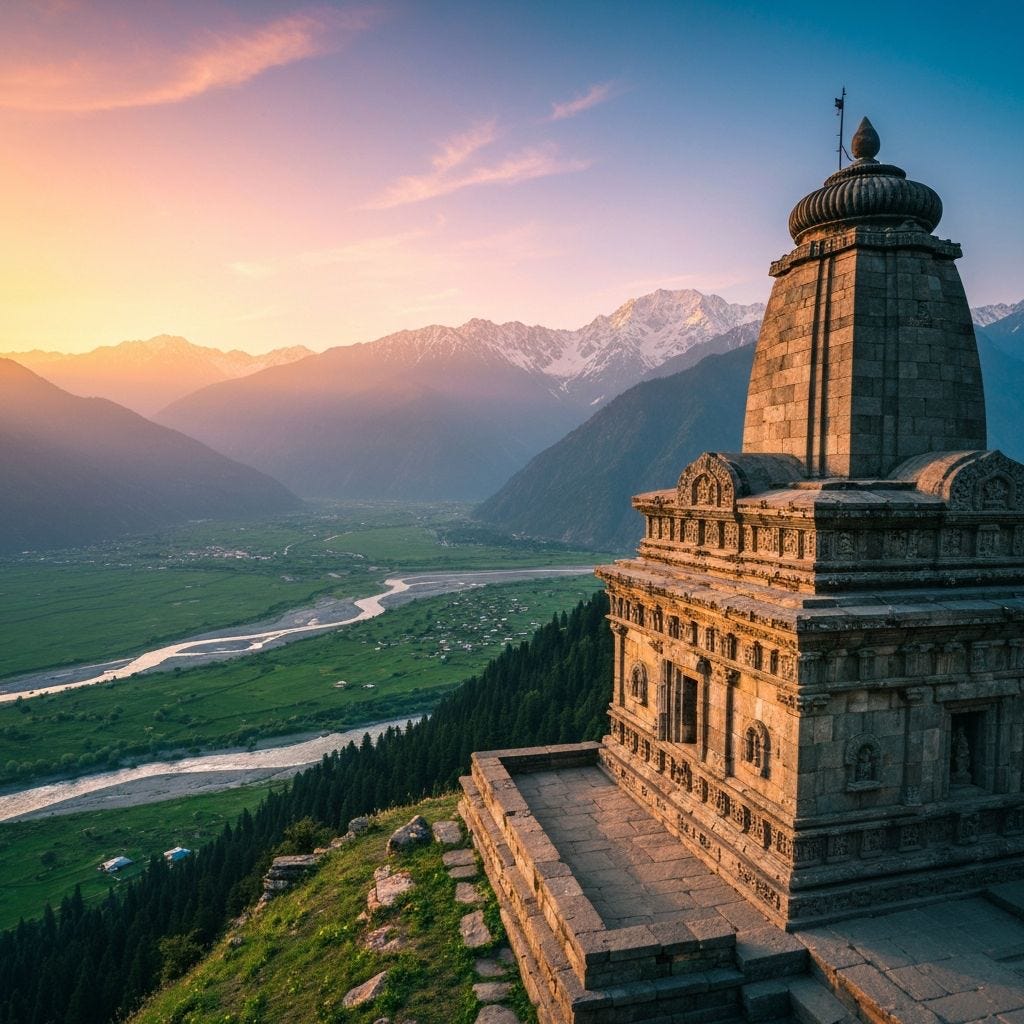
Rising 1,100 feet above Srinagar, this sacred hill is crowned by an ancient temple dedicated to Shiva. The site has been a place of pilgrimage since at least 200 BCE, and the views from its summit encompass the entire valley.
“From this peak, one sees the entire valley laid out like a mandala—a sacred pattern of divine manifestation.”
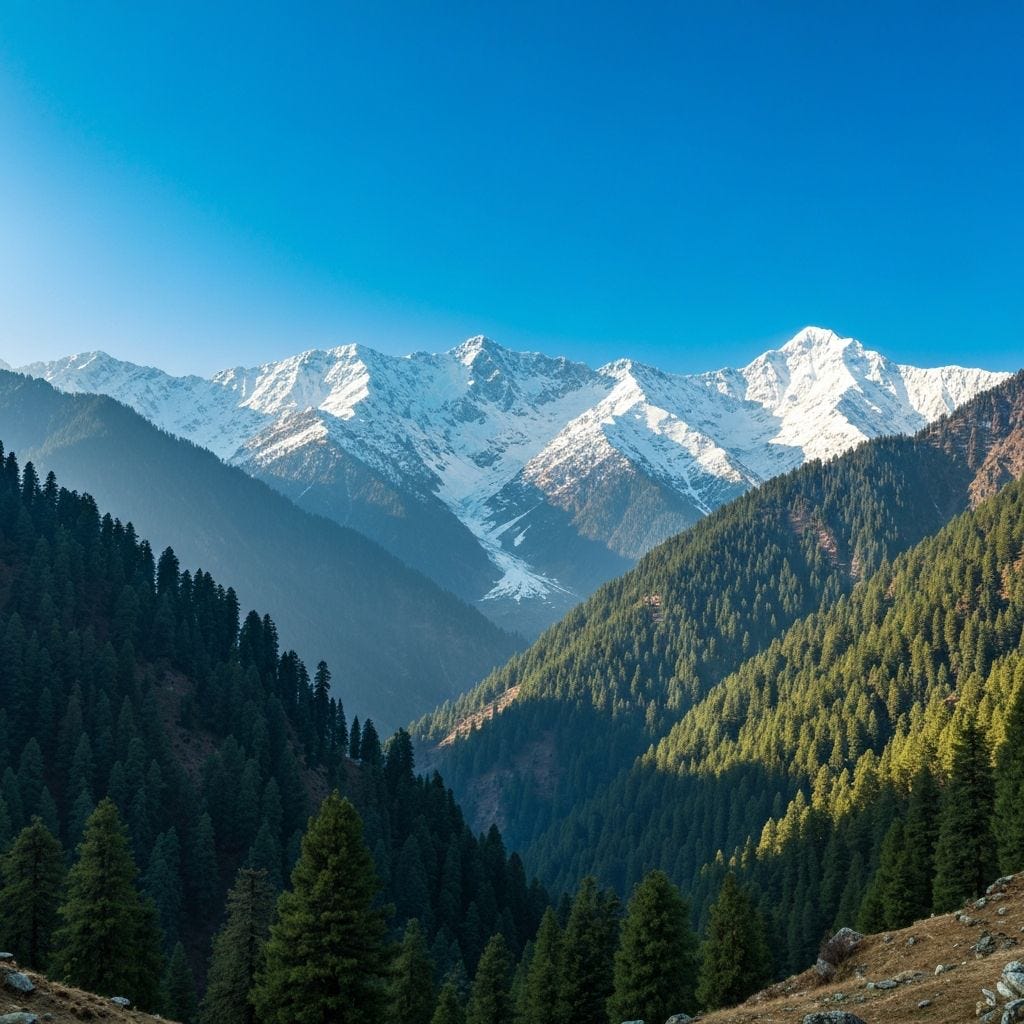
These mountains form a protective embrace around the eastern side of the valley. Their pine forests have sheltered meditation hermitages for centuries, and their slopes are dotted with sacred springs.
“The mountains stand as witnesses to the eternal—unchanging amidst the constant flow of seasons and centuries.”
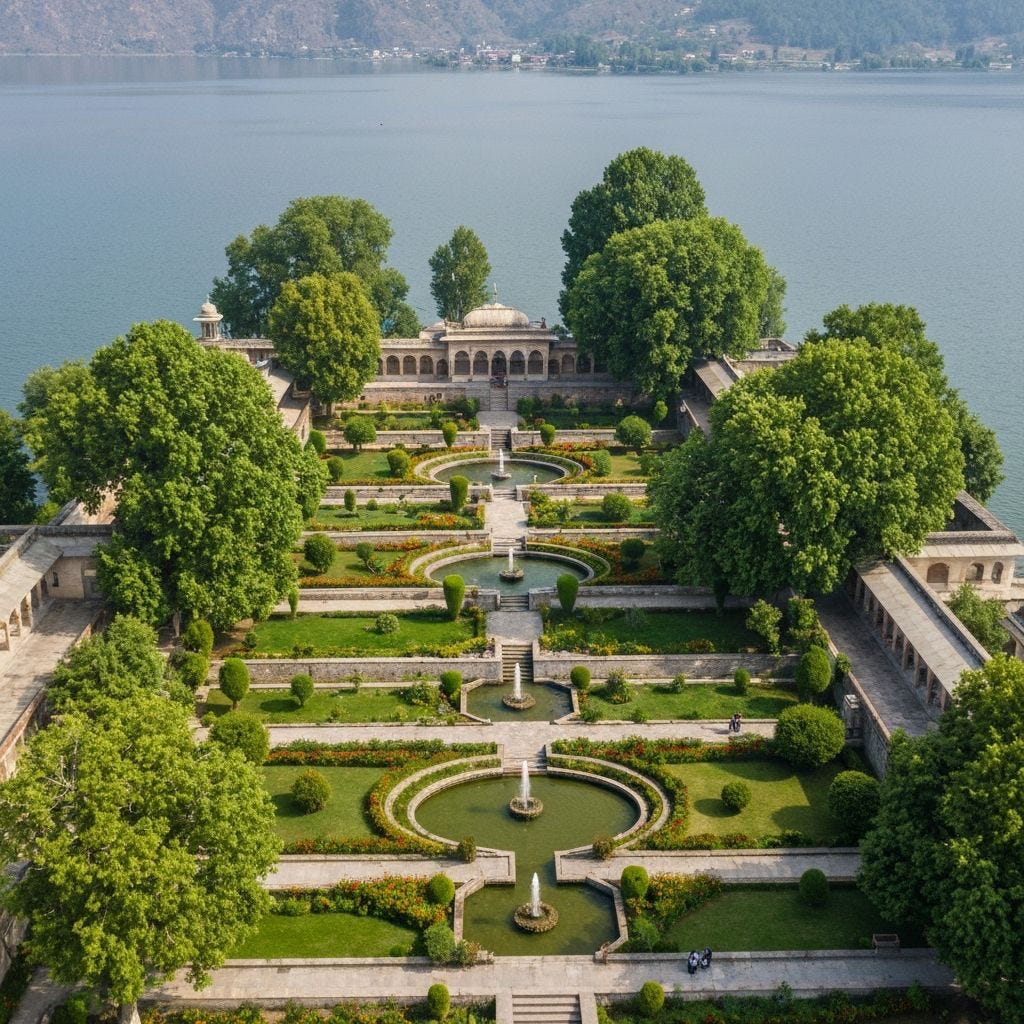
The terraced Mughal gardens along Dal Lake blend Persian aesthetics with Kashmir’s natural beauty. Their flowing waters, carefully designed to represent the flow of consciousness, create spaces of profound tranquility.
“These gardens are more than beautiful—they are meditations in landscape form, teaching the harmony of art and nature.”
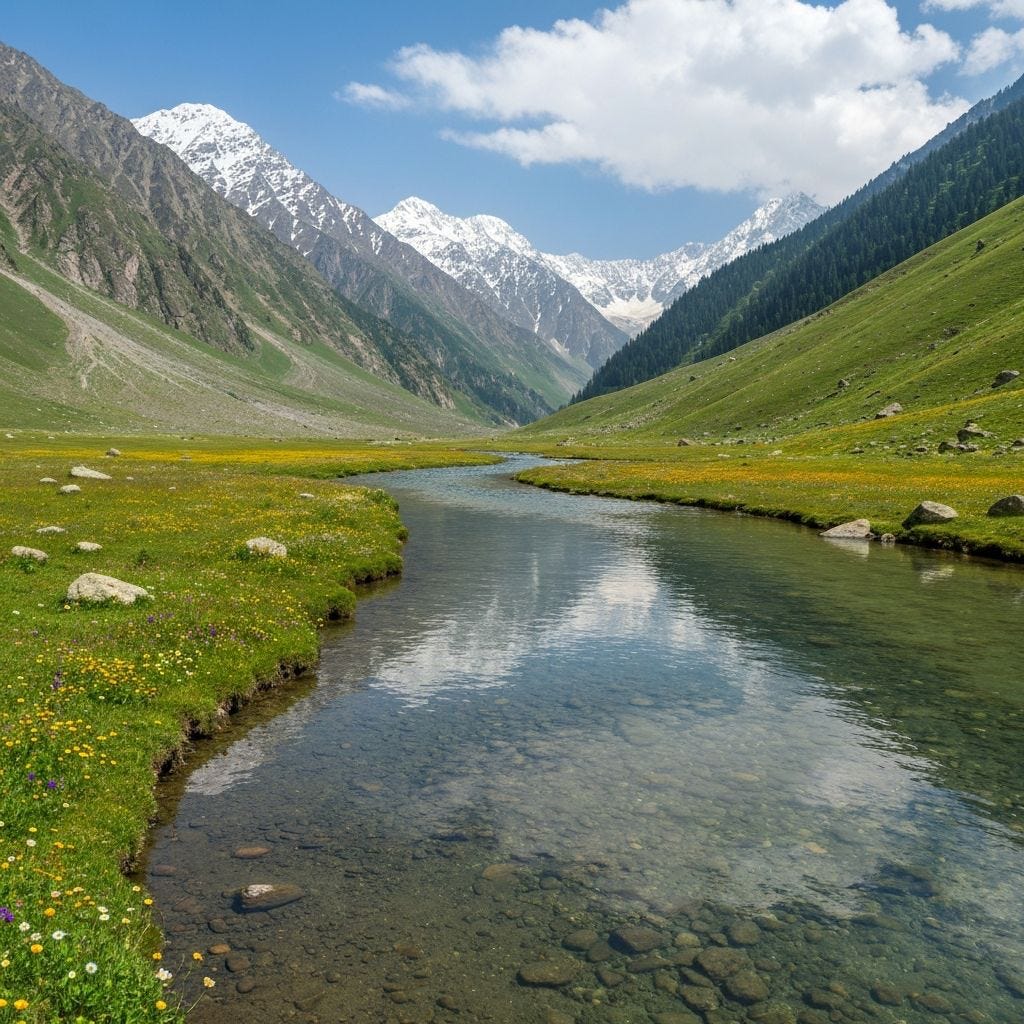
This pristine valley, with the Lidder River flowing through alpine meadows, embodies the untouched purity that Kashmir Shaivism sees at the heart of all existence. It has long been a destination for pilgrims and contemplatives.
“In the Lidder’s flow one sees the very movement of Spanda—the creative pulsation that gives rise to all manifestation.”
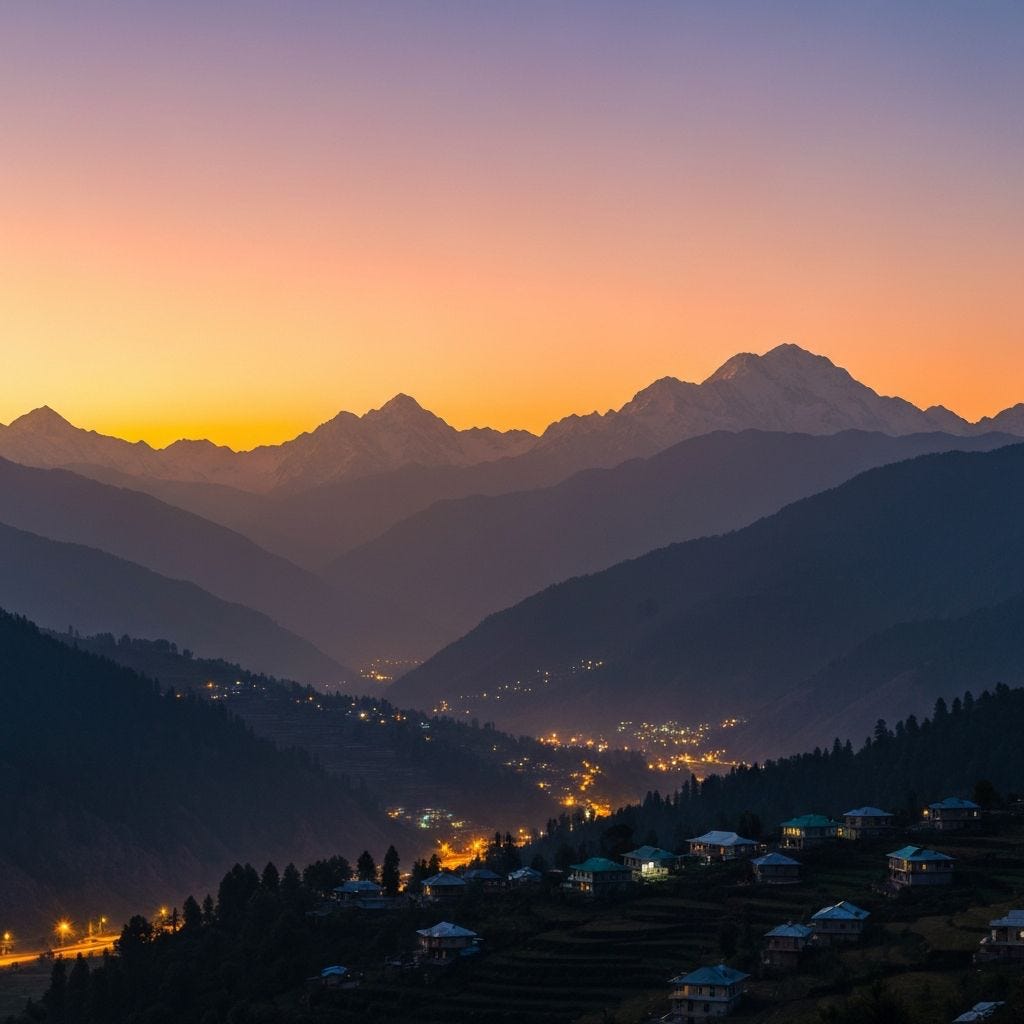
As the sun sets over the Kashmir Valley, the mountains and waters are bathed in golden light. This daily transformation has inspired mystics to see in nature’s beauty a reflection of the divine light of consciousness.
“The setting sun reminds us that even as forms change and dissolve, the light of awareness remains eternal.”
Throughout the valley, traditional villages maintain ancient ways of life in harmony with the land. Many of these communities have preserved spiritual traditions for generations, keeping alive the wisdom of Kashmir Shaivism.
“In these villages, one finds not museums but living traditions—places where the ancient teachings remain woven into daily life.”
Today, while the political situation in Kashmir remains complex, the spiritual legacy of this sacred land endures. The teachings that emerged from these valleys and mountains continue to inspire seekers around the world, reminding us that the divine is not distant but intimately present in every moment of awareness.
The beauty of Kashmir—its lakes, mountains, gardens, and valleys—serves as more than scenic backdrop. It is a living teaching, a constant reminder that the world we perceive is not separate from consciousness but is consciousness itself, dancing in infinite forms.
In the end, both Kashmir Shaivism and Dzogchen remind us that all divisions between traditions, philosophies, and religions are conventional designations pointing toward an ultimate reality that transcends all labels. This reality—call it Shiva, Buddha Nature, or simply pure awareness—is the very ground of our being, waiting only to be recognized.
The teachings of Abhinavagupta and Swami Lakshmanjoo, the profound aphorisms of the Shiva Sutras, and the sacred landscape of Kashmir itself all point to this same truth: You are not a limited individual consciousness trapped in a body, but the infinite consciousness in which all bodies, minds, and worlds arise and dissolve.
“The real practice of Kashmir Shaivism is to remain aware of your own nature in each and every breath. This awareness is not concentration—it is relaxation into your own being.”
— Swami Lakshmanjoo
May all beings recognize their true nature.
No posts
Comments
Nothing yet. Say the first thing.
Sign in to join the conversation.