
[Note: This working paper was updated on July 30 following the original July 23 publication. This is a long working paper at 7,100 over 8,500 words and may be truncated when sent through email. Read the full version from the Substack app or your browser. This working paper is archived as a PDF at SSRN. The footnotes and citations may be found in the PDF at SSRN. I did not replicate them here because that takes too much time and adds length to an already long email to your inbox. An abridged version of “Nickel and DIMEd” is available at Small Wars Journal.]
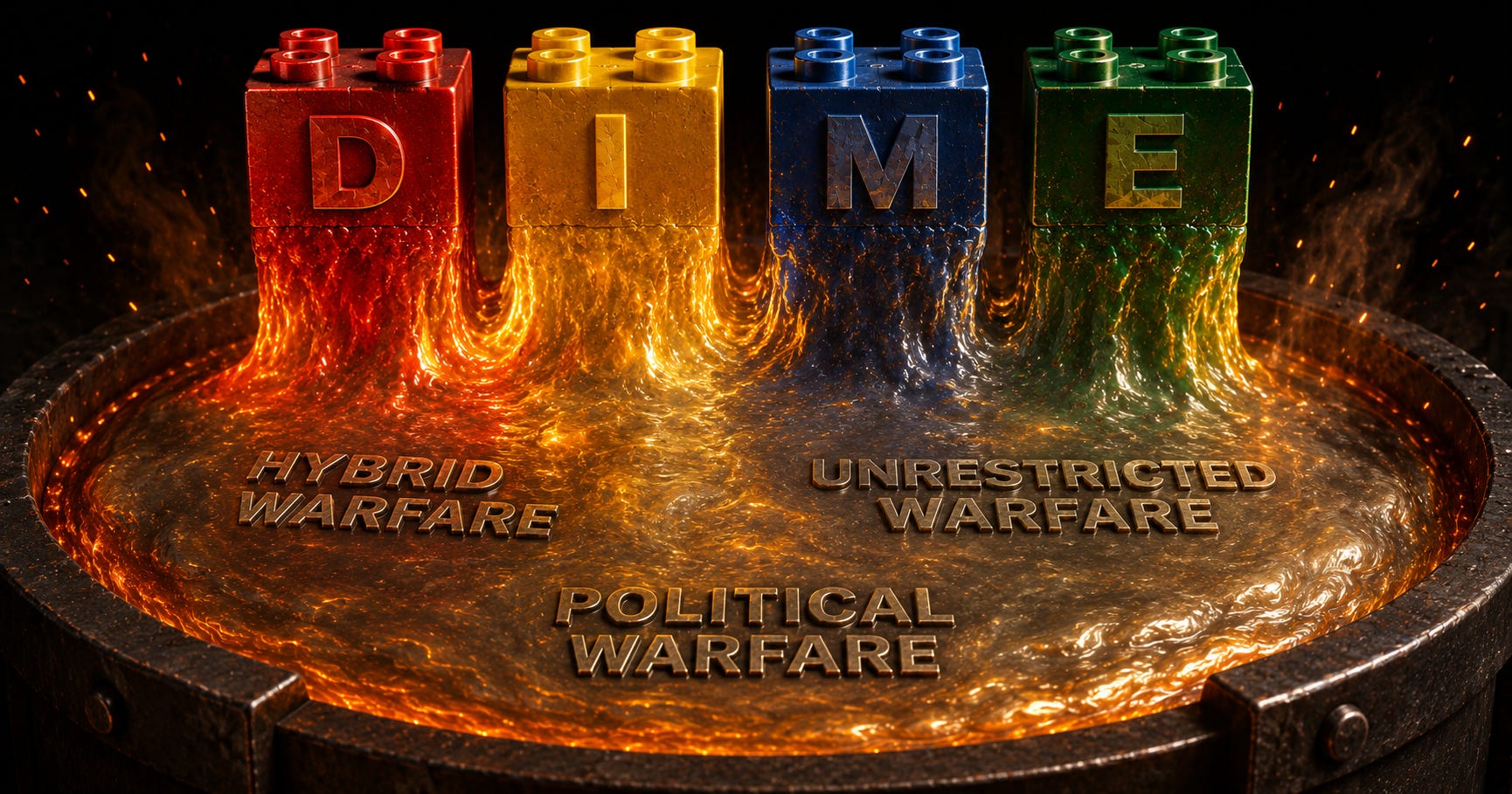
How a government conceptualizes national security inevitably dictates how it organizes its apparatus. A siloed conceptual framework yields siloed execution. For decades, the dominant cognitive model for American statecraft has been DIME (Diplomacy, Information, Military, and Economics). But as the complexity of global challenges has grown, so did the bureaucracy’s fear of being left out. DIME soon bloated into DIMEFIL, bolting on Finance, Intelligence, and Law Enforcement, and later into MIDFIELD by adding Development. This expansion was not driven by strategic clarity, but by administrative inclusion, ensuring departments had a letter and a designated seat at the table.
The unintended consequence of this model is severe as DIME (or DIMEFIL/MIDFIELD) fractures, rather than clarifies, national power. By categorizing national capabilities by agency zip code, the model locks national security analysts into artificial silos. It trains planners to ask, “Is this a diplomatic problem or a military problem?” instead of synthesizing capabilities to meet the need.
Discarding DIME is a prerequisite for building a national security enterprise capable of achieving its strategic objectives. Where DIME relies on the mechanical addition of forces operating at cross-purposes, a functional framework demands fusing capabilities to achieve mutually reinforcing effects across the spectrum of statecraft. A superior conceptual baseline for this approach exists in American military history. In an April 1918 report, The Psychologic Factor: Its Present Application, the U.S. Army General Staff recognized that the “strategic equation” of war encompasses four coequal factors: combat, economic, political, and “psychologic.” Retrospectively, this paper applies the label “PPCE” to describe this 1918 framework. Indeed, there is no evidence that since the 1939 publication of James Mock and Cedric Larson’s Words that Won the War, anyone other than your author has invoked this construct. Unlike DIME, PPCE maps power directly to functional outcomes rather than matching tasks to the federal government’s organizational chart.
Scholars of strategic theory often debate the extent to which a state’s political and institutional structures dictate its strategic execution. In his analysis of Clausewitz, Antulio J. Echevarria II, U.S. Army War College professor of strategic competition, notes that the concept of Politik encompasses both rational policy and the messy reality of institutional politics. Echevarria points out that because military institutions are shaped by these internal realities, “a purely military perspective cannot exist at all.” Yet, this is the false premise upon which the DIME framework relies. By artificially isolating the Military from Information and placing Diplomacy and Economics into distinct silos, the model treats national power as a collection of static “inanimate instruments,” to use Echevarria’s label, rather than dynamic, mutually reinforcing capabilities. Furthermore, Echevarria warns that competing institutional agendas often drag strategy out of the realm of rational policy and into the friction of politics. The bloat of DIME (and DIMEFIL/MIDFIELD) illustrates this phenomenon by centering interagency politics rather than integrated policy. Allowing agency lanes to govern our conceptual models results in bureaucratic determinism that elevates process over purpose, artificially limiting the ability to develop and execute effective strategy, grand or otherwise.
This mechanistic mindset of addition traps strategic theorists. In attempting to adapt classical theory to modern conflict, defense scholars frequently mistake dynamic, relational concepts for static, structural diagrams. Believing foundational constructs omit modern realities like industrial capacity and institutional innovation, they attempt to modernize theory by bolting on new components. For example, defense strategist Frank Hoffman argued that Clausewitz’s Trinity is incomplete because it neglects technology and economics, proposing to replace the traditional triangle with a five-element “Pentagonian” framework. David Maxwell, an irregular and political warfare scholar, expanded on this impulse, suggesting the model requires an eight-sided “octagon” to encompass political warfare.
While Hoffman diagnoses a historical blind spot regarding industrial capacity and technological adaptation, and Maxwell emphasizes the necessity of political warfare, their proposed solutions exemplify a strategic dysfunction labeled by your author as the Polygon Fallacy.
The Polygon Fallacy is the false premise that strategic complexity can be managed by simply expanding the geometry of these models. Classical frameworks were conceived as relational systems suspended in tension. Theorists freeze these dynamic concepts when they transform them into rigid geometric shapes. Consequently, when attempting to account for new operational realities, their instinct is not to analyze how the new reality alters the entire system, but to add a side to the shape.
This geometric expansion is an additive mindset. Adding “technology” is like bolting letters onto DIME: it treats national power as an administrative accounting exercise.
The Polygon Fallacy fosters an illusion of comprehensiveness. By adding new sides to a shape, an illusion is perpetuated that elements like technology, economics, or political warfare exist as separate, modular variables to be sequentially synchronized by a central planner. To mix metaphors, the octagon is like an eight-cylinder engine that has each piston firing in isolation. Technological capacity is not an independent variable but an environmental factor that fundamentally alters the physical reality, accelerates the element of chance, and continuously redefines the political objectives.
The United States struggles to arm itself for contemporary statecraft because it permits polygon-builders and acronym-generators to set the terms for evaluating power. Rather than tallying institutional outputs, effective organization and execution of policy relies on understanding the requirements to shape minds, affect wills, and influence physical realities across the continuum of statecraft, from waging peace to waging war. To navigate the realities of statecraft (past, present, and future), policymakers must demand the fusion of admixture over the compartmentalized sum of addition.
Translations of Carl von Clausewitz’s foundational text, On War, reveal a relevant conceptual fault line. In the influential 1976 of On War by Michael Howard and Peter Paret has this passage: “War is simply a continuation of political intercourse, with the addition of other means.” By using the word addition, Howard and Paret imply that military force and political intercourse do not fundamentally alter one another, but are merely stacked like separate blocks, allowing policy to proceed on one track while military violence operates in a parallel silo. This evokes an arithmetic, modular relationship of political intercourse to combat.
However, Clausewitz used Einmischung, which does not translate as mere addition. In 1873, Col. J.J. Graham rendered its meaning as “a mixture of other means,” a phrasing imprinted in American military thought by Col. F.N. Maude’s widely read 1908 republished edition. This mixture, based on the meaning of Einmischung is one of interference, intrusion, or meddling, specifically within a social or political context.
The authors of the 1918 U.S. Army General Staff report likely read Clausewitz either in the original German or Maude’s 1908 edition. Graham’s choice of “mixture” conveyed an irreversible infusion that either led to or paralleled the development of the PPCE framework.
Decades later, in 1943, translator O.J. Matthijs Jolles chose “admixture” to render Clausewitz’s famous dictum: “We maintain, on the contrary, that war is nothing but a continuation of political intercourse with an admixture of other means.” While “admixture” suggests a blend—like adding carbon to iron to create steel, a metallurgical or chemical fusion—Clausewitz’s actual language is far more aggressive. He described war not just as a mixture or layering of ingredients, but as a forceful, disruptive intervention in the political process.
Clausewitz’s meaning with Einmischung—whether translated to Graham’s “mixture” or Jolles’s “admixture”—is that it is not possible to surgically extract military action from political consequence, just as one cannot isolate psychological shock from economic sanction. Planners cannot divorce the psychological realities that shape and constrain political options, nor can they isolate the psychological effects of military action. They flow through one another, creating a synthesized reality.
This linguistic nuance mirrors the structural reality of how states apply power. George Kennan understood this synthesis. When he drafted the 1948 memo “The Inauguration of Organized Political Warfare,” he was not inventing a new isolated silo of statecraft. Fluent in German, having studied in Berlin and was familiar with German strategists, he almost certainly read Vom Kriege in German. Kennan’s arguably embraced Clausewitz’s central thesis that conflict is merely the expression and extension of politics. For Kennan, subversion and political warfare embodied Einmischung—a total mixture of overt alliances, robust economic measures, and psychological warfare functioning together as a continuous political act.
Hans Morgenthau recognized the reality of dynamic integration, rather than modular addition, of this Clausewitzian synthesis in Politics Among Nations. Observing that war had erased the neat boundary between peace and conflict, Morgenthau noted: “While formerly war was regarded, according to the classic definition of Clausewitz, as the continuation of diplomacy by other means, the art of diplomacy is now transformed into a variety of the art of warfare.” For Morgenthau, national power was not merely a mechanical sum of troop counts or industrial tonnage, but an organic blending of non-scientific, volatile human elements, specifically “national morale” and the “quality of diplomacy.” Morgenthau provided theoretical validation for what the War College writers empirically grasped decades earlier in their PPCE construct: political statecraft, psychological influence, economic output, and combat force do not operate in parallel silos, they continuously transform one another.
While U.S. strategic thought increasingly yielded to an arithmetic model that siloed diplomacy, information, military force, and economics into distinct operational levers, others also explicitly rejected such compartmentalization. Writing in 1938, Mao Tse-Tung diagnosed the intellectual trap of treating warfare as an assembly of modular parts: “Epistemologically speaking, the source of all erroneous views on war lies in idealist and mechanistic tendencies on the question.” Rejecting the notion that war could be broken into isolated levers, Mao warned that planners “with such tendencies are subjective and one-sided in their approach to problems,” and that those who “base themselves upon a single aspect or temporary manifestation” will inevitably misread the whole. Instead, he argued, “only by opposing idealist and mechanistic tendencies and taking an objective all-sided view in making a study of war can we draw correction conclusions on the question of war.”
Subscribing to the Howard/Paret “addition” theory provides the intellectual justification to create a diplomatic corps, an economic treasury, and a military apparatus that operate independently. The mixture/admixture theory proves such bureaucratic isolation is incompatible with the reality of conflict, which Clausewitz described as a “paradoxical trinity” composed of primordial violence, chance, and political subordination.
The depth of a strategic theory is intrinsically tied to its willingness to embrace the chaotic mixture of human conflict, rather than retreating into the sanitized, intellectually comfortable isolation of addition.
Ancient strategic theory, unburdened by the rigid bureaucratic structures of the modern nation-state, naturally gravitated toward admixture. Sun Tzu’s The Art of War represents a foundational text of integration, combining what modern analysts compartmentalize as political, information, economic, and military power. Sun Tzu also perceived these as a single, continuous spectrum and not as separate tools residing in different governmental departments waiting to be added sequentially to a campaign plan.
Both the U.S. national security apparatus and its academic pipelines remain challenged by this persistent reality. Competitors and adversaries of the United States grasp the concept, whether through instinct or adaptation. An American “Maginot Mentality” that overemphasizes military-based deterrence encourages, if not compels, these actors to bypass this singular front. While the U.S. strategic framework remains static, these actors adapt, viewing competition as a holistic endeavor where economic coercion, psychological manipulation, and violence are fused. When the U.S. national security community, blinded by the segregated DIME construct, observes this integration, they fail to recognize it as fundamental statecraft and invent buzzwords like “hybrid warfare,” “unrestricted warfare,” “lawfare,” “fourth generation warfare,” and “cognitive warfare.” These terms do not reflect new concepts; they identify the basic admixture of power that competitors and adversaries have mastered. Discussants lean into these terms because bureaucratic cylinder-vision conditions lead them to view anything outside the traditional, isolated military construct as an anomaly. To a strategist constrained by the compartmentalized DIME framework, terms like “hybrid warfare” and “cognitive warfare” serve as a necessary crutch to make sense of apparent anomalies. However, a strategist who grasps the fluid dynamics of PPCE, “hybrid warfare” is a meaningless distinction for something that is merely the natural, continuous application of statecraft.
Sun Tzu provided the ancient blueprint for functional integration, and Clausewitz provided the theoretical rigor required to understand this mixture in the modern state. He viewed war not as an engineered machine, but as a living, breathing organism, a “true chameleon” that continuously adapts to its political and social environment.
Clausewitz understood that war deals inherently with “living and with moral forces.” Because of this inherent vitality and unpredictability, war could never be reduced to an absolute science or a set of isolated variables. The military element cannot exist in a vacuum; it is constantly subjected to the overwhelming forces of chance, the friction of reality, and the passions of the people. This is the essence of his “paradoxical trinity”—composed of primordial violence (the people), chance and probability (the military command), and political subordination (the government).
Clausewitz recognized that the introduction of violence into political intercourse has the potential to stoke escalatory measures at the strategic level, altering the political objectives themselves. This feedback loop—where the means influence the ends just as the ends dictate the means—is the defining characteristic of an admixture. To view these elements as separate cylinders is to fundamentally misconstrueOn War. This is not to treat Clausewitz’s text as unassailable dogma, nor to suggest that administrative constructs like DIME were born directly from a misreading of 19th-century military theory. Rather, they are parallel symptoms of the same U.S. habit of decoupling military violence from political and psychological consequence, whether wielded by the state or inflicted upon it. This institutional impulse explains why Western strategic discourse periodically hails thinkers like Liddell Hart, Boyd, and Gray as revolutionary innovators, when they were simply attempting to re-anchor statecraft to the foundational realities of the realities that Sun Tzu, Clausewitz, and Mao recognized as basic truths.
If Clausewitz serves as the philosopher of admixture, Antoine-Henri Jomini is the architect of addition. His relevance to modern interagency failure is not historical trivia; it is foundational. Jomini provides the theoretical blueprint for the structural failures that paralyze American strategy today.
Attempting to reduce the chaotic violence of the Napoleonic Wars to a predictive system, Jomini defined warfare as a rational science governed by immutable, geometric principles. He categorized strategy restrictively as “the art of making war upon the map.” While he acknowledged the ultimate supremacy of politics, his framework cordoned the statesman off from the general. In the Jominian worldview, politics dictates the initial objective, but once the campaign begins, political influence must be aggressively minimized. The military must be left alone to operate within a vacuum of pure engineering.
This conceptual divorce established the precedent for the American “objective control” model of civil-military relations, the belief that politicians set policy and step aside while professionals wage war in isolation. When this separation fails to yield victory, the Jominian framework offers a ready alibi, shifting blame to political interference. The enduring American complaint—whether in the wake of Vietnam or during 21st-century wars—that “the generals were not allowed to win” is the ultimate expression of this pathology. It treats political and informational realities not as the very fabric of strategic conflict, but as unfair contaminations of a pure engineering exercise. Elevating this operational isolation into a framework for national power hollows out strategic depth. It codifies bureaucratic segregation, ensuring that American statecraft remains an exercise in parallel addition rather than unified admixture
This additive fallacy births the Maginot Mentality of statecraft: the conviction that a state can construct static cylinders of defense while ignoring the fluid requirements of psychological, political, and systemic maneuverability. Following World War I, French planners poured resources into concrete and steel silos, treating national security as a simple addition of fortifications. When the German army easily bypassed them, the static defense crumbled. Henry Kissinger warned in 1955 that exclusive reliance on an isolated cylinder of power creates a “Maginot mentality,” a strategic paralysis that leaves a nation vulnerable in the grey areas of peripheral conflict, including low-intensity conflict and political warfare. Adversaries exploit this vulnerability by fusing economic coercion, psychological manipulation, and localized violence to subvert partner nations, fracture alliances, and hollow out American influence.
The U.S. government embeds this conceptual error within the architecture of its national security apparatus. By constructing disjointed DIME (Diplomatic, Information, Military, Economic) silos, Washington built bureaucratic silos that isolates the State Department, the Department of Defense, and the Department of the Treasury in self-contained bastions, operating under the illusion that stacking them side-by-side equates to grand strategy.
Behind this structural inertia lies a deep statutory path dependency, actively reinforced by executive acquiescence. Congressional oversight is deeply asymmetric: the Armed Services and Intelligence committees wield the annual NDAA process to constantly resource and champion Title 10 and Title 50 capabilities, while foreign affairs committees exercise minimal authorization authority over Title 22. The executive branch is an eager accomplice in this compartmentalization. Rather than demanding integrated campaign authorities from Capitol Hill, executive departments internalize these jurisdictional boundaries—executing strategy through the very silos that fracture it. Lacking both legislative engines and executive demand to build political and psychological capacity, Washington continuously defaults to military options, institutionalizing process over purpose.
The institutional segregation of the early Cold War laid the precise groundwork for this strategic isolation. In 1953, the government definitively violated the principle of political-informational admixture by severing the information function from the Department of State, spinning it out into the newly independent United States Information Agency (USIA). Today, well-meaning but misguided calls to “bring back USIA” clamor for its resurrection, operating under the exact same Jominian fallacy: the naive belief that modifying an organizational chart will magically yield strategy, synthesis, and action. It will not. Moving boxes merely shifts the boundaries of the silos; it does not dissolve them. Without unified strategic direction, any resurrected agency is instantly captured by the same bureaucratic gravity that orphaned the informational element in the first place.
The defense establishment doubled down on the additive logic rather than correct this administrative siloing. As the complexities of modern governance grew, planners simply stapled more letters to the acronym, contorting the DIME taxonomy into absurd configurations. In 2018, Joint Doctrine Note 1-18 formalized MIDFIELD, expanding the construct to encompass Military, Informational, Diplomatic, Financial, Intelligence, Economic, Law, and Development. This sprawling taxonomy functioned as a bureaucratic participation trophy designed not to synthesize power, but to grant every agency its own letter in the national security calculus.
These variants gained currency as planners sought to encompass growing operational complexity, even as the endless additions exposed the fatal defect of the model. Adding “Finance” or “Law Enforcement” to a checklist does not improve strategic thinking; it merely invites the Treasury Department and the Department of Justice to interagency de-confliction meetings while ignoring the mutually reinforcing effects required to alter an adversary’s political will. Ultimately, these sprawling acronyms represent the final triumph of Jominian isolation applied to the administrative state
This exact institutional segregation justified the formal codification of the DIME framework. A genealogical investigation into defense and interagency archives reveals that DIME appeared in the 1980s almost magically, devoid of foundational strategic theory or rigorous academic pedigree.
The emergence of DIME was driven by administrative mandates rather than strategic innovation. The Goldwater-Nichols Department of Defense Reorganization Act of 1986 forced the executive branch to systematically articulate its strategic vision, resulting in documents like the 1988 National Security Strategy that utilized rigid headers to detail how the United States would employ its instruments of power. As DIME entered the military and interagency lexicon in the late 1980s and early 1990s, it was introduced as a high-level coordinating tool designed to force distinct agencies to communicate and align their efforts.
However, by the mid-1990s—as seen in foundational doctrinal documents like Joint Publication 3-0 published in 1993—DIME rapidly devolved into a de-confliction tool, designed primarily to establish jurisdictional boundaries and keep agencies safely inside their respective lanes. During the Global War on Terror, DIME calcified into a rigid, mindless bureaucratic checklist.
Crucially, when the DIME construct was formalized, it mapped directly to the organizational chart of the era. The “D” mapped to the State Department, the “M” to the Department of Defense, the “E” to the Treasury and Commerce Departments, and the “I” mapped to the USIA.
The inherent intellectual bankruptcy of this structural map was exposed when the USIA was abolished in 1999 and the Information silo was effectively orphaned, not because agencies competed to claim it, but because they routinely insisted it was someone else’s responsibility. Interagency actors routinely deflected accountability by championing calls for a reincarnated USIA, operating under the fantasy that a separate central agency would manage global influence without requiring them to surrender authority, planning, or oversight over policy or individual agency informational operations. Following the agency’s dissolution, the “I” in DIME did not map to the informational or public diplomacy elements that were folded into the State Department. Instead, the “I” was orphaned, resulting in an administrative vacuum. Agencies disowned responsibility by calling for a resurrected USIA, driven by the additive mindset that information was a cosmetic element to be sprinkled onto a problem after the fact. They indulged the double fantasy that a central agency could manage global influence on their behalf, while refusing to surrender an inch of planning, oversight, or authority over their own policy and operations.
Having discarded public diplomacy in 1953, the State Department refused to reintegrate it upon USIA’s dissolution in 1999, abdicating its role in synthesizing the psychological element with policy. Post-9/11, the Department of Defense filled this vacuum by default—assuming a strategic role it never sought and was culturally and functionally ill-equipped to sustain. The result of this civilian abdication was that American public diplomacy came to wear combat boots.
This behavior reveals DIME was always an organizational chart rather than a functional theory of power. If DIME had been a true strategic framework, the function of information—the shaping of minds, wills, and political realities—would have remained conceptually secure regardless of which physical agency housed it. Instead, the loss of the physical agency resulted in deep confusion over the capability itself.
This exact organizational mapping mentality—the instinct to equate strategy with an inventory of government agencies—drove the subsequent acronym escalation following September 11, 2001. Confronted with non-state adversaries executing holistic strategies that ignored government organizational charts, American strategists realized the four-part DIME checklist failed to capture the complexity of the operational environment.
Instead of recognizing the fundamental flaw in the additive model itself, the bureaucracy responded exactly as it had to the loss of USIA: by attempting to map new agencies to the org chart. The addition of law enforcement, intelligence, and finance to the strategic lexicon was further evidence of this mapping instinct. Planners were not identifying new functional realities of war; they were simply hunting for new organizational boxes to check. Just as the loss of USIA caused a grasping around for the “I,” the addition of new interagency actors caused a grasping around for new acronyms.
By treating strategy as an expanding inventory of agency toolkits rather than an integrated political effort, Washington completed its retreat from Clausewitzian synthesis. Breaking free from this paralysis requires abandoning additive checklists altogether and recovering a unified theory of strategy that restores the continuous admixture of politics, influence, and force.
The 1918 U.S. Army General Staff report offered a remarkably prophetic insight, framing modern conflict as a holistic PPCE (Political, Psychological, Combat, Economic) admixture. However, this study was never formally adopted as institutional doctrine. Rather than embracing its integrated vision of statecraft, the peacetime establishment allowed the report to gather dust while defaulting back to comfortable, pre-war silos. Because the military and political leadership failed to institutionalize this lesson, the holistic nature of strategy was left uncodified, forcing interwar theorists to independently rediscover and rebuild the theoretical foundations of admixture.
In the 1920s, British military thinker J.F.C. Fuller attempted to integrate scientific principles with the realities of modern statecraft. While Fuller searched for a “science of war,” he recognized that this science could not be limited to troop movements; it had to encompass the broader material and moral capacities of the state. Fuller argued that grand strategy prepares the whole nation before the war, establishing a comprehensive foundation that prevents the military from operating in a vacuum.
Sir Basil H. Liddell Hart further expanded the scope of strategy, pulling it away from the map-centric views of the 19th century. Liddell Hart defined grand strategy as the mandate to coordinate and direct all the resources of a nation toward the political object. He recognized that fighting power was merely one instrument among many, requiring the synchronized application of financial pressure, diplomatic isolation, and psychological influence.
Crucially, Liddell Hart argued that while military strategy focuses narrowly on winning the war, grand strategy must look “beyond the war to the subsequent peace.” This long-term focus necessitates an admixture. A purely military approach (addition) that physically annihilates the enemy but breeds generational hatred and regional instability has failed grand strategically because it compromises the “better peace.” Liddell Hart viewed time as a critical strategic resource, acknowledging that power must be carefully calibrated to sustain the psychological and economic stability of the home front over protracted periods.
Building upon this interwar foundation, mid-to-late twentieth-century theorists further eroded Jominian isolation by expanding strategic thought far beyond physical attrition. John Boyd pushed strategy deep into the cognitive, psychological, and systemic dimensions of human conflict. Though frequently reduced in modern military doctrine to a simplified tactical decision loop (the Observe-Orient-Decide-Act, or OODA, loop), Boyd’s strategic philosophy—captured in A Discourse on Winning and Losing—was a profound exploration of organic resilience and moral maneuver.
Boyd argued that conflict occurs across three distinct, deeply intertwined domains: the physical, the mental, and the moral. The Jominian mindset hyper-focuses on the physical domain by counting personnel, weapons systems, and casualties inside neat operational boxes. Boyd demonstrated that the physical domain is the least decisive. Actual strategic leverage is exerted in the mental and moral spheres.
For Boyd, the essence of strategy requires a dual focus:
Internal Cohesion: Preserving the moral and mental unity of one’s own system, fostering adaptability, trust, and shared purpose across the state.
External Disruption: Penetrating the adversary’s cognitive and organic structure to generate isolation, confusion, paranoia, and paralysis.
Boyd’s synthesis dismantles the DIME framework’s separation of the “Military” from the “Informational” and “Psychological.” In Boyd’s framework, information and narrative are not peripheral support tools used to explain military action after the fact. Rather, kinetic operations, diplomatic maneuvers, economic pressures, and messaging are all moral and mental vectors designed to alter the adversary’s perception of reality and break their collective will. Boyd understood war to be an organic, psychological contest where these vectors outweigh mere physical mass.
Colin S. Gray synthesized these insights into a definitive modern philosophy of statecraft, centering his work on what he termed the Strategic Bridge. Gray recognized that the persistent tragedy of modern national security enterprises is the structural and intellectual gap between military instrumentalities and political consequences.
Strategy, Gray asserted, is not a static plan, an administrative checklist, or a department on an organization chart; it is the inescapable, continuous process that translates military (and non-military) force into intended political consequences. The strategic bridge is the connective tissue that ensures tactical action remains strictly disciplined by political purpose.
Gray critiqued the technocratic operationalization of war. He warned that when a national security establishment treats war as a self-contained engineering problem, the strategic bridge collapses. The military executes brilliant tactical operations in a political vacuum, while civilian leaders issue vague political demands without understanding the physical and psychological limitations of the instruments they deploy.
Crucially, constructs like DIME exemplify the threat Gray warned against: bureaucratic obfuscation that replaces strategic thought with administrative taxonomies, mistaking a static inventory of tools for a dynamic theory of success. For Gray, statecraft cannot be partitioned into isolated agency silos or cataloged on a departmental checklist. Strategy is the art of weaving these instruments into a continuous admixture, ensuring that every operational act generates the specific political currency required by the state.
To rectify this persistent architectural failure, policymakers must abandon the additive DIME checklist and adopt an operational architecture that mandates admixture, actively correcting the additive mentality. The revised approach abandons nouns (institutions) and embraces functional realities (effects). Crucially, PPCE is not a four-sided polygon to replace a five- or eight-sided variant; it is a description of non-modular, coequal states of strategic matter that cannot exist independently.
This framework operates on three interlocking layers.
Statecraft is re-anchored in four non-modular operational effects rather than institutional owners:
Political: Generating the grand idea, consolidating domestic political will, marshaling coalitions of the willing and unwilling, and imposing dilemmas on adversaries form the guiding logic for all subsequent action.
Psychological: The moral and mental domains, defined by the continuous struggle for minds and wills to shape action, sustain or fracture societal or political cohesion, and subvert adversarial decision-making.
Combat: The application, or credible threat of physical violence to impose physical realities that alter the strategic calculus, serving as a direct expression of political will.
Economic: The mobilization or restriction of capital, resources, and markets, alongside the application of targeted financial influence, to secure logistical endurance, induce foreign dependency, compel behavior, and project power.
These core elements do not exist in isolation; they suspend within a Binding Matrix of Information and Time—the omnipresent environment through which all strategic force is transmitted, perceived, and regulated.
Information: Replaces its legacy status as a separate DIME-style pillar with recognition as an omnipresent environmental medium and operational accelerant. Information is both the medium through which physical and psychological actions are perceived by target audiences and the accelerant that determines the velocity with which strategic effects take hold. Because information operates as an environmental reality rather than a discrete munition, attempting to isolate it within a singular bureaucratic silo is akin to trying to contain gravity in a box.
Time: Serves as the ultimate regulator of the strategic admixture. Time operates along two critical vectors: operational velocity (compressing adversary decision cycles relative to one’s own) and strategic horizon (governing whether short-term operational gains aggregate into a sustainable, long-term “better peace”).
The first two layers remain conceptually inert without an operational apparatus driven by relentless leadership direction, budgetary alignment, and a synchronized strategic culture. The natural state of peacetime bureaucracy is Jominian addition; without active top-down intervention, Maginot silos inevitably reemerge to protect budgets, authorities, and organizational lanes.
Historically, the U.S. government attempted to construct this operational layer through Harry Truman’s Psychological Strategy Board (PSB) and Dwight Eisenhower’s Operations Coordinating Board (OCB). These boards devolved into toothless coordination committees not because their structural logic was flawed, but because the national security apparatus succumbed to institutional capture. Strong-willed cabinet secretaries, wedded to the addition mindset, systematically starved these boards of authority and resources. Dean Acheson routinely fought the PSB to protect State Department equities, while John Foster Dulles firmly embraced Jominian silos, deliberately ejecting the International Information Administration (IIA) from the State Department to create the isolated USIA. Dulles cleared State’s plates of the informational function because he viewed statecraft as modular blocks rather than a synthesized whole.
This historical failure proves that moving boxes on an organizational chart achieves nothing if the leaders inside those boxes remain trapped in a culture of addition. Resurrecting defunct agencies like the USIA is a nostalgic exercise that treats the symptom rather than the disease. True strategic depth requires a systemic transformation of the institutional mindset, executed across three distinct lines of effort:
The Admixture Mandate for Leadership: The President must condition Cabinet appointments on an ironclad commitment to the PPCE framework, with Jominian lane-protection actively penalized and corrected. Furthermore, this mandate cannot stop at the principal level; it must penetrate deep into the deputy, assistant secretary, and directorate tiers. Executive agencies must be led by individuals who require their teams to look instinctively within, across, and outside traditional departmental boundaries when formulating strategy.
Interdependent Agency Planning: Functional interdependence is not a mandate for interagency committee rule or lowest-common-denominator consensus. Forcing every department into every plan guarantees strategic bloat. Rather, it is a leadership standard of operational coherence: leaders must require planners from inception to account for the total PPCE environment, ensuring departmental actions reinforce the primary strategy rather than generating self-inflicted friction. Under this standard, isolated planning that relies on late stage “de-confliction” is not a procedural oversight; it is a fundamental failure of strategic command.
Educating Interdependent Practitioners: The nation’s national security professional schoolhouses, including the War Colleges, National Defense University, and the Defense Information School, alongside civilian foreign policy and national security graduate programs, must integrate this capability-driven model into their curricula. The goal is to cultivate practitioners of synthesis rather than silo-bound specialists.
Statecraft is inherently interactive and continuous, demanding that the framework govern offensive campaigns, immediate crisis management, and the continuous waging of peace. When adversaries strike, they seamlessly fuse their instruments of power to exploit Western institutional fractures. The diagnostic filter for any strategy must therefore evaluate action, reaction, and peacetime shaping against the holistic reality captured by the U.S. Army General Staff in 1918:
It is necessary to remember, in the first place, that this war is not one that is being fought by the military forces alone. There are economic, psychologic, social, political and even literary forces engaged, and it is necessary for us in order to defeat the enemy, to understand fully the strength of each. Nor can the investigation stop with the forces of the enemy: it must extend to each country in the world and to every people. The question of winning the war is far too complicated and far too delicate to be answered by a study of only the powers and resources of the nations in arms.
Guided by this logic, every strategic concept must pass through a deliberate diagnostic filter. The PPCE framework does not shackle leadership with bureaucratic vetoes; rather, it ensures that if leaders choose a narrow strategy, they do so with eyes wide open—not because a flawed strategic map blinded them to critical dimensions. To achieve this clarity, planners evaluate options through two distinct lenses:
Proactive Synthesis: Planners analyze how national capabilities multiply one another simultaneously rather than sequentially. They evaluate how physical posture (Combat)—which, as Clausewitz observed, is never a prelude to political action but an inherently political act—instantly shapes the cognitive landscape (Psychological) and alters material conditions (Economic) to achieve overarching political ends and secure international legitimacy (Political). To prevent a regression into siloed thinking, planners must view these dimensions beyond departmental boundaries: the Political dimension is not a synonym for state-to-state diplomacy, but the animating guiding intelligence and domestic consensus; the Psychological dimension is not a modular box for public affairs, but the fundamental domain of human will and moral cohesion. If a strategy ignores a core dimension, treats them as sequential phases, or relies on mere optimism—remembering that hope is not a strategy—the plan remains an additive exercise. Proceeding with a fragmented framework becomes a conscious leadership decision to accept strategic risk, rather than an accidental oversight.
Reactive Integration: When responding to an adversarial move, planners must reject the bureaucratic reflex of routing a crisis to a single agency based on its organizational zip code and walking away. The structural failure in modern crisis response is not the designation of a lead agency, but the leadership vacuum that follows: no entity is empowered to exercise cross-functional strategic command over the total response. Without dedicated authority orchestrating the interplay of national power, “lead agency” degrades into an excuse for institutional abdication, reducing interagency partners to passive observers or late-stage deconfliction assets. True reactive integration demands a fluid, multi-dimensional admixture where targeted economic leverage (Economic) and combat posture (Combat) are synchronized to fracture the adversary’s strategic narrative and erode their moral resolve (Psychological), all while relentlessly securing overarching political ends and legitimacy (Political). When an adversary strikes across multiple vectors, failing to command the entire synthesis ensures the state merely absorbs cost rather than shaping the outcome.
Ultimately, evaluating a strategic option through these dual lenses exposes whether a concept treats national capabilities as parallel, modular blocks to be checked off an agency checklist. Stripping away bureaucratic inertia, the choice to execute an additive plan rests entirely with leadership. However, the PPCE framework ensures that choosing a narrow, siloed path becomes a transparent decision made with full awareness of its strategic risk.
The debate over DIME’s effectiveness is fundamentally a debate over the nature of conflict and statecraft. Those who view strategic competition through a rigid, mechanical lens believe national power can be divided into neat, administrative pillars. This mechanical reductionism treats grand strategy as an engineering problem to be solved by assembling modular, agency-specific capabilities in parallel lines. However, this narrow application consistently yields strategic failures because it misapprehends conflict as a predictable transaction rather than an organic, dynamic collision of wills.
The fatal flaw of the DIME framework is not that adversaries ignore interagency boundaries, but that it misreads strategic reality. This is a vulnerability the U.S. inadvertently encourages rival powers to exploit. Modern competitors do not sort their operations for American bureaucratic convenience. Instead, they operate holistically, wielding political, psychological, combat, and economic power as an integrated, mutually reinforcing whole. By clinging to siloed lanes, the United States accepts a self-imposed strategic disadvantage.
This structural myopia explains why expanding strategic models through additive acronyms inevitably falls short. The insights of Frank Hoffman regarding technological adaptation and David Maxwell regarding political warfare remain strangled by the apparatus built to execute them. Hoffman and Maxwell correctly diagnose severe deficiencies in American strategic depth, yet their solutions are forced to compete within a DIME-configured bureaucracy that treats their concepts as minor additions to be de-conflicted at lower administrative levels. The PPCE framework creates the conceptual architecture their diagnoses demand.
Moving beyond DIME requires far more than moving boxes on an organizational chart. Power must be understood through integrated, cross-domain capabilities rather than static agency lanes. True power lives in an admixture, where economic weight, psychological influence, combat posture, and political ends do not simply support one another as adjacent vectors but interweave into a mutually reinforcing expression of strategic consequence.
Evaluating strategic options must expose whether a concept delivers true integrated capability or merely a bureaucratic checklist. Yet even the most meticulously designed framework remains a dead letter without relentless executive enforcement. While a President lacks the daily bandwidth to manage cross-functional mechanics, executive authority must remain fiercely uncompromising in demanding synthesis from the Cabinet. Left unmonitored, institutional inertia will always pull the security apparatus back into comfortable silos, prioritizing budgetary survival over cross-agency friction.
National security is not an acronym-building exercise. A state ultimately gets the national security apparatus its leadership demands and possesses the discipline to maintain. It is time to stop being nickel-and-DIMEd by institutional silos and instead organize American statecraft around the mutually reinforcing capabilities modern strategy requires.
***
Comments
Nothing yet. Say the first thing.
Sign in to join the conversation.