

Astronomers were fairly confident at the start of 1977 that they knew the Sun’s immediate neighbourhood quite well. These sky-watchers felt very comfortable that there would be no major surprises this side of Pluto. That is, until November 1 that year, when everything changed. Astronomer Charles Kowal was looking at some photos taken with his telescope and was stunned to find, between Saturn and Uranus (a place where nothing was supposed to be), what looked like a small planet.1
He chose to name his new find after the mythological being Chiron, whose father was Saturn and grandfather was Uranus.2 He didn’t realize, when he named it after the wisest of all of the half-man/half-horse creatures, that he was setting in motion the naming of a whole new group of celestial bodies.
Some astrologers began studying Chiron almost immediately. One of the most common themes to emerge quite early was that of deep wounding that split the self, and that healing could occur only when the person was willing to delve into the darkest depths of the self to reunite the disjoined parts.
Chiron was soon showing up in charts everywhere.
In the last decade of the 20th century, astronomers began to sweep the skies with ever more powerful telescopes, and in 1992 they were rewarded with the discovery of another body between Saturn and Uranus. Initially, it appeared to be so like Chiron that one magazine ran the headline, “Son of Chiron: Now Appearing in Space.”3 It was this similarity that led the discoverer to name it Pholus, after another centaur from mythology.
Astrologers began exploring Pholus, too, and while it definitely acted differently than Chiron did, it also dealt — at least, in part — with the necessity of delving into one’s “dark place” in order to become more whole.
Unlike Chiron, who could trace his origin to one of the gods, most of the other centaurs had a much less noble origin. Pholus’s father, for example, was a satyr who was known for his drunken carousing, while others claimed their lineage from a mortal who tried to seduce Hera, the queen of the gods, behind Zeus’s back. But within the myths of each of these creatures was a common element: dealing with the battle between the human side and the animal side, and confronting aspects of humanity’s darker side.
In 1993, a third body was discovered out past Saturn, and astronomers realised they were dealing with a whole new class of minor planets. When this planetoid was named after Nessus, another centaur, the decision was made to call this class of minor planets Centaurs. In the years to follow, the list grew to include Hylonome, Asbolus, Chariklo, Pelion, Okyrhoe, Cyllarus, Elatus, Echeclus, Bienor, Thereus, Amycus, and Crantor, as well as a few others that have not yet been named.4 Each of these is also being researched by astrologers who are discovering that these bodies represent signposts showing the road into those dark places buried deep within us.
In this series of articles, I hope to introduce you to the other Centaurs, and I’d like to start with Chariklo, named after the creature who became Chiron’s wife.
Chariklo was discovered on February 15, 1997, at 6°03’ Leo. The Sabian symbol for that degree is: “The constellations of stars shine brilliantly in the night sky,”5 and when we talk of her mythology, I think you’ll agree that it is a quite fitting symbol.
How Chariklo was named is a story in itself. A group of astrologers, the author included, had been studying several unnamed Centaurean bodies. We decided to send name recommendations for two of these, based on our research, to those astronomers who were in charge of naming minor planets. Our research suggested that the influence of one of them fit the nature of a centaur named Asbolus, and a good name for the other was Chariklo, Chiron’s wife. On October 1, 1999, our group received official word that our suggestions had been approved and these would be their names from now on. So, this naming marked the beginning of a new cooperation between astronomers and astrologers, something that hadn’t been seen for centuries. (This was only the second time in modern history when astrologers influenced the naming of a celestial body; two years earlier, astrologers submitted the name Nessus for the third Centaur discovered, and that name was approved.)
Astrologers today have had the great gift of obtaining ephemerides for each of the Centaurs before they were officially named. Thus, we were able to start researching the influences of these new bodies without the initial results being “colored” by knowledge of the mythological beings whose names they were later given. We place the Centaur in natal charts and look for commonalities between other people who have the same house position as, or aspects to, that Centaur, and we ask people to tell us what happened in their lives when a particular Centaur crossed over their Sun or other sensitive point.
For example, I put Chariklo into the charts of dozens of friends and relatives and hundreds of celebrity charts, long before she would be called by that name. In addition, we study the Centaur’s astronomical nature (size, orbit, colors, relation to other bodies) for further clues about possible meanings. When the Centaur gets its official designation, we have already begun to build a basic understanding of the Centaur’s meaning, and we start looking for further clues to its nature by exploring the mythology of its namesake and seeking to integrate it with what we have learned so far. But with all the Centaurs, the learning will continue for many years. (In our defense, we are still learning things about Pluto, which was discovered more than 80 years ago.)
Chariklo is the largest known Centaur. So, if we consider Chiron important astrologically, we should see Chariklo as at least equal in importance.
Our ancestors — the people who named the ancient planets like Mercury, Mars, and Saturn — were both astronomers and astrologers. I’d like to think they chose those names at least in part because they knew something about the influences of each planet, rather than just randomly choosing names from their pantheon. In the last few centuries, a split has occurred as astronomers, placing pure data on a pedestal, divorced themselves from astrologers, who chose to interpret what they observed. That split was not isolated to this branch of science, but could be seen in field after field as material rationality became the new touchstone. But in recent times, humanity has been trying to heal the split, and we’ve seen such things as orthodox medicine acknowledging the value of meditation and acupuncture, or authors like Fritjof Capra writing The Tao of Physics. Perhaps when astrologers began suggesting names for new bodies based on their observations, and astronomers gratefully adopted these names, it was a sign that this split, too, is beginning to heal.
© 2012, Zane B Stein – all rights reserved
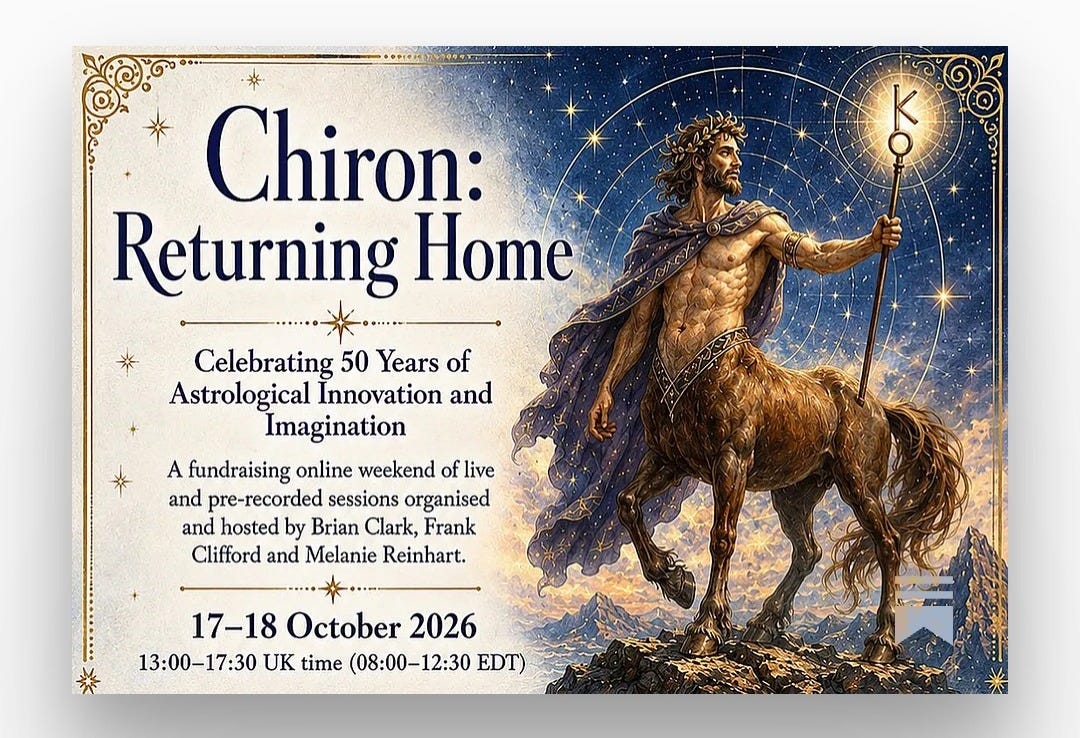
Join us for an exclusive weekend at the LSA for the Chiron: Returning Home fundraising weekend with Zane B. Stein
Zane B. Stein Zane B. Stein is an American astrologer (although now lives in Australia) and is known particularly for his focus on Chiron. He received the Canopus Award For Excellence in 1998. His book, Essence and Application: A View From Chiron, has been called truly groundbreaking. In 2022, he published Chiron – Healer and Wholemaker, which picks up where Essence left off. Zane has specialized in studying the many bodies discovered since Chiron, such as the many other Centaurean bodies like Pholus, Nessus and Chariklo, and TNO’s like Eris, Orcus and Sedna. He has lectured worldwide in person and online. He works with astrologer Lynette Malone to help grow the online community, Astrology Collective astrologycollective.org and his website is zanestein.com.
Zane will be joining the LSA on 17–18 October for the Chiron: Returning Home fundraising weekend.
To receive a discounted place, please visit londonschoolofastrology.com/courses/chiron50 and add the word Chiron to 'Have a Coupon?' at the payment page.
Subscribe to The Mountain Astrologer
Wife Photo by Edgar Chaparro on Unsplash
(All URLs, here and in the body of the article, were accessed in July 2026, unless otherwise noted.)
John Noble Wilford, “Mysterious Object Beyond Saturn May Be Solar System’s 10th Planet,” New York Times, November 9, 1977, p. 71.
Letter from Charles Kowal to the author, dated December 15, 1977: “I chose the name Chiron because he was the son of Saturn and grand-son of Uranus.”
M. Stroh, “Son of Chiron: Now Appearing in Space,” Science News, February 8, 1992, p. 87.
Dane Rudhyar, An Astrological Mandala: The Cycle of Transformations and Its 360 Symbolic Phases, Vintage Books, 1973.
Comments
Nothing yet. Say the first thing.
Sign in to join the conversation.