
Oh no, an opening act.
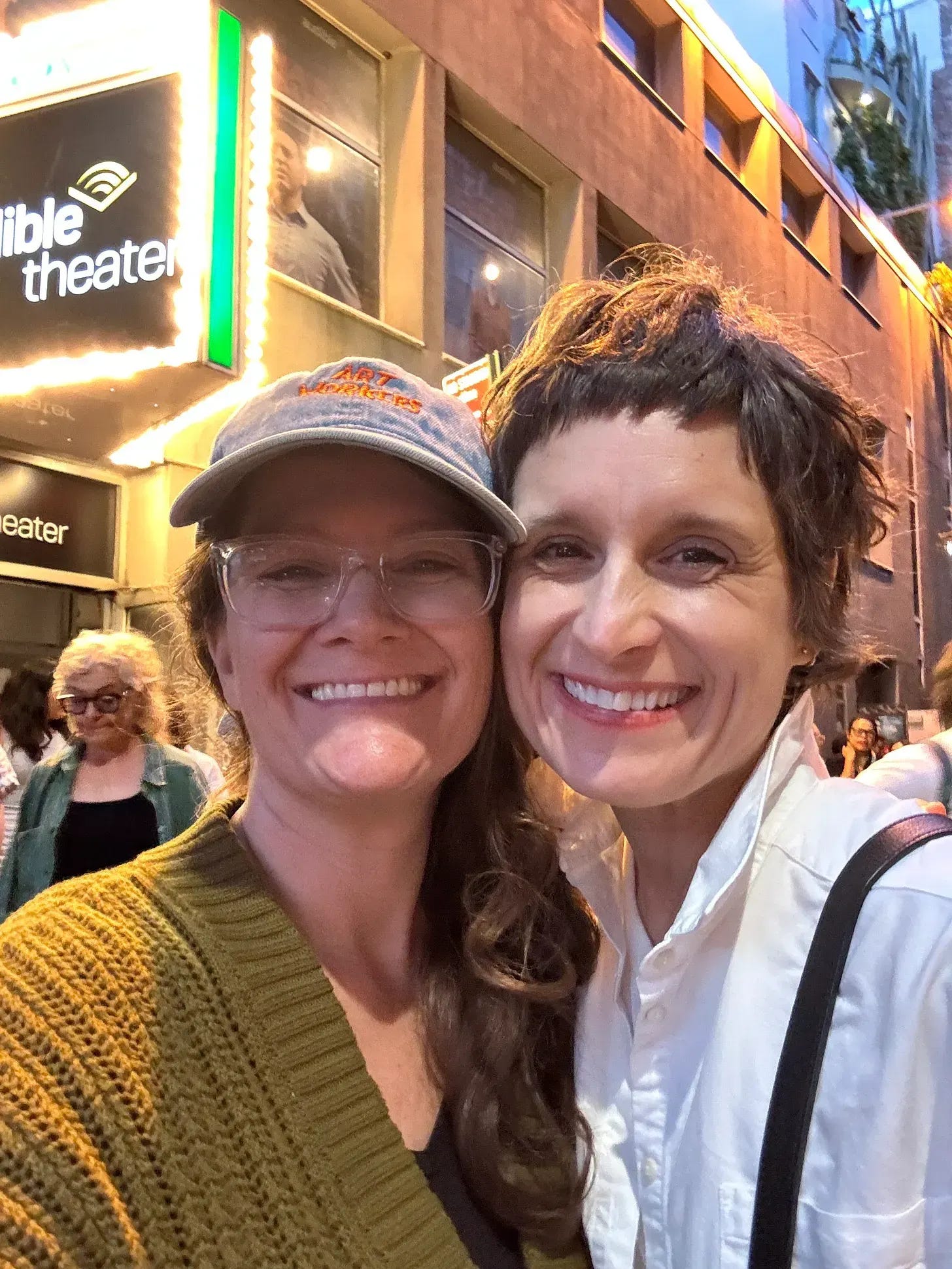
I’m at a theatre in the West Village to see Maria Bamford, my favorite comedian.1 I am an old lady, in habit if not yet in age, and I will only attend shows with assigned seats, preferably ending before 10 pm. I hadn’t banked on an opener, but Maria introduced her as the best, so I figure we’re in good hands.
Janet McNamara takes the stage, in jeans and a lightweight puffer vest, unzipped over a plain teal long-sleeved tee. She stands with her arms sort of stiff at her sides, and I notice her thumb, worrying the fingers on her left hand like a stone.
“So I went to a stand-up club the other night,” she begins. I can already hear the Boston in her voice, in the vowels and delivery, her wry and knowing tone. “And the guy on stage says he hasn’t had sex in six months.”
She waits just long enough for the little wave of first-laugh twitters to fade, then slays us with a single word.
“Amateur.”
My friend and I grip each other by the forearm and howl out with the crowd.
That’s it. She has us in her hands.
As she continues, it’s clear she is both a master of the form—she knows what she’s doing—and that a kind of uncertainty is building in the audience. Her monotone voice, her stiff affect, have none of the elastic physical comedy of Maria Bamford, who, when she later took the stage, rolled out lengthwise and stood up, kicking, and shouted, “This is a job!” Janet McNamara stands there, hardly moving except for that thumb I can barely see, wearing away at her forefinger while she talks.
Her content stokes the uncertainty I sense in the crowd, which coheres in me as a question: is she Autistic? I wonder if I alone am thinking this, if I have a hair-trigger radar now through Jonah and how he’s changed me. As she tells us a long joke that circles and circles, about listening to Justin Bieber’s Tiny Desk concert every morning when she wakes up and every night before she goes to bed, I have Jonah in my mind, his obsessive repetition of certain YouTube videos, and the question builds in me, are they (are we) laughing with or at her?
And then, with expert comedic timing, she breaks the tension she’s created. She tells us she’s in on the joke.
“I failed the Autism test five times,” she says.
It’s like a release valve has opened in the room. The laughter comes out loud and light. I love the absolute brilliance of this joke, because it’s as if we’ve been sitting there testing her, ourselves, evaluating whether she’s Autistic or not. She milked our guesswork for half the set, making it her own power, and now she can take us somewhere else.
I worry, briefly, that she might go on to make fun of Autism. I don’t think so, but the uncertainty is there. She could take us anywhere. That is, again, the thrill. I have no idea how comedians do it. It’s the most terrifying form I can imagine.
But she doesn’t. Instead, she makes fun of the evaluations themselves. This is cathartic for me, and surely others in the room. My own experience of the many diagnostic evaluations and forms I have had to complete for Jonah over the years is different in substance from what she describes, but the bottom line is the same: the abject crassness of reducing a person to a list of deficiencies, and how demeaning it is to have to abase yourself (or your loved one) in order to get support.
I remember one of the earliest assessments I had to complete, before Jonah was officially diagnosed with Autism. Trying to rank Jonah for things like “repeats unintelligible sounds over and over.” The assessment was full of words that rankled me, like “unintelligible,” which seemed too proximal to “unintelligent” for my liking, and the implicit judgments in the questions. I also hated the bluntness of available responses: yes, it’s true, he does repeat things over and over, and often I don’t understand. Often that’s my own limit. And, too, his prosody is complicated by hearing loss and his low muscle tone and high palate; but there’s nowhere on the test for this nuance or my reflections. Just a scale of 0 to 3.
Two questions in particular made me so enraged I wanted to break plates.
Has difficulty understanding when he or she is being ridiculed.
Has difficulty understanding what causes people to dislike him or her.
YOU have difficulty understanding, I remember seething at the test.
These diagnostic insults are the ones at the root of my unease , wondering, are we laughing with or at Janet McNamara. And they are the questions, or rather the uneasiness, obliterated by her comedic brilliance.
*
“I know how I affect people,” Janet McNamara says.
The day after the show, I went on a deep dive. I watched her full comedy special, “Not Smart Enough,” and an interview with her by Kory Andreas, a late-diagnosed AuDHD therapist and advocate, on the podcast That’s Me! The two talked about the challenges of social situations like meet and greets, where there’s an expectation of small talk and conversation.
“I want to want to do meet and greets,” McNamara says, and they commiserate together about being seen as assholes for declining situations that they know will set them up to fail, or where they may unintentionally make other people feel uncomfortable.
“Lots of times when I thought I was being really charming,” McNamara says, ”it’s like, ‘No, you fucked up.’”
The kind of improvisation required by conversation, which is assumed to be a social norm, in fact runs counter to the wiring of many people’s brains. Kory Andreas says neurodivergent brains thrive in a flow state, and when interrupted, it takes a great deal of effort to return. She says to McNamara that being on stage is maybe her flow state, and meet and greets are like the disruption. McNamara agrees.
I love that. I love that she found a form and structure in comedy in which how she is, specifically, is the source of her power. In her dryness and her timing, her economy with words. In the way that her way of being calls bullshit on social mores.
“Honestly,” she says to Kory Andreas, “[small talk] feels so fake. To have, like, phrases in your head where you’re like, ‘Thank you so much, thank you so much, it means a lot to me;’ it feels so fake to do that. Like, do neurotypical people live in a world where they just say things they don’t mean all day?”
The two of them crack up, and I do, too, watching from the distant shore of my laptop. Thinking of Jonah, how funny he is. How this observation from McNamara and Andreas captures one way that Jonah frees me: he has no reverence for false cheer, and is, I think, incapable of being fake. How I mean incapable here as a superpower, and how he shows me how often we mismeasure capability. How my friend said of Jonah just yesterday, with utter admiration, “He has zero fucks to give.”
*
“It’s such bullshit to say I do comedy to make people laugh,” Janet McNamara says. She’s talking with Kory Andreas about how comedy gives a structure for her expression. “It’s a control thing. You do comedy so you can control the room.”
The word control makes me think of legendary self-advocate Roland Johnson, and his rallying cry: “Who’s in control? We are!”
Johnson was a pioneering disability rights activist and self-advocate who survived decades of institutionalization in Pennhurst State School and Hospital, going on to be a national voice for the rights of people with intellectual and developmental disabilities before passing away in 1994. His life story is told in the memoir, Lost in a Desert World, recorded orally, as told to Karl Williams, and published posthumously, in 1999.
He was a key leader in the self-advocacy movement, which took shape in the United States in the late 1960s and early 1970s, as people with intellectual and developmental disabilities, many of them leaving institutions for the first time, began organizing to claim authority over their own lives. Rejecting the assumption that others should speak for them, self-advocates demanded community living, self-determination, and a place in the growing disability rights movement, creating organizations led by people with disabilities themselves.
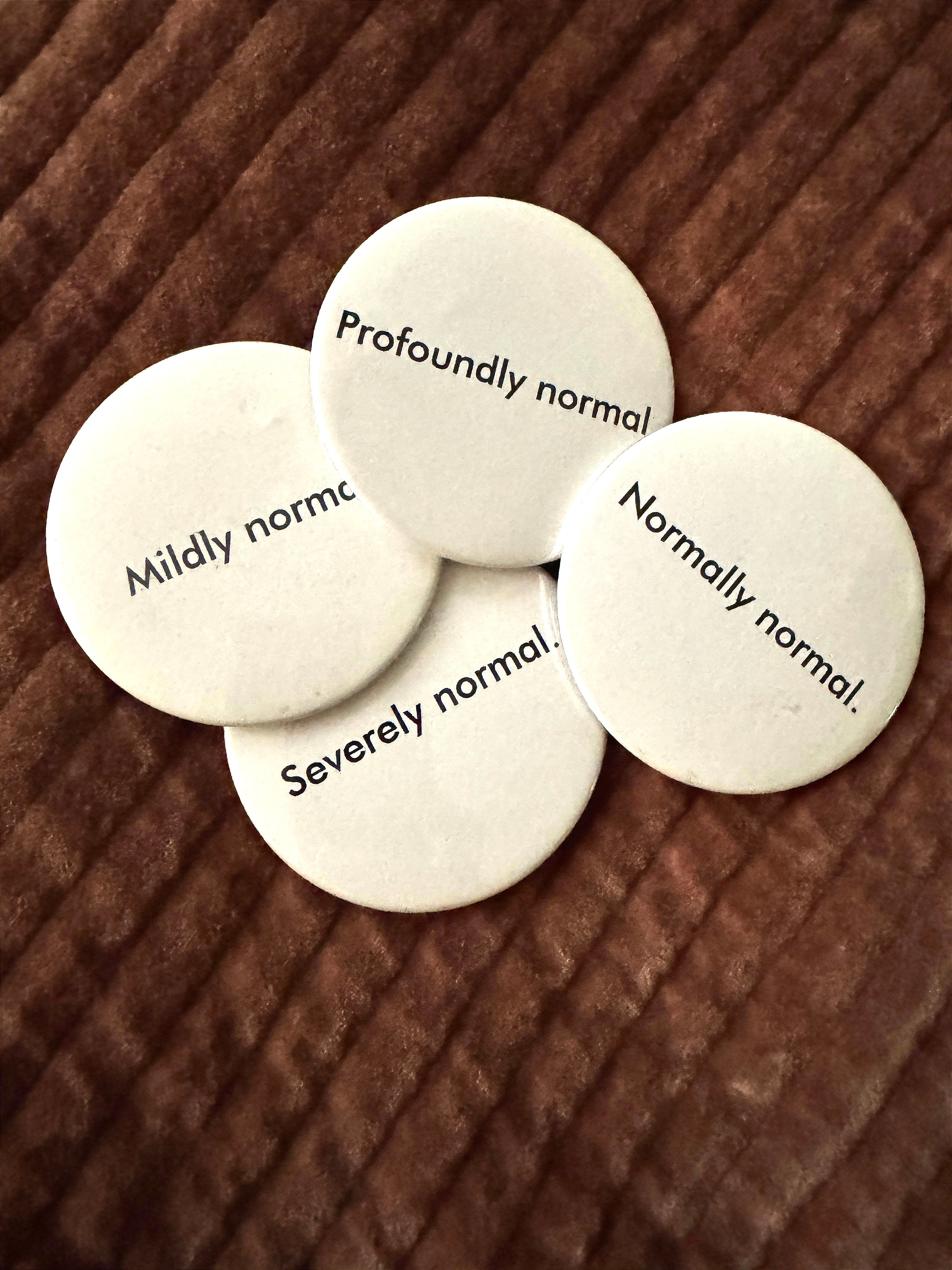
One of the early conferences organized by self-advocates in the United States was in Princeton, in 1986.2 The self-advocates who organized the Princeton conference made satirical buttons for the occasion, self-diagnosing as “Mildly Normal,” “Moderately Normal,” “Severely Normal,” or “Profoundly Normal.” At the time, the standard clinical and educational terminology in the United States was still based on the category “mental retardation,” classified with severity levels. These classifications were not rhetorical, they had real power, and were treated as objective categories, even as they profoundly shaped the scope of the possible in people’s lives.
The self-advocates played with this, appropriating the language of classification to make an excellent and deeply political joke. For one thing, they made plain the absurdity of the act of classification in the first place. And, by borrowing the terms of the classification hierarchy and applying them to “normal,” self-advocates made an incisive inversion: better to be “mildly” than “severely” or, worst of all, “profoundly” normal. The aspiration here is departure from normal. The norm, itself, is the problem.
I loved their mischief, and loved this anecdote so much that I made replicas of the buttons in their homage, to use in a presentation I gave at the Oral History Association annual meeting that year.
I first read about the Princeton conference in a collection of reminiscences called New Voices: Self-advocacy by people with disabilities, edited by Hank Bersani and Gunnar Dybwad. Dybwad was a Norwegian-American sociologist and disability advocate, and, along with his wife Rosemary Dybwad, they were some of the earliest and most influential allies of the emerging self-advocacy movement. Rejecting the paternalism that had long defined services for people with intellectual disabilities, the Dybwads argued that people with disabilities must speak for themselves, and helped foster the first national gatherings where self-advocates organized on their own behalf.
A few years into my friendship with Katy Dybwad, it dawned on me when she mentioned her grandparents’ work with disability rights—she was Dybwad as in DYBWAD. Gunnar and Rosemary’s granddaughter. We’d known each other for years and never put it together. I lost it, and her mind was blown that I knew about her grandparents, who aren’t widely known by those not already paying attention to this history. Once Katy and I made this connection, it became a new and precious chord in the song of our friendship, one I love to twang and feel reverberate, one that transcends time, back and forward, from the generations before us to the one we are raising, transcending the thousands of miles that are between us, which close once a year for our annual gathering, where I feel how sacred are the bonds of friendship I share with Katy, with our girlfriends, with the many forms community takes in my life. With how sacred and ongoing the fight is for community, for all.
Katy grew up with a framed poster-sized photo of Rosemary on her wall, marching and protesting with many self-advocates, holding a sign that read “Don’t think that we don’t think.” Katy’s daughter is named for Rosemary. Katy told me that Rosemary got her ears pierced at age 80, and that at Gunnar’s funeral, “people expressed total distress and heartbreak and joy in a way I’ve never seen people ‘get to act’ in formal grieving spaces.”
Her grandfather was a central character in the play, A Fierce Kind of Love, produced by the Institute on Disabilities at Temple University to tell the history of Pennsylvania’s intellectual disability rights movement. Fierce was written by Suli Holum, devised with an inclusive cast, and directed by David Bradley, the play draws on oral histories, archival research, and the lived experiences of self-advocates, families, and allies to trace the movement from institutionalization toward community, and the work that remains to be done. The question of the present-day reality for people with disabilities and their families was also taken up in community programming developed around the play, and I was part of a team facilitating interviews and photographs with people with IDD who are still living or working in segregated settings.3
The unfinished nature of the work of community living is prime in my mind these days. In June 2026, the Department of Justice issued a memorandum rejecting the long-standing interpretation of the Supreme Court’s 1999 Olmstead decision, that unjustified institutionalization is a form of disability discrimination. Although the memo does not change the law, it signals a dramatic shift in the federal government’s commitment to the principles that generations of self-advocates fought to secure.
We’re still so far away from what it takes to make it possible for people to thrive in community.
But I am glad to have access to sources, historical and contemporary, that show the humor and intelligence of people who the world might otherwise write off, misunderstand, misdiagnose, or ask to mask. I’m glad to find people who find the form that makes their own, singular voice shine.4
Creeping up close behind her is Chris Fleming, who I love for many of the same reasons.
The first self-advocacy conference in the United States was in Oregon, organized by People First Oregon, in 1974 (a short film about that conference is here.)
Interviews and photos from that project were installed in the capitol building in Harrisburg, and in Philadelphia’s City Hall, and can be found online here.
On this I also recommend Chris Martin’s excellent book, May Tomorrow Be Awake, for the way he writes about how poetry offers so many tools, syntax and rhythm, repetition and constraint, to scaffold and support expression among the neurodivergent poets he works with.

Comments
Nothing yet. Say the first thing.
Sign in to join the conversation.