
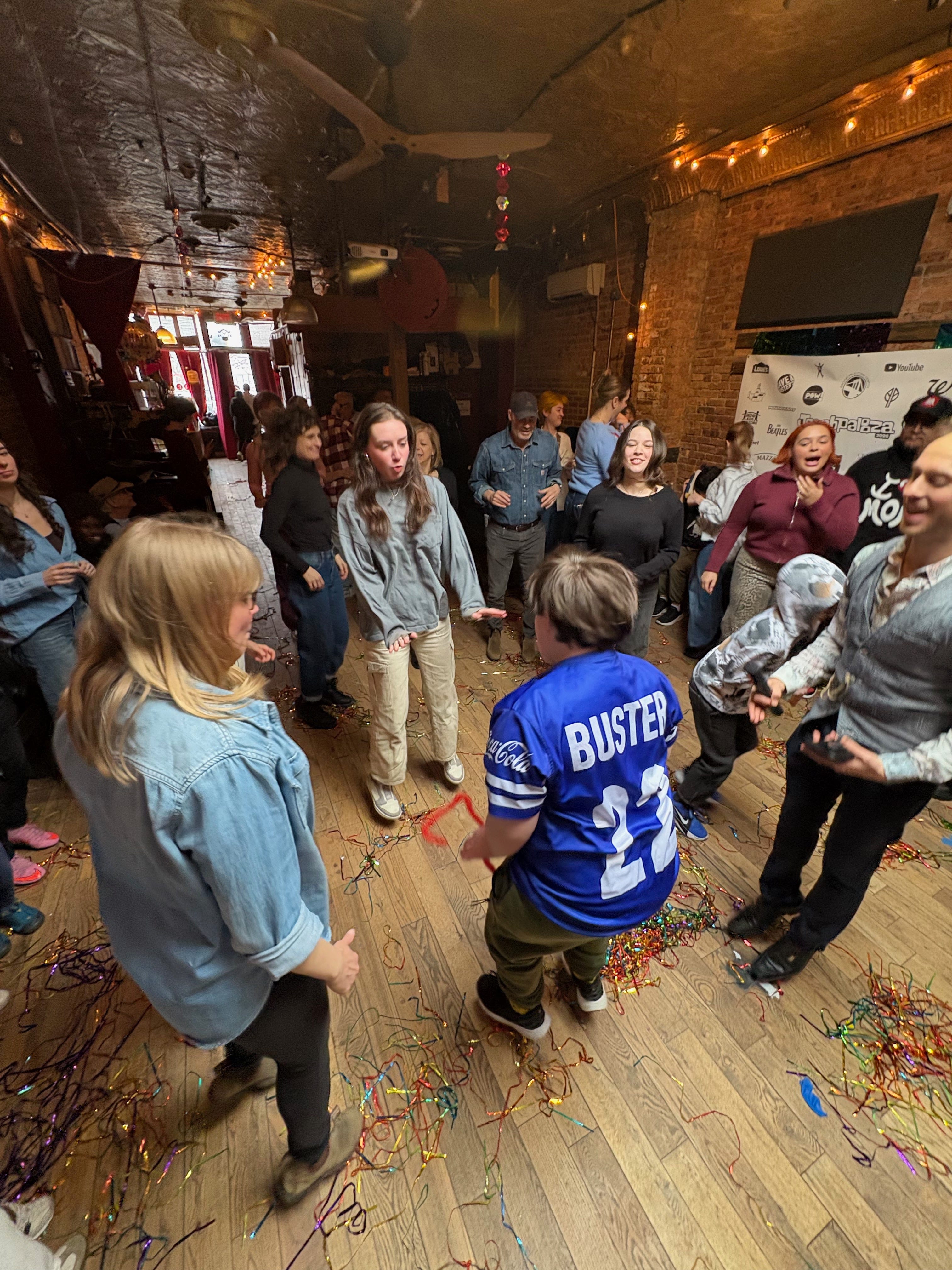
We had Jonah’s fourteenth birthday party at Jalopy, a little roots music venue that lets us rent it out. It’s dim lit with brick walls and pews we push to the side, opening up a dance floor we make good use of, with a little stage where Jonah performs. This year he sang. He’s a Beatles fanatic. He sings “Let It Be,” and in time, we all join in and sing along.
When he was born, I was halfway through grad school in oral history. This is a field I was drawn to in large part for its fierce insistence that people speak for themselves.
This simple tenet was scrambled when Jonah turned the kaleidoscope on the world for me. As a parent, what does it mean to let my son speak for himself, when his voice is not intelligible to others? And as an oral historian, how can I understand the history I’m living out, if I only listen to people who can speak?
I was also drawn to oral history because I love the human voice. How particular and inimitable it is, how impossible to describe but immediately recognizable. How voice is music. Prosody: a word for the fact that the musicality of voice—its rhythm, intonation, pitch, volume and patterns—conveys things beyond words, like emotions and meaning. A single word can have infinite meanings, given how it’s delivered. I loved the “oral” in oral history, and didn’t know what it meant, to maybe lose that.
Here’s a clip of me in 2017, trying to use my oral history tools—asking questions, recording audio—to capture Jonah. That year, he would stop on the sidewalk in front of a local shop that had a scrolling marquee in the window, running ads in digital words and numbers that would run across in patterns that I hadn’t noticed until Jonah did.
0:00
-1:49
I was trying to show him his own voice on the recorder, but I knew: he has other ways of speaking.
My recorder missed everything that makes Jonah’s particular voice: the rhythm and pitch of his body, the volume of his movements, his motions and whatever they might mean. But any acoustic trace of him still works on me like time travel, a trap door that opens right back, in this case, to five-year-old Jonah.
He does have a spoken voice, though many Autistic people are non-speaking. Jonah, whose speech is further complicated by hearing loss, has worked mightily with many speech therapists, and in ways all his own that I may not even see, to develop the complicated dance of breath, cognition, and physical effort needed to produce speech. Recording his orality is every bit as valuable as a full-tilt oral history. There is no replacement for the sound of him, himself. How could I ever describe this laugh?
The prosody of Down syndrome is sometimes itself the source of laughter; like when the sound of vocal difference makes kids laugh, as I wrote about in an earlier post. One of the self-advocates I interviewed for this project asked me to cut out the part of their recording where they sang a song. “I like my voice,” they told me, “but I can’t trust the general public.” And sometimes the sound of a person with Down syndrome’s voice is used explicitly as the butt of the joke, as Wyatt Cenac did in an episode of This American Life. I appreciated how Dan Perry, a historian, journalist and parent to a son with Down syndrome, engaged Cenac and Ira Glass about the joke. But the bottom line was that they decided the sound of a voice with Down syndrome was fair game as a punchline.
Jonah won’t likely ever have the cultural power to speak back to someone like Ira Glass, or a large platform for his own self-expression, in his own terms. I don’t know how to stoke even a small flame of hope for a culture in which he can speak for himself, in his own ways, and be heard by many for the complex person he is.
But I do know how to gather together the people who love him, and show him they know how to listen. And I know, fourteen years in, that the circle around him can keep growing. And that these people, who see and love him for who he is, who both understand and create his context, these are our co-witnesses who will stand with us in the bright light of how he shines.
Someone I interviewed years ago—one of the only advocates for Down syndrome I met who wasn’t a parent, himself—told me how parents can be the problem. Speaking over, or for, their sons and daughters with Down syndrome, or unintentionally infantilizing them. He told me about a conference where a young man with Down syndrome sang a Bruce Springsteen song and was met with roaring applause. My interviewee was appalled. The singing wasn’t good, he said. The praise felt condescending and dishonest. I pushed back a little, but not hard. I, too, have a hair-trigger for anything that feels patronizing, and politically, I agreed with him on the point about parents needing to step back. Jonah was a baby then, and I was determined not to become the kind of parent who mistook my own desires for his, or spoke as though my voice was Jonah’s.
The reality is, of course, extremely complicated. I often think of that anecdote, of the parents cheering on this young man belting his heart out like Bruce. I want to go back to my interview and ask more questions. To push back on the implication that only good singing is worthy of applause. No one at Jalopy would mistake Jonah for Paul McCartney, but that’s not the point. Everyone in that room knew, in some way, how hard earned this moment was, for Jonah. The invisible labor it takes him to vocalize, and the years of community-building that go into creating the conditions where he can sing into a microphone, and be met with joyful recognition. The applause isn’t condescending, because the audience knows him, and sees him for who he is, not who he isn’t, and celebrates what he’s doing instead of weighing it against what he can’t.
I was also drawn to oral history for its power as a practice of witnessing, and being witnessed. And for being alive to complexity and context. Jonah like everyone is a complicated person. He scrambles all manner of simple stories, and in this, he’s an ideal teacher for oral history. “Complicating narratives everywhere,” is one of the mantras of Oral History Summer School, an immersive training program for the ethical application of oral history practice in varied fields. [Workshops for May and June are still open—I highly recommend!) OHSS was founded by the incredible Suzanne Snider, who has welcomed me, from Jonah’s beginning, to think out loud, in community, about how oral history can be more than the verbal or spoken. Another thing I love about oral history is that it is alive to contradiction. Not surprisingly, I’ve been able to bring to the field my questions, some as fundamental as whether we can have oral history without orality, or history without story.1 And here, in writing, I’m finding space for my own voice, too. Not over or in place of Jonah’s, but my own, as a witness to him, through his impact on me. Stoking my hope of expanding the circle of those who see Jonah, and keeping on with my own work of learning to listen differently.
Any takers for a prompt?
Record the laugh of someone you love, and store it somewhere safe—you won’t regret it! Tell me in the comments if you do!
Bonus challenge: take a stab at describing someone’s laugh — maybe they laugh with their whole body, or laugh so hard they go silent, or maybe their laughter is silent to begin with, maybe it comes out like rocking, or hand-flapping, or a full-body motion. Metaphors welcome! Post in the comments!
It makes my day to hear from readers—click the heart or just say hi, either way it makes me happy! If you say hi to Jonah, I will pass it on to him!
Comments
Nothing yet. Say the first thing.
Sign in to join the conversation.