
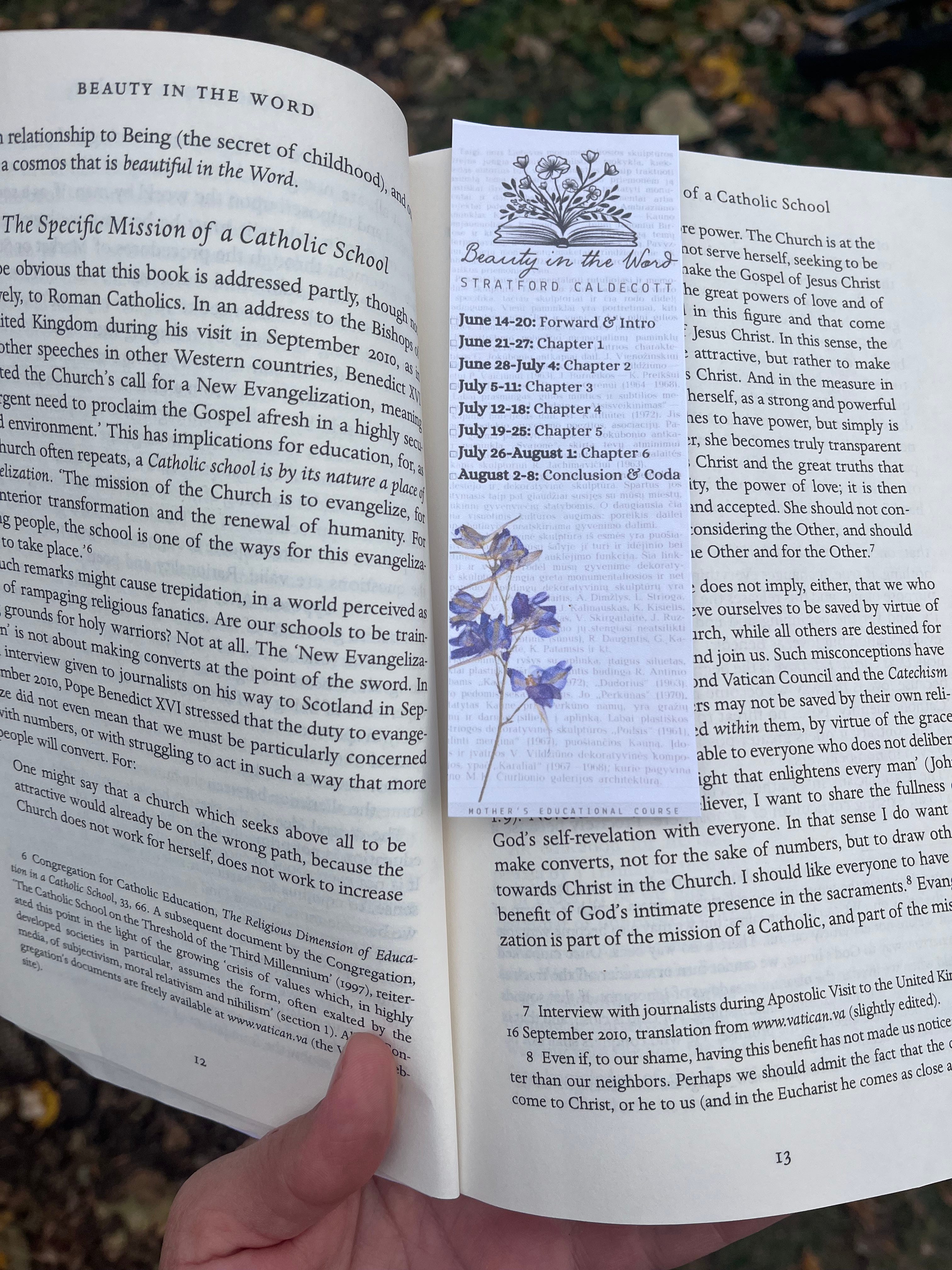
This week we are reading chapter one of Beauty in the Word. It is a catch-up week for Home Education.
Chapter one is titled Child, Person, Teacher: At the Heart of a Catholic School.1 Caldecott’s goal in this chapter is to try to find a balance between two competing philosophies of education, romanticism and classicism.
ROMANTIC VS CLASSIC
According to Caldecott, the “classic” educators believe their job is to convey information that is memorized and measured by examinations. They are often known for their discipline and rigor. While this model of education can excel at teaching a large amount of varied content and helping children form good habits, there are also some problems. An over-emphasis on the teacher could discourage intelligent inquiry from the children, and an over-reliance on grades and discipline could create an environment that is more about “force of habit and nostalgia” than real learning or faith.2
“Romantic” educators believe in experiential teaching and learning, emphasizing projects and self-discovery more than information transfer. They believe education that over-emphasizes rote learning and discipline is detrimental to learning and even to faith. While this model values inquiry, and the needs and curiosity of the child, the danger here is the loss of real instruction (and potentially, real learning) and an over-emphasis on the child/self. There are many things a children must be taught if he is ever going to know them, including the content of revelation and the elements of faith. Because it is so completely child and self-focused, Caldecott warns that the “romantic approach often ends up encouraging narcissism, overconfidence, and vacuous sentimentality. It gives an inadequate formation in basic skills, and undermines the determination to do well.”3
Caldecott gives us an overview of how these types of thinking developed by summarizing educational theories and philosophers of the modern period. He concludes that good education needs both the self-motivation of the romantic philosophies and the loving teacher who “sets the terms of learning” from the classic philosophy. It requires encouraging a child’s natural desire to learn (as the romantics claim) and the habits of discipline and attention (fostered best in the classic model).4
WHAT IS A CHILD?
Education also requires understanding what it means to be a child. Caldecott offers a brief theology of childhood, including how children have a sense of infinity that symbolizes the true infinity we find in God. We need to understand the stages of a child’s development, yes, but we also need to understand what it truly means to be “childlike.” I wonder if the best teachers are the ones who still do.5
A CHRISTIAN EDUCATION
Caldecott includes a long discussion about personalism philosophy. Whether you follow (or agree with) this philosophy, Caldecott describes what he thinks is most important in a Christian school: a unity of knowledge, the right balance between teacher and child, a respect for each person’s individual freedom and conscience, love and unity, valuing people more than ideas and information, the relevancy of both faith and science, a right understanding of authority, orientation towards the family, and initiation into a cultural tradition.6
THE HEART OF EDUCATION
Caldecott didn’t believe curriculum was made relevant to the child’s life by “shrink[ing] the content to match the child’s experience,” but by instead “expand[ing] the life of the pupil to match the proposed curriculum.”7 He believed the premise of the personalist philosophy of education was that “the human person should be educated for relationship, attention, empathy, and imagination.”8
Attention is a cornerstone of education for Caldecott, and something he devoted a large portion of the chapter to. He believed in the importance of attentive teachers and attentive students. When we read Charlotte Mason’s writings about the “habit of attention,” we will see that she very much agrees. For Caldecott, the importance of attention is ultimately about the importance of prayer:
Because prayer consists of attention, and all worldly study is really a stretching of the soul towards prayer.9
And this is the heart of education, because “prayer involves interior opening to the supreme Other. It is the relationship to God made possible by this opening that strengthens us in our attempts to know and love the whole creation, and our neighbors as our selves.”10
RESOURCES & DOWNLOADS
Beauty in the Word: Beauty in the Word can be purchased in the MEC Bookshop. The eBook is also available on Hoopla.
Term 3 Chat (all subscribers): I have opened up the Term 3 chat and I’d love to hear your thoughts as we read!
Red, White, & Blueberry No-Bake Fruit Kabobs (paid subscribers): This patriotic visual recipe will help children of all ages and abilities put something festive on the table for the Fourth of July!
Printable Bookmark (paid subscribers): The bookmark for Beauty in the Word has been added to the printable bookmarks page in the Downloads section.
Stratford Caldecott writes from a Catholic perspective. There will be some places in the book where members from different backgrounds will likely have different views/theology, but the book still presents a view of Christian education that all of us can benefit and learn from.
Beauty in the Word, pages 19-20
Beauty in the Word, pages 19-20
Beauty in the Word, page 25
Beauty in the Word, page 27
Beauty in the Word, page 34
Beauty in the Word, page 35
Beauty in the Word, page 34
Beauty in the Word, page 30
Beauty in the Word, page 35
No posts
Comments
Nothing yet. Say the first thing.
Sign in to join the conversation.