
In previous research reports, I traced the eugenics lineage from the nineteenth century to 1960. I demonstrated conclusive proof of its deliberate decision to go underground. The brand they chose themselves was “crypto-eugenics.”
This piece takes up the story from that vote forward. It follows the same people, the same institutions, and the same funding streams across the decades that followed, showing how the strategy written down in 1960 was carried out in plain sight under continually changing names.
This report is not exhaustive. In fact, it just scratches the surface. But it satisfies one critical objective:
Given the establishment’s perennial attitude problems, its lust for power and crimes during the 20th Century, we need to look closely at the eugenics branch of that establishment and follow its moves carefully from the past through the present and into the future.
The crimes enabled by their ideas in the 20th Century were put on trial at Nuremberg in USA vs. Karl Brandt et al.
They are now on trial again, in the 21st Century, in USA vs Dr. Anthony Fauci.
There is some overlap in his article with what I have said previously.
The truth bears repeating.
What I have done specifically with this essay is to rigorously trace the decades between 1960 and 2020. We all know too well what happened since 2020.
And…the same names still keep showing up.
When the Council of the British Eugenics Society voted that day in 1960, it did something almost no institution in the history of concealment has ever done: they wrote down, in their own minutes, that they were about to start hiding what they were doing.
Four years earlier, the Society’s secretary general, C.P. Blacker, had defined the term “crypto-eugenics” in a letter to a colleague: pursue the aims of eugenics without disclosing what you are really aiming at and without mentioning the word. In 1957, he recommended the Society adopt it as policy — “a policy of crypto-eugenics,” he called it, noting that the American Eugenics Society was already doing something similar and it seemed to be working. In February 1960, the Council formally resolved to pursue “activities in crypto-eugenics vigorously,” and in the same resolution, directed that funding be increased — specifically — to two organizations: the Family Planning Association, and the International Planned Parenthood Federation.
Those two organizations, by name, as the vehicles. Remember them.
The Council’s own handwriting sits today in the Wellcome Collection in London, available to anyone who wants to read it.
They did not stumble into concealment.
We will return to the Wellcome Foundation later…
Blacker didn’t just write the strategy — he built the delivery system. He left the Eugenics Society’s own secretaryship to become the founding administrative chairman of the International Planned Parenthood Federation, the organization the 1960 resolution had just named as a funding target. For a period, he ran both organizations from the same desk. IPPF’s first London office was provided free of charge by the Eugenics Education Society — the parent body housing its successor inside its own walls.
The Society’s institutional pedigree wasn’t fringe. Its founding president, in 1907, was Francis Galton himself — the man who coined the word “eugenics.” When Galton died in 1911, the man who succeeded him as the Society’s president was Leonard Darwin — Charles Darwin’s son. Winston Churchill served as vice president. The presidents of the Royal Society and the Royal College of Surgeons were on the rolls.
This was never a fringe operation.
If the British side of this had happened once, in isolation, it might be a strange historical footnote. That’s not what happened.
In New York, the American Eugenics Society had been founded in 1926 by Madison Grant, Harry Laughlin, and Henry Fairfield Osborn, president of the American Museum of Natural History, who had co-founded the Galton Society (New York’s own, separate namesake organization) with Grant and Charles Davenport eight years earlier. Osborn’s nephew, Frederick Osborn, joined the family project as a young man, discussing questions of heredity with his uncle. In 1928, Frederick became the American Eugenics Society’s Secretary.
He held that position for forty-four years. Until 1972.
One man personally carried the American side of this project across nearly half a century — through the war that made the word radioactive, and then through the decades when everyone assumes the old eugenics movement simply died out.
But it didn’t die. It just went underground.
And in 1968, Frederick Osborn wrote the sentence that might be the single most important primary-source document in this entire story:
“Eugenic goals are most likely to be attained under a name other than eugenics.”
Let that sink in.
Osborn wasn’t describing a plan for the future. By 1968, he was describing a plan that was already sixteen years underway — because in 1952, John D. Rockefeller III had founded the Population Council, and installed as its first president…Frederick Osborn.
Then there’s the hero of Planned Parenthood, Margaret Sanger — founder of the American Birth Control League, later Planned Parenthood, and in 1952 founder of the International Planned Parenthood Federation. But she was also a member of the American Eugenics Society.
Sanger’s own writings leave little room for ambiguity about her eugenic commitments. She repeatedly framed birth control as a tool for improving the quality of the population, not merely as a matter of individual liberty. She published and platformed eugenicists, accepted the language of “racial betterment,” and treated the restriction of reproduction among the “unfit” as a public good. In 1926 she accepted an invitation to speak to a women’s auxiliary of the Ku Klux Klan in Silver Lake, New Jersey. She later described the meeting in her autobiography without apology, noting the size of the audience and the money raised. And although she protested the transformation of eugenics and birth control language into planned parenthood, she lost the fight to the establishment operators.
You see, the covert strategy of the late 20th Century eugenics movement did not leave things to chance or inspiration. The American name change process was a very deliberate professional branding operation.
In 1939 the management firm of John Price Jones, Inc. engineered the merger that created the Birth Control Federation of America. On January 29, 1942, that Federation formally changed its name to the Planned Parenthood Federation of America. The shift was from the explicit language of “birth control” and “family limitation” to the softer language of “child spacing” and “planned parenthood.” Sanger initially opposed the new name. The decision was driven by the professional public-relations counsel of the Jones firm. D. Kenneth Rose of John Price Jones Company became National Director and led the expansion of the rebranded organization through the 1940s.
John Price Jones was one of the most important professional fundraisers and public-relations operators of the era. A former reporter, he made his reputation raising record sums for Harvard (the largest educational campaign of its time), other Ivy League institutions, major hospitals, and elite cultural organizations. His firm specialized in scientific fundraising techniques, donor lists of the wealthy, and reframing causes so they would be acceptable to mainstream corporate and foundation donors. The same firm that professionalized elite university and hospital fundraising was brought in to professionalize and rebrand the American birth-control movement.
At the exact moment of the 1942 name change, the Rockefeller Brothers Fund began its own formal support for the newly renamed Planned Parenthood Federation of America. John D. Rockefeller Jr. had already given early private support to Sanger’s work. John D. Rockefeller 3rd took particular interest in the cause and would later found the Population Council. The rebrand occurred inside the same foundation world that was already funding the movement and that would continue to fund its successor institutions for decades.
This is the American parallel to the British decision of 1960: drop the language that revealed the deeper purpose, keep the organizations and the funding streams intact, and place professional managers between the original ideology and the public. Sanger’s career is the cautionary tale in miniature — an explicit eugenic advocate whose movement was systematically rebranded, professionalized, and absorbed into the respectable institutional architecture that still carries its work forward under different names.
The old ways died hard though. As we have now seen.
In 1946, during the Nuremberg Trials, Julian Huxley became the first Director-General of UNESCO — and wrote, in UNESCO’s own founding philosophical document, that “even though it is quite true that any radical eugenic policy will be for many years politically and psychologically impossible, it will be important for UNESCO to see that the eugenic problem is examined with the greatest care, and that the public mind is informed of the issues at stake so that much that now is unthinkable may at least become thinkable.”
He wrote that in the founding charter of a United Nations agency.
Huxley was, at the same time, an officer and later president of the British Eugenics Society. In 1957, he coined the word “transhumanism,” and that same year received the Lasker Foundation prize in the category “Planned Parenthood — World Population.” He went on to co-found the International Union for the Conservation of Nature in 1948 and the World Wildlife Fund in 1961 — alongside Prince Bernhard of the Netherlands (founder of the Bilderberg Group), Prince Philip, and a third member of the Rockefeller family, Godfrey A. Rockefeller.
Prince Philip, decades later, as WWF’s sitting president, told a German press agency he was “tempted to ask for reincarnation as a particularly deadly virus” to address overpopulation.
The pattern that runs through all of this — take a genuine, defensible good (public health, conservation, family planning, science diplomacy) and use its moral authority to carry a program that could not survive being named plainly — is not my invention. It is the strategy the Eugenics Society itself wrote down, applied by the same overlapping cast of people, across institution after institution, decade after decade. Still can’t believe it? Read on.
(If you can’t believe it, research it for yourself…)
In 1974 National Security Study Memorandum 200, prepared under Henry Kissinger, named thirteen countries for population reduction as a United States security objective. It designated UNFPA, IPPF, the Population Council, and the World Bank as the delivery vehicles — chosen specifically so that the American strategic motive would not appear on the surface. The memo was adopted as policy in 1975.
The delivery vehicles named in a secret American national-security document were some of the same organizations the British Eugenics Society had voted to fund fifteen years earlier under a policy of crypto-eugenics.
Are you listening?
Kissinger and the Rockefeller family were joined at the hip. Kissinger first met Nelson Rockefeller in the mid-1950s when Rockefeller, then a special assistant to President Eisenhower, recruited the young Harvard academic to work on the Rockefeller Brothers Fund’s Special Studies Project. Kissinger directed panels of that project and later served as Nelson Rockefeller’s foreign-policy adviser and speechwriter through the presidential campaigns of 1960, 1964, and 1968. At Nelson Rockefeller’s memorial service in 1979, Kissinger described him as “my friend, my older brother, my inspiration and my teacher” for twenty-five years. When Kissinger left Rockefeller’s employ to join the Nixon administration, Nelson Rockefeller gave him a $50,000 severance gift “as a token of my friendship and my appreciation.”
David Rockefeller occupied the same institutional world. Kissinger and David Rockefeller sat together on Council on Foreign Relations study groups in the 1950s. David Rockefeller was a central figure in the creation of the Trilateral Commission; Kissinger became a founding member. In a February 1974 telephone conversation, while serving as Secretary of State, Kissinger told David Rockefeller in German-accented English, “you know that all say you are the chairman of the establishment…” After leaving office Kissinger chaired Chase Manhattan’s international advisory committee at David Rockefeller’s invitation. The two men later collaborated closely in arranging refuge for the Shah of Iran. In a 2017 Washington Post remembrance Kissinger called David Rockefeller “my friend” and described a sixty-year relationship that began at the Council on Foreign Relations.
The national-security cover for population policy and the private foundation architecture that delivered it moved seamlessly in lockstep. The secret ball was carried by men who operated at the highest level of national and international governance, in the same rooms, on the same boards, at the same study groups, and with the same strategic assumptions and professional secrecy for decades.
The suffering, however, was not secret.
India’s Emergency (1975–1977) supplied the clearest demonstration of what target-driven programs looked like when restraints were removed. More than eight million sterilizations, the great majority vasectomies, were performed in roughly eighteen months, with six million in 1976 alone. Police and local officials rounded up men, especially the poor and lower-caste; incentives, job pressure, and force were used. Nearly two thousand people died from botched procedures. Western funding, including World Bank loans of approximately $66 million between 1972 and 1980, had supported the broader sterilization drive. The backlash was severe enough that later Indian governments largely abandoned male sterilization as the primary method and shifted the burden onto women. Sterilization camps continued through the 1980s under numerical targets, with documented high rates of complications and deaths in camp settings. Similar pressures and resistance appeared across parts of Africa and Asia whenever programs were perceived as externally driven demographic targeting. In several African countries Catholic and Muslim leaders and medical associations publicly opposed family-planning campaigns as Western interference.
William H. Gates Sr. served on both the local and national boards of Planned Parenthood in the years before and around this period, prior to the 1973 Supreme Court decision in Roe v. Wade. In later public remarks he referred explicitly to “my Planned Parenthood days,” linking that experience to the family’s subsequent decision to make reproductive health one of the earliest and largest commitments of what became the Gates Foundation. He would go on to co-chair the Foundation from its formal establishment in 2000 until his death in 2020.
The institutional bridge to the Rockefeller network was direct and public. In December 2000, William H. Gates Sr. appeared at Rockefeller University alongside David Rockefeller and David Rockefeller Jr. for a program titled “Philanthropy in a Global Century.” Gates Sr. spoke; Patty Stonesifer, then leading the Gates Foundation’s early operations and working closely with him, was also present and conferred with Rockefeller Foundation president Gordon Conway. In his remarks Gates Sr. stated that the Gates Foundation had taken “our lead and our inspiration from work already done by The Rockefeller Foundation” in launching the Global Alliance for Vaccines and Immunization. Stonesifer later joined the board of trustees of the Rockefeller Foundation itself. The same Rockefeller University setting and the same circle reappeared in May 2009 when David Rockefeller hosted the private “Good Club” gathering of billionaires that Bill Gates and Warren Buffett organized.
The “Good Club,” see. So good it had to be a secret.
A primitive branding exercise perhaps, but by then, they didn’t need to work on it. The plan had been working well for almost fifty years. No one knew what the f$*! was going on.
George Zeidenstein served as president of the Population Council from 1976 to 1992, the longest continuous tenure after the founding generation of Rockefeller, Osborn, Notestein, and Berelson. He had been recruited by John D. Rockefeller III himself after Zeidenstein’s years with the Ford Foundation in newly independent Bangladesh. Under his leadership the Council expanded its international field offices, decentralized decision-making toward regional and country directors, and continued its core biomedical work on contraceptive development while shifting public language toward the interaction of population with women’s roles in development. The institutional machine built in the 1950s and 1960s did not pause; it simply operated under a longer-serving professional administrator who had been chosen by the founder.
The International Planned Parenthood Federation and UNFPA remained the primary multilateral delivery channels for population programs, exactly as they had been named in both the 1960 British Eugenics Society resolution and in NSSM-200. U.S. government funding fluctuated with the political cycle. The Reagan administration imposed the Mexico City Policy in 1984 at the International Conference on Population held in Mexico City, restricting aid to organizations that performed or promoted abortion, and cut contributions to UNFPA under the Kemp-Kasten amendment over concerns with China’s one-child policy. Those restrictions constrained public money; they did not dismantle the private foundation and NGO architecture that had been constructed to survive changes in official policy. The core organizations continued their work with foundation support and with funding from other governments.
The political necessity of continuous language change was now crystal clear. The 1974 Bucharest World Population Conference had produced open resistance from developing-country delegations, who rejected Northern demographic targets and insisted that “development is the best contraceptive.” That slogan was a genuine defense of sovereignty — a refusal of external management of other people’s fertility. Yet it also proved to be a double-edged instrument. Once “population control” became politically toxic, the same institutions absorbed the newly chosen phrases and described fertility reduction as the expected, beneficial side-effect of development, women’s status, and later “reproductive health.”
The delivery vehicles did not disappear; only the public vocabulary changed. NSSM-200 itself had anticipated the problem, warning that leaders in the targeted countries might see pressure for family planning as “economic or racial imperialism” and recommending that credit be given to local leaders while avoiding the appearance of coercion. Osborn’s earlier principle — that eugenic goals are most likely to be attained under a name other than eugenics — continued to operate. The 1984 Mexico City conference continued to drive the shift, placing greater emphasis on the status of women, but the underlying delivery vehicles remained the same.
Zeidenstein left the Population Council presidency in 1992. Margaret Catley-Carlson, a Canadian diplomat and former president of the Canadian International Development Agency, succeeded him and served until 1999. She brought a development-agency background into the leadership of the organization that Osborn and Rockefeller had built. The Council continued its research, training, and field programs across Asia, Africa, and Latin America under her direction. The institutional continuity was unbroken: the same organization, still funded by the same constellation of foundations, still staffed by professionals who treated population and reproductive health as a permanent field of international work.
Chris Elias joined the Population Council in 1990 as a senior associate in the International Programs Division. He later served as country representative in Thailand, with programs across Southeast Asia, and remained at the Council through the end of the decade. His ten years inside the organization placed a future Gates Foundation president of global development directly inside the institutional descendant of the American Eugenics Society’s most important postwar creation.
At the same time the William H. Gates Foundation — the precursor entity directed by William H. Gates Sr. — began making targeted grants into the field. In 1998 it gave $1.7 million to UNFPA. In 1999 it gave $1.73 million to the International Planned Parenthood Federation Western Hemisphere Region. The private channel that would later become the dominant funder of the entire apparatus was already writing checks to the exact organizations named in the earlier secret policy documents.
The language continued to evolve under pressure. “Population control” remained toxic after Bucharest and after the documented coercive campaigns in India and elsewhere. The preferred terms became “reproductive health,” “reproductive rights,” and “women’s empowerment.” These phrases emphasized individual choice and gender equity while the same institutions continued the core work of fertility reduction in high-growth regions of Asia and Africa.
The 1994 International Conference on Population and Development in Cairo formalized much of this shift, embedding the new vocabulary in international consensus documents and presenting it as a departure from earlier demographic-target approaches. In India, however, sterilization remained the dominant permanent method, so…not much of a departure.
Now overwhelmingly female, the method included camp-based programs continued under quota targets, with ongoing reports of coercion, inadequate consent, and medical complications. Somehow, no one designated these camps as historic violations of the Nuremberg Protocol, but they were.
Across parts of Africa, religious and professional resistance persisted, including organized opposition from Catholic medical groups and Islamic leaders who framed external family-planning pressure as cultural or demographic interference.
By the close of the 1990s the hand-off was prepared: Elias had completed a decade inside the Population Council, Catley-Carlson was completing her term, and the Gates Foundation precursor was already funding UNFPA and IPPF under the updated language.
Linda Martin served as Population Council president from 2000 to 2004. Peter J. Donaldson succeeded her in 2005 and held the post until 2015. The Council continued its dual work of social-science research and biomedical product development under both leaders. Chris Elias left the Population Council in 2000 to become president and CEO of PATH, the Seattle-based global health organization focused on vaccines, diagnostics, and delivery systems for low-income countries. He remained in that role until 2011. The move from the Population Council into PATH kept him inside the same professional world of global health delivery while expanding his operational reach.
The Bill & Melinda Gates Foundation was formally established in 2000. William H. Gates Sr. became co-chair and remained a central figure in its strategic direction until his death. The Foundation rapidly scaled its commitments to family planning, maternal and child health, vaccine delivery, and the same set of organizations — UNFPA, IPPF, and the Population Council — that traced directly back to the mid-century project. What had begun as modest precursor grants in the late 1990s became a multi-billion-dollar funding stream that made the Foundation the largest private actor in the field. The public framing remained “reproductive health,” “women’s empowerment,” and increasingly “global health.”
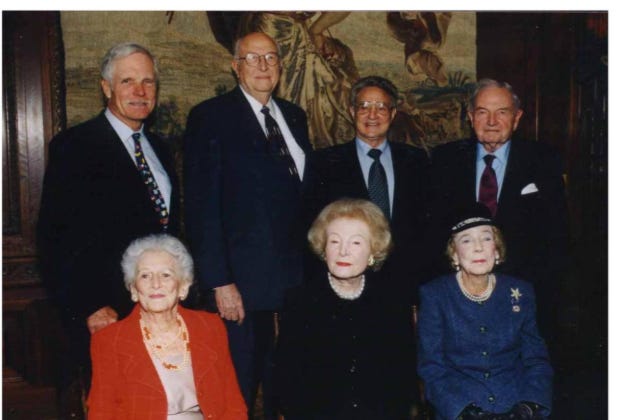
In May 2009 fourteen of the world’s wealthiest individuals met at the President’s House of Rockefeller University in Manhattan. The meeting was organized under the auspices of the Gates Foundation; the venue was arranged with David Rockefeller Jr.’s involvement. Bill Gates, Michael Bloomberg, Warren Buffett, George Soros, David Rockefeller Jr., Oprah Winfrey, Ted Turner, and others discussed population and the future of large-scale philanthropy. The session lasted several hours and was deliberately kept from public view; some aides were told the principals were attending “security briefings.” The Chronicle of Philanthropy learned of it only afterward, by accident.
Michael Bloomberg’s attendance at that meeting was not an accident.
A Johns Hopkins alumnus and former chair of the university’s board of trustees (1996–2002), Bloomberg has given more than $3.5 billion to the institution over decades—the largest philanthropic investment by any individual in a single American university. The School of Public Health was renamed the Bloomberg School of Public Health in his honor. Johns Hopkins, through its Center for Health Security, hosted the major pandemic preparedness tabletop exercises of the past three decades, including Dark Winter (2001), Atlantic Storm (2005), Clade X (2018), and Event 201 (2019, co-sponsored with the Gates Foundation and the World Economic Forum).
In 2020 Bloomberg Philanthropies contributed $10.5 million and provided organizational leadership to design and stand up New York’s large-scale COVID-19 contact-tracing program in partnership with the state and the Bloomberg School of Public Health. The same year it launched a $40 million COVID-19 Global Response Initiative, partnered with Resolve to Save Lives (an initiative of Vital Strategies, itself funded by Bloomberg Philanthropies and supported by the Gates Foundation), that trained nearly 6,000 health workers across 31 African countries, expanded laboratory capacity, built contact-tracing workforces, and supplied rapid-response funding—framed explicitly as both immediate pandemic response and preparation for future epidemics. Bloomberg Philanthropies also gave $8 million to the WHO Solidarity Response Fund (part of more than $200 million in total support to the WHO over more than a decade); Bloomberg himself serves as WHO Global Ambassador for Noncommunicable Diseases and Injuries. In 2021 the Partnership for Healthy Cities initiative, run with the WHO and Vital Strategies, funded vaccine outreach and distribution planning in 18 cities across Africa, Asia, and Latin America.
The same philanthropic networks that had long funded global-health architecture, population programs, and pandemic-preparedness exercises moved rapidly into operational contact tracing, training curricula, vaccine rollout support, and direct partnership with the WHO and the Gates-linked Resolve to Save Lives apparatus.
And the secrecy practice that the British Eugenics Society had made policy in 1960 was still operating, now inside a private gathering of billionaires at a Rockefeller institution.
Meanwhile, the suffering continued.
Across Africa and Asia, programs continued under the newer language even as sterilization remained a primary method in places such as India. Numerical targets and donor pressure persisted. Health Ministry data later showed 1,434 sterilization-related deaths in India between 2003 and 2012. The earlier coercive episodes and the resistance they generated remained the reason the public vocabulary had to keep changing.
Peter Donaldson remained Population Council president until 2015. Julia Bunting, previously with the UK Department for International Development and the International Planned Parenthood Federation, succeeded him and served until 2023. The Council continued its research and product-development work under both. In 2012 Chris Elias moved from PATH to the Gates Foundation as President of Global Development, the position he still holds. He joined the Global Preparedness Monitoring Board and participated in Event 201 in October 2019 — the tabletop pandemic exercise co-sponsored by the Gates Foundation, the World Economic Forum, and the Johns Hopkins Center for Health Security that simulated a novel coronavirus outbreak and the coordinated international response.
Adrian Hill held a formal position at the Galton Institute, the renamed successor to the British Eugenics Society. He directed the Jenner Institute at the University of Oxford and led the development of the Oxford–AstraZeneca vaccine. That vaccine was specifically positioned for use in developing countries through COVAX because it was cheaper and easier to store and transport than the mRNA alternatives. It was later restricted or suspended in multiple countries after serious blood-clotting events were confirmed, and AstraZeneca eventually withdrew it from the global market. Hill’s dual role placed a principal architect of a major pandemic vaccine program inside the direct institutional successor of the organization that had voted for crypto-eugenics in 1960.
What could possibly go wrong?
Jeremy Farrar directed the Wellcome Trust from 2013 to 2023. Wellcome is the archival custodian of the British Eugenics Society’s own records, including the 1960 Council resolution that formally adopted the policy of crypto-eugenics. The same institution that holds the primary-source documentation of the decision to go underground later became one of the most powerful private funders in global health, vaccine research, and pandemic preparedness.
Farrar moved from that position directly into the center of the COVID response. On the night of January 31, 2020, Anthony Fauci emailed Farrar that if scientists confirmed a laboratory problem with the new virus they should report it to the appropriate authorities — “in the USA this would be the FBI and in the UK it would be MI5.” Eleven days later Farrar organized the conference call that produced the “Proximal Origin” paper arguing for a natural origin. Email records later showed that Farrar’s own role as organizer and participant was deliberately downplayed; one participant noted that his name was “appropriately not mentioned.” The phrase captures the method: keep the institutional continuity and the key personnel, but manage the public record so that the connections and original mission remain obscured.
After leaving Wellcome, Farrar became WHO Chief Scientist. The arc is continuous: the private foundation that preserves the British Eugenics Society’s minutes and the 1960 crypto-eugenics resolution; the same foundation’s long-term funding of global health and vaccine platforms; the private coordination channel between Farrar and Fauci in the earliest days of the outbreak; the managed authorship of the paper that shaped the official origin narrative; and finally the elevation of the same individual into the senior scientific post at the World Health Organization.
Bill Gates held a Department of Energy Q clearance for seven years during this period, giving him formal access to classified national-security information. DARPA briefed the Gates Foundation on military biothreat programs. The personnel lines, the funding streams, and the security clearances now operated inside the same institutions that would shape the first years of the COVID response. The public language had by this point settled heavily on “global health,” “pandemic preparedness,” and “equity,” continuing the long sequence of substitutions that began when “eugenics” and “population control” became politically unsustainable.
In 2014 the Kenya Catholic Doctors Association, together with Catholic bishops, publicly charged that a WHO- and UNICEF-supported tetanus toxoid vaccination campaign targeting women of reproductive age was a covert fertility-control program. They stated that laboratory tests they commissioned detected β-hCG in vaccine samples and argued that repeated doses could induce sterility.
Although officials rejected the claims, the controversy itself — the doctors’ formal intervention, the laboratory dispute, the official denials, and the resulting political pressure — is documented.
In India, sterilization camps continued to produce high-profile failures, including multiple deaths in Chhattisgarh in 2014; in 2016 the Indian Supreme Court ordered the phase-out of camps and measures against target-driven coercion. Contested claims of mass paralysis linked to polio campaigns and of formal expulsion of the Gates Foundation from India circulated widely; the Indian government denied the expulsion, and the Foundation continued operations. But the documented resistance and the contested allegations formed part of the same pattern of distrust that had forced continuous linguistic adaptation since the 1970s.
The same institutional pattern Fauci had exercised for decades over the federal AIDS apparatus — centralized control of narrative and research priorities, rapid elevation of preferred interventions, and exclusion of dissenting clinicians and researchers — reappeared in the COVID response. Chris Elias remained President of Global Development at the Gates Foundation and a sitting member of the Global Preparedness Monitoring Board. Adrian Hill remained at the Galton Institute. The conservation-to-pathogen pathway that ran through EcoHealth Alliance and the Wuhan Institute of Virology stayed inside the research-funding architecture.
And yes, EcoHealth Alliance is a perfect example of the crypto-eugenics operation in practice. Take a look:
Peter Daszak is a British zoologist and disease ecologist who led EcoHealth Alliance, a New York-based nonprofit that describes its mission as protecting people, animals, and the environment from emerging infectious diseases. The organization traces its lineage directly to the conservation world. It was founded in 1971 by the British naturalist and author Gerald Durrell as the Wildlife Preservation Trust International, later operated as the Wildlife Trust, and was rebranded EcoHealth Alliance after merging with Daszak’s Consortium for Conservation Medicine. Durrell’s conservation networks overlapped with the same elite British and European circles that produced the World Wildlife Fund and related institutions — circles that included Prince Philip and Prince Bernhard and that had long carried forward older eugenic and population concerns under the language of conservation and planetary management.
Daszak’s own career moved from pure zoology and parasite research into the emerging field of “conservation medicine” and then “One Health” — the framework that treats human health, animal health, and ecosystem health as a single system. He became one of its most visible advocates. Under his leadership EcoHealth Alliance received tens of millions of dollars in U.S. government funding, including multi-year National Institutes of Health grants to study bat coronaviruses in China in collaboration with the Wuhan Institute of Virology. A portion of those funds was passed to the Wuhan lab. EcoHealth was, for a time, the only U.S.-based organization conducting that specific line of coronavirus research on the ground in China.
When the new coronavirus appeared in Wuhan, Daszak moved quickly to shape the public narrative. In February 2020 he organized a statement published in The Lancet that condemned “conspiracy theories suggesting that COVID-19 does not have a natural origin.” He arranged the letter so that his own name and EcoHealth’s long collaboration with the Wuhan Institute of Virology would not appear as central. Emails later showed him instructing colleagues that certain signatures should be kept at a distance so the statement would not look self-interested. The same period saw private discussions among senior scientists and officials — including Anthony Fauci and Jeremy Farrar — about the possibility of a laboratory origin. Those discussions produced the “Proximal Origin” paper that publicly declared a laboratory scenario “implausible.” Daszak’s organization sat at the institutional intersection of the research that had been funded in Wuhan and the early efforts to manage how the origin question would be discussed.
In January 2025 the U.S. Department of Health and Human Services formally debarred both EcoHealth Alliance and Daszak for five years, citing repeated violations of the terms of their NIH grant, failure to report certain experiments, and related compliance failures. The debarment closed one chapter of the institutional continuity this map has followed from the 1960 British Eugenics Society resolution through the conservation and global-health networks of the late twentieth and early twenty-first centuries.
But doctrinal and secrecy momentum has penetrated deep into the US National Security Establishment.
In the early hours of one morning in 2023, someone inside the CIA’s Weapons and Counterproliferation Mission Center rewrote the agency’s draft assessment of COVID-19’s origins. The technical analysts on the team had already examined the evidence more than once. In one internal review, eight of ten personnel, including the subject-matter experts, leaned toward a laboratory origin. After management ordered a reassessment, six of the seven remaining technical experts still concluded that a lab leak was the more likely explanation. Non-specialist management overruled them. The finished product was changed to the deliberately non-committal line: “We may never precisely know the origin of SARS-CoV-2.” Analysts who had insisted on the laboratory assessment later faced retaliation. The people who overrode them did not.
James E. Erdman III, a career CIA operations officer later assigned to the Director of National Intelligence’s Director’s Initiatives Group, brought the internal record into sworn Senate testimony in May 2026. He stated that CIA scientific analysts had concluded multiple times between 2021 and 2023 that a laboratory origin was most likely, yet those conclusions never shaped the official narrative released to the public or to Congress. He further testified that Anthony Fauci had influenced the intelligence community’s process by supplying a curated list of subject-matter experts—several of whom had already participated in the February 2020 discussions and the Proximal Origin paper that publicly dismissed a laboratory scenario. The intelligence managers, Erdman said, made decisions “inconsistent with the conclusions of subject matter experts and analytical tradecraft, consistently favoring the theory of zoonosis or natural origin.”
Fauci told Congress under oath that he had largely left the issue of origins alone and had kept an open mind. The contemporaneous record shows otherwise. On the night of January 31, 2020, he emailed Jeremy Farrar that if scientists confirmed a laboratory problem they should report it to the appropriate authorities—“in the USA this would be the FBI and in the UK it would be MI5.” He participated in the closed-door guidance that shaped which experts the intelligence community consulted. The January 2020 email traffic, the February 1 conference call, the management of the Proximal Origin paper, and the later closed-door influence over the intelligence review cannot all be reconciled with the claim that he simply left the question alone.
The pattern is institutional. Technical specialists reached one conclusion. Management, operating in the same secrecy culture that has long characterized intelligence and national-security work on biological threats, substituted another. The analysts who had been right were displaced. The people who overruled them advanced. The public was given a finished product designed to end discussion rather than to report what the experts had actually found.
The machinery built across the preceding decades did not require reinvention. It only required the same people, the same institutions, the same funding streams, and the same habits of concealment — and the same continuous adaptation of public language under pressure from resistance — to keep functioning.
In 2020 Burundi declared the WHO Representative and three other experts persona non grata and ordered them to leave, citing interference in the COVID response during an election period.
Remind you of anything closer to home?
Is crypto-eugenics now a zombie on autopilot? What is going on?
The following conclusion is supported by the evidence:
A continuous, unbroken chain of named people and named institutions runs from a 1907 eugenics society through a formally voted decision to hide its purpose in 1960, through unbroken personnel and funding continuity across the following six decades, into the exact institutions that now sit at the center of global pandemic policy, biodefense research, and intelligence assessment.
The people in this chain span generations with different beliefs, different degrees of awareness, different motives — some genuinely believing they are doing good.
But what the documents reveal is also this:
After Nuremberg, formal eugenics advocacy institutions born of the most powerful British and American high society wrote down that they intended to keep pursuing their aims vigorously while making sure the public was unaware of their work. Their intent was explicitly to hide these activities under different branding. To survive and succeed, the agenda had to hide and control the predictable opposition emerging from both traditional values and the latest trends in human ethics. That is how eugenics came to be — among its many disguises — birth control, population control, planned parenthood, women’s empowerment, public health and finally pandemic preparedeness.
For sixty-six years, following the people and the money, that is what appears to have happened — not because every person involved was in on the secret, but because the machinery they inherited was built, on purpose, to keep working without anyone knowing what it was really doing, and whether or not anyone remembered why.
One of the most effective ways to bury personal responsibility is to create institutional assumptions about what ideas and actions are good so that no one knows when they are part of something questionable, or morally repulsive.
That problem has a long history in religion, war, politics, technology, and…fertility.
My father spent a large part of his life angry at Planned Parenthood and Roe vs Wade.
At different times I thought he was either wrong, unhinged or both. I believed in women’s rights, and it looked to me like he was fighting the wrong fight, aimed at the wrong target, for reasons that felt more like instinct than evidence or principle. He never once, in all the years I heard him talk about it, mentioned eugenics. It was always Roe v. Wade! or Planned Parenthood! — and he campaigned against them most of his life.
I didn’t really understand what he was on about, until the totalitarian madness of COVID made me look under every rock and rethink everything I thought I knew.
Near the end of Dad’s life, while we were working on his autobiography together, The Supreme Court overturned Roe vs. Wade. By that time, I had finally woken up to the various problems associated with the history of birth control, and I was no longer as upset about the Court’s decision as I once thought I might be.
I still support women’s rights to choose within a non-criminalized point of view which includes appropriate consideration for the child and first principles.
But I suspected what I now know. I had realized that it’s time we looked at all these issues with fresh eyes.
Dad, on the other hand, went out of his mind with a wild mixture of joy, grief, and rage, crying and carrying on from his bed at the farm in Pennsylvania. He struggled to communicate through limited verbal abilities, but I could tell that he was fuming and regretting, and imagining how glorious it would be if the President of the United States could just use the military to shut down every abortion clinic in the country. I think I remember him talking about mobilizing fleets and planes…the whole nine yards. The images he was transmitting still linger in my mind’s eye. He had once been considered a candidate for President, and I could see then that he had it all planned out.
I was shocked. Not at the politics. But by how emotional he was. My father was a powerful man, and when he got upset, it was like lightning and thunder, and sometimes tears raining down from my eyes.
But I had never, ever, seen him like that before.
And now I understand.
He wasn’t wrong that something really bad is going on.
And that we have to do something really big to stop it.
He was absolutely right.
My Dad was a great historian. He knew everything there was to know about the Declaration of Independence and Constitution, the Revolutionary War, the American Founders, Abraham Lincoln, the Civil War, World War II, Economics, and the Gold Standard among many other specialties. He had gone to elite schools, worked with elite organizations and intelligence agencies and was a member of secret societies like Wolf’s Head and the Knights of Malta. A member of the US Army Reserve, he had been one of Reagan’s greatest Cold Warrior allies.
So he had a major conflict. As much as he despised and criticized the establishment, American and British, he also wanted to be part of it. And so, whether consciously or not, he sometimes kept his research and criticism just above the level at which one can see below the surface of the ocean. He saw big waves on the surface that scared him, but he wouldn’t go under the water.
And so, he never had these documents in front of him. Having fought Communists and Democrats all his life, he somehow totally missed the Deep-State-China-Biden-WHO global coup and ended up seeing COVID as a patriotic World War II drill: in which the orders were as follows: believe in the government, and fight the hidden enemy as described on TV…. and on the box after talking with your doctor.
Now I see that his moral compass and emotional intensity were all intact. They were just skewed by the lack of information produced by sixty years of secrecy. In that Roe vs. Wade outburst he was responding to something real: a felt sense that the organizations and court decisions supporting birth control were hiding something big and bad inside their moral judgments.
He was right, but he had no way to prove it. What came out instead was raw force, a wish for power big enough to simply make the wrongness stop, because he couldn’t really see, or make anyone else see the full scale of the wrongness itself.
That gap — between knowing something is wrong and being able to show people exactly why — is a lonely place. I know it well myself, but only now do I really understand why he was so upset.
Despite our differences, it is well known to family and friends that I have the same intensity as my father around fundamental moral issues. The difference is that I am not standing where he stood.
I have the documents.
Frederick Osborn’s forty-four years of service to the cause with Rockefeller funding throughout the transition to crypto-eugenics. I have Blacker’s own letter, in his own hand defining the rationale and the new mission. I have Sanger’s connection to the Ku Klux Klan and the whole eugenics cartel. I have a CIA track-changes log with no name on it, at 1:53 in the morning, regarding the single most consequential geopolitical health event of all time, and a whistleblower who was willing to put his name on the record instead.
My Dad felt the shape of something he never got to see whole.
This essay is what it looks like, laid out, and there’s a lot more where this came from.
I don’t know if it would have been enough for him. No amount of documentation is ever enough to heal a wound like that.
But I think it’s what his gut was pointing at, and I finally have it, and I want him to know, I finished the thought.
That might help…a little.
No posts
Comments
Nothing yet. Say the first thing.
Sign in to join the conversation.