
The last time I saw my grandpa, I was sitting beside him in his den — the room where I always sat with him in London, Ontario, the one with more books and knick-knacks he collected from traveling the world crammed onto the shelves than should reasonably fit. He was 96 and met his great-granddaughter, who was 1.5. And at the end of that visit, he told us not to come back until his 100th bday.
I remember thinking it was such a Grandpa joke to make, but that was exactly like him.. setting a target and fully expecting to meet it, as if turning 100 were simply the next item on a list he intended to finish.
He almost made it. Grandpa died on August 1st, three months shy of 98. Seven weeks earlier, in June, my other grandfather — the one I called Opa — died too. And in the time since, I keep circling back to something that surfaces most often around 2am, when I’m walking my toddler back to bed: a long life and a fully lived one are not the same thing.
In that den, Grandpa would ask me question after question, and then answer anything I asked in return. If I mentioned something that I knew he wouldn’t have thought of before, like maybe homeschooling my daughter someday, there was never a comment about right or wrong. He’d tell me how things used to work, and then he’d say, genuinely, how much better it was that things were different now. He read a mix of fiction and nonfiction, constantly, and his den proved it. He watched golf for hours and played it too. And even at 95, he could talk to me about AI — not just tolerate the conversation, but actually understand it, ask good questions about it, want to know more. He wasn’t interested in it because he was trying to stay relevant. He was interested because something new existed in the world, and he wanted to know what it was. He never once, in all my life, told me something I believed was wrong.
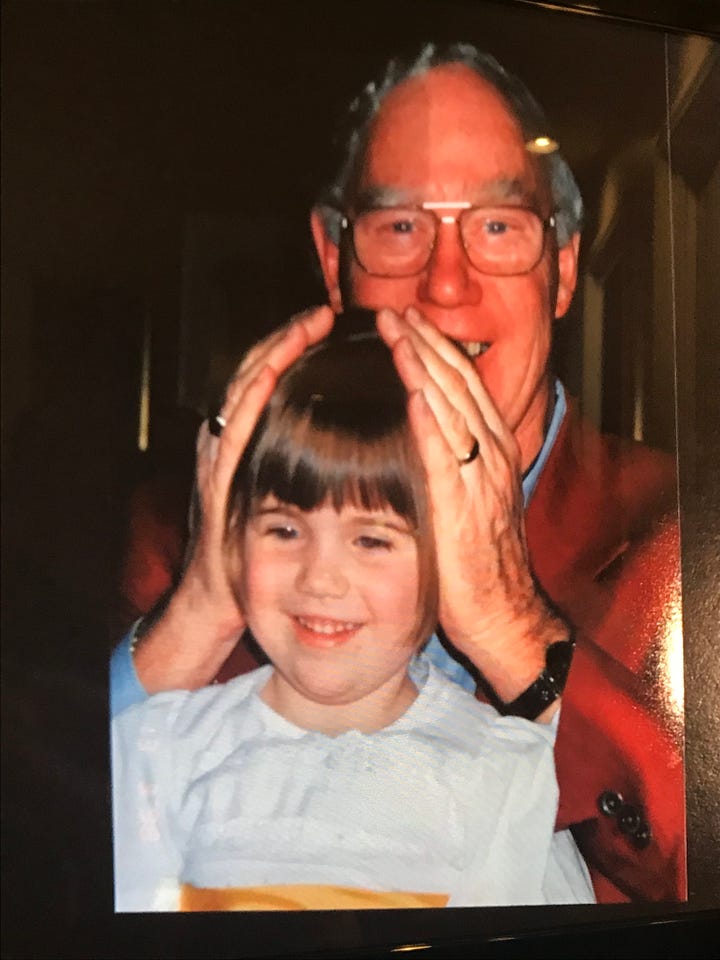

Long before the den, before decades of reading and refusing to let his mind go still, he dropped out of high school. He started small — buying fridges from people who were replacing them, fixing what could be fixed, reselling the rest. It wasn't a plan so much as a habit: he kept noticing what people actually needed, and he kept building toward it. Fridges turned into stoves, then bedroom sets, then living rooms, until what he'd built, without ever finishing high school, was the largest independent furniture store in Canada. I don't think he set out to build an empire. He just never stopped being curious about the next thing people needed.
I don’t want to make it simpler than it was. Running that kind of business meant he was gone constantly, and my mom grew up with a stay-at-home mother raising five kids born thirteen months apart, and a father who was rarely there. They lived very well for their times. They also grew up with something missing, and my mom and her siblings are still working through what that absence cost them now as adults. Her parents eventually divorced, and both remarried. My grandpa and my Grandma KK had both shared and separate interests, and also had their own individual curiosity about the world, which was different from my Opa and Oma, who spent nearly all of their time together within five feet of each other. Once Grandpa and Grandma KK retired, they traveled everywhere — safaris, Japan, wherever caught their interest. They ate well. They spent money on the people they loved and being part of clubs. It’s the same idea a few writers have put a name to — dying with zero — but he was living it before I ever had language for it.
My Opa, on the other hand, seemed to lose his sense of what came next once work ended. He didn’t read books. He didn’t have many interests outside of the job that had structured his whole life. And once that was gone, I struggled to see what he was reaching toward. I don’t want to reduce his life to unhappiness, because none of us can really know what someone else carried — but from where I stood, there was a kind of surrender in him long before his body gave out, and he’d wanted to be done, I think, for close to ten years.
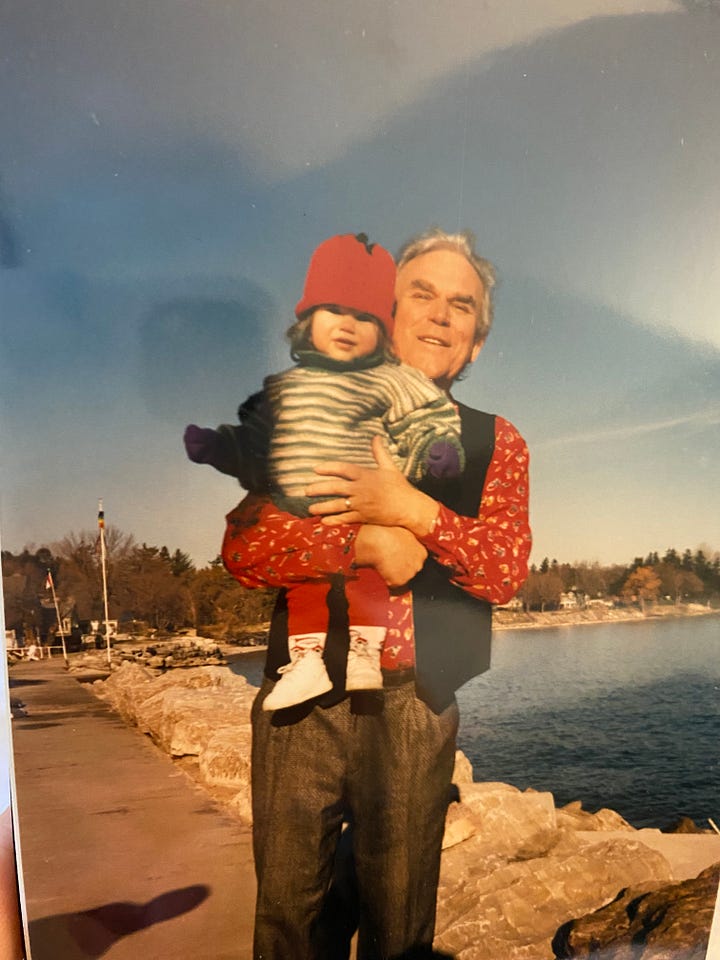

The two deaths mirrored the two lives, somehow. Grandpa’s was fast, old age of course and then cancer at 97, one month of chemo he chose because he wanted to reach 100+, and then it took him so quickly he didn’t make it back to his hospice bed set up in his den. He wanted more time and didn’t get it. Opa had been asking for the opposite for what felt like a decade, and for a long time, he didn’t get that either.
I’ve also noticed, only in looking back, how differently I experienced being known by each of them. My mother’s mother, on the other coast in California, was someone I could tell anything — boys, sex, drugs, mistakes, all of it — and she’d just talk to me like a real person. My Opa and Oma were not that. I’ve written elsewhere about the fight that made this clear to me: how they were unsettled by the woman I’d become after motherhood specifically, how it felt like they only ever knew about 5% of who I actually was. That’s its own grief, and its own essay. I mention it here because it’s tangled into the same lesson — both of them showed me, in different ways, what I don’t want to become: someone incurious about the people she loves, unwilling to be surprised by who they turn out to be.
Because here’s the part I didn’t expect this essay to be about when I sat down to write it. My grandfather’s curiosity was never really just about books, or fridges, or AI. It was about staying open to the people in front of him, even as they changed into people he hadn’t planned for. My Opa, in my experience, stopped doing that long before he stopped living. And I have a daughter who will spend her entire life becoming someone I can’t currently predict. I don’t want to be the kind of mother who decides who her kids are early and then spends the next fifty years relating to the version she decided on. I want to keep discovering them and not deciding too soon what they’ll value, who they’ll become, or which of their choices I think are right, but staying genuinely interested in whoever they turn out to be.
Money sat differently in each of their hands, too, and this is where I think the real inheritance shows up most clearly. My Opa and Oma held onto money so tightly that buying a coffee from a local shop was treated like a small betrayal — every penny saved is a penny you didn’t need to make, they both used to say. He’d crossed the ocean as a teenager with sixteen dollars in his pocket and built a real life in construction in Toronto, and by any measure, he did well. But money never stopped being about scarcity for them, even decades later, even more than comfortable there was never quite enough, and the way I spent mine was something to be commented on, corrected, and disapproved of over and over often leaving me in tears and a panic attack. The fear of there never being enough has been one of the quiet anxieties of my life, something I carry most days without fully noticing it. In my mind, Grandpa was the opposite. He talked about money openly, and his belief was simple: if you earn it, use it. Not debt, not recklessness but for God's sake, just take the trip, because you might not get another chance. Try the restaurant if it looks good. Live the life the money is supposedly for. Otherwise, he’d ask, what was the point of any of it. I did not inherit a business from either of them, but instead I inherited two completely different definitions of enough, and I’m only now starting to decide which one I want to raise my own kids inside of.
My husband and I have been asking our own version of that question lately, and it keeps changing shape. For a while, “enough” felt like a number in our bank account. An income we thought would finally make us feel perfectly secure. The more we talked about it, the less it held up, because what if the number meant I had to go back to full-time work, which after choosing to walk away from my career to be with my daughter was no longer the goal. So we stopped asking what number, and started asking what feeling we were going for. A hundred thousand dollars and four days a week might mean far more to us than three hundred thousand and a seventy-hour one. Those are just numbers I’m using to make the point, but the shift underneath them is real, and it’s gotten more concrete in the weeks I’ve been watching what a lifetime of either scarcity or expansiveness with money actually does to a person by the end of it.
Here’s what I keep landing on. I don’t think I fully inherited my grandpa’s business instincts, or his tolerance for risk, or even his generation’s version of ambition. I think what he actually gave me was smaller than that and more of a way of moving through the world that stays interested: asking another question, picking up the next book, sitting with an opinion you don’t share without needing to correct it, trying the thing you’re not qualified for just because it caught your attention. He did that until he was almost 98, which is probably the only reason a man that age could talk to his granddaughter about artificial intelligence like it was the most natural thing in the world.
I don’t think the opposite of death is really life. I think it might be curiosity. Because the moment we stop asking, stop noticing, stop letting the people we love surprise us, some part of us starts living as though the story is already finished. Grandpa kept his story open until he was almost 98. That’s what I think I’m really mourning, and what I think I’m really inheriting.
I have a toddler and keep noticing how easy it is to file things under later. I’ll write more when they’re older and I have a bigger chunk of time to myself. I’ll learn about art once I can actually afford to buy a piece. I’ll travel, read, rest, build the thing I actually want to build — later, once this season is easier. And then I watched a man reach almost 100 years old, still saying tell me more right up until the end, and a hundred years suddenly felt like a shockingly short amount of time to spend waiting for your life to start.
I don’t want a long life so much as I want one I’m not spending waiting to escape — the version where I stay interested now, in the middle of it, instead of promising myself I’ll get curious again once the hard part is over.
Some mornings, that just looks like this: coming downstairs at the same time as my daughter, reading my own book on the couch beside her while she listens to her audiobook. We share one blanket, and our feet always end up tangled together. I follow whatever I’m curious about, and she follows whatever she’s curious about. I used to think enough would be a number. I’m realizing now it’s actually this — a slow morning I didn’t have to earn first.
And maybe that’s what I want most for her, too — not a blueprint for what a good life is supposed to look like, but the same permission: to stay interested in her own, to keep changing her mind, to grow into someone I didn’t predict and still want to know.
So maybe that’s the whole inheritance. Not a hundred years, not a furniture business. Just permission to stay interested in the life that’s actually in front of me, instead of the one I keep telling myself is coming later. Because later might not come and my grandpa knew that better than almost anyone I’ve known, right up until the very end.
Just the asking. Just: tell me more.
I would love to hear from you.
What's on your 'later' list right now? Something you keep telling yourself you'll get to eventually….
Comments
Nothing yet. Say the first thing.
Sign in to join the conversation.