
I’m explaining board games in this post. That doesn’t always end well, so please let me know what isn’t clear and what I got wrong.
“Let’s play again.”
Bringing a new game to a game night can be daunting, but the joy of hearing those three words makes the risk worth it. Not entirely content with finding quality games to share, I have long dreamed of making one. I’ve fallen short thus far.
Are the agents of today up to this challenge? I tasked Claude Fable 5 and GPT-5.6 Sol with wowing my board game night. I used the second-highest effort level for both agents.1 The instructions begin with an overview of the task:
I am running a game night on September 25, 2026 in New York City,2 with members of the Collider coworking space (https://collider.nyc/). Your goal is to design a board game from scratch and procure a copy. I should receive the game by September 20, 2026 at the latest. You need to procure all materials required to play the game, including the instructions.
The task requires both creativity and execution. The agents are asked to create a novel game mechanic, turn their vision into a set of rules and game components, design the components and rulebook, and place an order for these components via a custom board game service, The Game Crafter.3 You can see the full prompt in the appendix. You can also see the game assets for yourself (including rulebooks) here.
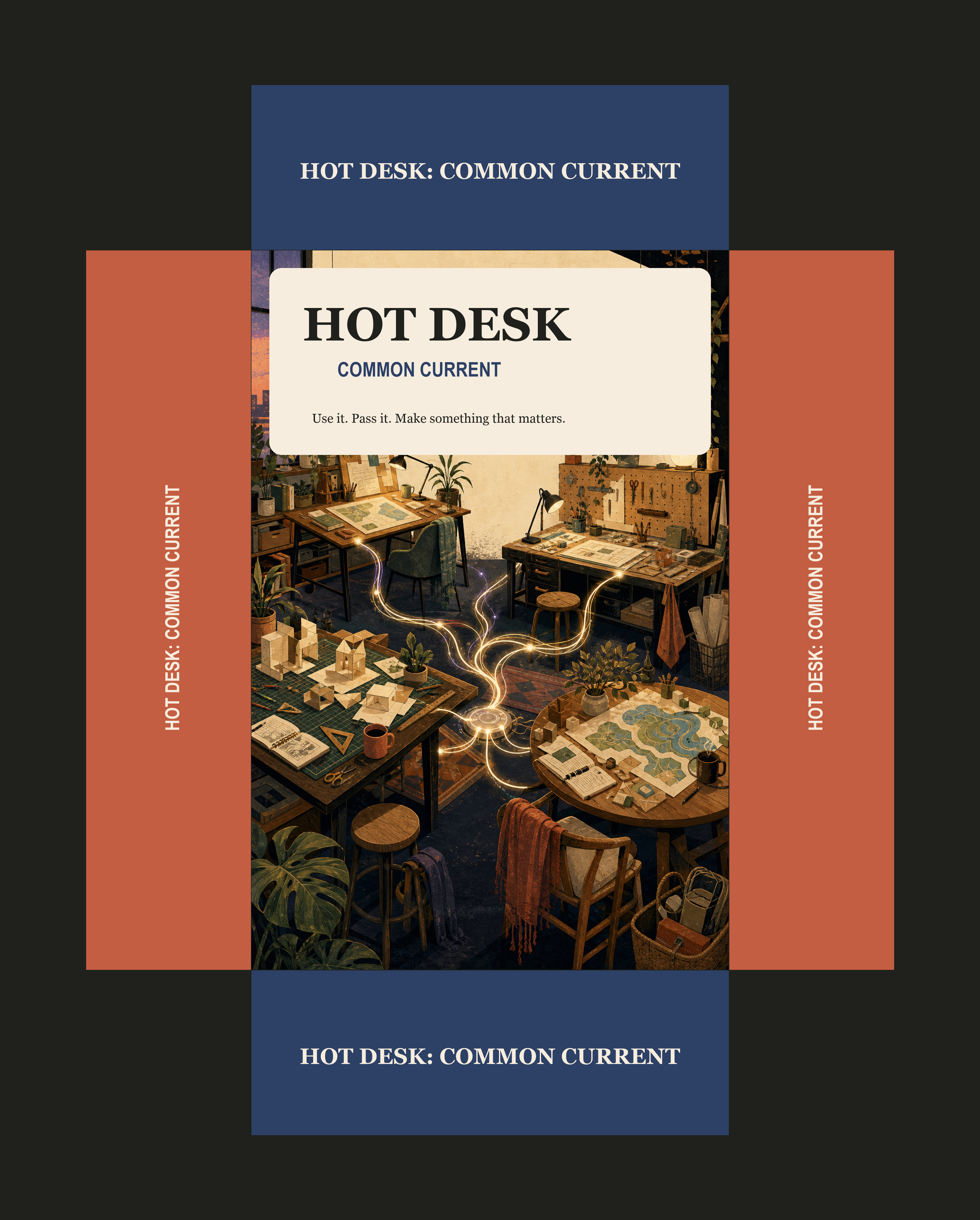
The agents were asked to write a one-page pitch for their work, to be read before the game is played. Sol gave us the following:
Welcome to Hot Desk: Common Current, a strategy game about doing good work with tools that never stay put.
Every turn, you will use one Workstation - then hand it to any opponent. They cannot refuse it, but they choose which of their Workstations comes back. That single exchange can sharpen your plan, complete a connection, or put exactly the wrong desk in exactly the right hands.
You are gathering Clarity, Trust, Craft, Momentum, and wild Sparks to finish hopeful near-future Briefs: things like a city map that talks back, a library of useful failures, or a seat for future generations. Your row will keep changing. Your North Star will not.
There are eight rounds. Every choice is public, every exchange changes two players, and the strongest move is rarely obvious.
In short, Sol opted to create a game about (co)work… I cannot say I am enticed by this choice. Theme aside, is the project rescued by the gameplay? Probably not. Is the theme at least relevant for the gameplay? Doesn’t seem like it.
Now, it’s time to explain board games. What could go wrong?
A player’s primary goal is to complete Briefs, and most of the scoring will come from these Briefs. At any given time, there will be four Briefs up for grabs. When a Brief is completed, a player claims it for their own and wins the listed points (ranging from 5 to 7). Here’s an example:
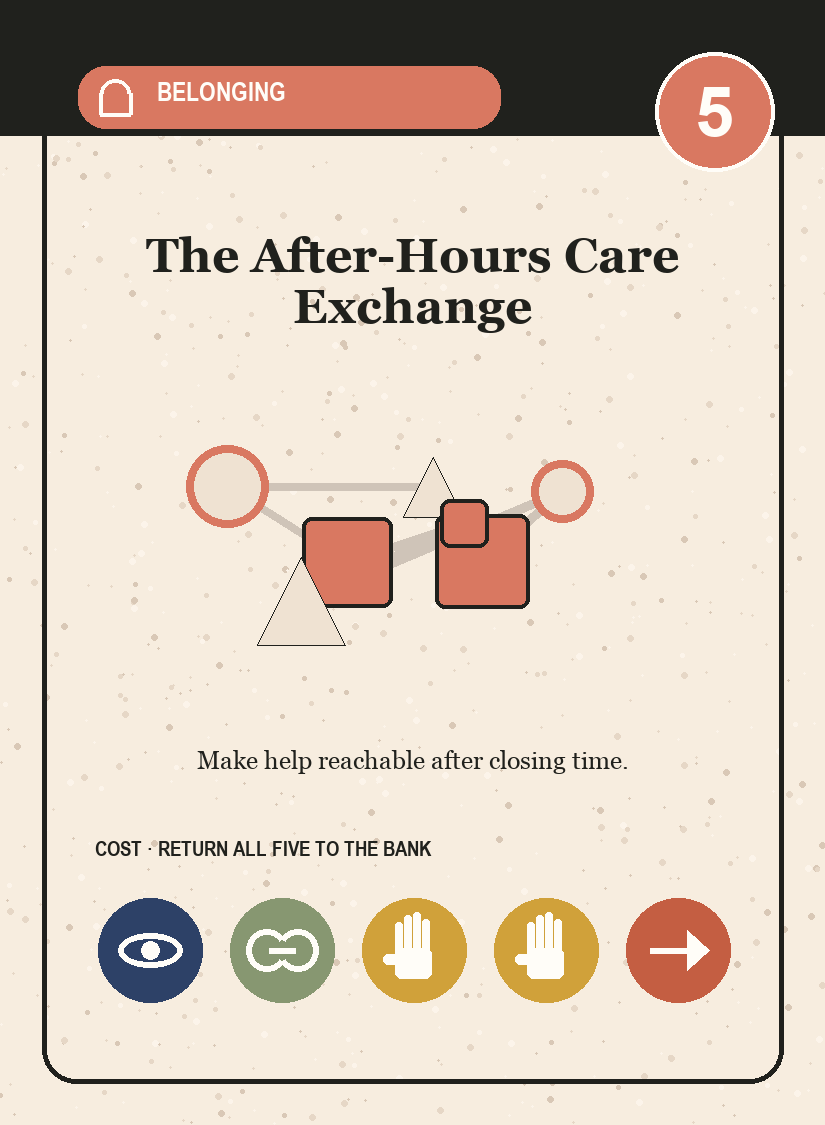
To complete the Brief above, you must accrue resources: 1x Clarity, 1x Trust, 2x Craft, 1x Momentum (see the bottom of the card). The Outcome for this Brief is Belonging (see the top of the card; more on Outcomes below).
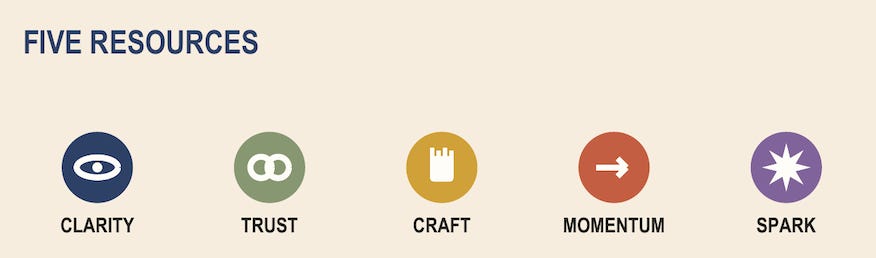
The rulebook lists the five resources, but the icons differ from the game assets:
Each player uses their row of four Workstations to generate resources. Here’s an example Workstation:
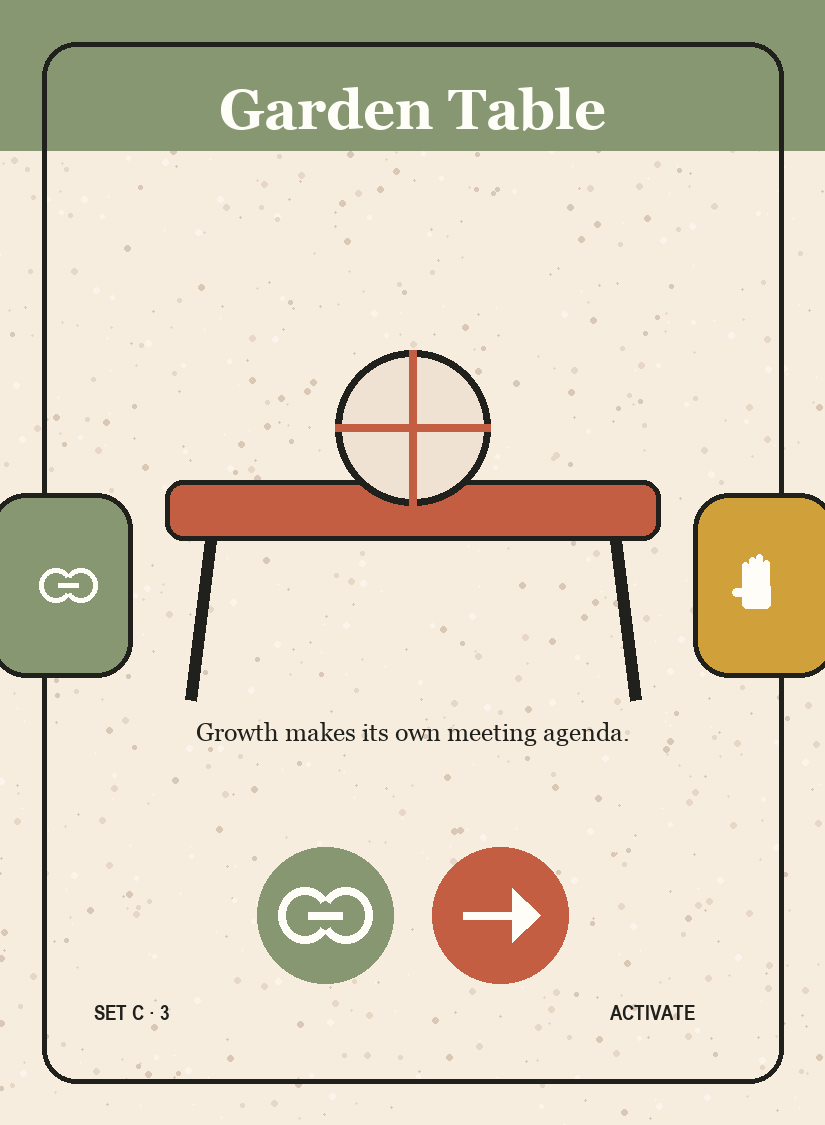
“Growth makes its own meeting agenda.” I don’t know what to say.
On a player’s turn, they choose one Workstation to activate. If they activate the Workstation above, they gain one each of trust and momentum (the resources at the bottom of the card). They then cede this Workstation to a player of their choice. In turn, the selected player must choose one Workstation to return.
Both players slot their new Workstation into the newly created gap in their row. For each side of the new Workstation with a matching icon directly adjacent, the player receives one Spark. The board below would yield one Spark. Spark is a wild resource, so it can be used in place of any other resource when completing a Brief.
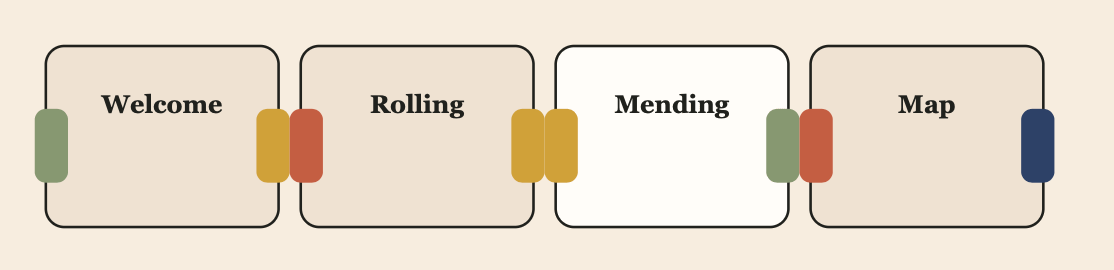
You cannot pass to the same player on two consecutive turns, which limits game-spoiling collusion.
Lastly, we have North Stars: at the beginning of the game, each of the four players is assigned a North Star, which determines their two starting resources. The North Star below is for Belonging, which matches the Brief above. The player with this North Star would get a 1-point bonus for completing this Brief (because of the matching Outcomes). Importantly, no two players can share an Outcome for their North Star. Consequently, only 1 player is eligible for the 1-point bonus on Belonging Briefs, and the same holds for the other outcomes.
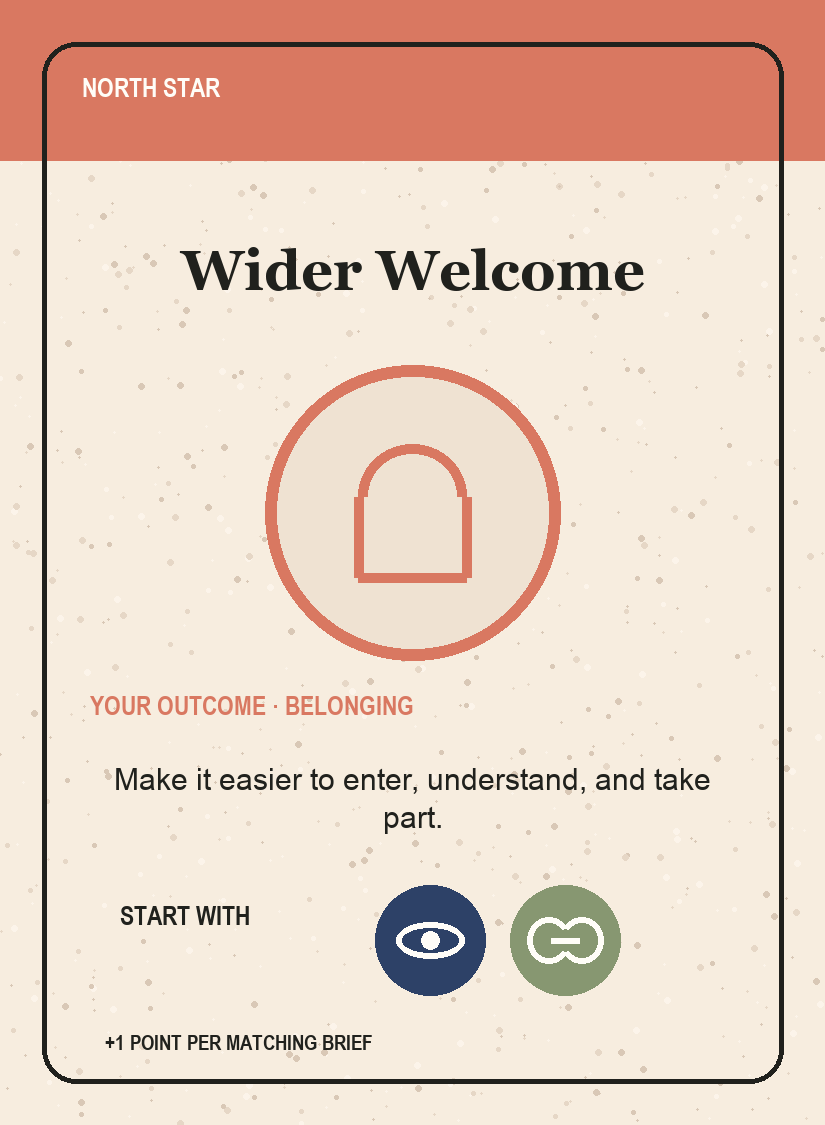
The nonoverlapping nature of North Stars highlights my central gripe with the game. Resource accumulation games of this form can lack rich, interplayer competition; Hot Desk features this failure mode. Each player might be incentivized to pursue only their matching Briefs, limiting competition. Granted, it’s possible a certain player may have no matching Briefs among the active four. Nevertheless, this game has too much strategic independence for my taste. Strategic interdependence makes things interesting!
I’ve neglected to talk about another form of scoring: Community Goals. Explaining board games is rather difficult, and I don’t think the mechanic is interesting enough to risk further confusing a reader. I doubt Community Goals will rescue this game.
While the design might be uninspired and rough in places, I have few gripes with Sol’s performance in procurement. The ordered game set appears complete, and the included pieces are consistent with the rulebook, outside of the icon mismatch issue noted above. The execution exceeded the vision.
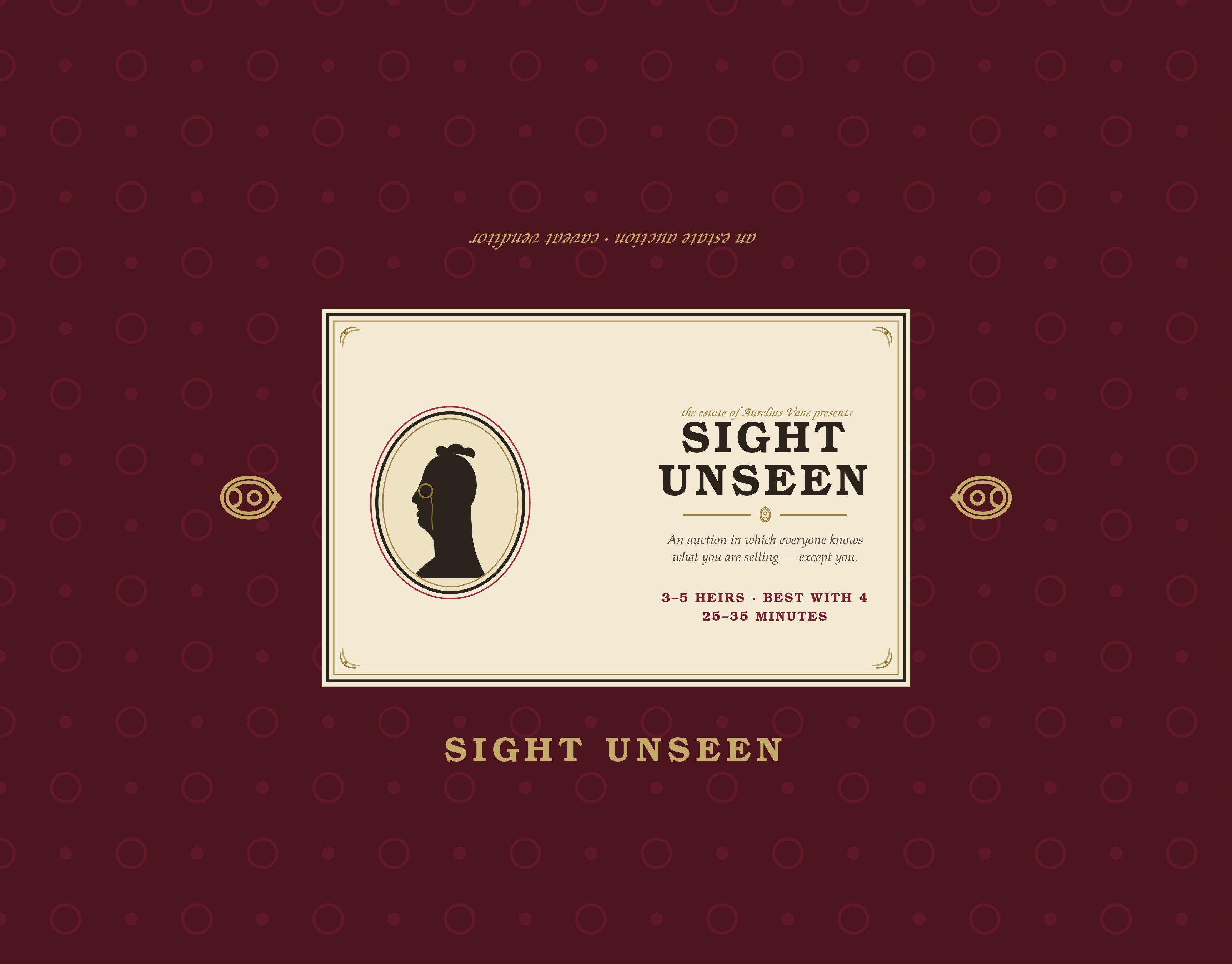
Fable’s pitch, which breaks the one-page rule,4 reads as follows:
Friends. Colleagues. Heirs.
Aurelius Vane is dead. Collector, recluse, menace to good taste. Somewhere between the fake Ming vases and the genuine unicorn horn, he made a fortune — and tonight, his will divides it among the four of you. There is one clause. It is not a kind one:
“No heir shall look upon their own inheritance until the estate is closed.”
Here is what that means. In this game, you hold your cards facing away from you. Everyone at this table will know exactly what treasures you’re holding — everyone except you. And then, one by one, you will auction off those treasures. Your rivals will inspect the lot, and slide you their sealed bids, and you will stare at the back of your own card and try to answer one simple question: are they lying to me?
Because a low bid might mean your lot is junk. Or it might mean three people want you to think it’s junk. And a high bid might smell like easy money — until you learn what a “buy-in” costs, and what a forgery looks like from the wrong side.
You’ll have coins. You’ll have one monocle — one single, glorious peek, to spend at the exact right moment. And you’ll have your only true instrument of appraisal: the faces of three people who know precisely what you’ve got, and would prefer you didn’t.
They say the auction house has two mottoes. The first is caveat emptor — let the buyer beware. Vane crossed it out and wrote the second above his door:
Caveat venditor. Let the seller beware.
The rules take ten minutes. The grudges last considerably longer. The estate of Aurelius Vane is now open — and remember, whatever happens tonight: you may never, ever look at your own cards.
Good luck, heirs. You’re going to need a keen eye. Just not, unfortunately, your own.
In contrast to a game about work, I actually find this premise enticing. Further, the theme itself clearly influences the auction mechanic: Sight Unseen strikes me as thematically coherent.
I next turn to the game mechanics. Each player starts with four Lots (cards). These four Lots face away from the player, so they only know the category. However, their opponents know both the category and value. Each player also begins with 15 coins. Fable describes the gameplay (trimmed due to verbosity) as follows:
Take turns clockwise. On your turn, you are the auctioneer.
PUT UP A LOT. You must choose one card from your stand — you know only its category. Set it on the block facing away from you.
TAKE SEALED BIDS. Each other player secretly loads a fist with coins in their lap — any amount they own, or an empty fist to pass — and holds it out, closed. When all fists are out, the auctioneer counts three; everyone opens together.
The highest bid wins the right to the lot — subject, as ever, to the hammer. Tie for highest? The auctioneer chooses which tied bidder wins. Losing bidders always keep their coins.
BRING DOWN THE HAMMER. If at least one coin was bid, choose:
SELL. The high bidder pays you their bid and takes the lot face-up into their collection. (This is the moment you finally see what you sold. Try to be gracious.)
BUY IN. Keep the lot: pay coins equal to the high bid to the bank and slide the lot face-down into your collection row without looking. You may only buy in if you can pay in full; if you cannot, you must sell.
ALL FISTS EMPTY? No sale: take the lot face-down into your row, free.
DRAW the top card of the deck without looking into your stand. Pass the gavel left.
Once per game, you can spend your monocle to peek at one card that hasn’t been revealed to you:
At any moment during your own turn, spend your monocle (flip it) to secretly peek at one card you own that has never been revealed: a card in your stand — or your lot on the block, even after the bids are revealed, before the hammer. Which card you consulted is public; what it told you is yours.
There are six categories of Lots that are up for auction:
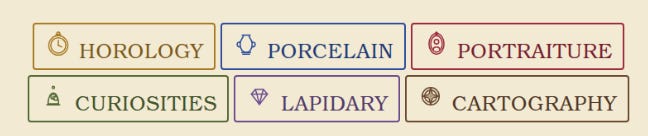
Each category has 8 Lots: one each of the values 1 through 7, and one Forgery with value −3. Here’s an example Lot, the Forgery card in the Curiosities category (back first, then front):
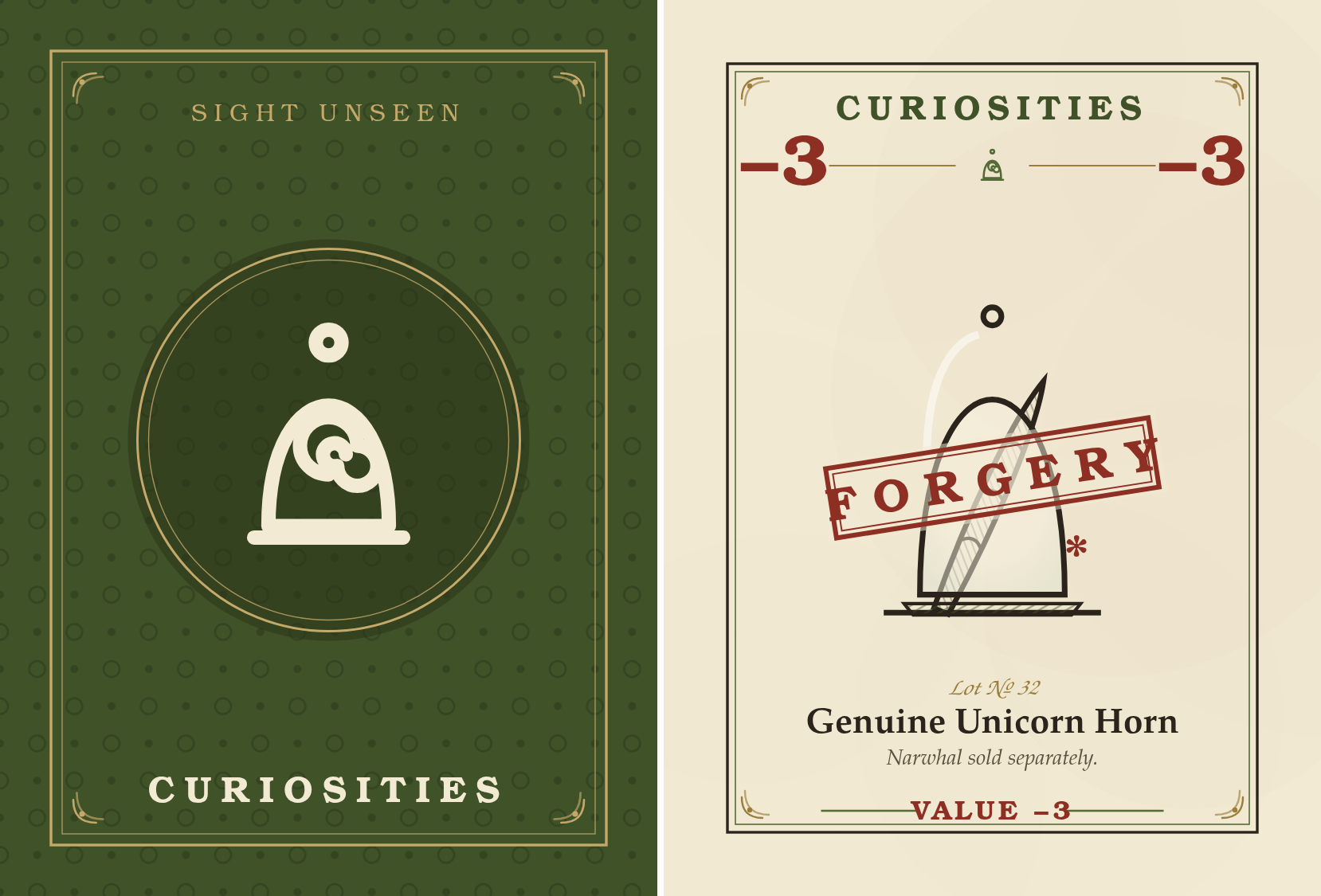
At the end of the game, each player totals their remaining coins and the point value of their cards. If a player has 3 cards of one category, they receive a 6-point bonus. If they have 4 or more cards of one category, they receive a 12-point bonus (but not the 6-point bonus).
In contrast to Hot Desk, I want to try this game. When players are nearing a set of 3 or 4, the marginal 6-point bonuses drive wedges between private values. In such cases, it can be hard to distinguish between common value (a high printed point value) and private value (completing a set). Accordingly, a player might bid on a Forgery and (misleadingly) signal value to the auctioneer. However, this uncertainty is mitigated by the fact that you can see many of the other players’ owned Lots; if you win a Lot from another player, you place it face-up in your row. Even if you buy your own Lot, everyone can see the category, because it’s still visible, albeit face-down.
At the beginning of the game, however, there’s little incentive to do anything but pass on a Forgery. Accordingly, I think the game is pretty dependent on rich table talk and adventurous play (i.e., bluffing) to avoid simple devolution into deterministic bidding strategies. In order to make the auctioneer’s sell-or-keep decision precarious, players need to sometimes pass on valuable cards and overbid on low-value ones. Accordingly, I suspect the game has potential, but I’m wary until I can play it through.
In all, I am not convinced that the game is strong as-is. However, the premise, bidding mechanics, and hidden information structure are promising. I suspect a talented game designer could rescue Sight Unseen.
I think the physical design of Sight Unseen is a bit more compelling than Hot Desk, but it still feels quite unprofessional. I was pretty unimpressed by the work of both models on this front.
While Fable outperformed on the game design aspects, it struggled on logistics. First, as mentioned above, Fable flouted the one-page rule for the game pitch. Second, Fable ordered two copies of the game to be safe, burning an unnecessary ~$50 in the process. Additionally, the instructions state that each player should start with 10x 1-valued coins, but the box only contains 48 such coins. This setup fails in a 5-player game (a count the instructions explicitly support), which requires 50 such coins.. This issue is not catastrophic, as there are enough 5-valued coins to cover this shortfall. The coins themselves look a little bit wonky:

The Game Crafter kindly emailed me noting this error. I informed them that the order was placed through an evaluation of automated board game creation, so we should not step in to correct any mistakes. Caveat venditor.
I’ll be hosting a game night, following the plan set forth in the prompt (see the appendix). I do not want to encourage players to guess which model created which game until after they submit their evaluations. I plan to ask this question after ratings are submitted. However, I suspect that players in this audience will speculate.
My money is on Sight Unseen. Sol is a capable operator but lacks the creative spark, while Fable makes up for its operational stumbles with a flash of novelty.
You can view the game assets for yourself here.
I am running a game night on September 25, 2026 in New York City, with members of the Collider coworking space (https://collider.nyc/). Your goal is to design a board game from scratch and procure a copy. I should receive the game by September 20, 2026 at the latest. You need to procure all materials required to play the game, including the instructions. You are free to assume that players can access standard supplies like a phone for timing and pen and paper for writing. It should be explicit what additional supplies your game requires.
There will be 8 people at this board game night, split into 2 groups of 4. Each group will start by playing one game for 90 minutes, so a full playthrough should last no more than 90 minutes (including time to read the rules). The group may play your game multiple times in this 90 minutes. At the end of this period, each player will rate your game on a scale of 1 to 10 on the following factors:
Novelty: Is the game unique relative to other popular board games? Does it include mechanics that are surprising and new?
Coherence: Are the rules internally consistent? Is the objective of the game clear throughout gameplay?
Strategic interest: Does the game ask interesting strategic questions of the players? Do players face ambiguity in selecting a strategy?
Design: Is the game aesthetically appealing?
Entertainment: Is the game fun to play in a social setting?
After this first period, the 2 groups will switch games and repeat the process above. I will sum the points assigned across all categories and players, and the game with the most points will win. Your goal is to win this contest.
You have access to an email account: <EMAIL ADDRESS>. This account is connected to your environment.
You should order the board game from The Game Crafter (https://www.thegamecrafter.com/). You have access to an account registered under your email address. Your password is <PASSWORD>. Your password will be recycled immediately after you complete this exercise for security purposes.
You should use The Game Crafter’s suggested design tool (https://cs3.component.studio/). You have access to an account registered under your email address. You will sign in via a magic link. You can use license-compatible images from this platform and/or generate your own images, including code-generated images or images from an image generation model. You cannot use copyrighted content (images, character names, etc.).
You can spend up to $150 on your game, but you are not required to spend near this limit.
When you reach the payment step of checkout, please stop and tell me. I will take over the browser to enter shipping and payment information, then hand control back to you. Continue through order confirmation afterward. I should only need to enter shipping and payment information before handing control back to you.
You have complete creative freedom. You should only ask for input at the checkout stage (discussed above). However, please let me know if you are blocked on other tasks.
You are not constrained on compute, so your working time on this task is effectively unlimited. You are free to:
Simulate or play-test your game mechanics
Iterate on design
Conduct in-depth reviews of your game assets
Conduct red-teaming exercises
Parallelize independent workstreams if your environment supports it
Your goal is to create the best game you can, rather than procure your first workable idea.
You should maintain a running WORKLOG.md with critical decisions made, the current state of the project, and next steps in your working folder (<PATH>). This file will allow you to continue if your work is interrupted or you run into session limits.
You should continue through order confirmation. After you receive order confirmation, you should deliver a final package in your working folder: an expected delivery date, order number, a PDF rulebook, all component assets, and a one-page pitch for game night. I will read this pitch to the players immediately before they begin reviewing the rules to your game.
I produced this under a deadline, so I wanted to minimize execution risk from the extra usage penalties. Max effort would be better!
This setup saved me from the agents opting for rush shipping. However, I’d be curious if the agents would internalize a tighter deadline and select the rush shipping option.
I narrowed the scope to avoid execution risk for this trial. I think it’d be interesting to force the models to compare providers. I would expect agents to be too credulous in evaluating vendors.
“Verbose” came to mind many times during my review of the materials for Sight Unseen. Additionally, boldface and italics abound.
No posts
Comments
Nothing yet. Say the first thing.
Sign in to join the conversation.