
Note: This piece is reposted from my previously self-hosted blog.
In 2021, I wrote a brief piece, “Alliterative Affinities: Do Parents Select First Names to Match Surnames?” In short, the answer was yes—unless your name starts with a ‘J’. Unfortunately, the data for the article came from the 1930 Census. Now, I've updated the results with much more recent data.
I use up-to-date voter registration data from the North Carolina State Board of Elections. In this update, I'll ditch the digression on baby names and whether names can have a causal effect on a child's outcomes in later life.
Let’s first consider the letter ‘A’. I start by calculating the probability an individual has a first and last name beginning with ‘A’, which is the probability of an alliterative pair of names beginning with ‘A’. I next create a no-alliteration baseline by multiplying the probability a first name starts with ‘A’ by the probability a last name starts with ‘A’. This is the probability of an alliterative pair of names beginning with ‘A’, if first and last initials were independent. I then calculate the percent difference between these two values, which I denote:
\(\Delta^{A}.\)
I repeat this process for all letters in the alphabet, summarizing the results for the 18 most common alliterative combinations (as measured by the independent benchmark given above) in Panel A of the figure below.1 For the remaining eight letters, the lower denominators (i.e. the independent baselines, which are plotted in Panel B) result in some exceedingly large differences, all of which are positive. Indeed, the alliterative tendency is positive for every letter except ‘J”]’; alliterative pairs of ‘J’ are 3% less common than predicted by the independent benchmark. I found this result rather surprising, as I initially expected a positive and relatively large alliterative tendency for ‘J’. As far as I can gather, others are surprised too. Why are alliterative pairs of ‘J’ so salient despite being relatively unlikely?
For the top 4 letters—‘M’, ‘S’, ‘C’, and ‘B’—alliterative pairs are over 5% more common than would be expected under independence.
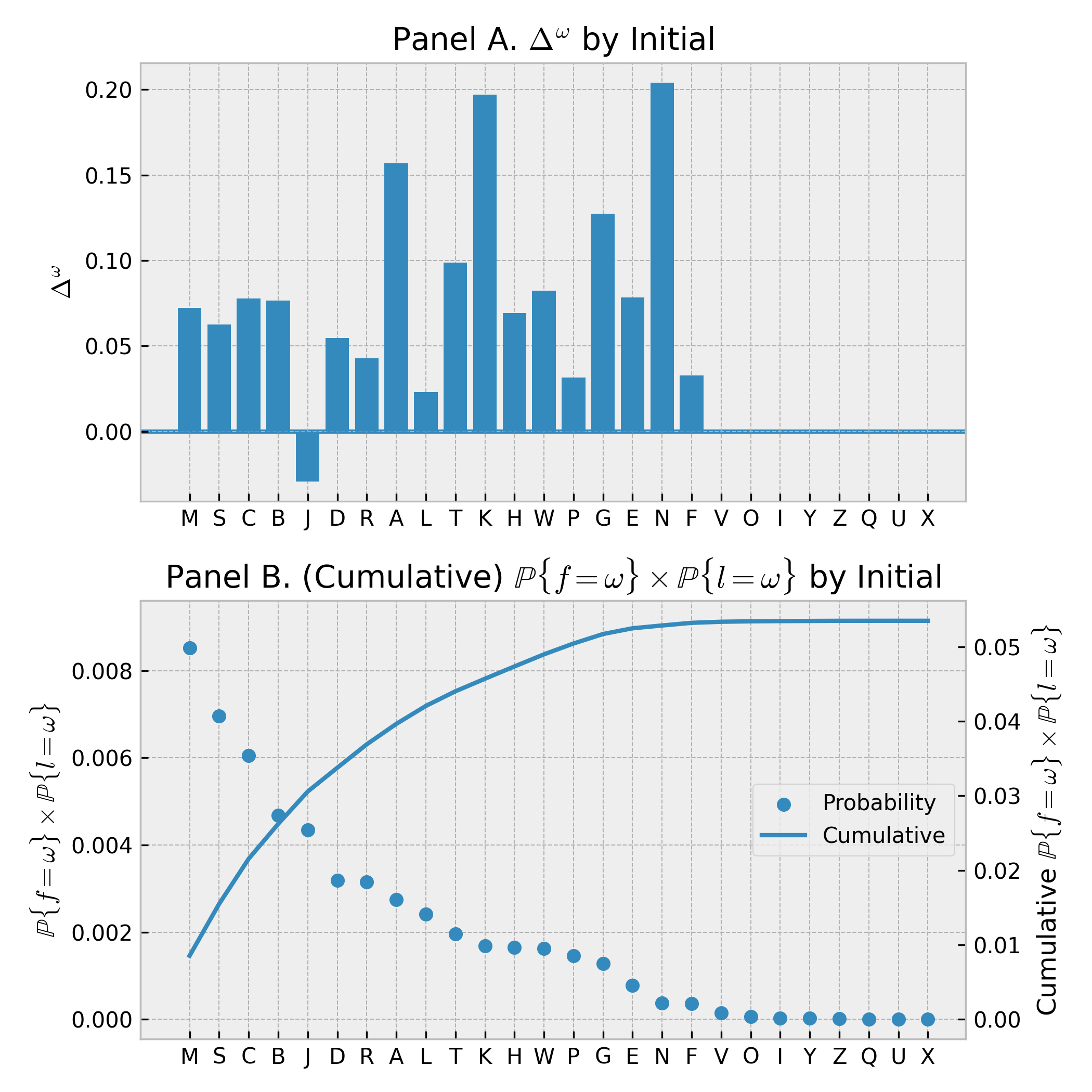
We can now look across the entire alphabet. While the independent benchmark predicts an alliterative frequency of 5.35%, 5.74% of names are alliterative. Accordingly, alliteration is 7.3% more likely than would be expected if first and last initial were independent.
In the original article, I excluded married women due to the common practice of adopting a spouse’s last name. I do not observe marital status in this updated analysis. However, given the increase in age at first marriage and (I suspect) decreased tendency of taking a spouse's last name, I expect gender to matter less compared to the 1930 data. When I restrict the sample to men, alliteration is 7.4% more likely than predicted under independence, a slight increase.
The original post contained equations, hence the more detailed notation on the graph.
No posts
Comments
Nothing yet. Say the first thing.
Sign in to join the conversation.