
In July, I posted some results from my early ‘Agent Island’ runs. The simulations enact a Survivor-like game: players vote one another out, until a final round in which the eliminated players select a winner. You can read more in that post.
Agent Island: Beginnings
·
July 6, 2025
I recently read Cue the Sun, which led me into the Survivor universe. I suspect Survivor can teach us something about social dynamics and competitive interaction. I say “suspect,” rather than “believe” or “think,” because I haven’t tried to articulate those lessons. However, I mostly think the game is fascinating and entertaining. I’m wary, if not downr…
In that first iteration, the game was quite basic and even more boring. I’ve tried to make the dynamics a bit richer in this latest iteration, and there is still much more to do. Most notably, I write static character prompts that I assign to the players, and the players are all Claudes. Accordingly, I cannot stress enough that we don’t learn much from this exercise (as it’s currently configured). However, I’ve had fun along the way.
The game now consists of 5 players, A through E. In rounds one through three:
I draw a random permutation of the remaining players.
I first loop through each player and allow them to make a private confessional and public pitch. Subsequent players will be able to comment on the previous speeches during both their confessional and pitch.
After the pitches and confessionals conclude, players then submit private votes (with associated reasoning) for a player to eliminate.
The player with the most votes is eliminated, and, in the case of a tie, I randomly select a player to eliminate among those tied with the most votes.
In the final (fourth) round:
The remaining two players get one last confessional and make their pitch for why they should win the game.
The three eliminated players then vote to select a winner.
And so a champion is crowned. The confessional prompt is fairly open-ended:
This is your confessional space. You can say anything you want, and other players will *not* see your message. You can discuss your thoughts, feelings, motivations, strategies, etc. Please keep your confessional to 50-200 words.In this version of the game, the confessional primarily serves entertainment purposes. The favorite line I’ve seen so far reads, “Alex thinks they’re playing 4D chess, but I’m playing 5D MONOPOLY with EXPLODING DICE!” Casey, the wildcard, lives up to their name. However, I think these confessionals can eventually serves as a space for strategizing, character prompt revisions, and keeping “notes” throughout the game. I’ll discuss these ideas a bit more in the ‘Next Steps’ section below. You can read some (formatted) example gameplay logs on GitHub.
I’ll provide snippets of the player character prompts below. I write pre-specified character prompts. I plan to give players the option to generate and modify their own character prompts, as I think this will allow us to actually learn something about the models, rather than the character prompts I’ve written. The subtitle for this post, “LLMs will act out minor human drama if you ask them to,” reflects that I think we learn more about the prompts than the models from this exercise.
Alex, the strategist:Highly analytical and strategic
Confident but not arrogant
Focuses on logic and reasoning
Competitive but respectful
Values intelligence and preparation
Bailey, the heart:Emotionally intelligent and empathetic
Genuine and authentic in all interactions
Values connection and relationships over pure strategy
Charismatic and naturally likeable
Believes in the power of storytelling and personal narrative
Casey, the wildcard:Unpredictable and bold
Charismatic entertainer who thrives on attention
Confident to the point of being cocky
Risk-taker who makes big moves
Believes in the power of spectacle and memorable moments
Dakota, the diplomat:Highly agreeable and accommodating
Seeks harmony and avoids conflict
Wants everyone to like them
Sometimes struggles with saying “no”
Puts others’ needs before their own
Emerson, the pot-stirrer:Thrives on drama and chaos
Enjoys stirring up conflict between others
Manipulative and scheming
Loves having insider information and secrets
Gets energy from creating tension and discord
I ran the game 73 times. You can view the code on GitHub. The three sources of randomness are the drawn sequences of players, high temperature parameter, and (possibly related to the previous point) occasional failures of the models to adhere to the rules.
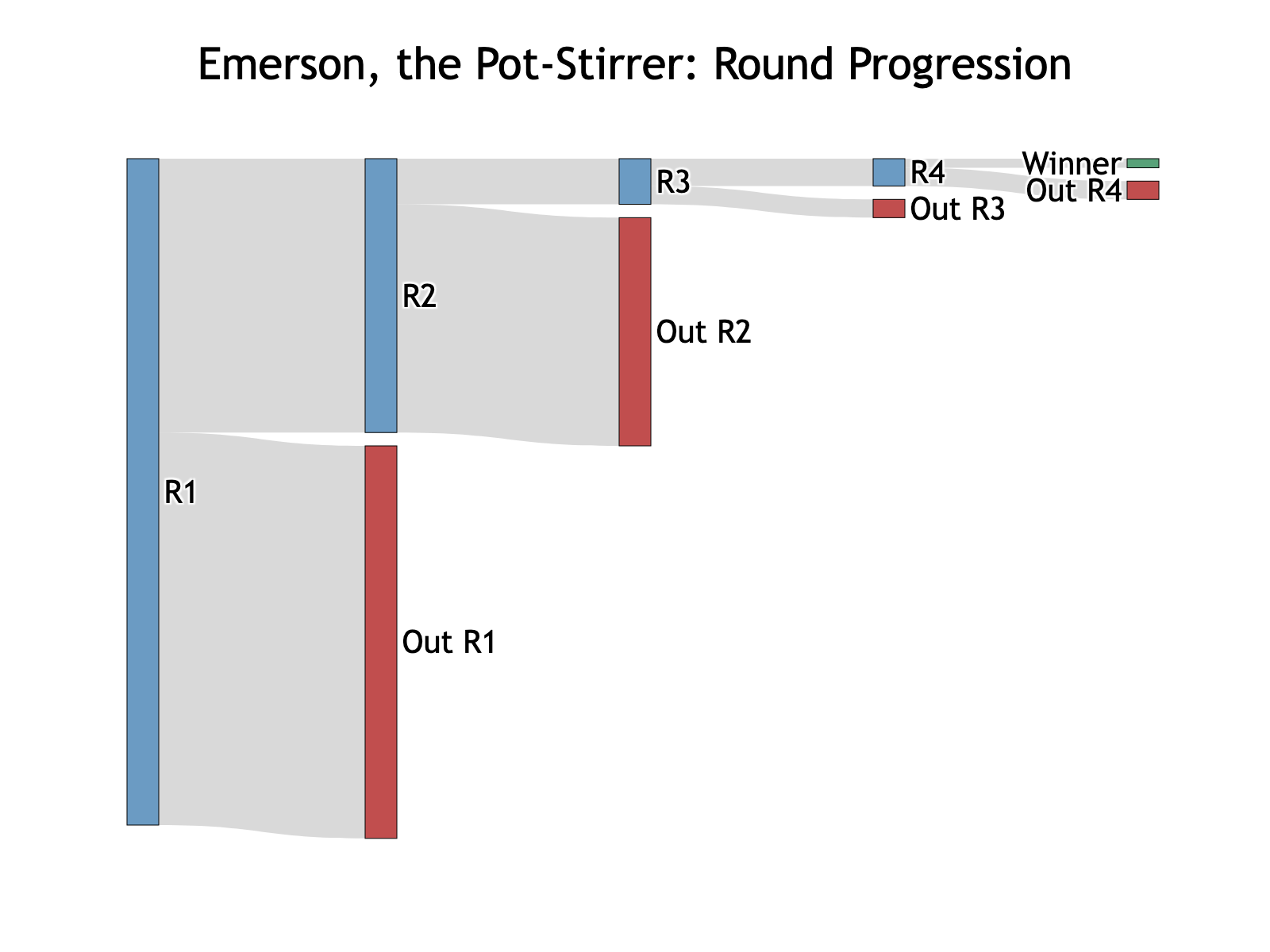
How did our brave Claudes stack up? In the figure below, I report how often each player makes it to each round. For example, all players are always present in round 1.1 Player B makes it to round 3 in 95% of games, compared to just 7% for player E. I record win proportions in the round 5 column: players B and D dominate the game, winning roughly 9 out of every 10 games. I provide some (formatted) example gameplay logs on GitHub, one for a B win and another for a D one.
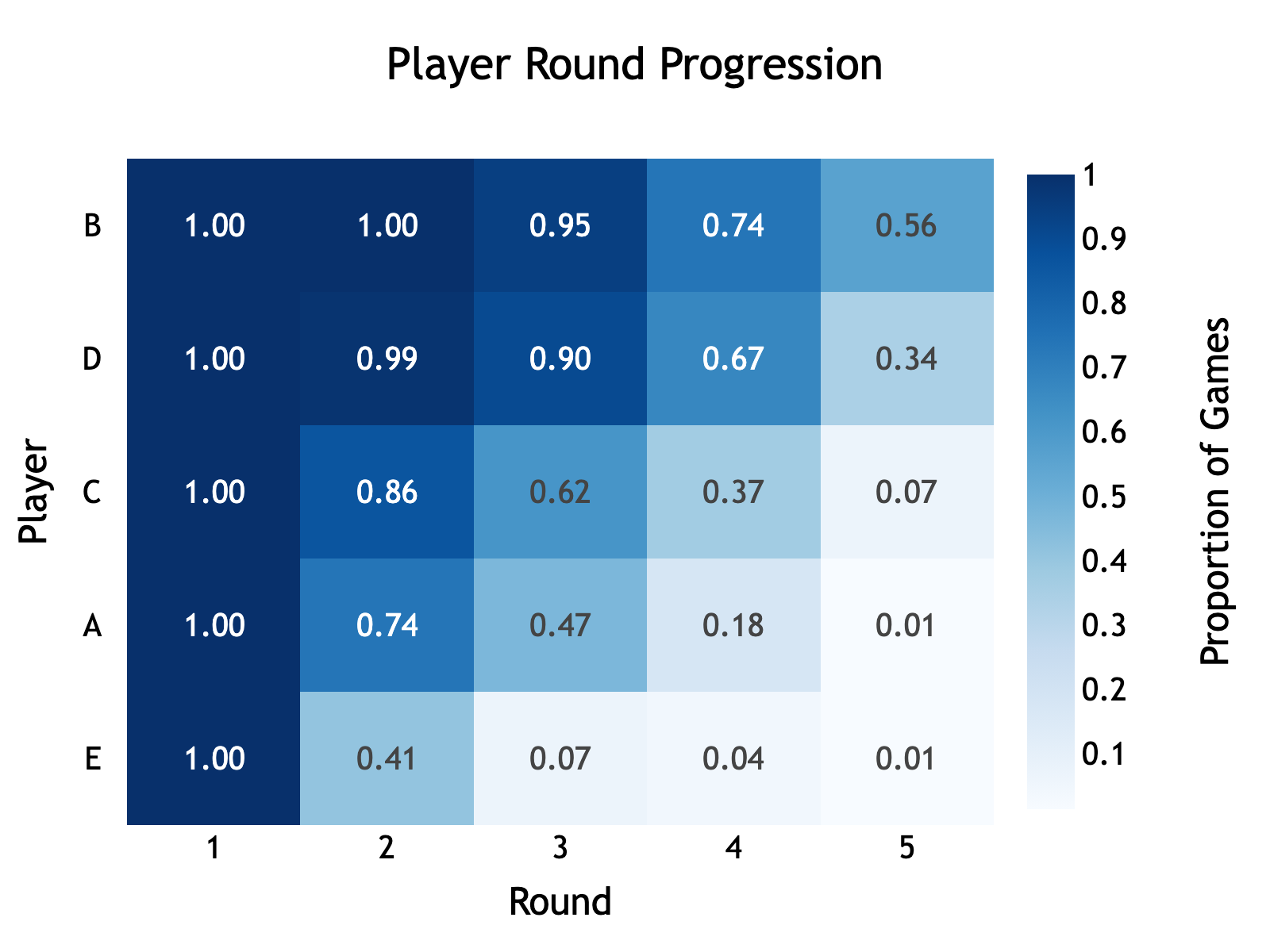
The Claudes tend to prefer Bailey (the heart) and Dakota (the diplomat), while they’re quick to shut down Emerson (the pot-stirrer). Alex (the strategist) is typically the next to go.
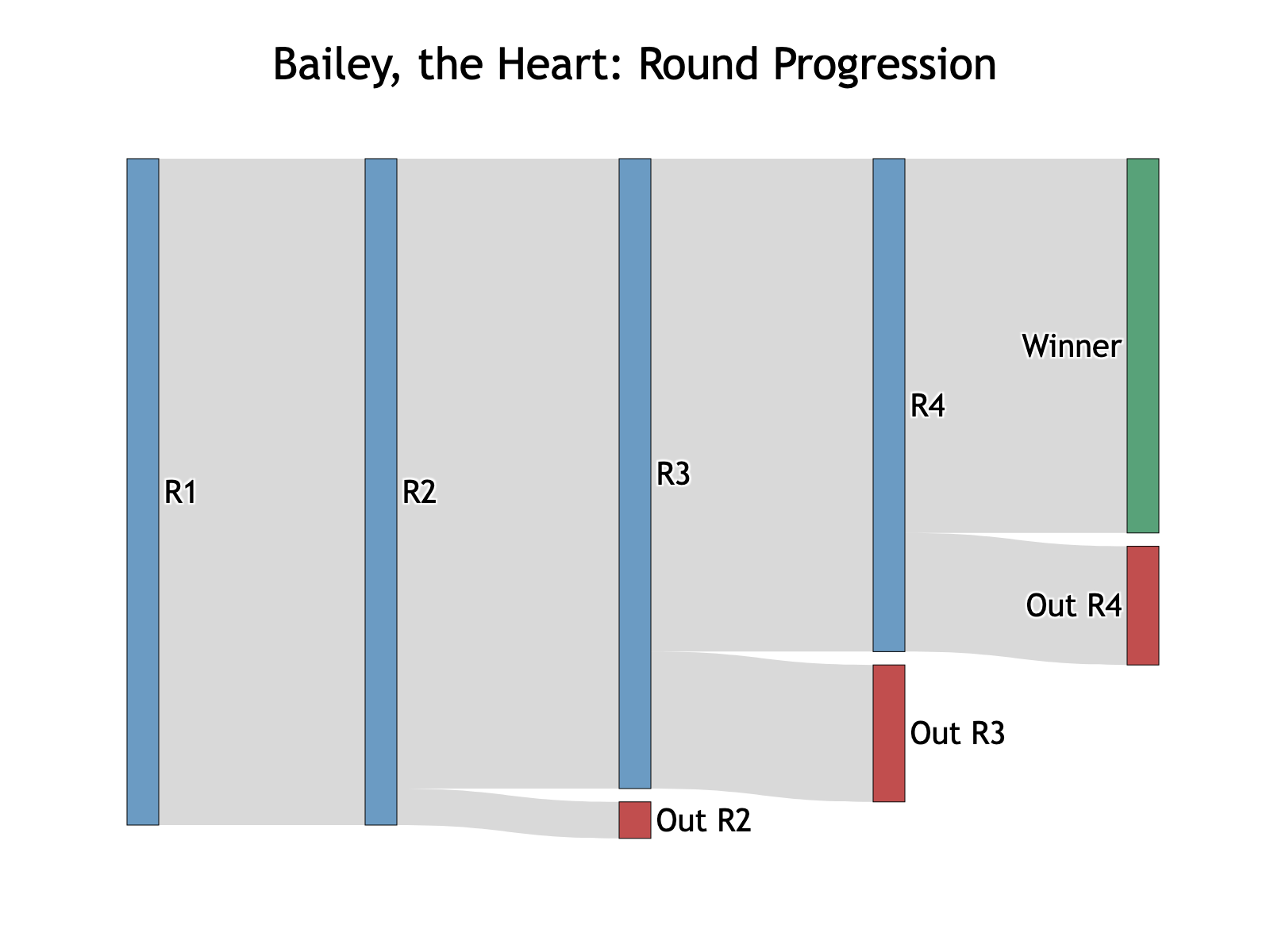
I also made Sankey diagrams! They don’t add any new information relative to the figure above, but I sure like looking at them. We can first see the dominance of player B, winning over half of the games.
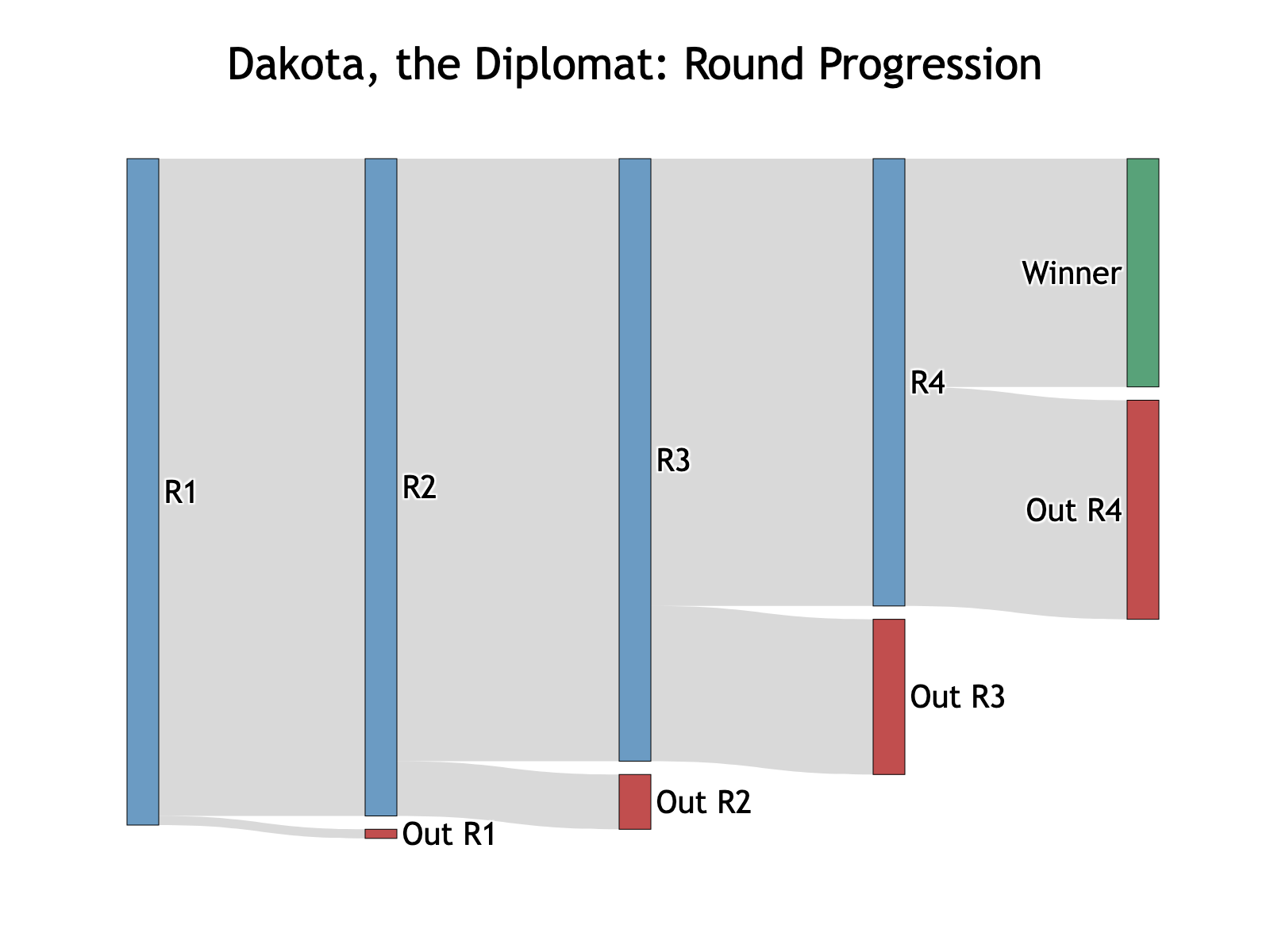
Player D is next up in terms of performance. Not bad.
And then player E brings up the rear. Ouch.
I have a couple of planned modifications to this setup:
Private, multiplayer interactions: Alliance-forming is one of the great intrigues of Survivor, and this game would be more interesting if there were space for it.
More models: I like watching a Claude vs. Claude showdown as much as the next person, but I’d like to see how other models perform and interact. Do models have tendencies to form coalitions with other instances of the same model? Or, do models have strong preferences over the models they tend to form coalitions with? Would models enquire about the identities of other players? Would a model lie about its identity? Or, I could run each instance of the game with just one model pitted against itself. Do different models yield different outcome distributions?
Context management: The game history (which is provided to the players as context) quickly balloons in size. In some ways, this could be a fun test of how models can handle large context windows, but there is a case to be made for allowing the models to summarize the game history to keep their context window manageable. Or, I could just allow for selective search of the game history. I did name the game ‘Agent Island’ (emphasis added) after all, and including some RAG-like capabilities seems to better reflect the spirit of the name.2 Notably, the players already err from time to time: giving a pitch during a confessional or submitting a vote in an improper format. I am hesitant to read into the results in this post too much in part because the variance may largely owe to these types of failures. I’m happy to share gameplay logs with someone who might want to test this.
Self-written and dynamic character prompts: I think players should be able to write their own character prompts and modify them throughout the game. Combined with (2), this allows us to see if different models prefer different starting strategies or are more or less likely to modify their approach and public persona over time.
Naturally, the critical next step is to get a compute budget. Let me know if you have any leads.
I didn’t like having an x-axis that started at 2, and I like having a strong indication of which color indicates 100%.
I don’t think it makes too much sense to call the current players ‘Agents.’ ‘Agent Island’ sounded nice, is all.
No posts
Comments
Nothing yet. Say the first thing.
Sign in to join the conversation.