

[Programme note: Apologies for the slight break — I was on holiday and then travelling a lot with work. To make it up to you, this is going to be a bit of a bumper edition.]
Last week, USTR published the findings of its first (of two) major Section 301 investigations that will form the legal foundation for Trump’s tariff agenda, post Supreme Court striking down his IEEPA tariffs.
The investigation into whether other countries’ failure to impose and/or enforce rules penalising forced labour undermines the competitiveness of US firms selling into their markets finds that … surprise[!] … it does.
As a result, the following countries will be hit with a 10% tariff on a wide range of products; everyone else covered by the investigation gets 12.5%:
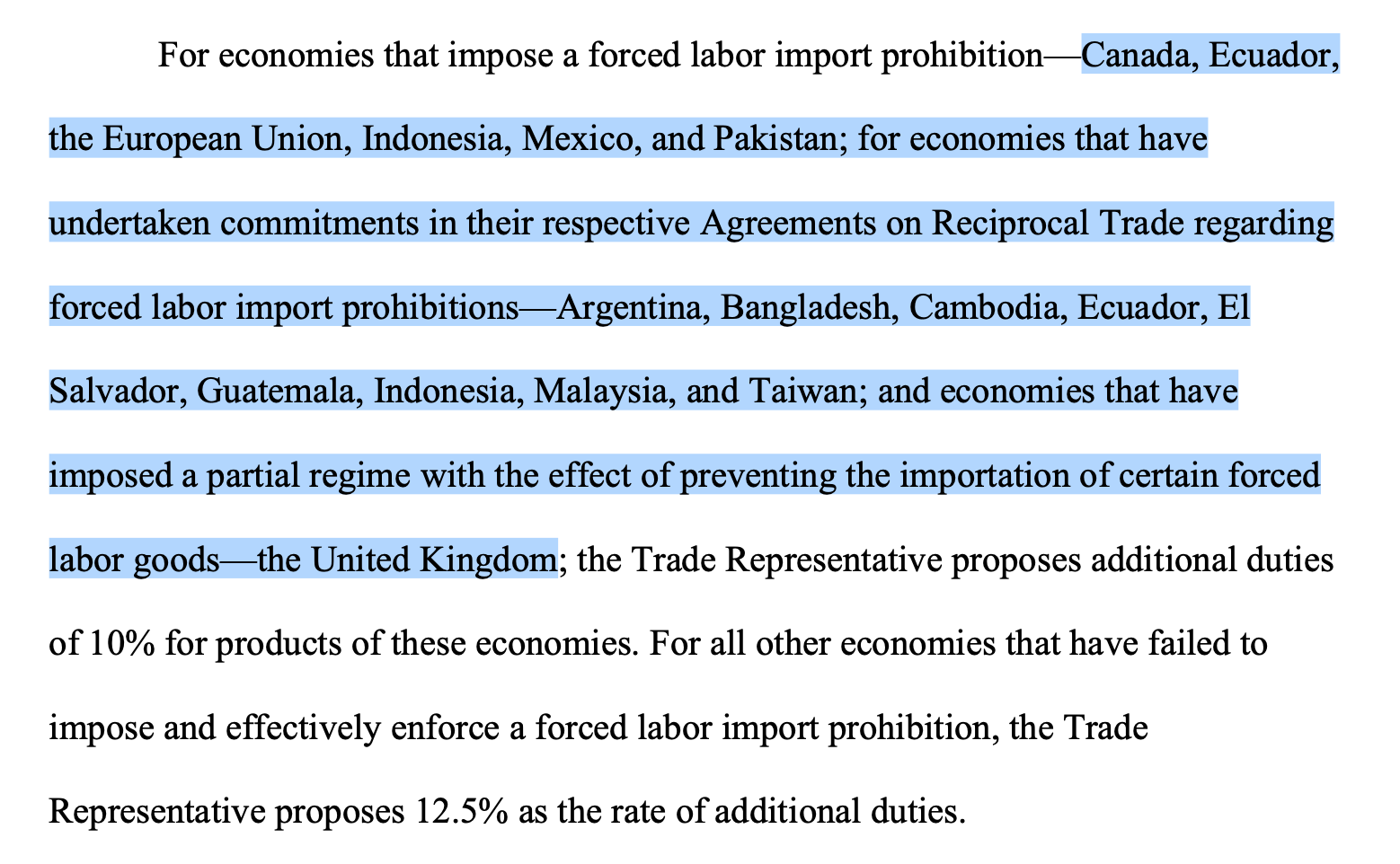
In practice, this leaves many of the countries in a similar position to where they were under IEEPA.
For example, the UK is exactly at parity — 10% plus the pre-existing MFN tariff (yes, these 301 duties stack). The EU is more or less similar, given its IEEPA 15% tariff incorporated any US MFN tariff, while the 10% is plus MFN meaning that while some tariffs do clear the 15% threshold, most fall under.
It’s slightly trickier for, e.g. Singapore, which is subject to 12.5% plus MFN, which will see tariffs clearing the previous 10% (although threatened with 15%) ceiling. However, the pre-Trump US-Singapore free trade agreement does provide exporters the opportunity to remove the MFN tariff rate and take the edge off … so it’s not at all clear cut.
The big question now is what happens with the second Section 301 investigation into “Structural Excess Capacity and Production in Manufacturing Sectors”.
While it doesn’t cover all the same countries as the first, quite a few, including the EU, Mexico and Taiwan appear on both lists. This leaves open the possibility of the applied US tariff on such countries going significantly higher.
To my mind, there are different ways this could go. The second S301 could …
find a further breach, leading to a significantly higher tariff (let’s say 10+%) being applied in addition to the forced labour S301 rate. This would leave the US in breach of many of its recent “deals”.
find cause for an additional tariff only in those instances in which it needs to adjust the tariff rate upwards slightly to bring the applied tariff level in line with that previously imposed under IEEPA. For example, for Indonesia we could see this second S301 imposing a 5.5% tariff on top of the forced labour 12.5% to get the rate back to 18%; the EU in contrast would get a rate of 0% to leave things where they are.
find cause for an additional large tariff rate (10+%) on the countries under investigation, but use slightly spurious reasons to calibrate the level down on a country-by-country basis to conveniently match whatever has been agreed previously.
If I were Trump, I would go for option 3, solely because it would create a legal basis to threaten to up the tariff on each country further if/when they upset me or don’t hold up their end of any deal (I’m looking at you EU) … but I’m not. So let’s see.
If it wasn’t for Trump, pretty much the only thing I would be working on right now is the EU’s Industrial Accelerator Act (IAA), which we’ve discussed here before.
Slightly unexpectedly, last week this led to many conversations about the EU’s non-preferential rules of origin regime.
This is because as per Article 7 of the proposed IAA legal text, the EU is going to rely on its non-preferential rules of origin to determine whether a qualifying input (either from within the EU or a trusted partner) is sufficiently European.
This has created some confusion, largely because while people and firms have often encountered preferential rules of origin in the context of free trade agreements, they tend to be less familiar with the non-preferential rules.
Anyway, if at all useful, in an EU context, the non-preferential rules assign origin either on the basis of a product being …
a) “wholly obtained” in a specific territory; or
b) the country where there the last economically justified “substantial” processing or working took place
For certain products there are specific rules, but there are lots of gaps. See the list HERE and general guidance HERE.
While I think this approach by the EU probably makes sense given firms technically have to abide by the non-pref rules regardless — the alternative is to add another 600 pages or so the regulation inserts individualised product specific rules — it does create some issues and questions.
For example:
You potentially create a situation in which manufacturing that takes place in e.g. Morocco qualifies as “European” due to the free trade agreement (FTA), but a product that doesn’t qualify for the FTA due to it not complying with the FTA’s preferential rules of origin does qualify for the IAA scheme because it complies with a weaker non-preferential rules of origin. Not a big deal really, but slightly odd.
Given the EU’s non-preferential rules of origin are unilaterally designed and are likely to change in the coming years — for example there is pressure from France and others to review them due to guard against trade defence circumvention, and the Commission has been consulting on auto non-pref rules of origin for a while — even if a company were told that a specific third country was going to qualify as a trusted partner for one of the IAA schemes, you can’t know right now what specific origin rules is going to apply.
Turkey gets pretty messy, quickly. As you all know, Turkey is in a customs union with the EU, which means goods trade tariff free (for the most part) sans need for preferential rules of origin declarations. The EU’s non-preferential rules of origin apply, but these are largely only relevant for imports subject to EU trade defence measures, such as steel (yes … the EU applies some trade defence measures to Turkey despite being in a customs union with it). The issue with the IAA is that firms have set up their Turkish production with no real thought to rules of origin, so you could end up with a scenario in which Turkey is granted access to an IAA scheme, but the exports don’t qualify under the EU non preferential rules, particularly if they get tightened per bullet two … and this all comes as a bit of a surprise.
Soumaya Keynes and Chad Bown have a new book out: “How to win a trade war: a friendly guide to an unfriendly world”. Buy it HERE.
I haven’t read it yet, but I do have a copy on my desk ready to go, so will probably write a review when I do. I may also give away a copy as a prize for something, I just haven’t worked out what that something is yet.
Suggestions welcome.
For now, here’s a photo of me and Chad from last week, looking tired.

From a the March WTO Global Trade Outlook and Statistics, here’s what world trade in goods could look like under different AI growth/energy cost assumptions:
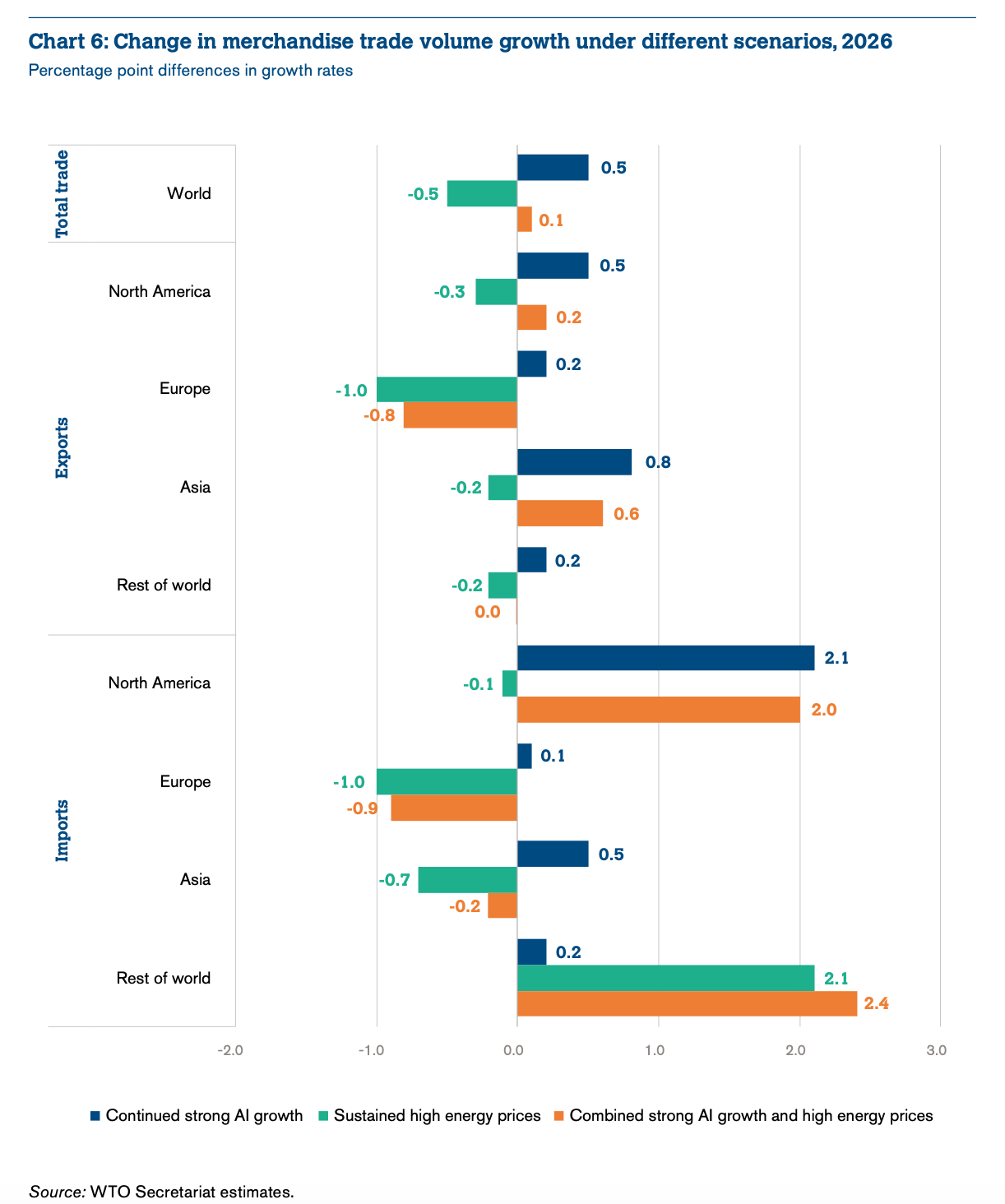
Lots of people are writing about the state of world trade, including David Henig with his “WhatsApp World Order” [Read HERE] and USTR Jamieson Greer and his “Economics for the Real Economy” [Read HERE]. I am yet to develop a grand theory of everything. Maybe one day.
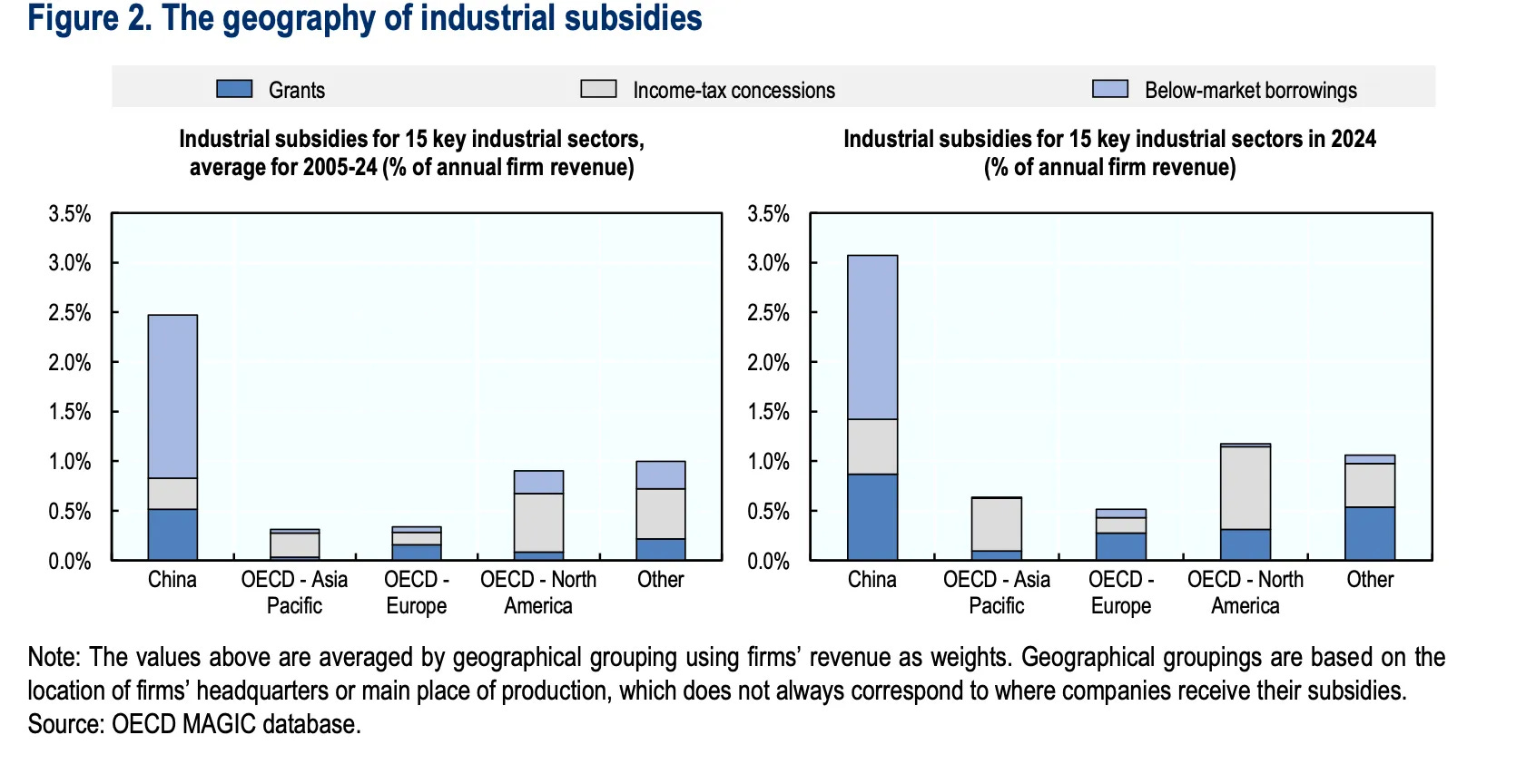
The OECD published its MAGIC Database of Industrial Subsidies [Read HERE] which included this chart which made a lot of people mad (look at the China column):
CBP has started to ramp up its FAFO approach to enforcement, with a $549.5 Million settlement reached with a company accused of dodging US tariffs. [Read HERE] More of this to come, I think … given the 3 June Executive Order titled ‘STRENGTHENING CUSTOMS ENFORCEMENT’. [Read HERE].
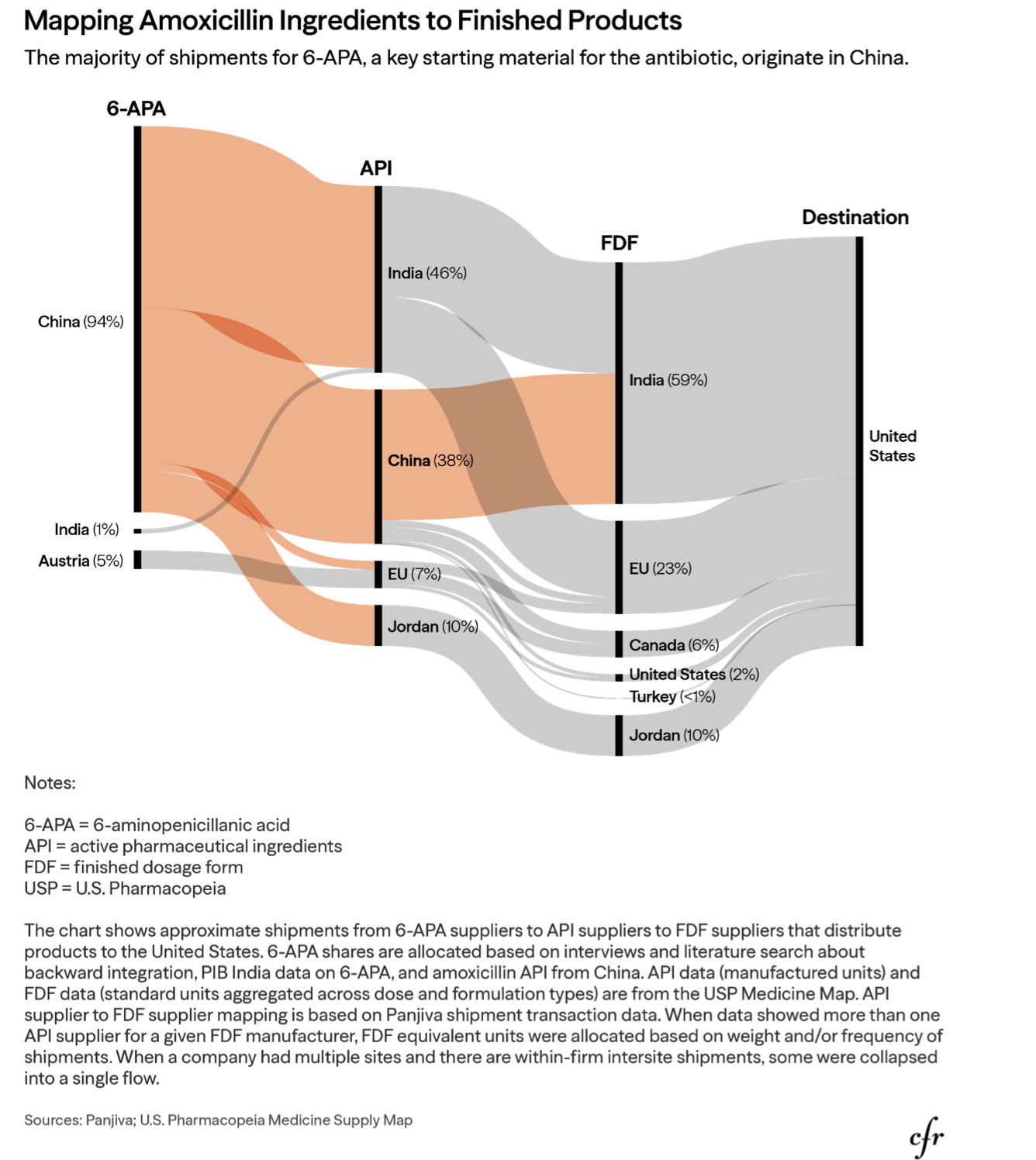
CFR has published a new paper looking at the US’s dependency on China for key medicines, and the risk of this dependency being weaponise in future, a la rare earths. It includes charts such as this, for amoxicillin (a widely prescribed antibiotic). [Read HERE].
Best,
Sam
No posts
Comments
Nothing yet. Say the first thing.
Sign in to join the conversation.