
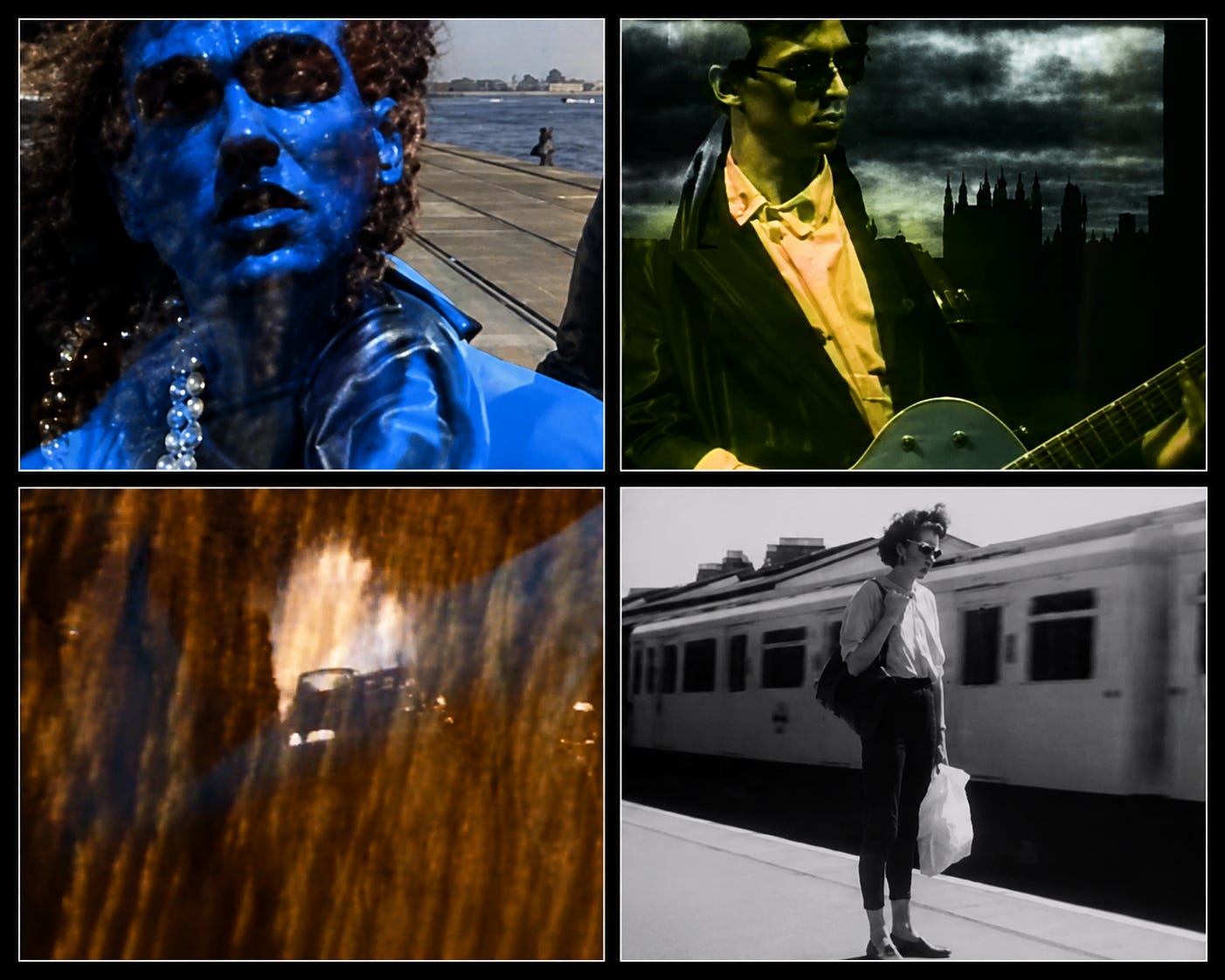
Among Smiths fans, it is no revelation that Morrissey was notoriously averse to the idea of the band participating in the making of promotional videos to market their music. Viewing the medium as shallow, he dismissed it as “pantomime” - little more than a marketing-driven distraction from the music itself. Notwithstanding this principled stance, the Smiths had appeared in two promotional films for “This Charming Man” in 1983. However, after Sire Records produced an unauthorized video for “How Soon Is Now?” the following year, his reluctance hardened. In late 1984, Morrissey told Melody Maker that the Smiths would “...never make a video as long as we lived.”1
This resistance created a clear tension for Rough Trade Records, which recognized the growing prominence of music videos as a means of promotion and exposure, yet had to find a way to expand the band’s reach without compromising its frontman’s sensibilities.
Given Morrissey’s public renunciation of the medium, it was rather surprising when the band returned to it in 1985 with a promotional film for “The Boy with the Thorn in His Side,” to coincide with the single's September release.
This reversal was born of necessity rather than enthusiasm. Eager to promote the new single in the United States, Sire Records pressed the band to produce a music video, while Rough Trade likewise viewed the medium as an opportunity to bolster the Smiths’ commercial prospects. Morrissey and Johnny Marr reportedly resisted but ultimately relented in the face of intense pressure, but only on the condition that the film crew come to the Studio where the band was working, with a case of wine in tow.
“We said, ‘Okay, if you want to film us you’ll have to come to the studio ‘cos we’re not leaving. And bring lots of red wine.’ It was horrible, so we just got drunk.”2 -Johnny Marr
The resultant music video did little to dispel the band's skepticism toward the medium. Johnny Marr later complained that it “managed to make us look like twats.”3
Fundamentally, the Smiths possessed a singular aesthetic that set them apart from nearly every other band of the era. They were unwilling to sacrifice their artistic vision for commercial gain, regarding such compromises as beneath them. Until this point, that conviction had been overlooked, ignored, or treated as an obstacle to be overcome through pressure and cajoling. What had been missing was a way to meet the band on its own terms while still navigating the commercial realities of the MTV era. As Mayo Thompson, the Smiths' label manager at Rough Trade, later recalled, “the only way we're going to pull this off is with someone they cannot refuse because of his reputation.”4 That someone was Derek Jarman, whose uncompromising artistic vision aligned so closely with the Smiths' own that the promotional music video could be reimagined not as a marketing obligation, but as a genuine artistic collaboration.
What is perhaps most remarkable is that neither Morrissey nor the other members of the Smiths collaborated with Jarman in any meaningful sense during the production of the videos. Indeed, Morrissey agreed to the arrangement only on the condition that he and the band never meet the director - a stipulation that was the lynchpin of Jarman's involvement.
“We never actually met Jarman - he did them [the music videos] privately while we were in America, which was absolutely the only way we’d agree to do it.”5 - Morrissey
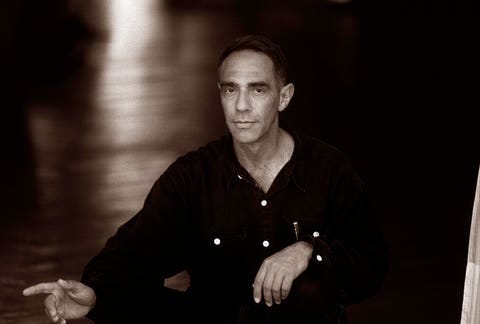
An English filmmaker, artist, stage designer, and writer, Derek Jarman was born in Northwood, Middlesex, in 1942, the son of a Royal Air Force officer from New Zealand. He studied English, history, and art history at King’s College London before attending the Slade School of Fine Art at University College London, where he spent four years beginning in 1963.
Jarman first gained recognition as a production designer, working with director Ken Russell on The Devils (1971) and Savage Messiah (1972). He soon began producing his own experimental Super 8 films before making his feature-film debut with Sebastiane (1976). He followed this with Jubilee (1978), a provocative and anarchic vision of Britain inspired by the Silver Jubilee of Queen Elizabeth II the previous year.
Throughout the following decade, Jarman established himself as one of Britain’s most original filmmakers. The Tempest (1979) reimagined Shakespeare’s play through a striking visual lens, while The Angelic Conversation (1985) explored themes of desire and identity through a series of dreamlike tableaux accompanied by Shakespeare’s sonnets. Caravaggio (1986) brought the Renaissance master’s paintings to life in richly composed cinematic images, and The Last of England (1987) and War Requiem (1989) confronted themes of war, death, and cultural decline. His final films, Edward II (1991), Wittgenstein (1993), and the poignant Blue (1993), secured his reputation as one of Britain’s most important independent filmmakers.
Jarman’s work in music promotion extended well beyond the Smiths. Jarman also directed films for artists including Marianne Faithfull, Bryan Ferry, the Pet Shop Boys, Patti Smith, and the Sex Pistols. Yet his collaborations with the Smiths remain among the most distinctive visual interpretations of popular music ever produced.
Derek Jarman died from an AIDS-related illness on 19 February 1994 at the age of fifty-two. In recognition of his extraordinary contribution to British cinema, Jarman was named a Fellow of the British Film Institute in 1990.
Derek Jarman directed four promotional films for the Smiths in 1986: “The Queen Is Dead,” “There Is a Light That Never Goes Out,” “Panic,” and “Ask.”
Jarman combined the footage from “The Queen Is Dead,” “There Is a Light That Never Goes Out,” and “Panic” into a short film also titled The Queen Is Dead, suggesting that he regarded the individual works not merely as promotional videos but as interconnected parts of a larger artistic whole. That broader vision is evident throughout the four promotional films. The Queen Is Dead captures the song’s defiant anger and anti-establishment spirit through a collage of archival imagery. There Is a Light That Never Goes Out unfolds like a surreal dream, transforming longing into visual poetry. Panic juxtaposes performance footage with evocative imagery that heightens the song’s atmosphere of anxiety and social unrest. By contrast, Ask embraces warmth, optimism, and playful romance, perfectly complementing one of the Smiths’ most buoyant singles.
The Queen Is Dead
The film begins with a speeded-up black-and-white shot of the Albert Memorial in Kensington Gardens, London, while an audio sample of “Take Me Back to Dear Old Blighty” from the 1962 film The L-Shaped Room plays in the background. The memorial’s spectral presence is emblematic of a majestic and powerful England long since past. Rather than celebrating monarchy, the image becomes a symbol of national decay, enhanced not only by the muted hue of the shot, but also by the camera speed, which shows clouds rapidly passing over the memorial: a metaphor for the passage of time. Jarman’s use of this image evokes a sense of faded nostalgia coupled with a hint of deeper cultural rot.
As the title track commences, the viewer is briefly confronted with a cluster of young children smiling innocently into the camera lens. This is quickly followed by a longer sequence featuring an androgynous young person entering a fenced-off, derelict industrial site and spray-painting THE QUEEN IS DEAD in stark block lettering across a wall. From there, the film unfolds as a kaleidoscope of black-and-white and color imagery: projected figures drift across backgrounds featuring roses, sunflowers, thistles, burning wreaths, a spinning guitar, and fleeting images of a xylophone and trumpet.
The ephemeral figures twist, spin, and bounce erratically across the screen, creating a pervasive sense of dislocation and discordance. Crowns of the royal style sweep through the frame, while negative-film-stock imagery of streets, Buckingham Palace, and dancing children flickers into view. The androgynous figure reappears throughout the film and is eventually shown, clad in a dress, wearing, tearing, and finally flinging the Union Jack to the ground in a series of fragmented, seemingly unconnected shots.
As the song enters its outro, the figure, dressed in a long-skirted gown, lowers the garment from the shoulders to reveal herself as a woman. The song’s final notes are accompanied by a distant shot of Buckingham Palace viewed from across the lake in St James’s Park. This final shot, functioning as a visual coda, speaks volumes, exuding a sense of cold remoteness and fading glory.
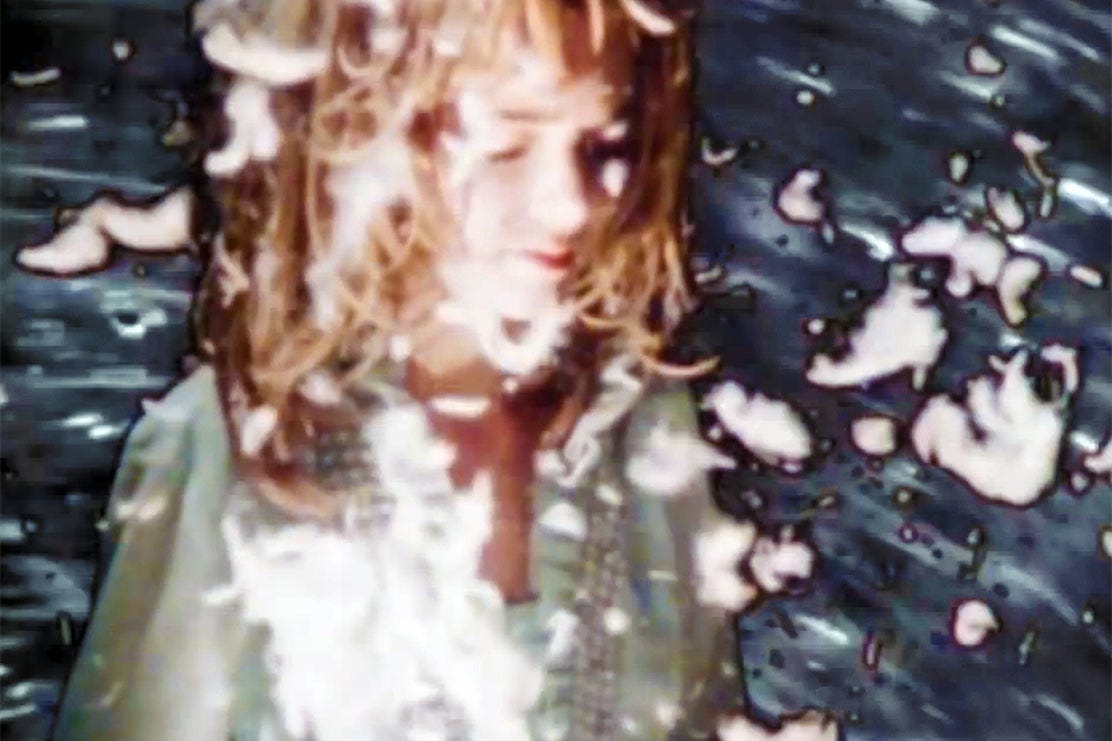
There Is A Light That Never Goes Out
The viewer is presented with ethereal images that fade in and out. A golden, shimmering screen superimposed over much of the video serves as a visual metaphor for the porous boundary between the conscious and subconscious. One initially sees a close-up of an androgynous figure lying at rest, though not quite asleep, as evidenced by occasional blinking. The image of this figure dominates much of the film, serving as a kind of gatekeeper between the realms of reality and dreams.
What follows is a rapid succession of fleeting images: a young couple embracing in a country field; brief shots from a moving vehicle passing through a busy city intersection; and then an oddly familiar residential street…perhaps Kings Road in Stretford? Grainy black and white images of a burning vehicle appear each time Morrissey sings, “Driving in your car,” sometimes accompanied by choppy footage of a fireman flitting around the flaming wreck.
Jarman’s use of imagery in “There Is a Light That Never Goes Out” is an especially adroit means of evoking a disconcerting moodiness and dreamlike experience that lingers long after the film has ended. One is initially befuddled by what one has seen, as the intellect attempts to analyze and make sense of the images. The exercise is largely self-defeating. Jarman’s use of light, camera speed, diverse imagery, washed-out colors, and snatches of black and white film, with many of the images seemingly tilting and shifting as they appear before fading away, appeals more to the soul than the mind, to the spirit rather than the flesh. Not unlike the song it accompanies, the video achieves a degree of transcendence that almost defies description.
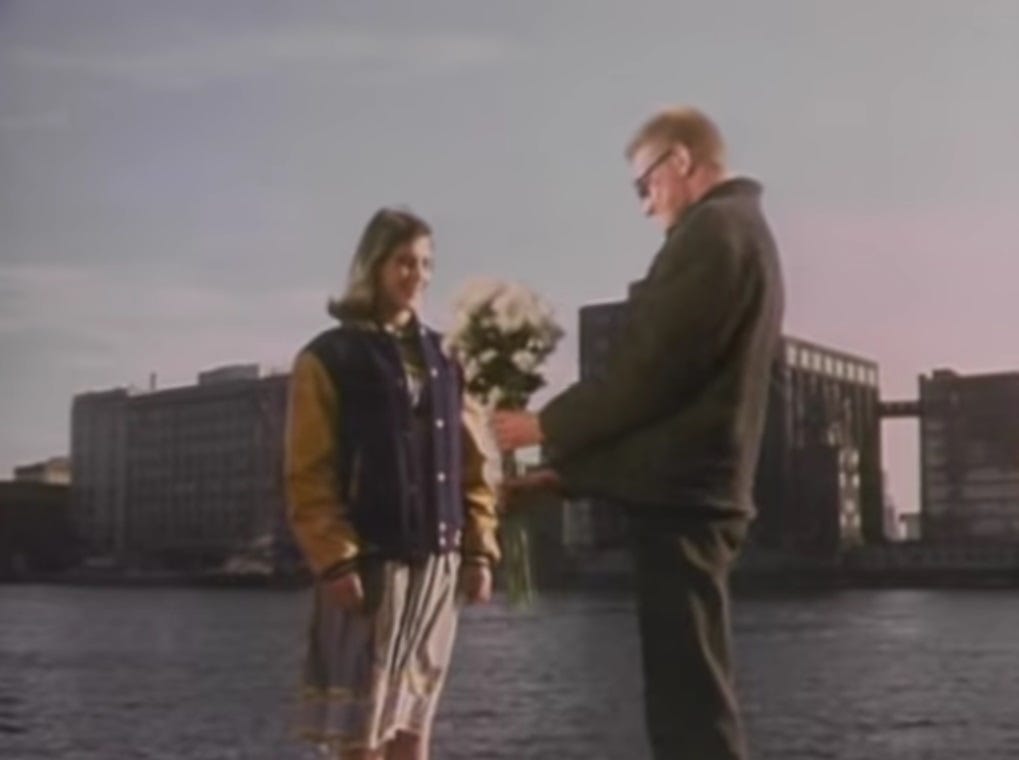
Ask
The previously mentioned alignment between Morrissey’s artistic vision and Jarman’s visual aesthetic is especially evident in the video for “Ask,” whose underlying theme is the irrepressible need for human connection amid a fractured, indifferent world gripped by turmoil. As Morrissey sings, “If it’s not love, then it’s the bomb that will bring us together,” the video centers on an intensely shy, bespectacled young man presenting a bouquet of flowers to his love interest. Around them, a cast of vividly dressed figures leaps and dances, one even waltzing with a skeleton, so that the scene oscillates between innocence and absurdity, tenderness and collapse. Youthful exuberance does not ignore the world’s instability. It persists in spite of it.
Throughout the film, fleeting, ghostlike images of the band, primarily Morrissey, surface and dissolve as though emerging from, and retreating into, the ether. Each appearance is tinted differently, yellow, blue, purple, and green, so that Morrissey becomes less a fixed presence than a shifting emotional register. The result is dreamlike and elusive, rendering the band simultaneously present and intangible. Rather than documenting a performance, Jarman creates an emotional landscape that lingers in the viewer’s imagination long after the final frame.
Panic
The promotional film for "Panic" contrasts dissolving black and white imagery with the band, each member, including unofficial "Fifth Smith" Craig Gannon, bathed in vivid, saturated hues as they perform the song. Rather than illustrating Morrissey's lyrics literally, Jarman interweaves fleeting glimpses of graffitied walls and urban streetscapes with recurring images of a solitary young man and a hand that repeatedly enters the frame ahead of the moving camera, creating the impression that the viewer is being led through the city's fractured landscape. The contrast is deliberate. While "Panic" is one of the Smiths' most urgent and confrontational recordings, Jarman's imagery often conveys a quiet humanity, subtly suggesting that the song's anger is directed not at people themselves but at the cultural decay and mediocrity encroaching upon the world they inhabit. As with much of Jarman's work, the imagery functions as visual counterpoint rather than accompaniment, becoming an independent artistic statement that deepens the song's emotional resonance instead of merely illustrating its lyrics.
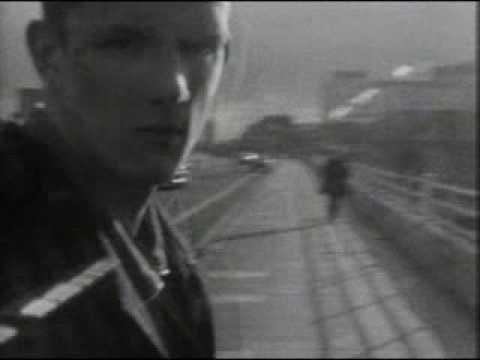
More than twenty years after the Smiths disbanded, and nearly fifteen years after Derek Jarman’s death, a previously unseen promotional film for “I Won’t Share You” surfaced online in late 2008. The film is a re-edited version of Jarman’s six-minute contribution to the 1987 anthology film Aria, in which he and nine other directors created visual interpretations of operatic works. Most accounts suggest that Jarman repurposed the footage in the early 1990s for a multimedia exhibition organized by Rough Trade to benefit the Terrence Higgins Trust.6 When Rough Trade entered liquidation,7 however, the exhibition was cancelled, and Jarman’s completed film was apparently shelved.
Jarman’s original Aria segment depicts an elderly opera singer giving her final performance, intercut with grainy 8 mm home movies of her youthful love affair, portrayed by Tilda Swinton8 as the singer’s younger self. It is believed that, had he completed the final edit, Jarman would have incorporated performance footage of the Smiths, much as he had in “Ask” and “Panic.”
Though unfinished, “I Won’t Share You” remains an evocative work of art. Produced during the waning years of MTV’s cultural dominance, when promotional videos remained largely disposable marketing tools, Jarman’s film once again demonstrates his remarkable ability to transcend the conventions of the medium. Rather than serving merely as visual accompaniment, it deepens the song’s quiet emotional resonance, providing a fitting epilogue to one of popular music’s most unlikely artistic collaborations. Though brief, the partnership between Derek Jarman and the Smiths demonstrated that the promotional music video could aspire to genuine art. In Jarman’s hands, even a film created to market a single became something timeless.
Watch Jarman’s film for “I Won’t Share You” here:
Derek Jarman’s fascination with outsider identity, Englishness, memory, and the decay of national mythology closely paralleled many of Morrissey’s own lyrical preoccupations. That connection helps explain why his films feel so inseparable from the Smiths’ artistic identity. Though they worked in different media, each treated marginality, emotional isolation, and cultural displacement not simply as suffering, but as a vantage point from which to see through the illusions of mainstream culture.
To describe Jarman's work for the Smiths as merely avant-garde does it a disservice. Rather than simply illustrating the songs, he interpreted them, creating films whose imagery became inseparable from the music itself. Like two vocal harmonies creating the illusion of a third voice, the union of Jarman's imagery and the Smiths' music produced something greater than either could have achieved alone. Nearly four decades later, those films remain the most enduring visual expression of the Smiths' music.
Ian Pye, “A Hard Day’s Misery,” Melody Maker, 3 November 1984
Simon Goddard, The Smiths: Songs That Saved Your Life (Richmond, Surrey: Reynolds & Hearn, 2004), 152.
Johnny Rogan, The Smiths: The Visual Documentary (London: Omnibus Press, 1994), 122.
Tony Fletcher, A Light That Never Goes Out (New York: Three Rivers Press, 2012), p. 522.
Morrissey, interview in Melody Maker, 26 September 1987.
Terrence Higgins Trust is a British charity that campaigns about and provides services relating to HIV and sexual health.
Rough Trade entered receivership in 1991 after rapid expansion of its distribution network, cash-flow difficulties, and increased competition from the major labels, bringing the original Rough Trade Records company to an end and disrupting many independent labels that depended on its distribution network.
Katherine Matilda "Tilda" Swinton (born 5 November 1960) is a Scottish actress renowned for her versatile and often unconventional performances in independent and mainstream film.
No posts
Comments
Nothing yet. Say the first thing.
Sign in to join the conversation.