
Written during the summer of 1984, when Morrissey suggested to Johnny Marr that they should "do a song about the fair," "Rusholme Ruffians" first took shape at Jam Studios in London that July, where the Smiths recorded an early version of the song with producer John Porter. This initial attempt at the song ran for nearly seven minutes. The track emerged from a remarkably productive series of sessions that also yielded the songs later released on the William, It Was Really Nothing single ("How Soon Is Now?" and "Please, Please, Please, Let Me Get What I Want"), together with "This Night Has Opened My Eyes" and an early version of "Nowhere Fast." For a brief time, "Nowhere Fast" was earmarked as the band's next single, with "Rusholme Ruffians" and "This Night Has Opened My Eyes" slated as its B-sides before those plans were quietly abandoned.1
This initial recording, since dubbed the ‘Electric Version’, was leaked in late 2010, taken from a record company CD-R created for a reissue project that was ultimately shelved. It subsequently appeared on the bootleg rarities LP The Smiths.2 Listen to the track in the following link:
0:00
-6:42
Another version of the song was recorded on 1 August 1984 for the band's third session on John Peel's BBC Radio 1 program. Produced once again by Porter, it was broadcast on 9 August.
Listen to the Peel Session version here:
0:00
-4:05
The definitive version of “Rusholme Ruffians” followed something of a peripatetic journey to completion. Recording began in October 1984 at Amazon Studios in Liverpool, with the Smiths - principally Johnny Marr - serving as producers and Stephen Street in the role of recording engineer. Overdubs were added the following month at Ridge Farm Studios in Surrey before the final mix was completed in December 1984 at Island Records’ Fallout Shelter studio in London.
For added atmosphere, the song’s intro was dubbed with a pastiche of fairground noises taken from a BBC sound effects LP. In the final seconds of the track, after the music comes to an abrupt halt, the unmistakable sound of a cash register is heard. It is an apt coda to a song in which money, as well as “brass” - Northern slang for money - figures prominently in the lyrics:
a boy is stabbed
and his money is grabbed
an engagement ring
doesn’t mean a thing
to a mind consumed by brass
The definitive album version of “Rusholme Ruffians” is contained in the following link:
0:00
-4:20
The song's title derives from Rusholme, a working-class district of Greater Manchester located approximately two miles south of the city centre.3 During the late nineteenth and early twentieth centuries, the area expanded rapidly as rows of modest terraced houses and later large council estates were built to accommodate Manchester's growing industrial workforce. Although Morrissey was raised in nearby Stretford, Rusholme's reputation as a distinctly working-class neighborhood, and the site of the annual fair that inspired the song, made it a fitting choice for the title.
During an appearance on The Old Grey Whistle Test (BBC Two), recorded in December 1984 and broadcast on 12 February 1985, a mildly animated Morrissey told presenter Mark Ellen:
“There’s a song called ‘Rusholme Ruffians’ is about going to a fair and being stabbed. Fun fairs in Manchester are very violent things. These things where communities get together for fun and frolics, etcetera, and someone always ends up being stabbed, which adds to the excitement.”
Although his matter-of-fact description of stabbings at local fairs may strike the listener as more than a little flippant, it is perhaps better understood in the context of his formative years in working-class Manchester during the 1960s and 1970s, where street violence, petty crime, and public disorder were familiar features of urban life. Long before the organized gang culture that would later define parts of south Manchester, local fairs themselves had acquired a reputation as places where drunkenness, theft, and violence often accompanied the festivities.
Yet for Morrissey, the annual fair was also one of childhood’s defining rituals. Looking back years later, he reflected, “As a child I was literally educated at fairgrounds... It was the big event. It was why everybody was alive. On threadbare Manchester council estates once a year fairs would come around. It was a period of tremendous violence, hate, distress, high romance and all the truly vital things of life.”4 The fair was more than an amusement; it was a concentrated expression of working-class life, where exhilaration and danger, romance and brutality, all unfolded within a single evening.
Recalling the Rusholme fair in particular, Morrissey explained, “In Rusholme, it was the only thing people had... It was the only pleasurable distraction and they turned it into a total horror. You couldn’t keep me away from them! I quite liked the idea of seeing people living on the emotional edge. Fascinating.”5
That observation goes to the heart of “Rusholme Ruffians.” Rather than simply recounting a violent night at the fair, the song captures the peculiar allure of a place where ordinary people briefly escaped the routines of everyday life, only to find themselves, in Morrissey's words, "living on the emotional edge" - a world where excitement and violence, romance and despair, exhilaration and disappointment existed side by side.
Musically, "Rusholme Ruffians" is propelled by a distinctly rockabilly-inspired rhythm that immediately distinguishes it from much of the Smiths' catalogue. Johnny Marr has explained that the song's distinctive sound grew out of his affection for Elvis Presley's 1961 hit "(Marie's the Name) His Latest Flame."6 Like many great songwriters, Marr treated an earlier work not as something to imitate, but as a creative springboard, transforming its rhythmic impulse into something entirely his own. According to Marr, his parents frequently played Elvis's recording when he was a child, and he became fascinated by its chord changes.
As Marr later recalled:
“That was blatantly done [copying the chord changes]. Morrissey said to me, ‘Let’s do a song about the fair,’ and for some reason my association with the fair was to pull out that Elvis riff. We tried, but we couldn’t get away from it.”7
Listen to Elvis’s recording here to hear the remarkable similarity between the two songs:

In the remainder of this essay, I explore:
How Victoria Wood’s Fourteen Again supplied many of the lyrical building blocks for “Rusholme Ruffians” and why Morrissey’s borrowings were far more transformative than imitative.
Why the song is much more than a colorful account of a Manchester fair, becoming instead a meditation on violence, spectacle, romance, and the comedy of everyday life.
The overlooked literary and philosophical influences that illuminate the song, from Victoria Wood to the Roman poet Lucretius.
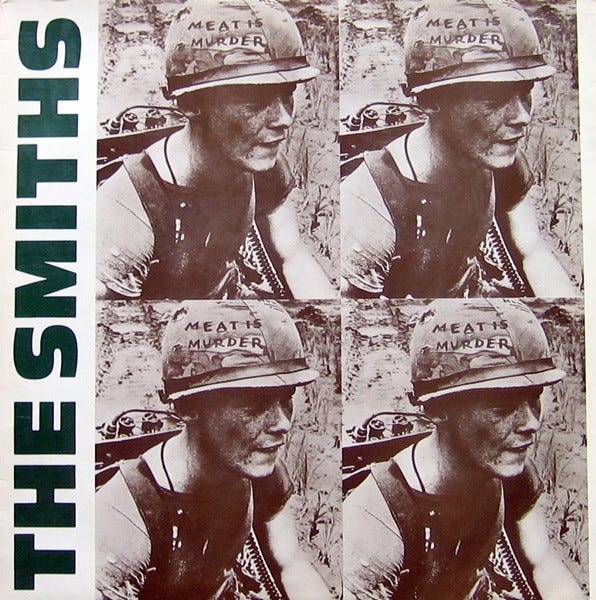
What the Meat Is Murder runout inscription “ILLNESS AS ART” reveals about Morrissey’s ability to transform the harsh realities of working-class life into enduring art.
Why “Rusholme Ruffians” stands as one of the Smiths’ finest examples of artistic alchemy, seamlessly weaving borrowed musical and lyrical influences into something wholly original.
Whether you’ve loved this song for decades or have only recently discovered its dark wit and irresistible energy, its story reaches far beyond the fairground rides and flashing lights.
Subscribe to read the full essay.
Comments
Nothing yet. Say the first thing.
Sign in to join the conversation.