
As much as I would like it to be the case, very few people vote directly on foreign policy. I’m confident that Gaza was a big factor in Kamala Harris’s 2024 presidential election loss, but it was nowhere near as big a factor as Biden’s (barely) hidden decrepitude or the inflation generated by his pursuit of the Ukraine war. I really care about foreign policy, US voters generally don’t.
So it’s been a pleasant, if mystifying, surprise to find foreign policy at the center of many of the country’s most important recent elections. The way it’s often portrayed in the media is that Left wing candidates are centering crazy foreign policy positions, when in truth their foreign policy positions are the least radical thing about them. It’s the “Centrist” establishment that is forcing radical foreign policy ideas down the public’s throat and getting repeatedly rejected for it.
This week’s podcast is a Question & Answer episode. We typically do one every 50 episodes or so, and we’re almost at episode 200, so the timing seemed right. I also spent last week on vacation in Northern Michigan, so wasn’t able to prep a more in depth episode. At the beginning of the episode, Ruairi and I discuss Abdul El-Sayed’s stunning victory in the Democratic primary for one of Michigan’s two seats in the US Senate on August 4th. You can listen to the episode here, or you can read on for more thoughts on that fascinating election.
Mayor Mamdani’s victories in New York City last year were easy to dismiss as a leftist outlier in a unique urban setting. The June 23rd romp of Mamdani supported congressional candidates through some of the poorest, but also some of the richest districts in New York City was harder to ignore, but could be dismissed along the same lines.
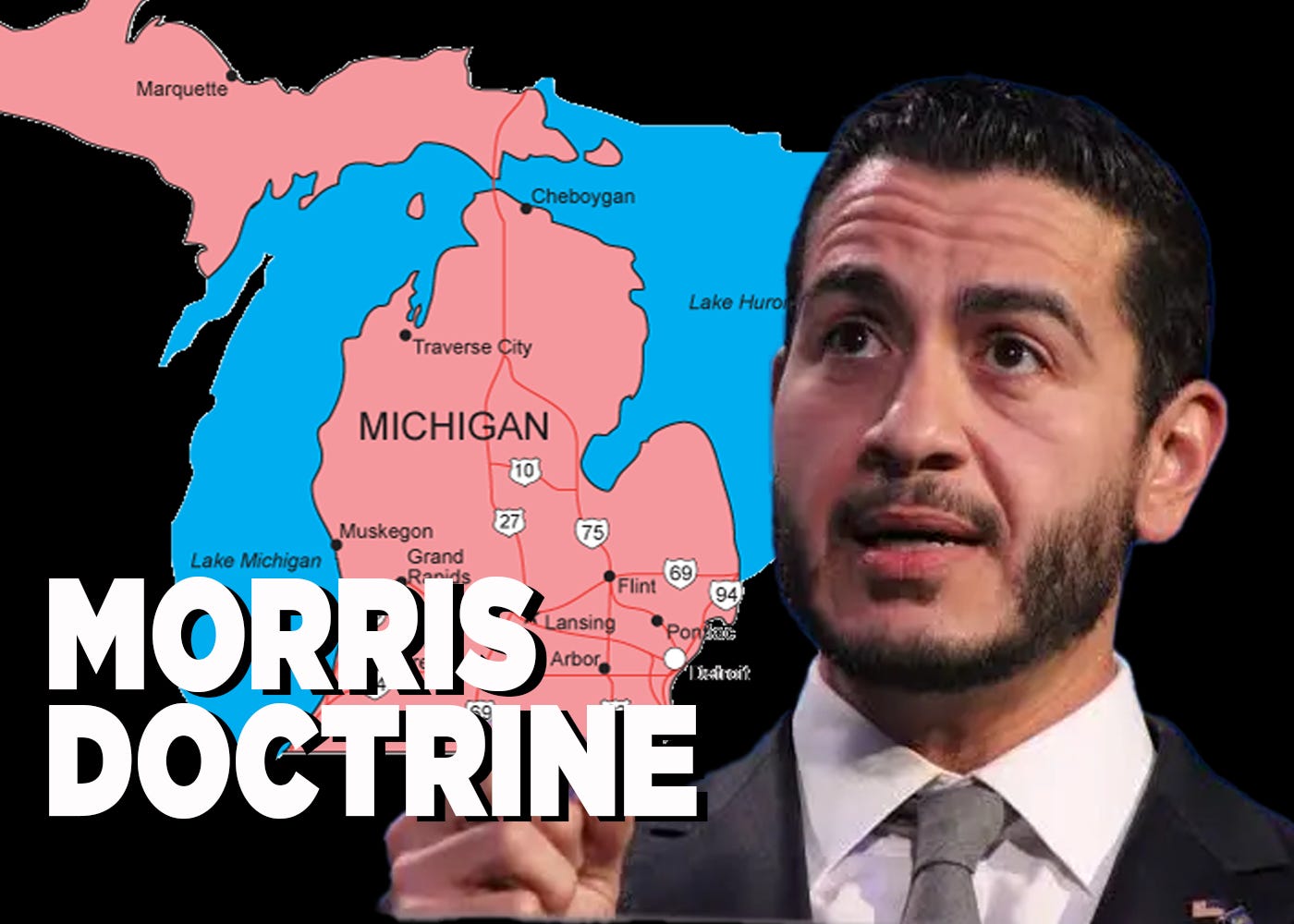
The victory of Abdul El-Sayed in Michigan, not in an urban district, but in a state wide election to the US Senate, is impossible to dismiss. Some bad polls, which put El-Sayed massively ahead in the closing days of the race, allowed bitter centrists to write some pretty absurd headlines, suggesting his victory didn’t matter because he only won by 1%.
That’s ridiculous. El-Sayed overcame the opposition Democratic establishment figures like Michigan’s governor Gretchen Whitmer, Senate minority leader Chuck Schumer, and many others who endorsed his opponent Haley Stevens. He defeated an 11 to 1 PAC funding disadvantage, as this primary became the latest most expensive primary in history thanks to AIPAC and its fellow travelers.
The Michigan voters don’t care much about foreign policy. But the Democratic party leadership did. If Washington, DC wasn’t so married to a radical, violent policy of supporting Israel, it’s very unlikely that El-Sayed would have won this victory.
Election analyst Ettingermentum summed up this dynamic very well in a recent piece.
The story is as simple as it has always been: mainstream Democrats simply lack the critical thinking necessary to understand that the impact of Israel as an issue cannot simply be measured by how many people say that the Israeli-Palestinian conflict is their #1 issue in a poll. While they interpret such results as proof that their voters don’t care about the issue either way and that they are thus free to take whatever boutique position they want on it, the exact opposite is the case. It is precisely because Americans do not hold a deep personal interest in the conflict—that they don’t “see Israel in their dreams,” as one might say—that the centrist position on the issue has become incredibly toxic. Voters now correctly take the faction’s insistence on intensive American support for the country as a case of misplaced priorities at best and outright corruption at worst, and it drives them directly to left wing candidates..
My only quibble with Ettingermentum is that I think he’s being too polite here. The passion for covering up Israel’s mass murder, and the expectation that everybody celebrate US troops committing murder FOR Israel is a disgusting form of death worship, and the US voting public is finally getting sick of it.
Abdul El-Sayed spent most of the past year as the third place Democrat in the race for the Michigan Senate. What drove him to the top was yet another centrist miscalculation around Israel. In March, Mallory McMorrow, the more exciting of the less progressive candidates running for the seat, tried to delegitimize El-Sayed for campaigning with Hasan Piker, a left-wing online personality, who is vocally opposed to Israel’s genocide.
Much like Andrew Cuomo’s attempt to make the New York City mayoral race about Israel, McMorrow’s gambit failed miserably. Very few Michigan voters were thinking about Israel. By centering the Democratic Establishment’s radical pro-Israel views, and her willingness to defend the Gaza genocide, McMorrow effectively drove herself out of the race. She also drove a flood of donations for Abdul El-Sayed, from Michigan and out-of-state donors like myself, who are sick of US support for Israel.1
El-Sayed’s jump forward led to a tidal wave of pro-Israel money for Haley Stevens, his remaining opponent. This allowed her to blanket the airwaves, which may have helped. On June 13th, I was in a Michigan bar watching the Knicks win the NBA Championship. I was only in the bar for 15 minutes, but every advertising break featured at least one Haley Stevens ad. The flood of pro-Israel money may have helped her, but it also made her look like a stooge of Washington, DC interests, which may have cost her the race.
By putting Israel at the center of the race, the Democratic Leadership ended up with a much more left-wing nominee than they wanted in Michigan. El-Sayed is not a member of the Democratic Socialists of America. He’s nowhere near as left wing as Mamdani or the other New York Democrats. But he’s among the most left-wing Senate nominees in the Midwest in a generation. He’s a big booster of Medicare for All.
Much of the Democratic establishment seems to have learned their lesson this week. His two opponents, Stevens and McMorrow, have warmly endorsed El-Sayed, as has Governor Whitmer, and even Chuck Schumer. El-Sayed may have a harder fight against Republican Mike Rogers in November than one of the centrists would have had. I’m not sure that’s true, but it’s possible. If the Democratic establishment wants to avoid a similar situation in the future, they need to ditch their weird obsession with helping Israel murder Arabs.
Many Establishment Democrats may be waking up to this. Some emphatically are not. The most prominent dissenter this week has been Michael La Rosa, a former Jill Biden Spokesperson, who has endorsed Republican Mike Rogers against Abdul El-Sayed. It’s a rather odd position for a Democrat to take.
Ryan Grim of Drop Site News shed some light on La Rosa’s positioning here. He’s another centrist prioritizing foreign genocide over everything. And it’s not even an Israeli genocide this time.

Ryan Grim@ryangrim
In March, @MichaelLaRosaDC’s firm was hired to represent a Libyan warlord. He spent the next several months lecturing progressives about their morality.


Matt Duss @mattduss
https://t.co/LvtAXkHMgk
12:10 AM · Aug 9, 2026 · 65.3K Views
12 Replies · 119 Reposts · 635 Likes
Doing PR for Hifter in Libya means doing PR for the United Arab Emirates. La Rosa doesn’t just have Gaza’s blood on his hands, he also has Sudan’s. If Republican Mike Rogers wants to beat Abdul El-Sayed in November, he might want to try distancing himself from the supporters of blood-soaked Middle Eastern US client states. It’s proving to be a successful strategy.
You can listen to our 200th episode Q&A on Spotify, or on YouTube below…
Full disclosure: I did not donate to El-Sayed. I may do so in the future. I have definitely donated to pro-Palestinian candidates in this congressional cycle and I intend to do so again. I ended up not donating to El-Sayed in the primary because the polls were so good, and I didn’t think he needed the money!
No posts
Comments
Nothing yet. Say the first thing.
Sign in to join the conversation.