
So do we have a Saudi Nuclear Deal or not?
This past Wednesday July 22nd, all of Washington, DC was shocked to hear that the Trump administration had signed a terrifyingly generous deal to develop Saudi Arabia’s nuclear industry. Sane people were bothered because it’s a terrible deal, as we’ll cover below. But even Trump’s most war-hungry supporters in the weapons industry and Israel lobbies were shocked.
Ever since Joe Biden proposed this awful deal, years ago, the arrangement was supposed to be that Saudi Arabia would normalize relations with Israel as the price. Since the intensification of Israel’s Genocide in Gaza in 2023, Saudi Arabia has consistently held that normalization is off the table. On Wednesday, Trump’s people signed the deal, in return for nothing, shocking everyone.
The oddly unified opposition to the deal got Trump to reverse course by Thursday morning.
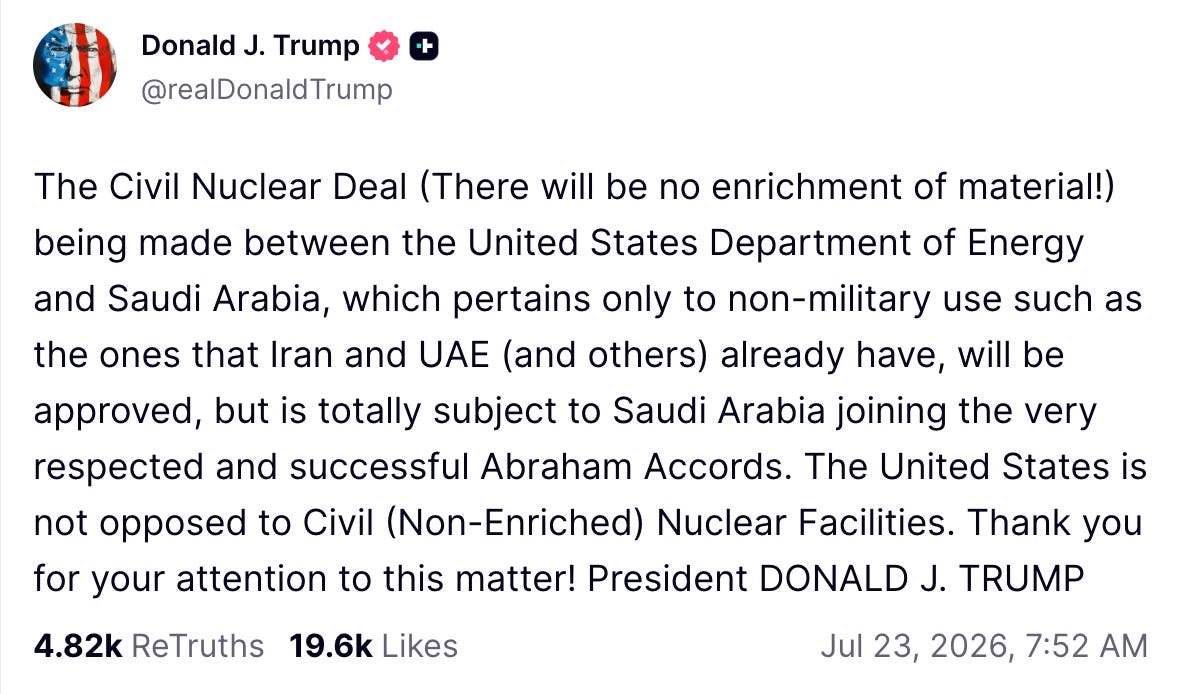
In a typical Trumpian feat of deal-making, he decided to add a condition to the deal he had already signed. By supposedly making the deal subject to Saudi accession to the Abraham Accords, Trump is attempting to force Saudi-Israeli normalization. Saudi Arabia has made it very clear that it will not accept this without some Israeli moves towards a Palestinian state. It’s conceivable that those Israeli moves could be cosmetic, but the current state of Israeli politics means not even meaningless moves towards peace with Palestine are possible.
So do we have a Saudi Nuclear Deal or not?
I think it’s more likely than not.
The US and Saudi governments now have a written and signed deal. Trump tried to revise it with a tweet. Maybe this is one of those Trump tweets that sticks and gets turned into policy by Chris Wright at the Department of Energy or Marco Rubio at the State Department.
Or maybe Trump’s tweet gets forgotten and the policy moves forward. In Trump’s America, the worse thing usually happens. So we’ve probably got a deal.
Richard Fontaine’s obituary of South Carolina Senator Lindsey Graham in the Atlantic is way too kind. But one paragraph in particular has been making the rounds, with good reason.
“When I was first elected to the House,” he recalled, “I looked for the they. They who run things. They who know how things really work. They who know what they are doing. But I couldn’t find the they.” After that, he went on, “I went to the Senate. But there was still no they. And then I started to get invited to the White House, and to closed-door briefings, and to meetings with top officials. No they.” “What I finally realized,” he concluded, “is that there is no they. There is only we, and we usually don’t know what the fuck we’re doing.”
There truly are no adults in charge in Washington, DC. The crises of the Great Depression and World War II might have made some adults, but those folks died out in the 1990s. Lindsey Graham was a more than a little bit ridiculous Senator from a not very powerful state. But his corrupt war-hawkery had outsized influence, mostly because he showed up and had strong and consistent views.
Graham’s insight sheds direct and indirect light on the travesty that is the Saudi-US nuclear deal. In the closing weeks of his life, the always receding prospect of Saudi-Israeli normalization was one of Graham’s main priorities. He had helped keep the Saudi Nuclear Deal on the agenda throughout the Biden and Trump presidencies. But he was also adamant that it only be signed in return for a Saudi commitment to get further in bed with Israel. Some reporting has suggested that it was Graham’s death that allowed Trump to move forward with the deal, without any Saudi commitments to the Israelis.
The Graham quote also sheds light on why the Saudi deal exists in the first place. It’s a really, really bad idea. But it’s an idea. The Saudi Nuclear Deal is a policy option that appeals to a number of constituencies, and could conceivably happen, with or without the Israeli component. In the leaderless, senseless US foreign policy environment Graham describes, policy ideas that can make connected people rich tend to survive.
Folks have recently pointed out that my anger at Saudi Arabia over 9-11 is a bit ugly and irrational. Saudi Arabia was obviously the country most responsible for the attack, but the folks who carried out that 25 years past atrocity are mostly dead. MBS’s rise to power both crushed Wahhabism ( or at least its export) and cleared out a lot of the middle ranks of Saudi power that plausibly bear responsibility for attacking the US in 2001. I’m still wrestling with it, but I’m open to the idea that my outrage at the idea of bringing nuclear tech to “the 9-11 people” is a bit irrational and unfair.
The problem is the deal itself. I believe that the US should be helping the world, even the un-democratic world, build out peaceful nuclear technology. It’s been a policy priority for the United States since President Dwight Eisenhower in the 1950s, and it’s the right thing to do for the environment. It’s obviously in the US interest to secure these development deals for our nuclear industry, rather than France, Russia or China’s.
In 2009 the US signed a nuclear development deal with the United Arab Emirates that is now seen as the “Gold Standard” for peaceful development of these technologies. The “123 agreement” standard set by the UAE deal requires International Atomic Energy Agency inspections, and limits on domestic enrichment of nuclear fuel. These safeguards make it much harder for countries to develop a nuclear bomb. It’s the form that every US deal should take moving forward.
The Saudi Nuclear Deal includes few of those safeguards. The laxness of the deal is the point. Saudi Arabia wouldn’t need to make peace with Israel to get a more stringent 123 agreement. The deal Trump briefly agreed to treats nuclear non-proliferation, the only real national security interest the United States has, like toilet paper. The only justification that the US has for pursuing our current war against Iran is fear of Iranian domestic enrichment. The Saudi Arabia Nuclear Deal allows Saudi Arabia to enrich. It’s an act of extreme foreign policy malpractice.
The Saudi Nuclear Deal is deeply offensive, whether or not it is attached to Saudi-Israeli normalization. It’s something we absolutely should not do. It’s very characteristic of our past decade of geriatric boomer government that we seem to be doing it anyway.
In case you missed it, I published a produced video yesterday! It’s about the US cable news culture of death-worship, and how it’s making the US war with Iran worse.
No posts
Comments
Nothing yet. Say the first thing.
Sign in to join the conversation.