
In the last post, I discussed how AI changes social engineering and customer manipulation. The core point was simple: AI does not merely make scams more polished. It makes them more personal, more scalable, and more difficult for customers and employees to recognize in real time.
This post moves from persuasion to payment movement.
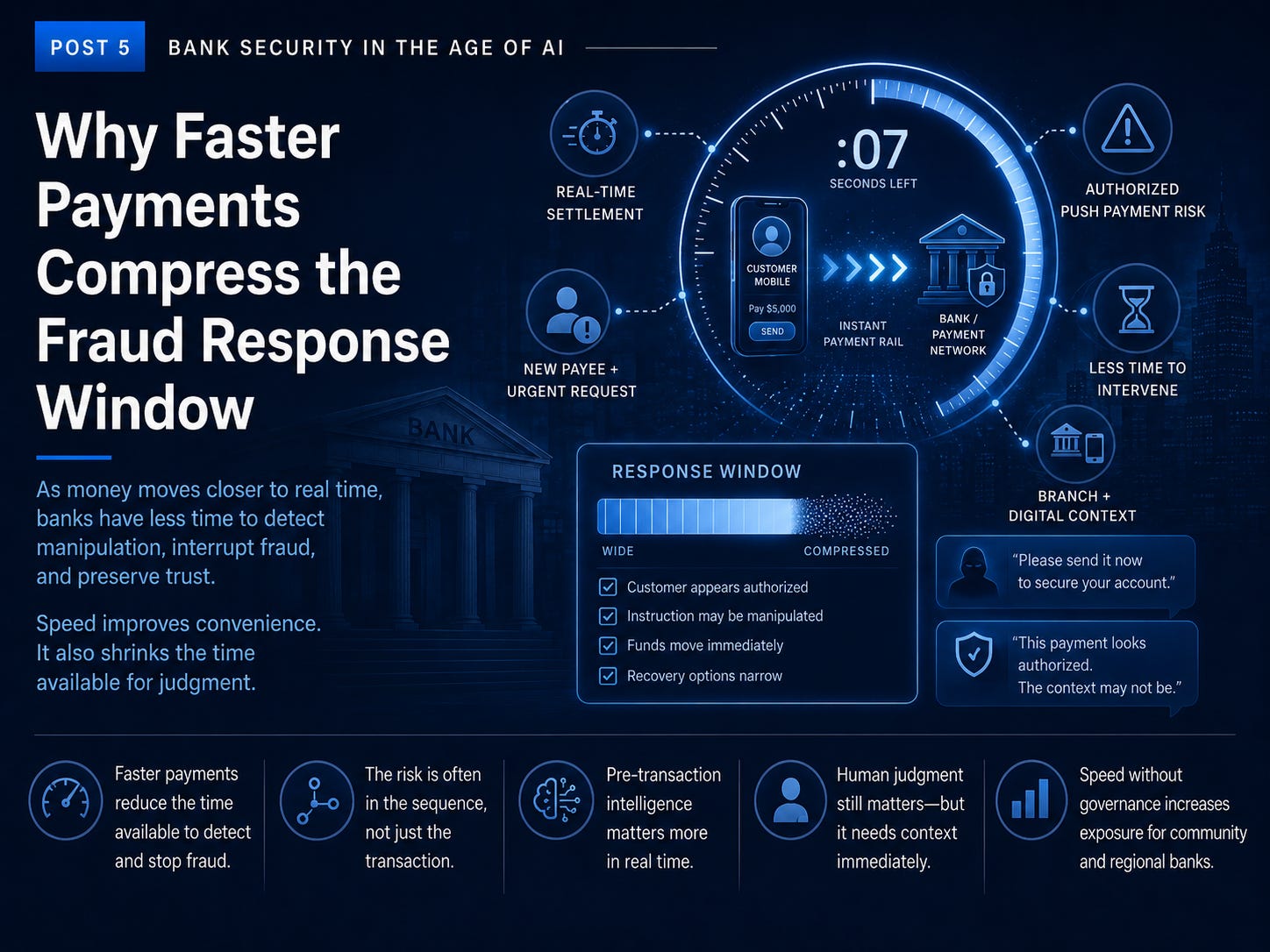
Fraud becomes more dangerous when the time between deception and settlement collapses. Faster payments, real-time payments, same-day ACH, instant account transfers, and embedded payment experiences all improve customer convenience and commercial efficiency. They also reduce the time banks have to detect, investigate, interrupt, and reverse suspicious activity.[1]
That does not mean faster payments are bad. They are not. The banking system is moving toward speed because customers, businesses, fintech platforms, payroll providers, merchants, and treasury departments increasingly expect it.
But faster money movement changes the security model.
For decades, banks benefited from friction. Batch windows, settlement delays, call-backs, return processes, manual review, branch conversations, and back-office exception handling created time. That time was not always efficient, but it was useful. It gave fraud teams an opportunity to notice something wrong before money was gone.
In the AI era, that cushion is shrinking.
Traditional bank fraud controls were built around a slower operating environment.
A suspicious ACH file could be reviewed. A wire might require a call-back. A new account could be watched for a period of abnormal activity. A branch employee might notice nervous behavior, a mismatched story, or an unusual urgency. A back-office analyst could compare a transaction against prior history and escalate the exception.
None of these controls were perfect. But they assumed that the bank had time to think.
That assumption is becoming less reliable.
When payment rails move closer to real time, the bank’s decision point moves closer to the moment of customer interaction. The window to intervene shifts from hours or days to minutes or seconds. In some cases, once the payment is sent, the practical recovery options are limited. The RTP network, for example, describes settlement as final and states that sending institutions cannot revoke or recall a payment after it has been submitted to the network.[2]
That changes the question.
The question is no longer, “Can we detect fraud eventually?”
The question becomes, “Can we detect enough risk before the transaction clears?”
That is a different operating model.
Most fraud is not just a technical attack. It is a timing attack.
The fraudster wants urgency. The fraudster wants confusion. The fraudster wants the customer, employee, or institution to act before the full context is understood.
AI makes that easier.
A customer can receive a realistic voice call, a polished text message, a fake vendor invoice, a deepfake executive instruction, or a personalized message that references real details from prior breaches or social media. The fraudster can push the customer toward immediate action: move the money now, verify this account now, protect your funds now, pay this invoice now, approve this change now.
The payment rail then becomes the exit path.
In a slower system, the bank might still have time to detect a mismatch, question the instruction, flag the payee, or interrupt the transaction. In a faster system, the bank may need to make that judgment while the customer is still under the influence of the scam.
That is why faster payments compress the fraud response window. They do not merely move funds faster. They force the institution to reach a confidence decision faster.
The hardest cases are often not the ones where a criminal breaks into the bank.
They are the cases where the customer is manipulated into authorizing the payment.
This is commonly described as authorized push payment fraud. The customer believes the payment is legitimate. The bank sees a valid login, a valid device, a valid credential, and a customer-initiated instruction. From a narrow systems perspective, the transaction may look authorized.
But from a broader risk perspective, something may be wrong.
The customer may be sending money to a new beneficiary. The amount may be unusual. The timing may be abnormal. The customer may have just changed contact information. The device may be familiar, but the behavior may not be. The payment may follow a sequence of events that suggests manipulation: a password reset, a new payee, a high-pressure phone call, a branch visit, or an unusual digital session.
This is where traditional fraud models can struggle. If each system only sees its own slice of the transaction, the bank may miss the story.
The risk is not always in the payment alone. It is in the sequence.
In a slower environment, post-transaction review still had value. A bank could investigate, return, reverse, or recover funds in some cases.
In a faster environment, more of the intelligence needs to move upstream.
That means banks need better risk assessment before the payment leaves. They need to understand the customer, the session, the device, the payee, the channel, the branch interaction, the timing, the behavioral pattern, and the institutional policy context at the moment of decision.
This is not just a fraud-screening problem. It is a governance problem.
A real-time payment decision should not depend entirely on a single fraud score or a narrow transaction rule. It should reflect a broader institutional view:
Is this customer behaving normally?
Is this payee known or new?
Is this transaction consistent with the customer’s history?
Has the customer recently changed credentials, devices, contact information, or account settings?
Has there been recent suspicious activity across similar customers, branches, accounts, or channels?
Is the employee following the correct exception process?
Is the policy appropriate for this risk category?
Should the session continue, pause, escalate, require step-up verification, or require supervisory review?
The faster the payment, the more important the pre-payment control layer becomes. This is consistent with recent FedNow risk-management work, including network intelligence tools intended to help institutions assess receiver-account risk before sending instant payments.[3]
It is tempting to think of faster payments as purely digital. That is a mistake.
Branch operations remain part of the security perimeter.
A customer may walk into a branch after being coached by a scammer. An elderly customer may be instructed to withdraw funds, initiate a transfer, or move money to a supposedly safer account. A small business customer may be responding to a fake vendor change. A branch employee may see the customer in person but still lack enough contextual information to understand the broader risk.
The branch employee may not know that the customer received a suspicious digital message, recently added a new payee, or attempted a large online transfer earlier that day.
The digital team may not know that the customer appeared confused, pressured, or unusually insistent at the branch.
The fraud team may not see the full picture until the payment has already moved.
This is why the branch cannot be separated from the faster-payments conversation. The bank needs a shared risk view across channels. The customer’s story may begin in a text message, continue in a phone call, move through online banking, and end at a branch counter.
Fraudsters do not respect the bank’s internal org chart.
In the AI era, employees are not just process operators. They are part of the control system.
That does not mean every teller, banker, call-center representative, or operations analyst should become a fraud investigator. That is unrealistic.
But it does mean employees need better support at the moment of interaction.
They need clear policy guidance. They need escalation paths. They need to know when the system is seeing risk that they cannot see from the counter or the call. They need training that reflects live scenarios, not just annual compliance modules. They need systems that help them slow down the right transaction without turning every customer interaction into an interrogation.
The point is not to add friction everywhere.
The point is to add intelligent friction where the risk justifies it.
That distinction matters. A bank that slows down every payment will frustrate customers and lose business. A bank that never slows down risky payments will absorb fraud losses, reputational damage, regulatory scrutiny, and customer harm.
The future belongs to banks that can distinguish between normal speed and dangerous speed.
Faster payments would be challenging even without AI.
AI makes the problem more urgent because it accelerates the front end of fraud.
A scammer can generate better messages, better scripts, better fake documents, better voice impersonations, and better timing. AI can help identify vulnerable targets, tailor language, test approaches, and scale outreach. It can make the customer more confident in the false story before the payment instruction ever reaches the bank.
By the time the transaction appears, the fraud may already be mature.
The customer has been persuaded. The account has been prepared. The destination has been selected. The urgency has been created. The payment rail is simply the final step.
This is why banks cannot think about faster payments in isolation. Faster payment risk is part of a broader threat stack:
First-order fraud still exists.
AI enhances the fraudster’s ability to persuade and scale.
Quantum risk, over time, will place additional pressure on the trust infrastructure beneath identity, encryption, and authentication.
Faster payments sit in the middle of that stack because they determine how much time the bank has to respond.
For bank boards and executive teams, the question is not whether faster payments should be adopted. The market is already moving in that direction.
The better question is whether the bank’s control environment is moving at the same speed as its payment environment.
If payments are becoming real time, then fraud intelligence, customer-risk context, branch escalation, exception governance, and audit evidence must become closer to real time as well.
That does not mean every decision must be automated. In fact, full automation can create its own risks. Banks still need human judgment, especially in ambiguous cases involving customers, branches, exceptions, vulnerable populations, and reputational exposure.
But human judgment must be supported by better context.
The institution needs to know what is happening across channels. It needs to know whether employees are following policy. It needs to preserve evidence of why a transaction was allowed, paused, escalated, or denied. It needs to learn from near misses, not just confirmed losses.
The response window is shrinking. The learning window must expand.
Banks should begin asking a practical set of questions:
Where do we still rely on batch-era fraud controls?
Which payment types are moving faster than our ability to investigate?
Can we see customer behavior across digital, call-center, branch, and payment channels?
Do branch employees receive real-time risk context when a customer may be under manipulation?
Can we distinguish normal customer urgency from scam-induced urgency?
Do we have clear escalation rules for high-risk faster-payment scenarios?
Are our fraud, operations, compliance, and branch teams working from the same risk picture?
Can we preserve an audit trail showing how the bank handled the decision?
Are we learning from attempted fraud, abandoned transactions, and near misses?
Those questions are not theoretical. They go directly to the bank’s ability to operate safely in a faster payments environment. Nacha’s 2026 fraud-monitoring rule changes are another signal that the industry is pushing fraud responsibility earlier and more broadly across the payment chain, including originators, service providers, senders, ODFIs, and RDFIs.[4]
Faster payments are not the enemy. They are part of the future of banking.
The problem is not speed by itself. The problem is speed without context.
A bank can move money faster safely if its controls, employees, policies, and intelligence layer are designed for that environment. But if faster payments are added on top of slow governance, fragmented systems, and disconnected branch operations, the fraud response window will continue to compress faster than the institution can adapt.
In the AI era, banks need to shift from after-the-fact fraud review to live-session risk governance.
That means more than watching transactions. It means understanding the customer interaction before the transaction is complete. It means connecting digital behavior, branch activity, payment rails, policy rules, employee actions, and institutional memory into one decision environment.
Fraudsters are trying to turn speed into advantage.
Banks need to turn context into control.
The institutions that do this well will not merely reduce fraud losses. They will preserve customer trust in a financial system where money moves faster, scams become more convincing, and the margin for hesitation continues to shrink.
[1] Federal Reserve Financial Services, “Fraud and Instant Payments: The Basics.” The Federal Reserve notes that instant payments create unique fraud challenges because they are immediate and irrevocable.
[2] The Clearing House, “RTP for Financial Institutions.” The RTP network materials state that sending financial institutions cannot revoke or recall a payment once it has been submitted, and that settlement is final.
[3] Federal Reserve Financial Services, “FedNow Service Network Intelligence API Launches,” May 14, 2026. Related FedNow materials describe receiver account-level data, risk mitigation tools, and the use of shared fraud information to strengthen instant-payment risk controls.
[4] Nacha, “Credit-Push Fraud Monitoring Resource Center” and “New Nacha Rules.” Nacha describes 2026 fraud-monitoring rule changes requiring broader fraud monitoring across ACH participants, including Originators, Third-Party Service Providers, Third-Party Senders, ODFIs, and RDFIs.
No posts
Comments
Nothing yet. Say the first thing.
Sign in to join the conversation.