
Banks have always operated inside a threat environment.
Fraud is everywhere. Credentials get stolen. Accounts get taken over. Insiders pose real risks. Vendors create exposure. Cyber intrusions never stop. Social engineering actually works. Payments get manipulated. Compliance failures carry serious consequences.
None of this is new.
What’s changing is the composition of the threat landscape and the speed at which it operates.
Banks are no longer defending against only human-speed fraud or conventional cyber attacks. They’re defending against layered threats that compound: traditional fraud enhanced by AI, identity attacks amplified by synthetic media, reconnaissance accelerated by automation, and long-term trust risks emerging from quantum computing.
This doesn’t mean panic. It means updating your mental model.
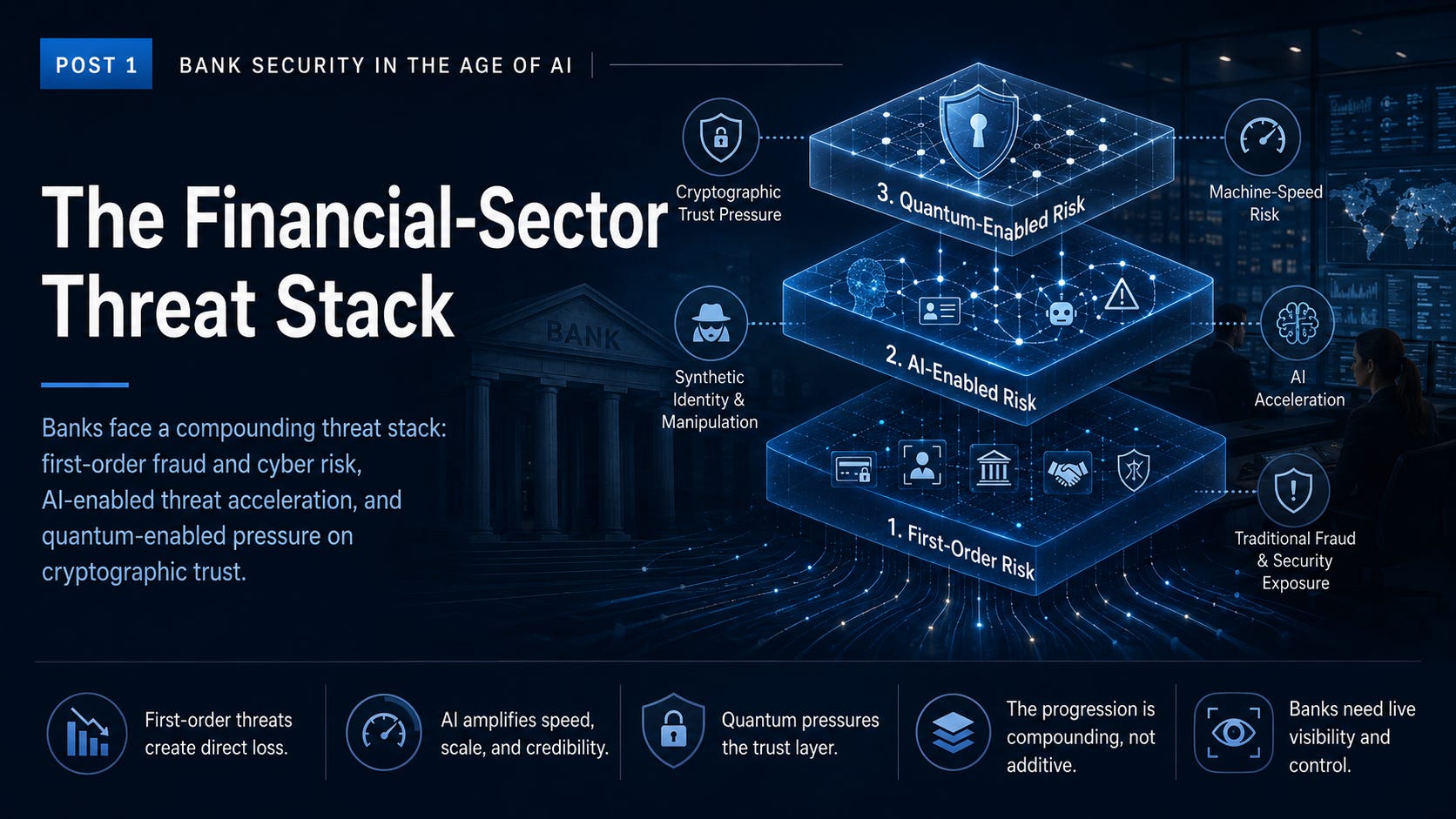
The most useful way to think about bank security right now is as a three-layer stack:
1. First-order risk — the fraud and cyber threats banks already know about
2. AI-enabled risk — the enhancement layer that makes existing threats faster and cheaper to execute
3. Quantum-enabled trust pressure — the long-term strategic risk to cryptographic foundations
Each layer matters. But the real danger isn’t any single layer—it’s convergence.
First-order risk is what banks already understand.
Account takeover. Business email compromise. Credential theft. Synthetic identity fraud. Insider misuse. Elder fraud and social engineering. Payment redirection. Wire and ACH manipulation. Vendor compromise. Ransomware. Audit gaps. Compliance breakdowns.[1]
Most banks have controls in place to address these threats. Fraud teams. Cybersecurity teams. Compliance functions. Vendor-management programs. Internal audit. Regulatory examination processes.
But many of these controls were designed around human-speed workflows.
A customer walks into a branch. A teller reviews the transaction. A call center agent takes a request. A fraud analyst investigates an alert. A security team reviews logs after the fact. A compliance officer reconstructs events weeks later for an audit.
That model still matters. Human judgment remains essential.
But the operating environment is evolving faster than the control structure can keep up.
The problem isn’t that banks lack controls—it’s that too many of those controls rely on after-the-fact review, periodic reporting, rule-based alerts, and escalation paths that can’t move fast enough when attacks are automated and adaptive.
You have human-speed controls in a machine-speed threat environment.
AI doesn’t create most threats from scratch. It amplifies existing ones.
That’s why AI-enabled risk is best understood as an enhancement layer.
AI helps attackers do old things better, faster, cheaper, and at scale.[2]
Phishing emails become more convincing. Fake customer stories become emotionally precise. Fraudulent documents become easier to generate. Voice calls become harder to trust. Mule account networks become easier to coordinate. Stolen identities become easier to weaponize across channels.
The attacker doesn’t need to be sophisticated. The tools do the work.
AI changes the economics of fraud. It slashes reconnaissance costs. It eliminates language barriers. It makes personalization scalable. It helps criminals test variations in seconds. It crafts social engineering scripts, generates fake documentation, enables customer impersonation, and probes internal processes.
For banks, this creates a dangerous asymmetry.
Attackers operate at machine speed. Institutions respond through fragmented human workflows.
The issue isn’t just deepfakes—those are one visible symptom. The deeper problem is synthetic credibility.
Banks must now constantly question: Is this really the customer? The employee? The vendor? The transaction pattern? The device? The business relationship? Normal behavior?
Traditional authentication asks whether a credential is valid. The emerging problem is whether the entire session is authentic.
That distinction matters.
A fraudster may have the right password, the right device, the right personal information, and a convincing story. The bank sees pieces of the truth but misses the full behavioral context.
AI-enabled threats exploit gaps between systems.
They exploit the gap between branch operations and digital banking. Between fraud monitoring and cybersecurity monitoring. Between customer identity and transaction behavior. Between vendor risk and operational dependency. Between policy documents and live execution. Between what the bank discovers after an incident and what it needed to know during the session.
The next phase of bank security isn’t about adding another dashboard—it’s about coordinating institutional awareness in real time.
Quantum computing is different.
It’s not a fraud tool today in the way generative AI already is. For most banks, quantum isn’t an immediate operational threat walking through the door this morning.
But quantum creates long-term pressure on trust.
Modern banking runs on cryptographic assumptions. Digital identity, encrypted communications, secure transactions, software updates, certificates, archives, payment systems, and vendor connections—they all depend on cryptographic trust.
Quantum computing threatens part of that foundation.
The concern isn’t just whether a future quantum computer could break older public-key encryption. The concern is strategic timing.
Some sensitive data has a long shelf life. Adversaries may collect encrypted information now and decrypt it later when quantum capabilities mature. This is called “harvest now, decrypt later.”[3]
For banks, the practical question isn’t whether quantum risk arrives all at once. It won’t.
The practical question is whether you’ve started identifying where long-lived cryptographic trust matters most.
Which systems rely on vulnerable cryptography? Which vendor relationships are critical? Which archives hold sensitive long-duration data? Which certificates, keys, and identity systems need migration? Which systems will resist upgrades? Which parts of your security architecture assume today’s cryptographic protections will last as long as the data they protect?
Quantum risk isn’t just a technology problem—it’s an inventory, governance, vendor-management, and migration problem.[4]
That makes it a board-level issue. And it needs to be addressed before it becomes a crisis.
The three layers described above aren’t separate risks sitting side by side.
They form a nonlinear progression.
The progression isn’t additive—it’s compounding. First-order threats create the loss event. AI-enabled threats accelerate the velocity and reach of that event. Quantum-enabled threats undermine the trust assumptions beneath it.
Think of it this way:
First-order risk = direct exposure
AI-enabled risk = direct exposure × speed × scale × credibility
Quantum-enabled risk = long-term pressure on cryptographic trust
This isn’t a precise actuarial formula. It’s a framework for understanding why the control environment can’t simply add more tools—the risk landscape itself is compounding.
Consider a conventional phishing attack.
A first-order phishing email creates direct loss. An attacker sends a message. A customer clicks. Credentials are stolen. An account is compromised. The bank detects the fraud, investigates, and remediates. Loss occurs, but the event is contained.
Now add AI.
AI-enabled phishing amplifies personalization, volume, timing, language quality, and credibility. The attacker generates thousands of variations tailored to individual customers. Messages arrive at optimal times. The language is fluent, contextually appropriate, and free of the telltale errors that once signaled fraud. The attack adapts in real time based on customer responses.
The loss event doesn’t just happen more often. It happens faster, at greater scale, with higher success rates, and at lower operational cost to the attacker.
Now consider quantum risk.
Quantum computing doesn’t just enable “more phishing.” It threatens the encryption, identity systems, certificates, archives, and vendor trust infrastructure that banking depends on. If an attacker harvests encrypted customer communications today and decrypts them in five years, tomorrow’s phishing attacks could be informed by yesterday’s private conversations.
The trust layer itself is under long-term pressure.
Each layer changes the nature of the problem, not just its magnitude.
First-order threats attack accounts and systems.
AI-enabled threats attack speed, scale, and credibility.
Quantum-enabled threats attack the trust layer itself.
This is why traditional security controls—designed for first-order risk—struggle against the compounding threat stack. Adding more fraud analysts doesn’t counter machine-speed attacks. Adding more monitoring tools doesn’t address synthetic credibility. Adding more encryption today doesn’t solve quantum risk tomorrow.
The control environment needs to evolve alongside this progression.
The mistake is treating these three layers as separate problems.
You might say fraud belongs to fraud ops. AI risk belongs to cybersecurity or innovation. Quantum belongs to cryptography and infrastructure.
Each statement holds some truth. None is enough.
The real issue is convergence.
First-order fraud gives attackers their target. AI gives them speed, scale, personalization, and the ability to adapt in real time. Quantum threatens the deeper trust layer on a longer timeline. Together, these forces undermine your ability to see what’s happening, decide what matters, intervene at the right moment, and prove afterward that you acted responsibly.
That last point matters.
Bank security isn’t just about stopping bad events. It’s about preserving institutional accountability.
When a regulator, auditor, board member, customer, or legal authority asks what happened, you need more than a general explanation. You need a clear record: signals detected, decisions made, policies enforced, issues escalated, outcomes documented.
In the age of AI, auditability is security.
Most banks aren’t defenseless. Many have invested heavily in cybersecurity, fraud detection, identity controls, monitoring tools, vendor oversight, and regulatory readiness.
But there’s an emerging gap between detection and live governance.
Detection tells you something may be wrong. Governance answers a different question: given what we know right now, what should the institution allow, slow down, escalate, block, or review?
You can have alerts without coordinated live-session control. You can have policies without a way to apply them consistently across digital, branch, payment, call center, vendor, and employee contexts. You can have logs without a coherent institutional memory of why you made each decision. You can have fraud tools and cyber tools without a unified view of behavioral risk.
The future requires active institutional control.
Not just monitoring. Not just reporting. Not just post-event investigation.
Active control means you interpret risk signals during the session, apply policy, escalate to human review where appropriate, and preserve an audit trail.
This doesn’t remove humans from the loop. It makes human judgment more timely, better informed, and better governed.
The first step isn’t buying a new tool. The first step is asking better questions.
Boards and executive teams should be asking:
Where are our fraud, cyber, identity, and vendor-risk systems disconnected?
Which customer or employee sessions can turn high-risk before anyone notices?
How quickly can we spot a suspicious pattern across branch, digital, payment, and call-center channels?
Do our policies just sit in documents, or do they actually shape live decisions?
Can we tell the difference between valid credentials and authentic behavior?
How do we handle AI-generated documents, voices, images, messages, and identities?
Do we have a migration plan for post-quantum cryptography?
Can we explain why a high-risk action was allowed, delayed, escalated, or denied?
Are our controls moving as fast as the threats?
These aren’t theoretical questions. They’re practical operating questions for financial institutions of every size.[5]
Large banks may have more resources, but they also face more complexity. Community and regional banks may have closer customer relationships, but they often have fewer specialized technical teams.
Both face the same strategic challenge: the threat landscape is becoming more automated, more synthetic, and harder to manage through traditional workflows alone.
Bank security in the age of AI is fundamentally a governance problem, not just a technology problem.
The goal isn’t to chase every new threat with another disconnected system. It’s to maintain control as threats accelerate.
That requires better behavioral awareness. Better policy execution. Better live-session visibility. Better escalation paths. Better audit trails. Better cross-functional coordination. Better preparation for cryptographic migration. Better institutional learning over time.
The banks that adapt best won’t simply add “AI” to their security vocabulary. They’ll redesign governance around the reality of machine-speed risk.
This series continues with an exploration of the changing security landscape for banks, focusing on practical institutional risk.
We’ll examine AI-enabled fraud, identity pressure, branch and digital-channel convergence, vendor risk, regulatory examination readiness, auditability, telemetry, post-quantum planning, and the growing need for real-time governance.
The goal isn’t alarmism. It’s clarity.
The financial system is built on trust. In the age of AI, trust depends on more than credentials, encryption, and after-the-fact review. It depends on whether institutions can observe, understand, govern, and prove what’s happening while it’s happening. That’s the new security frontier for banks: not just detecting risk after the fact, but governing trust while the session is still alive.
And it’s arriving faster than many institutions are organized to handle.
[1] FS-ISAC, “2024 Financial Services Threat Report“, 2024. Comprehensive assessment of cyber threats, fraud trends, and ransomware targeting financial institutions.
[2] Federal Trade Commission, “AI and Fraud: How Criminals Use Artificial Intelligence“, 2024. Analyzes AI-enabled phishing, deepfakes, social engineering, and document fraud in financial scams.
[3] NIST, “NIST Releases First 3 Finalized Post-Quantum Encryption Standards“, August 13, 2024. Announcement of ML-KEM, ML-DSA, and SLH-DSA standards for quantum-resistant cryptography.
[4] NSA Cybersecurity and Infrastructure Security Agency (CISA), “Quantum-Safe Cryptography Migration Roadmap“, 2024. Strategic guidance on identifying vulnerable cryptographic systems and planning migration to post-quantum standards.
[5] FFIEC, “IT Examination Handbook: Cybersecurity“, Federal Financial Institutions Examination Council. Framework for assessing technology risk, information security governance, and cybersecurity readiness in financial institutions.
No posts
Comments
Nothing yet. Say the first thing.
Sign in to join the conversation.