
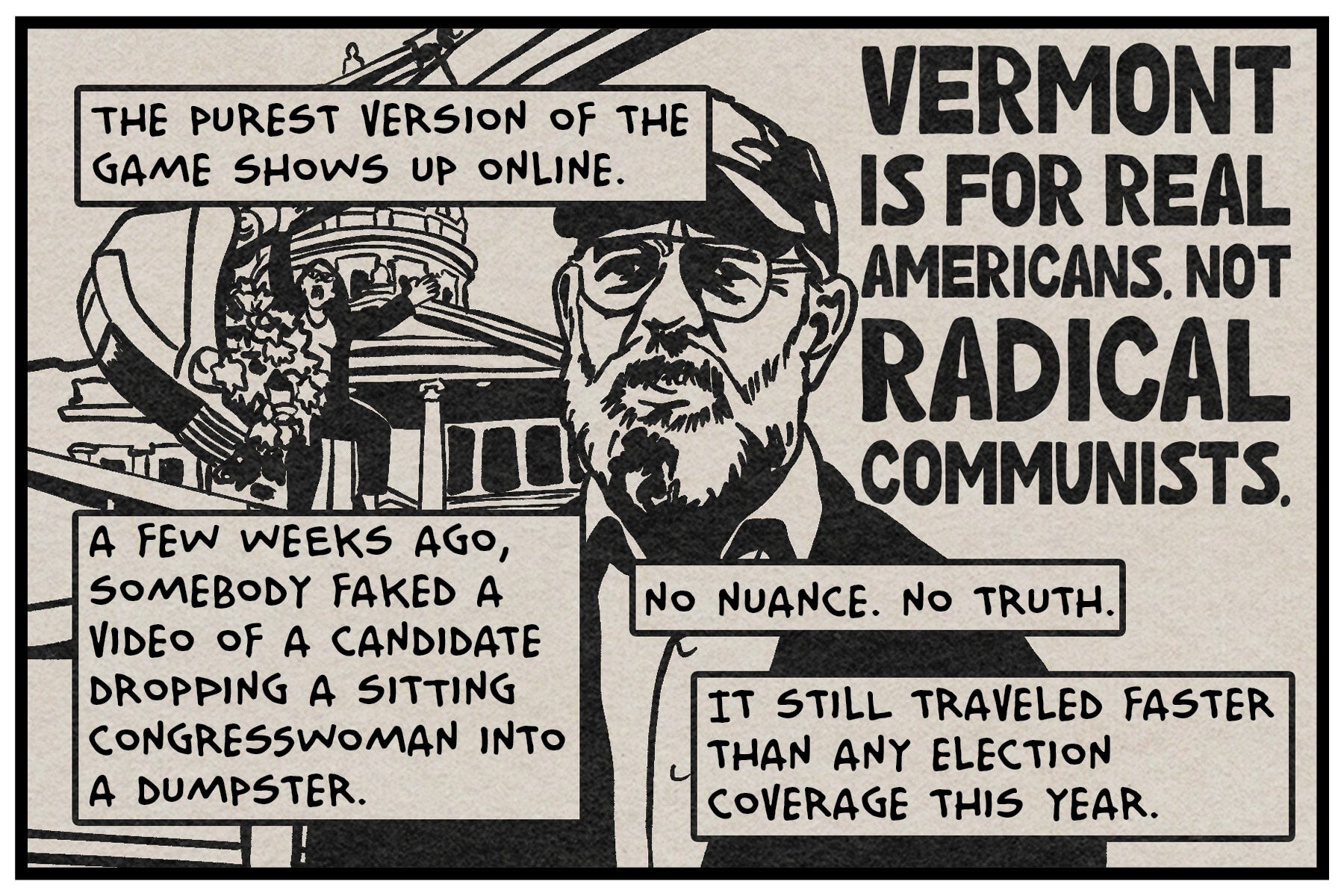
Sitting in the kitchen, slurping a cup of coffee, we talked about local newspapers. I was moving to Vermont at the time. Dickey, my college roommate's dad, had recently sold his newspaper and retired. The paper was one of those independent weeklies that served his mid-sized Vermont town and the smaller ones around it. Dickey had spent most of his working life running that paper. It had been his livelihood, much like it had been his father's before him.
Back then, you could make a living covering selectboard meetings, budget votes, and the high-school championship. And because the paper was profitable, Dickey had the time and the money to do the part that actually mattered. Because of classified ads and local business coupons, he could put somebody in a folding chair at every candidate forum in the county. His paper could be the place where a first-time candidate saw their own name in print for the first time.
Dickey probably would have chuckled if you called what he did “guarding democracy.” As far as he was concerned, he was just getting a paper out every week. But he did acknowledge that the local paper was how a town heard itself think.
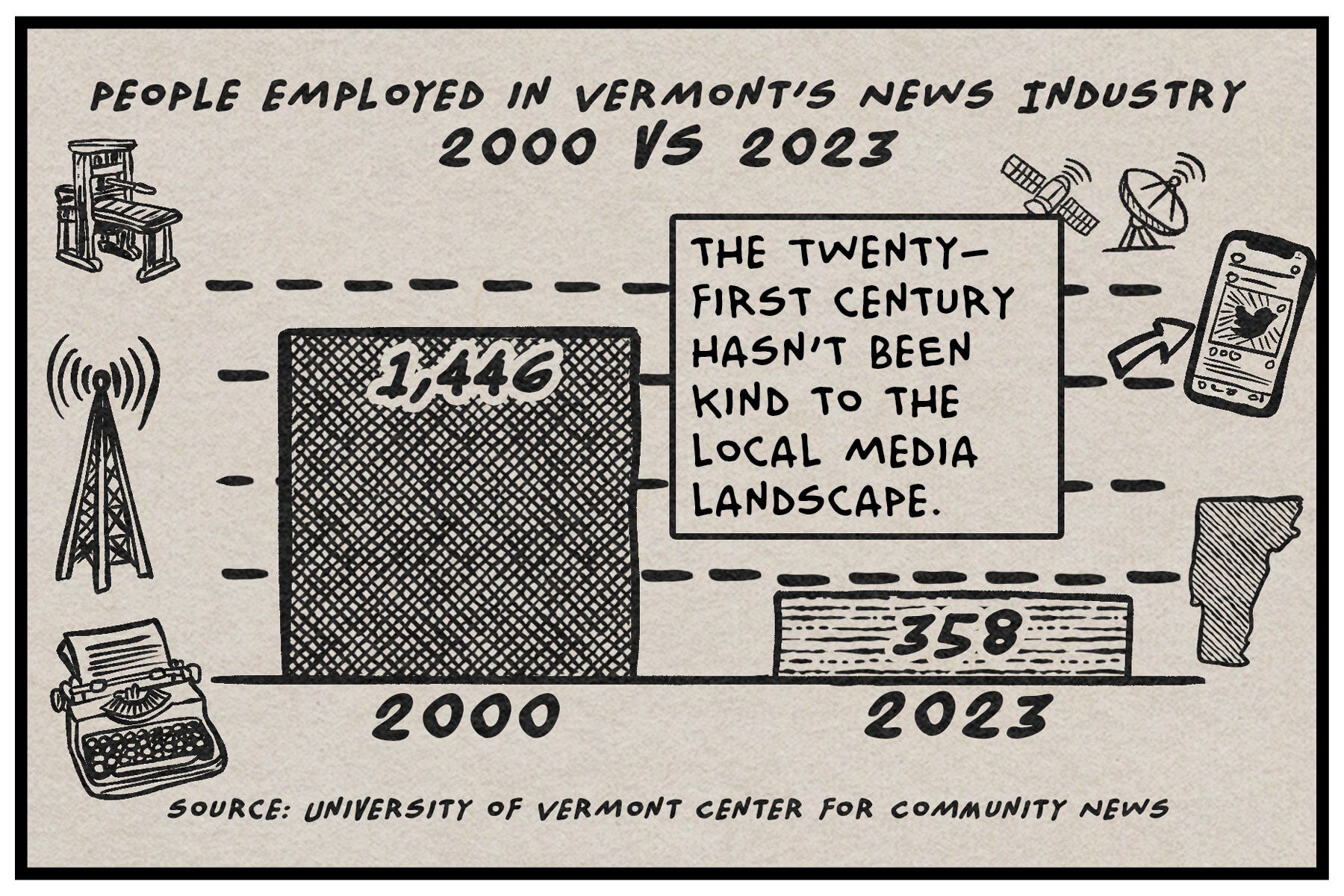
In circulation since the 1870s, Dickey’s old paper still comes out every week. It still “covers” the selectboard meetings. These days, when the current publisher/editor can’t find a human being willing to sit through a three-hour Tuesday-night meeting about culverts and mill rates — and he mostly can’t, because the money to pay that person vanished years ago — he runs the minutes through ChatGPT to build the article. And I’m not trying to AI-shame anyone here. The guy is doing his best to keep the lights on and the printing press running. That’s a noble mission that probably requires a good deal of compromise. Newspapers like the one Dickey ran are a critically endangered species these days.
When the Cincinnati Post shut down back in 2007, something weird happened in the surrounding suburbs that relied on the paper. Fewer candidates ran for local office. Incumbents got harder to beat. Voter turnout dropped. When the newspaper died, the elections it used to cover went slack. This phenomenon has been frequently researched. In a California-based study, it was found that the easiest way to make elections less competitive is to shrink a newsroom. Cut the reporters, and the incumbent’s margin gets wider.
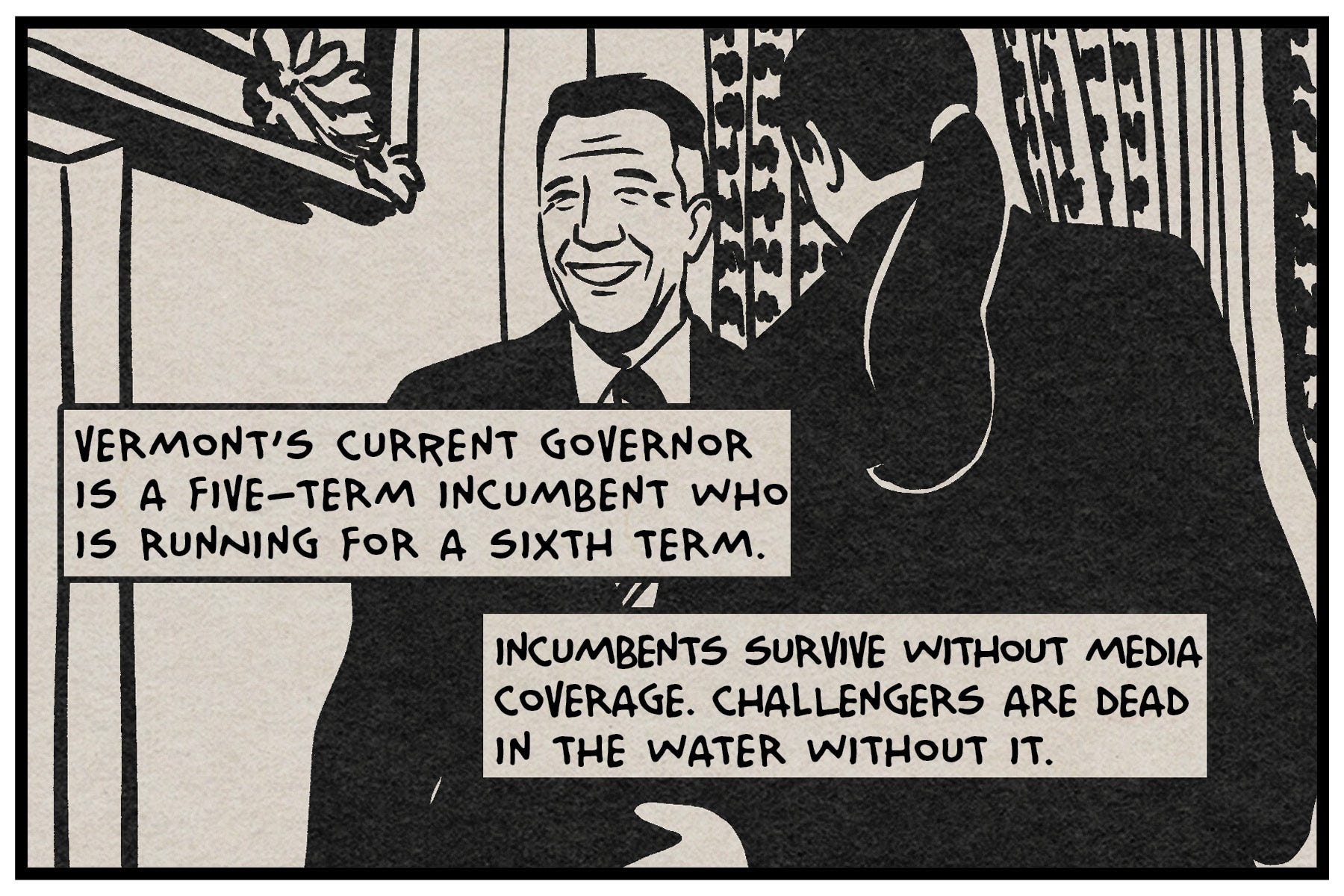
Phil Scott has been the governor of Vermont for nearly ten years. He’s won five elections. He’s now running for a sixth term. He’s the most popular governor in America.
Now set that next to the condition of the state he’s actually been running. Property taxes are climbing fast enough to scare people out of their houses. Housing costs are brutal. The schools cost a fortune, while the results slide in the wrong direction. We have the most expensive health insurance costs in the nation. We’re one of the oldest states in the nation, and our population is shrinking. By most measures anyone actually uses, Vermont is in rougher shape than it’s been in a long time.
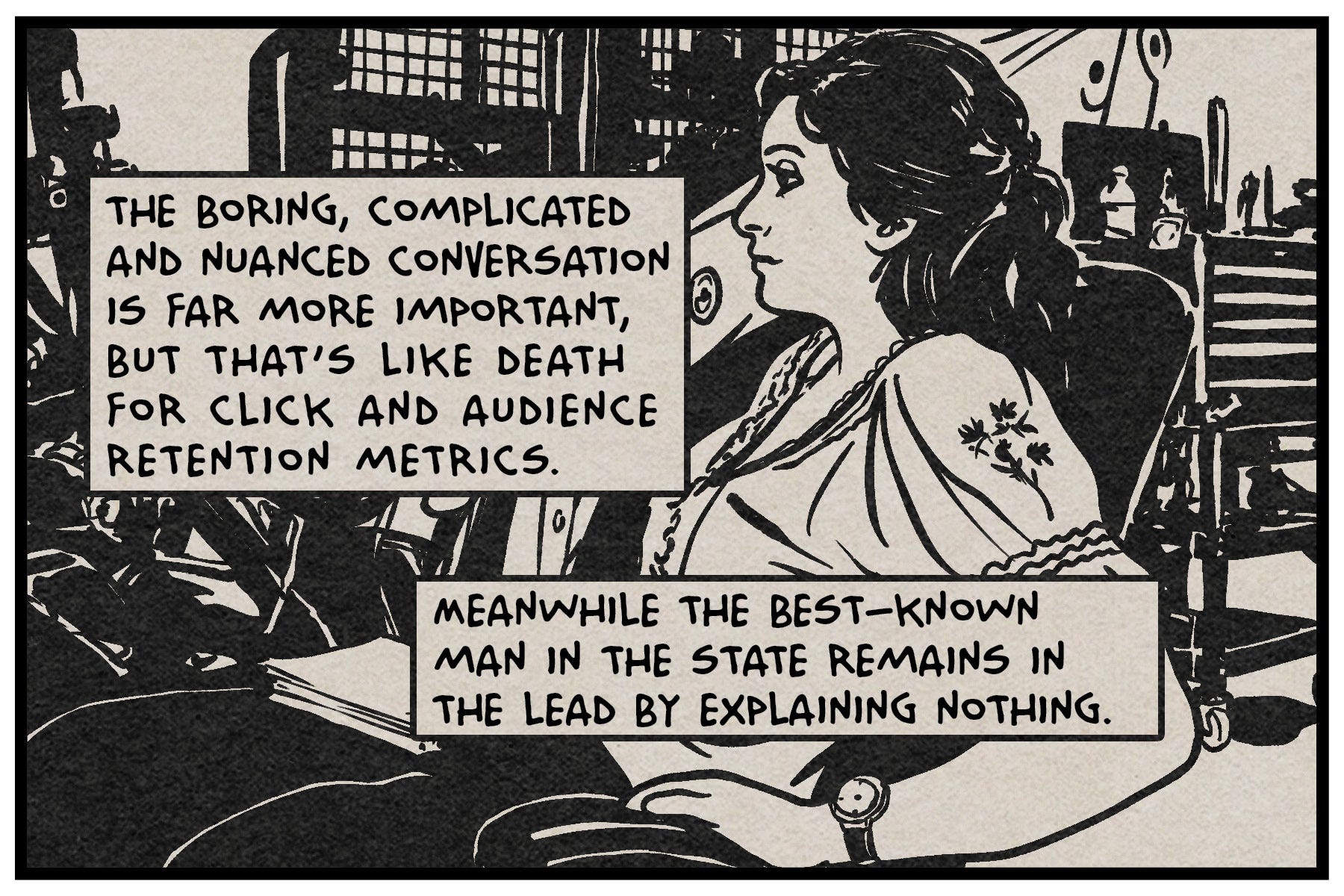
The most popular governor in the country, presiding over a state that’s quietly coming apart at the seams, and he’s the 5:1 betting odds favorite to win again in November. Each election he has run in has become less and less competitive.
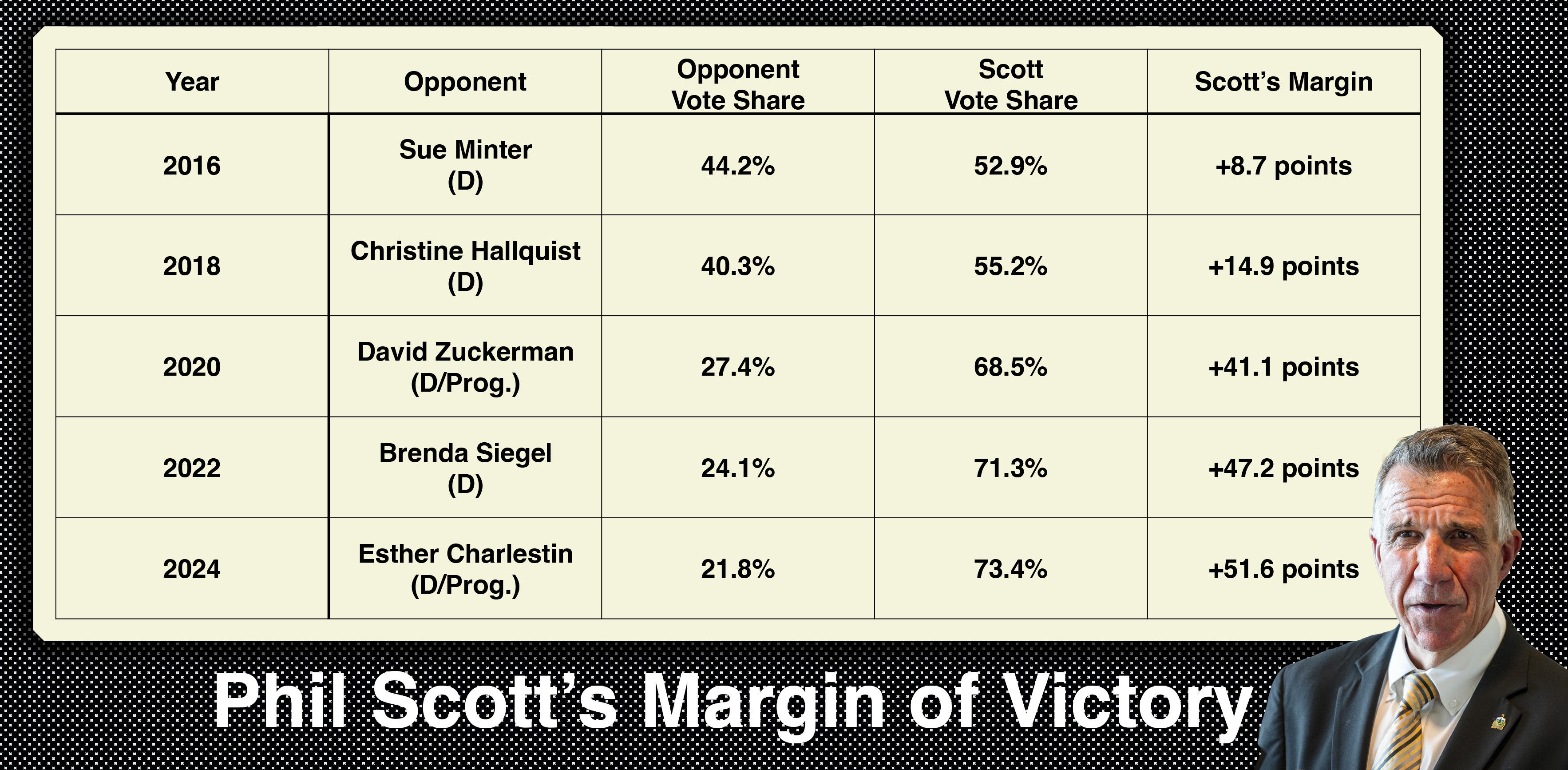
The coverage that used to make a Vermont governor explain himself has thinned to the bare minimum, so he doesn’t have to. He can run for a sixth term without ever really accounting for the five that came before. And that’s not meant as shade to the folks working hard every day in Vermont’s shrunken media landscape. It’s just what happens when the local news industry shrinks by about 75% over the past 25 years.
I think Phil Scott is a fundamentally decent and ethical guy. I’ve voted for him in the past. Heck, I might even vote for him again in the future. But I also want to know what my options are. I think other folks in Vermont want to know, too. The two people most likely to take his job are Amanda Janoo and Aly Richards. Chances are, you’ve never heard either name. The current betting odds reflect this.
(SIDE NOTE: Yes, prediction markets are gross. But there is no publicly available polling data for the current wave of Vermont elections. That’s another byproduct of the sad state of the local media landscape.)
Dickey's paper could afford to put a real person in a folding chair at every candidate forum in the county. But that business model is no longer financially feasible. Something cheaper and more automated has evolved to fill the gap.
What's grown up in the empty space is a handful of sites that look like local news and don't employ a single reporter. They take what the few reporters Vermont has left actually went out and wrote, run it through the machine, and republish the blurred copy with no byline. Sometimes the copy is wrong. Confidently, cheerfully wrong. And every so often, the wrong version is the kind that gets a couple of hundred people furious about a thing that never happened.
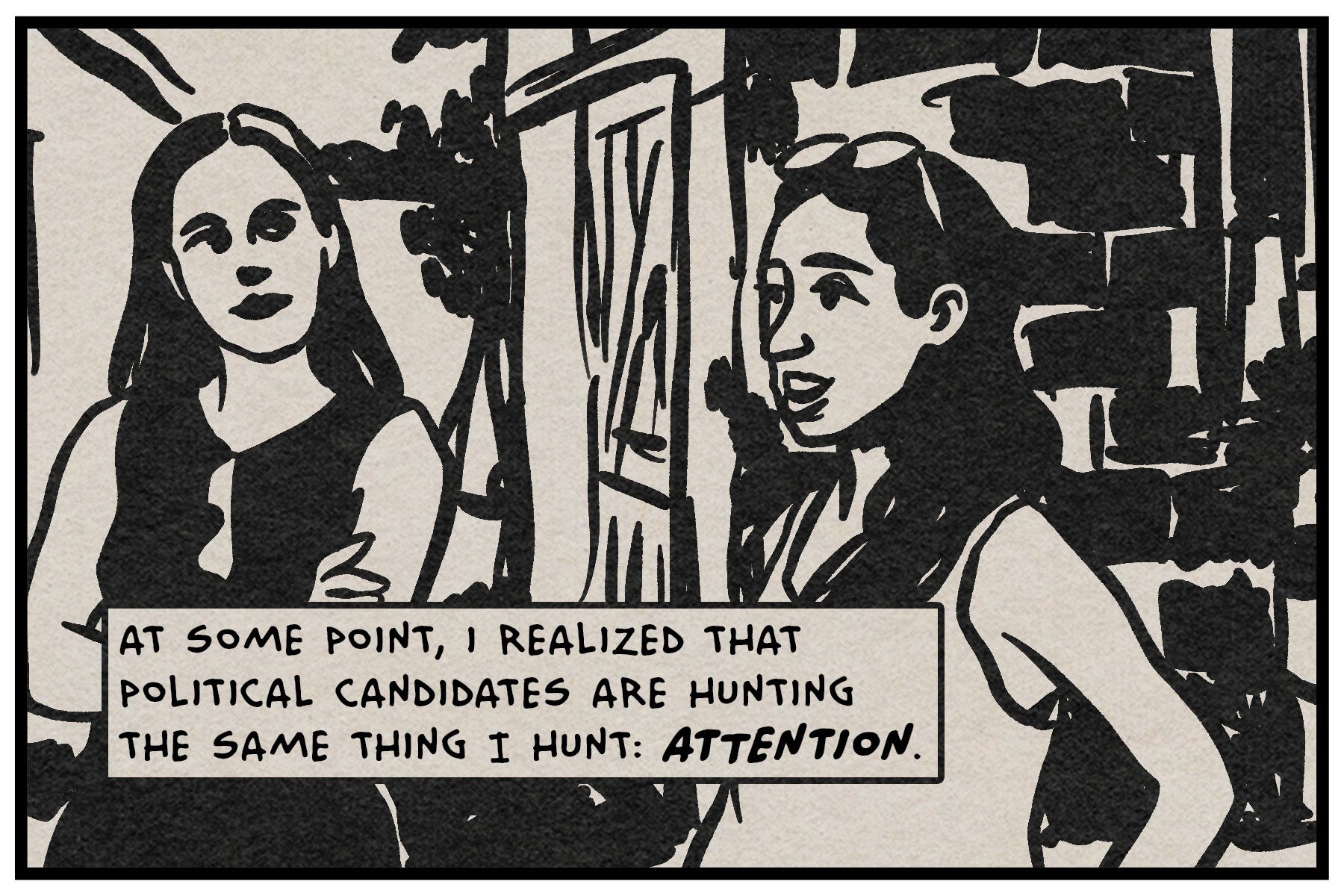
That’s the careless version of slop filling the local news void. But the kind I'm actually worried about has a human more directly steering the ship. It's built for one job: attention. Attention is what reliably generates votes and/or money. And the cheapest way to gain a lot of attention in a hurry is to make people mad.
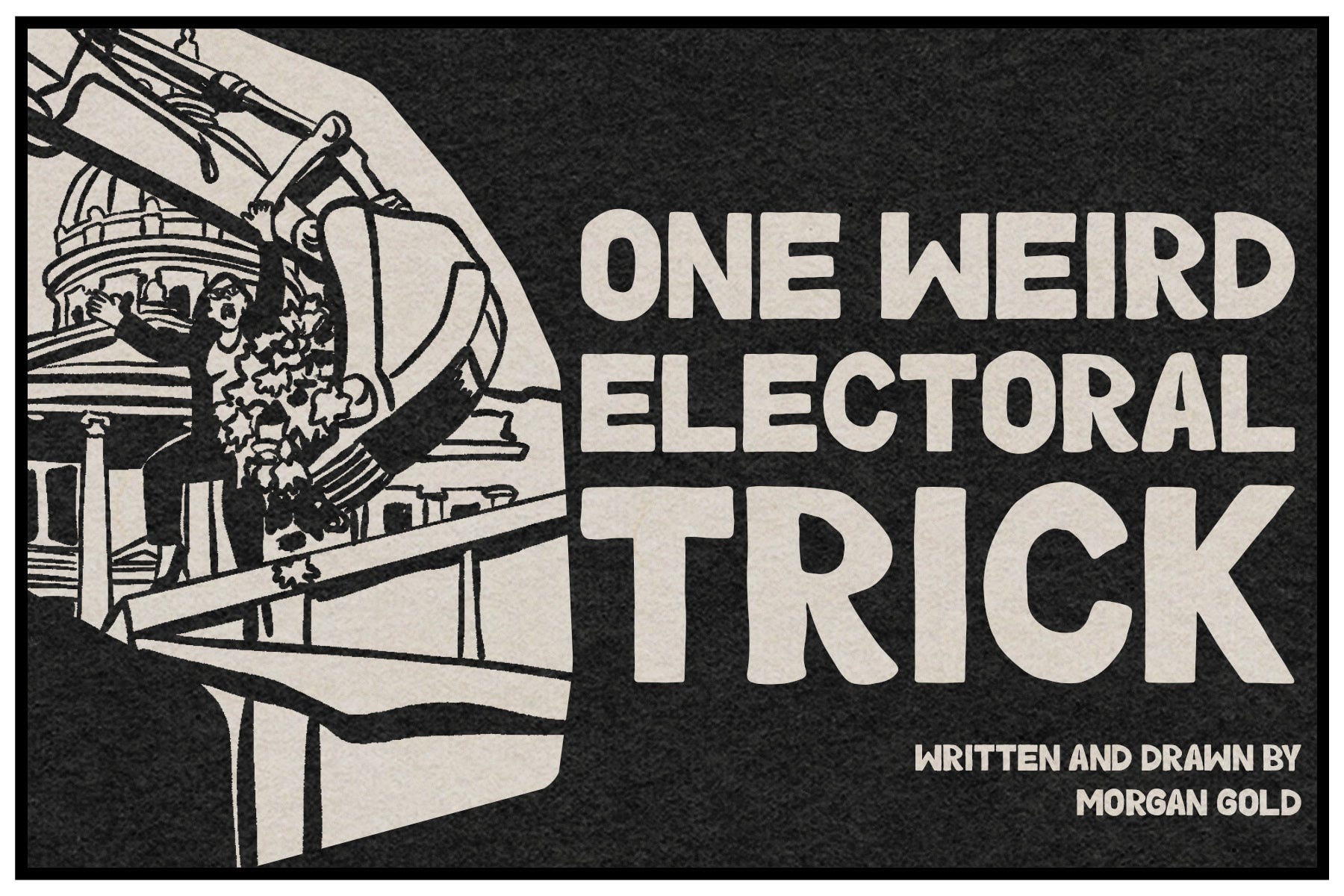
A few weeks ago, a weird video started making the rounds. It featured Vermont Congresswoman Becca Balint being scooped up by an excavator and dumped into a dumpster. It was obviously fake. There was nothing true in it and nothing to understand. And that was the point. It wasn’t built to tell anyone anything. It was built to get attention. And it got attention.
And here’s the thing about that video. It doesn’t matter that everyone knew it was fake. I knew it was fake. You’d know it was fake. Nobody watched an excavator dump a sitting congresswoman into a dumpster and filed it as news. But knowing it’s fake doesn’t get you out of it, because your brain doesn’t store the asterisk. It stores the picture. Weeks later, the fact-check is gone, and the image isn’t.
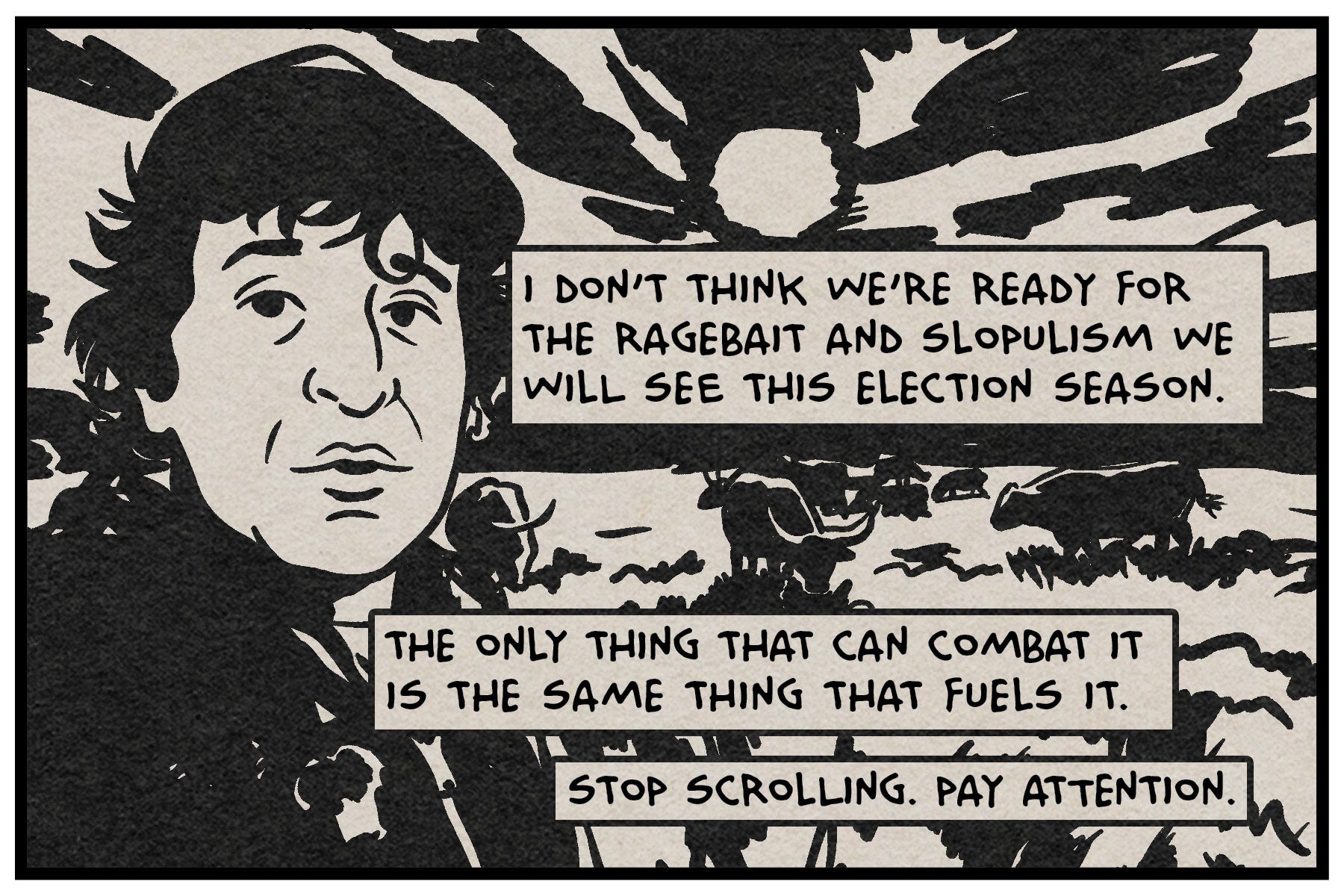
You used to need a budget, a studio, and a couple of weeks to pull off the visuals in the Becca Balint video. Now all you need are a few three-sentence prompts and a Grok account. We are living in the golden era of political slop videos being made at scale. As a society, we’re genuinely not ready for what’s going to happen this fall.
Slopulism. Populism plus slop. Low-effort, sensational, half-true content engineered to go viral instead of inform. Rage-bait with a political target. The Balint video is a textbook case, but by November, it won’t stand out because there’ll be a flood of them. (SIDE NOTE: I’m using the AI-fueled definition of this portmanteau. Other folks use it as a derogatory term for populist policies that are shallow or poorly thought out. I would argue it’s far too accurate a label for AI-political slop to not use it that way.)
I noticed a strong uptick in this type of content earlier this spring while making my documentary about Vermont Act 181. As the Vermont primary season has begun to take shape, it’s getting even worse. Slopulism takes many forms. It ranges from lame political cartoons to mindless infographics to journalistic-looking essays that digest large amounts of information and try to convey a real reporting vibe.
Sure, we had generative AI tools available during the 2024 election season. But those tools weren’t even remotely as good or ubiquitous as they are today. The barrier to entry for distorting reality is now significantly lower than the barrier to entry for reporting it.
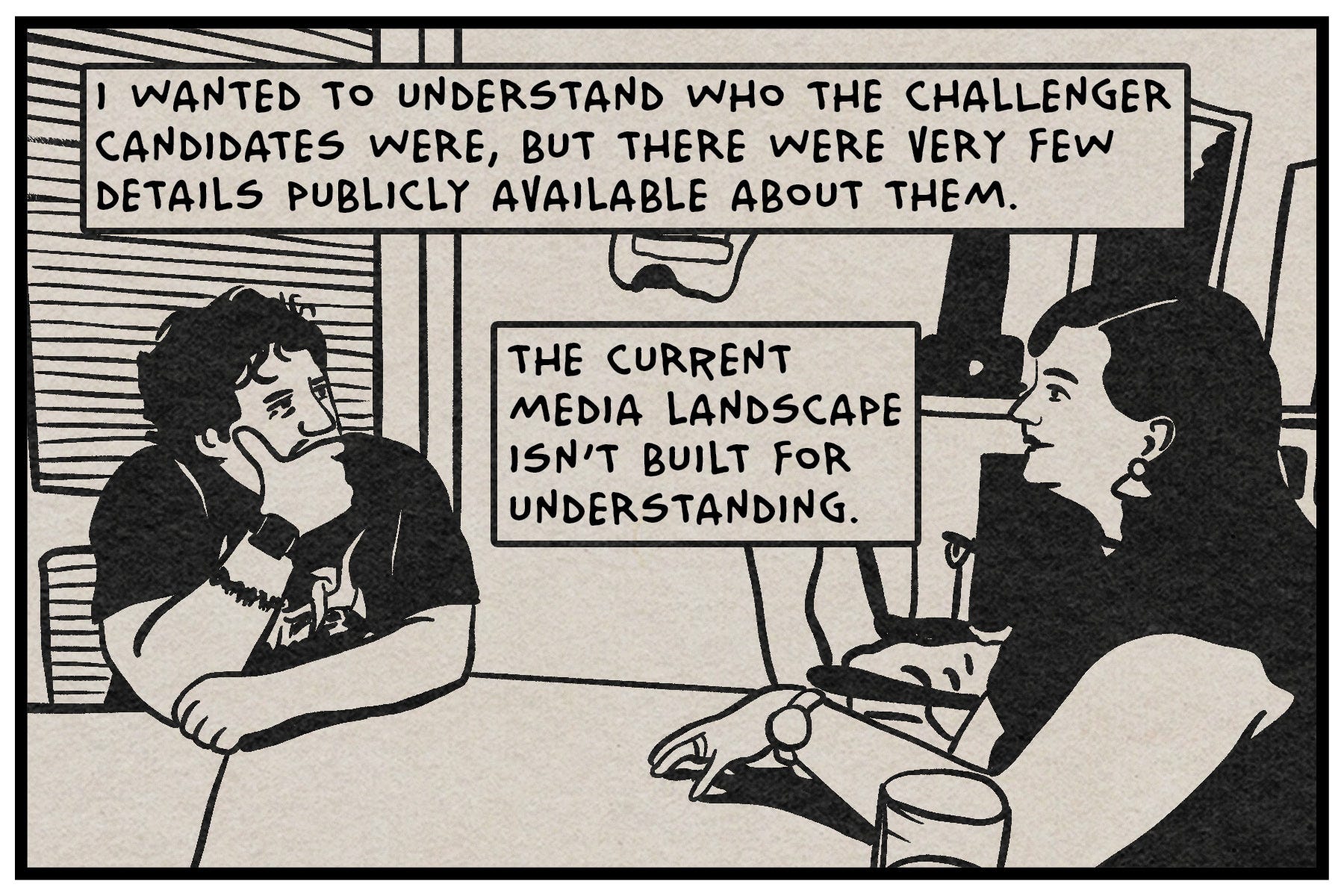
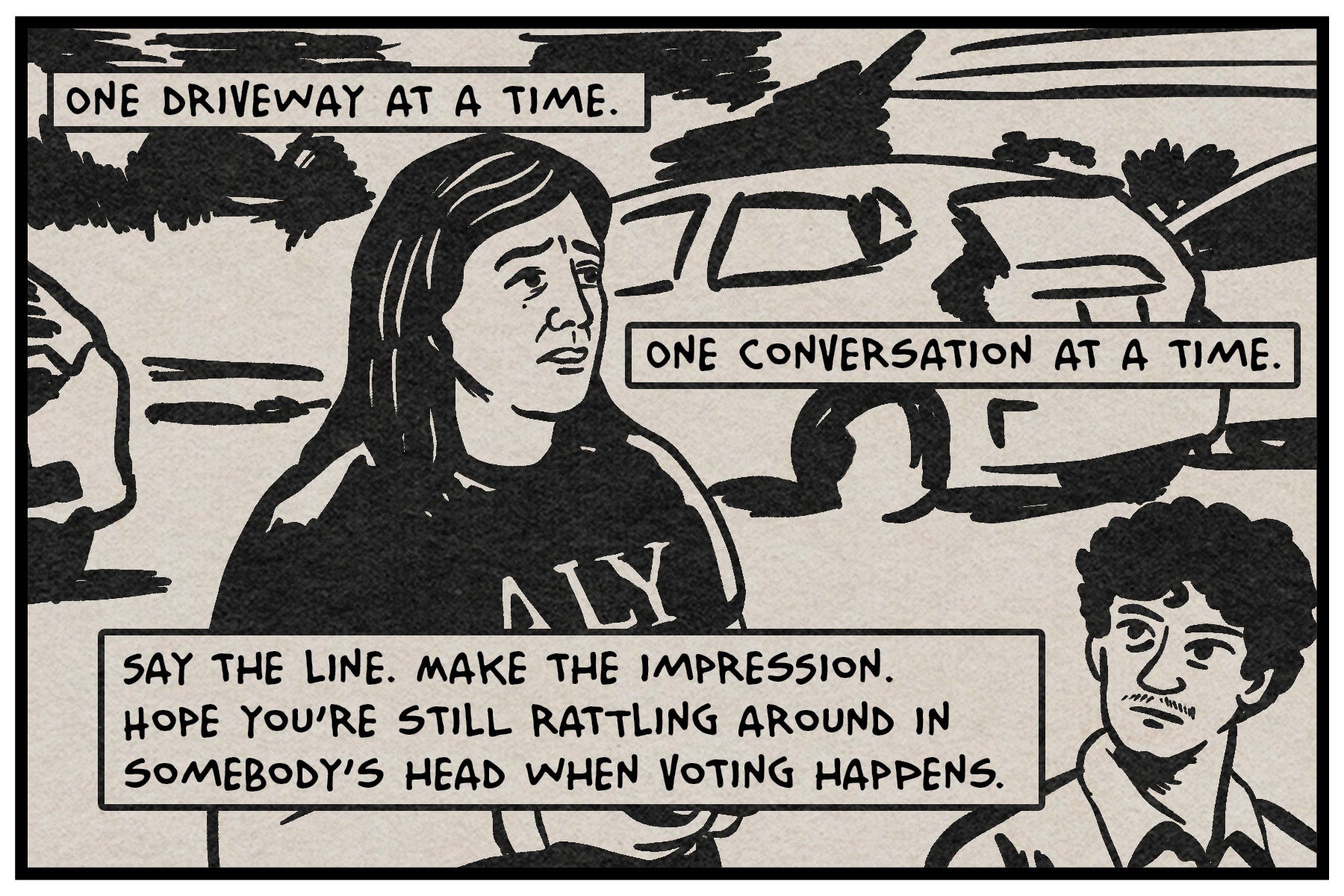
Over the past few years, I have been growing more and more depressed about all the things we have discussed thus far. Earlier this spring, I decided to do something slightly ridiculous about it. I started driving around the state to sit down with the people running against the incumbents — the challengers, the long shots, the names you’ve never heard.
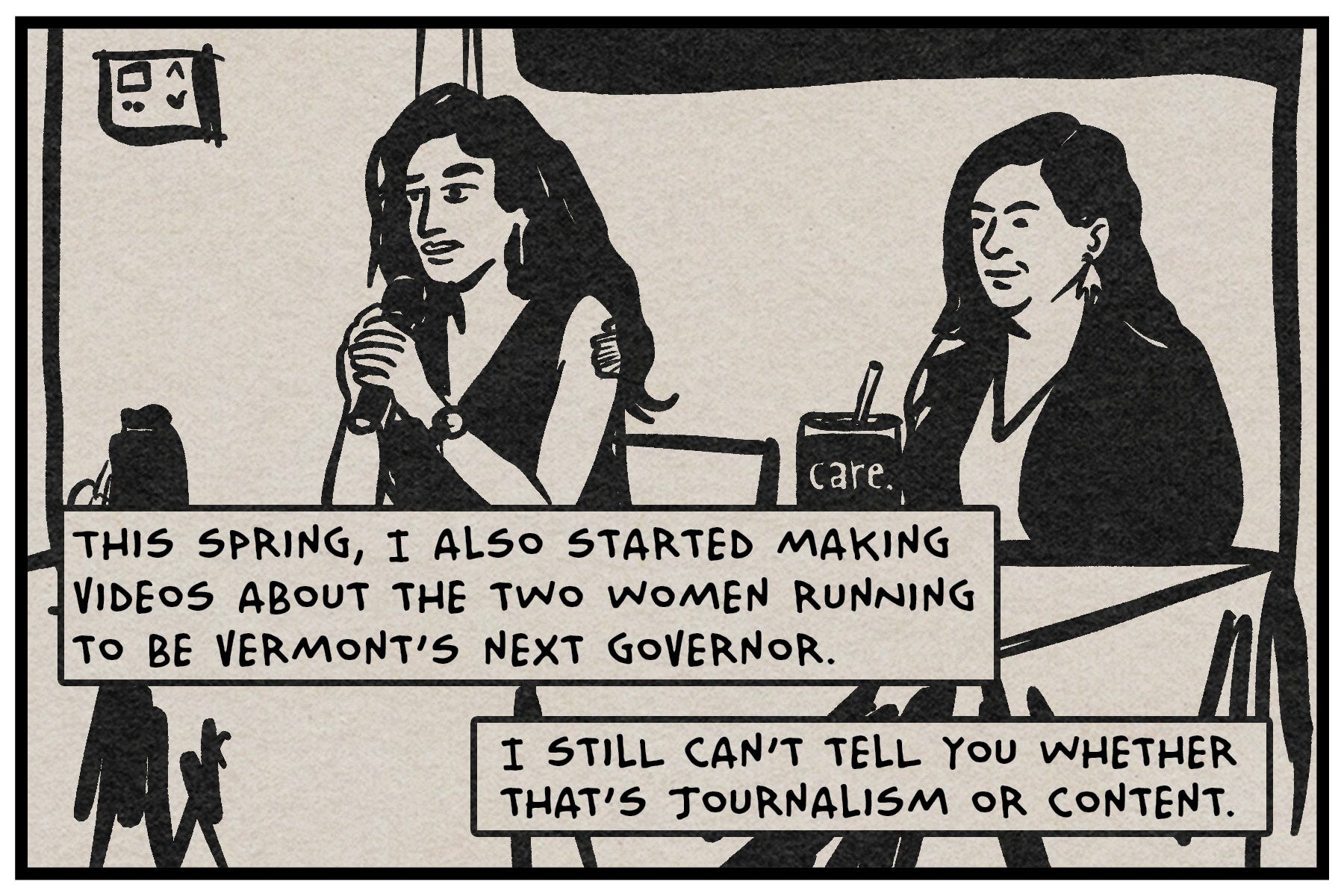
I tagged along on the campaign trail with Aly Richards and Amanda Janoo, the two women running for governor. I’ve been attending community events hosted by folks running in state primaries. Last week, I spent almost two hours with Gerald Malloy, who’s one of the Republican guys running against Becca Balint. As I write this, I’m still pestering Mark Coester (the other Republican running against Becca Balint) for an afternoon of his time. And I’m going to keep pestering, because I genuinely want to know what the guy thinks. (SIDE NOTE: Mark, if you’re reading this, I’ll call you back tonight.)
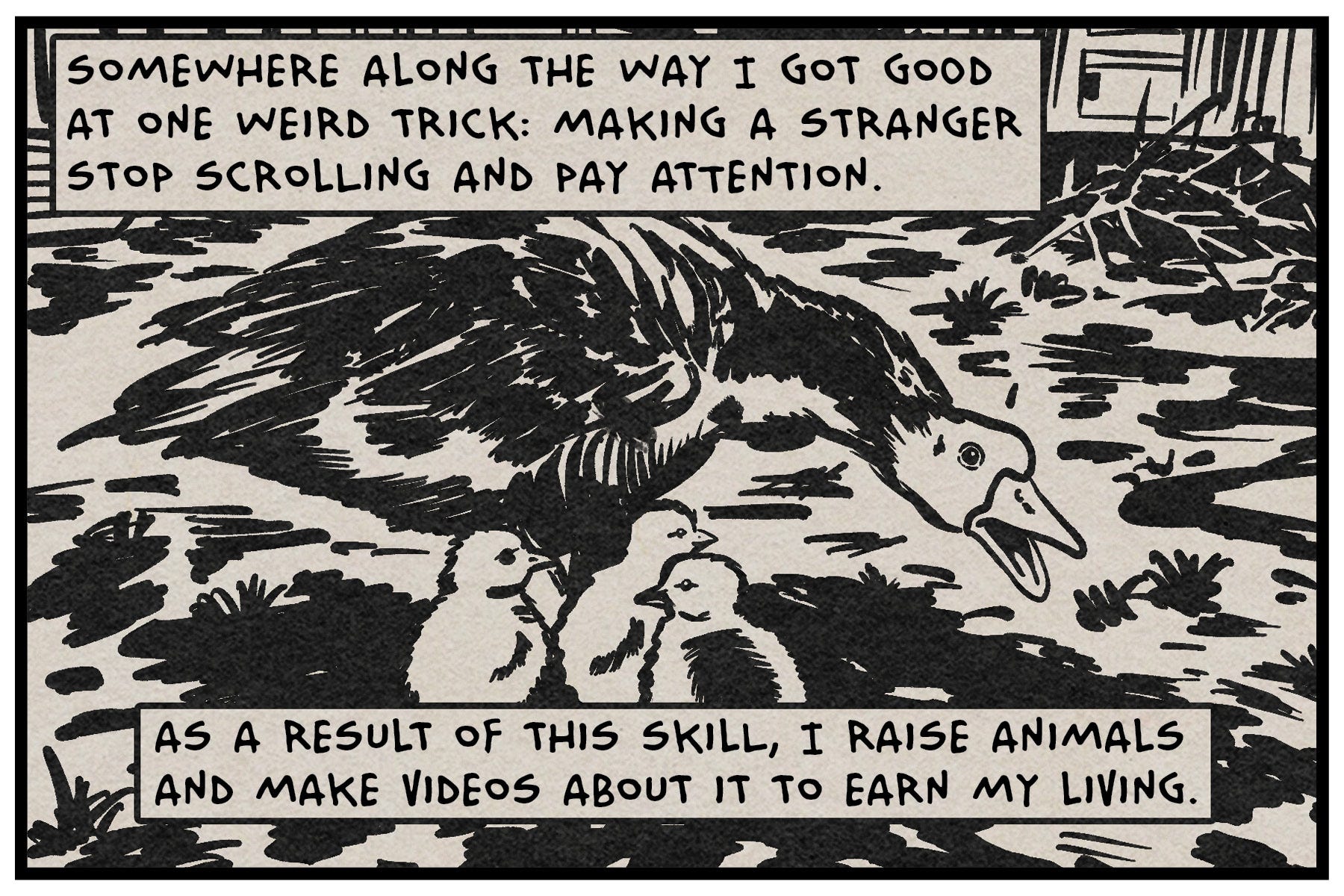
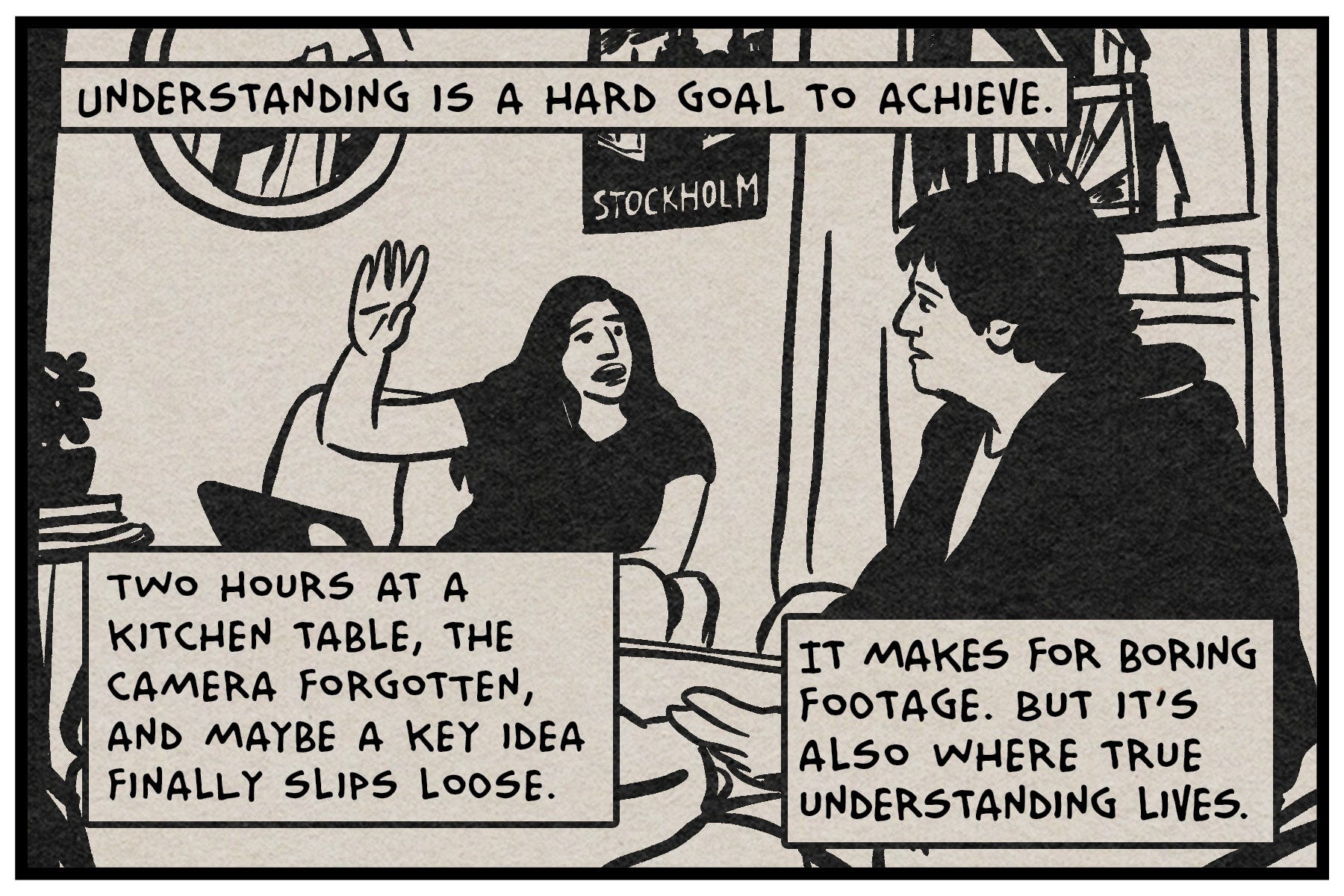
To be clear about my credentials, I got none. I have no training and no editor. I’m a guy who films his ducks and goats to pay most of his bills. I show up with a camera I usually strap to my livestock guardian dog and a list of questions I scratched out at my kitchen table. And I get a lot of things wrong. I miss the obvious follow-up. I let people skate on answers that a real reporter would’ve nailed them on. If you’re picturing some scrappy act of citizen journalism, please lower your expectations. I'm just another digital scavenger picking at Vermont’s political carrion.
Making these videos is most definitely not a viable business model. From an algorithmic perspective, it’s a flaming bag of dog poop left on the doorstep. But much like the newspapers of old subsidized their local political coverage through classified ads and local business coupons, I subsidize my coverage activities by writing books and making videos of about shaggy cows and shaggy dogs.
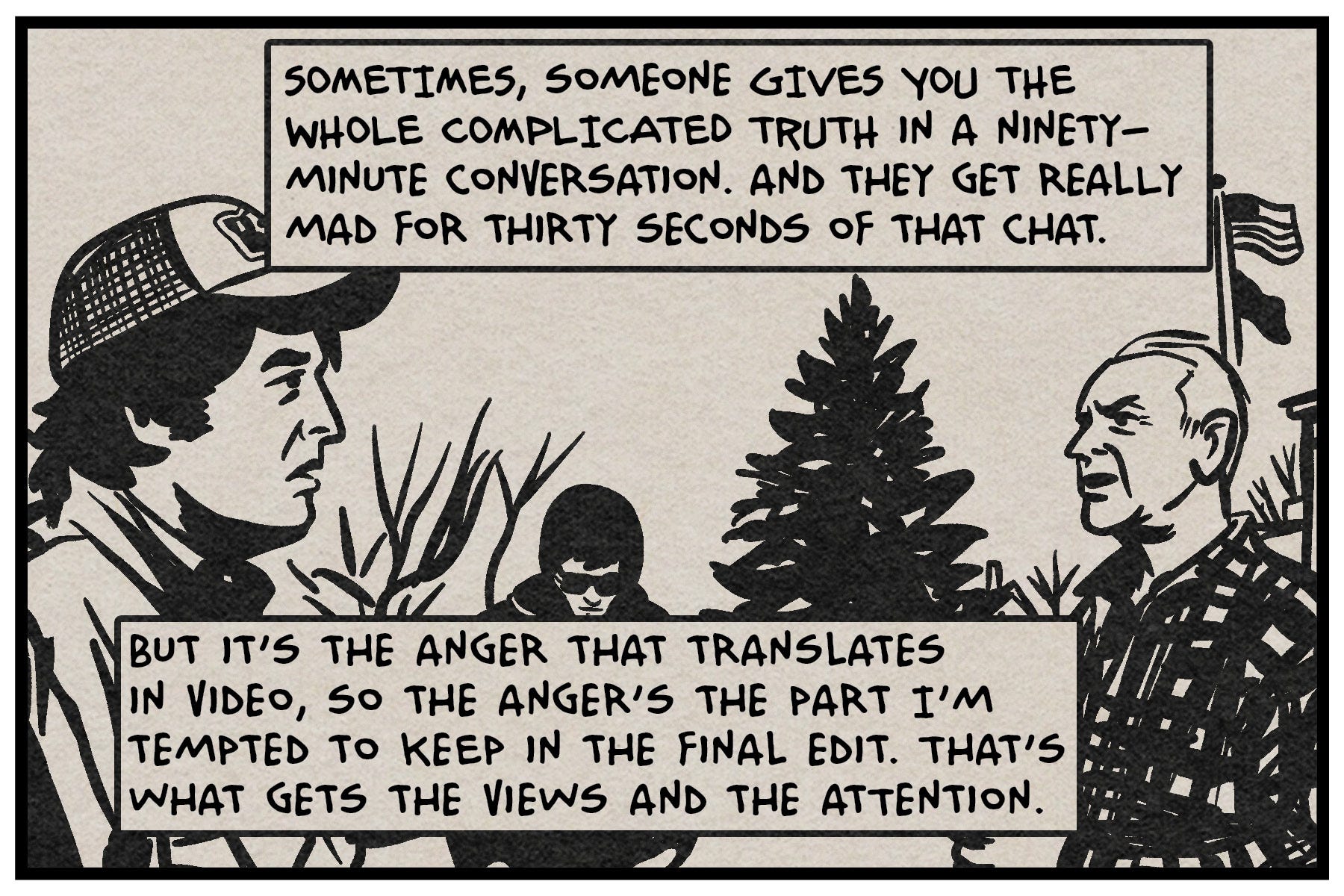
A long, nuanced conversation with a little-known primary candidate gets a fraction of the views (and AdSense dollars!) generated by a cheap, inflammatory video designed to make people angry. The algorithm is built to reward the slop and ragebait. The health of a real community demands nuance and understanding.
Local reporting once paid people to endure the boring parts of civic life and make the highlights something the rest of us could read over a cup of coffee. As the old system continues its 21st-century collapse, the vacuum is being filled by material optimized for attention rather than understanding.
And there is no regulatory fix coming to save us from this. I highly doubt the market will magically start appreciating the fine art of nuance again. (Did it ever?) The platforms and their algorithms will keep doing what they were designed to do: keep us scrolling by turning our collective distrust into a highly profitable commodity. That’s just the way it is.
Thinking back on that day about a decade ago when Dickey talked about why his paper mattered, he didn’t reach for cliches like “watchdog” or “democracy dies in darkness.” He talked about people. His newspaper covered more than a dozen towns. As he once put it, shortly after retiring, the job was “so people know things about each other, how our government works, and how our economy works.”
And yeah, we still need people doing that.
Thanks for reading Stories Told by Morgan Gold! This post is public, so feel free to share it. It helps me out big time when you do!
Most of the images in this week’s comic were pulled from stills from videos I recently shot. I opted to trace photos rather than my usual cartooning style because I always feel awkward drawing real people I know as cartoons. When I’m tracing a photo, I feel like I don’t have to defend my artistic choices as much as when I’m doing something original. To all of the very real people depicted in this week’s comic, my apologies. I was just tracing, and I probably did a bad job. I didn’t mean to make your face look weird.
I also chose this style because it’s fun to change things up sometimes. When you draw in the same style over and over again, it can start to feel like drudgery. Strip after strip. Panel after panel. Plus, I’m still drawing Powder Keg in the background of this summer.
As for my political video series, I’m still editing and collecting interviews. I’m also hoping to interview the incumbents. I’ve had much more luck talking with the challengers. They’re more open to it because, as I mentioned above, they have a much greater need for the exposure. I’m still holding my breath until I get a chance to interview both Becca Balint and Phil Scott. If anyone from their teams is reading this, please respond to my email! And if you’re reading this and you’re not part of their teams, but you would like to see those interviews, feel free to send them a message encouraging them to sit down with me.
To write this week's essay, like most of the essays, I recorded it as a video and then edited the transcript. I talk way better than I type. I doubt I’ll ever find the motivation to edit the footage for this essay because it felt like too much navel-gazing for YouTube. But that’s why I love Substack!
We had a bunch of ducklings hatch on the farm yesterday. Their mother is Sprite, a duck I hatched last year. The most relaxing thing you can do on the farm right now is spend some time watching them.
Did I mention I released a new book this year? If you liked this essay, you might like my book.
No posts
Comments
Nothing yet. Say the first thing.
Sign in to join the conversation.