
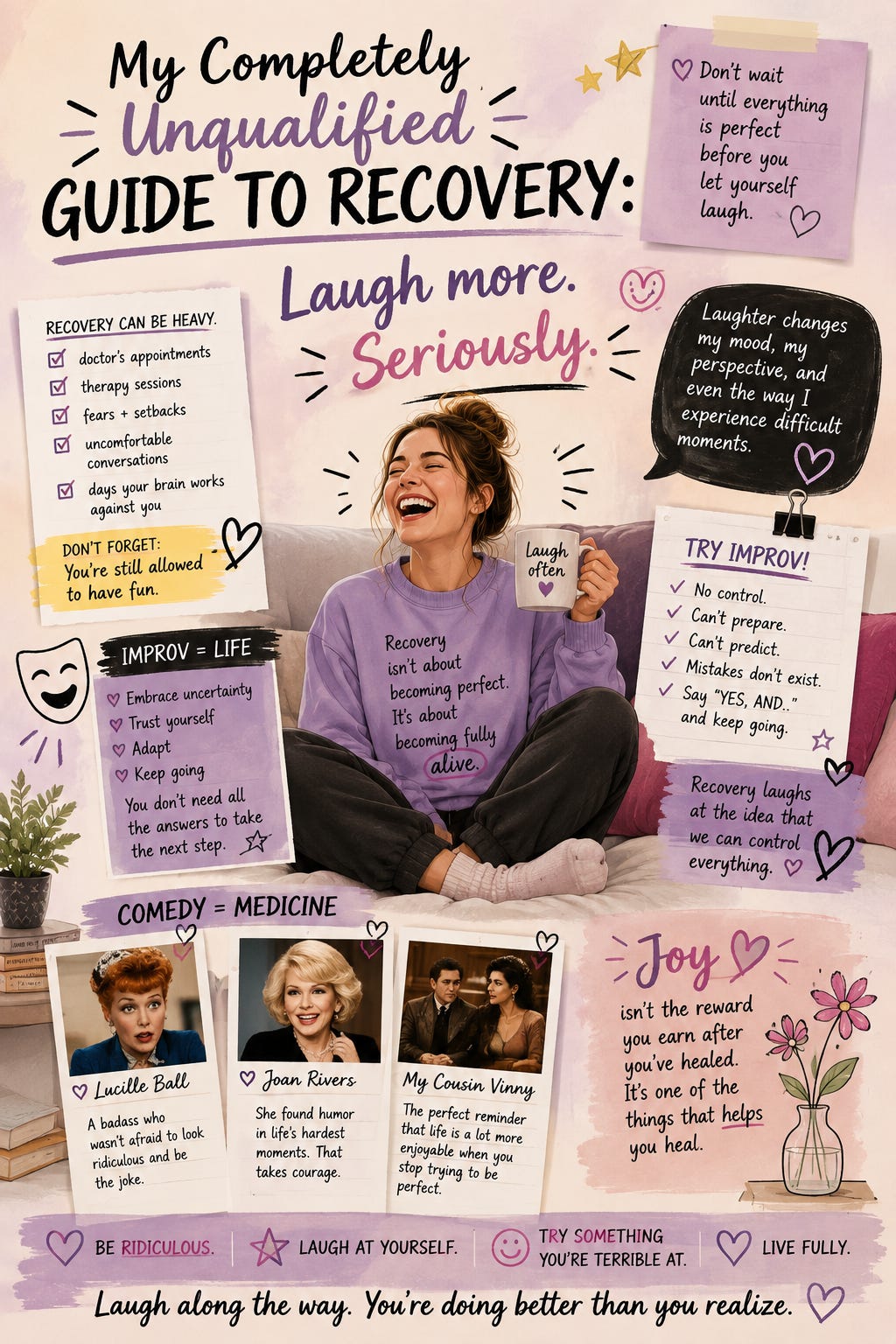
If you asked me what helped me most in recovery, you’d probably expect a profound answer. Maybe mindfulness. Meditation. Journaling. Some magical breathing technique where you inhale positivity and exhale childhood trauma. And while all of those things can absolutely help, one of the greatest forms of medicine I’ve ever found doesn’t come with a prescription. It’s laughter.
I honestly think laughter changes everything. It changes my mood, my perspective, and even the way I experience difficult moments. Recovery can be so heavy. There are doctor’s appointments, therapy sessions, fears, setbacks, uncomfortable conversations, and days where your brain feels like it’s working against you. If we’re not careful, recovery becomes so serious that we forget we’re still allowed to have fun. Somewhere along my own journey, I realized healing doesn’t have to mean walking around looking like you’re carrying the weight of the world. Sometimes healing looks like laughing so hard your stomach hurts.
One of the best things I ever did—and something I think every single person should try at least once—is take an improv class. Especially if you’re a control freak. Actually...especially if reading that sentence made you uncomfortable.
I grew up acting and eventually got into an elite acting conservatory. Looking back, I’m still not entirely sure how that happened. Apparently I had a talent for making up complete nonsense on the spot. The admissions people called it improvisation. My family probably just called it Morgan making things up again.
The beauty of improv is that you have absolutely no control. You can’t prepare. You can’t rehearse. You can’t predict what’s going to happen next. Someone points at you and suddenly you’re pretending to be a dentist treating a giraffe while riding a roller coaster. You don’t get to say, “Hang on, I’d like to prepare a PowerPoint presentation first.” You simply say, “Yes, and...” and keep going.
The funny thing is, recovery works a lot like improv. We spend so much of our lives trying to control every possible outcome. We want certainty. We want guarantees. We want to know exactly how everything is going to unfold before we take the first step. Recovery laughs at that idea. It asks us to move forward anyway. To trust ourselves. To tolerate uncertainty. To keep going even when we don’t know what comes next.
What I love most about improv is that mistakes don’t really exist. If someone forgets what they’re supposed to say, everyone builds on it. If something unexpected happens, it becomes part of the scene. Nobody stops and says, “Well, that’s over. You ruined the whole performance.” They simply adapt. Imagine if we treated ourselves with that same grace. Imagine if every mistake wasn’t proof we were failing but simply an invitation to keep creating.
I honestly think every entrepreneur, physician, therapist, parent, teacher, perfectionist, and recovering people-pleaser should be required to take an improv class. It should count as continuing education. Or therapy. Or at the very least, cardio, because you’ll laugh harder than you’ve laughed in years.
Comedy has always been one of my greatest teachers. Lucille Ball was an absolute badass. She wasn’t afraid to look ridiculous, fall flat on her face, or be the joke. At a time when women were expected to be poised and perfect, she showed the world that vulnerability and silliness could be a superpower. She made millions of people laugh simply by refusing to take herself too seriously.
Then there’s Joan Rivers. Whenever I’m having a bad day, she’s one of the first people I put on. She had this incredible ability to take life’s hardest moments and somehow find humor without pretending the pain wasn’t real. That takes courage. It’s easy to make jokes when life is easy. It’s much harder—and much more beautiful—to laugh while life is messy.
And then there’s what I consider one of the greatest gifts ever given to humanity: My Cousin Vinny. If that movie doesn’t make you laugh, I genuinely don’t know what to tell you. Joe Pesci, Marisa Tomei, the courtroom chaos...it’s perfection. Every time I watch it, I’m reminded that life is a lot more enjoyable when you stop trying to look perfect all the time.
The older I get, the more convinced I become that laughter isn’t the opposite of healing—it’s part of healing. It reminds us to stay present. It pulls us out of our heads and back into the moment. It creates connection. It softens fear. It gives us permission to breathe.
Recovery taught me many things, but one of the biggest lessons was this: don’t wait until everything is perfect before you let yourself laugh. Joy isn’t the reward you earn after you’ve healed. Joy is one of the things that helps you heal.
So take the improv class. Watch the comedy special. Go see stand-up. Be ridiculous. Laugh at yourself. Try something you’re terrible at. Let yourself look foolish every once in a while.
Recovery isn’t about becoming a perfect person.
It’s about becoming a fully alive one.
And if you can laugh along the way, I think you’re doing better than you realize.
Your donation helps fund workshops, educational resources, Roundtables, community outreach, and the media we create to change the conversation around mental health and eating disorders. It also pays for the deeply glamorous behind-the-scenes essentials: production, travel, technology, and approximately one million emails.
No posts
Comments
Nothing yet. Say the first thing.
Sign in to join the conversation.