
People have a lot to say about the lives they never lived.
The older I get, the more I realize our brains are like old computers. We don’t remember downloading half the software that’s running in the background. Somewhere along the way, someone installed programs called You’re not enough, Pretty matters more than smart, and People will like you more if you’re smaller. The scary part? Most of us never clicked “Accept.” We were just kids sitting in classrooms, watching TV, listening to adults talk in kitchens, and absorbing everything around us.
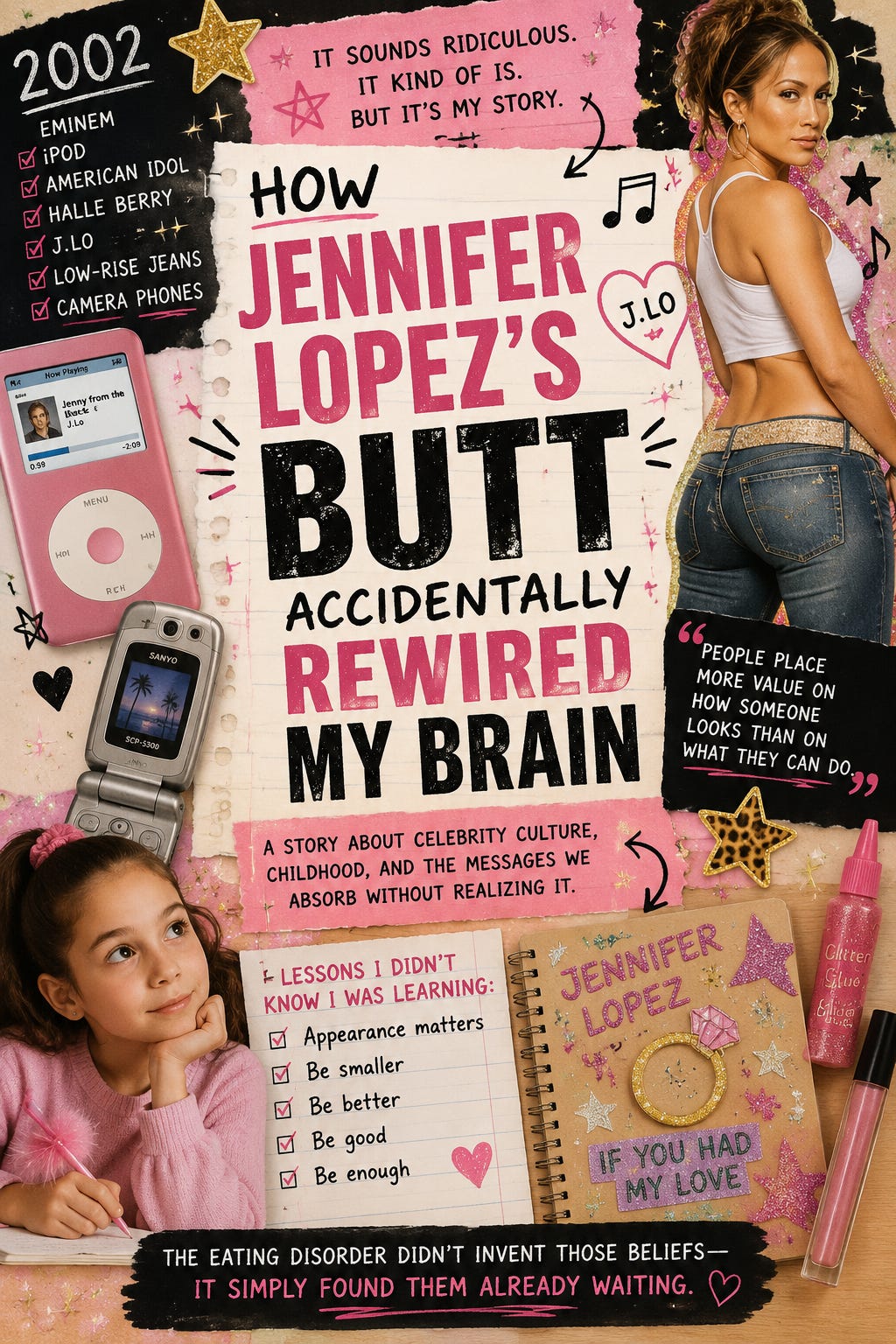
Welcome to 2002.
Eminem’s The Eminem Show was the biggest-selling album of the year. Apple released the second-generation iPod with a mind-blowing 20 gigabytes of storage, and everyone collectively asked, “Who on earth needs twenty gigabytes?” (Answer: apparently all of us, plus 87,000 blurry photos of our dogs.) The first camera phone hit the United States, unknowingly beginning humanity’s long, complicated relationship with taking 47 photos before deciding we “hate every single one.” American Idol premiered. Halle Berry made history at the Oscars. Rosie O’Donnell publicly came out. Michael Jackson made headlines after dangling his son over a hotel balcony. The world felt different, but somehow simpler.
And then there was Jennifer Lopez. Or, as we respectfully called her back then... J.Lo.
Every girl wanted the low-rise jeans, giant hoop earrings, shiny cargo pants, and the newsboy hat. Looking back, I still don’t understand how we all collectively agreed that jeans should sit approximately one centimeter above your pubic bone. It was a fashion choice that required the confidence of a Navy SEAL and the abdominal muscles of an Olympic gymnast.
Everywhere you went, Jenny from the Block was playing.
“Don’t be fooled by the rocks that I got...”
Jennifer Lopez was basically telling us she was still just like us, despite being one of the biggest celebrities on Earth. It was oddly comforting.
That year my fourth-grade teacher assigned us a report on an influential person from New York. Most of my classmates chose Eleanor Roosevelt, Alexander Hamilton, John D. Rockefeller, or Aaron Copland. My mother looked at me and said, “You should do Jennifer Lopez.”
Honestly? Iconic parenting.
While everyone else was presenting historical figures who shaped America, I showed up interpreting the lyrics to If You Had My Love wearing enough pink glitter to violate several fire safety codes. I even glued together my own custom pink diamond ring because... commitment to the bit. Fortunately, my teacher happened to be from the Bronx.
Know your audience.
I got an A.
Even as a kid, though, I noticed something strange. People didn’t just talk about Jennifer Lopez’s music. Or her acting. Or the fact that she somehow sang, danced, acted, and looked like she had eight extra hours in every day. They talked about... her butt. Constantly.
I remember sitting there genuinely confused.
“Why is everyone talking about Jennifer Lopez’s butt?”
It seemed like such an odd thing to become internationally famous for. Here was this incredibly talented woman, and somehow the headline always came back to one body part.
I asked my mom and one of her friends why everyone cared so much. My mom’s friend looked at me and said something I’ve never forgotten.
“You know, Morgan, sometimes people place more value on what someone looks like than on what they can do.”
I remember feeling angry. Not because I understood beauty standards. I didn’t. I was ten. I was angry because it felt unfair. Why should appearance matter more than talent? Why did someone’s body get more attention than their work?
At ten years old, I thought adults had this all figured out.
Spoiler alert... they did not.
Looking back, I realize something important. Nobody sat me down and said, “Morgan, your appearance determines your worth.” Nobody handed me a rulebook. Nobody gave a lecture. Instead, I learned through thousands of tiny moments: the conversations adults had when they thought kids weren’t listening, magazine covers in the grocery store checkout line, television interviews, fashion trends, celebrity gossip, comments about dieting, comments about “good” foods, and comments about “bad” bodies. None of it felt dangerous. It just felt... normal.
That’s the thing about culture. It doesn’t usually scream. It whispers. And when enough whispers happen over enough years, they become your inner voice. For me, those whispers didn’t create my eating disorder by themselves, but they absolutely helped write the code my brain would eventually run. The eating disorder didn’t invent those beliefs—it simply found them already waiting.
If you like what we're building, help us build more of it. Revolutionary concept, I know.
No posts
Comments
Nothing yet. Say the first thing.
Sign in to join the conversation.