
In our culture, there are no rituals around pet loss. Nobody schedules dinner delivery or comes to sit shiva with you. Every one of us has a unique bond with our animal friends, so grief will vary even within a family. Because of all this, it can be difficult to know how to support a friend, family member or colleague grieving the loss of a pet.
Pet loss grief is valid and real. Even if someone’s grief looks different from what you think it "should" look like—it's their loss, and their grief.
Here are six ways to comfort a friend who is grieving an animal—for Father’s Day, or year-round:
Don't minimize the loss. Companion animals, like humans, are not interchangeable. They are sentient beings with whom we share this planet. Each one has unique traits, and each relationship is unique. You'd never walk up to someone who just lost a sibling say, "Well, you can just get another brother." Cats, dogs, horses, rabbits, ferrets and more are family members, and each one is irreplaceable. Saying "It's just a cat" not only shows ignorance of sentient beings; it's also a fast way to create a permanent chasm between you and your grieving friend.
Allow their grief, which may be different than yours. She may not cry in front of others. He may withdraw and need lots of time to himself. They may want to talk about it all the time, or not at all. Some people can't tolerate seeing reminders of their companion around the house, and so they get rid of the beds, scratching posts, ramps, etc. Others leave the food bowls out for a year or more. There is no one right way to grieve, and none of us can judge another person's emotional process.
Offer the type of support they need. There are different types of social support, and what we need varies, depending on circumstances and each individual's personality. Nearly all of us need emotional support when we're grieving (empathy and nurturing). Some people may benefit from practical assistance—bringing them dinner, driving them to pick up their animal’s ashes, or making an urn. There's also informational support (sharing of objective information—not to be confused with giving advice) which may be desired (or not) when someone is dealing with a pet’s severe illness. Sharing your own experience can be helpful, but be careful to keep the focus on your friend and her needs. Avoid giving advice unless it's specifically requested.
Share pet loss resources. Since I first wrote this article in 2018, a number of pet loss grief resources have emerged. Consider sharing Beth Bigler’s IG account, Honoring Our Animals, where she offers wisdom and a monthly group for pet loss grievers. Or send a link to Best Friends Animal Society’s Angels Rest. For those grieving the loss of a doggo, share my interview on Dog Words (still one of my all-time favourites). And, of course, you can always give them P.S. I Love You More Than Tuna, for all species.
Honor the animal’s memory. Make a donation to a rescue in the memory of a friend’s beloved pet. Make a video, an urn (with permission), artwork or a scrapbook. Show the bereaved that you understand the depth of their loss.
Respect the person's spiritual beliefs (or lack thereof). Whether you think the animal is waiting for her human at the Rainbow Bridge, or has become a part of all living things; whether you believe he will reincarnate in another form, or is simply gone for good—none of that is relevant. What does matter is what the grieving individual believes. This is not the time to debate whether or not one belief system is right and another wrong.
Reflect back to the person how much they loved and cared for the animal. This may sound simple, but it might be the most important item on this list. Because so much of our relationship with pets happens away from other humans, it can feel like nobody understands the depth of our grief, or just how much we loved them, or the sacrifices we may have made. By simply witnessing the depth of their love, their loss and their grief, you are giving them the gift of being seen.
Focus on their loss, not your own. While it’s tempting to say “I know what you’re going through,” the truth is, that phrase is more for our own comfort than the other person’s—we want to feel like we’re being helpful; our ego wats to believe that we’re making a diffeerence. On top of that, sometimes it’s difficult to witness another’s grief, and we might say those things as a way to our own feelings of discomfort. Yet each bond is unique. Try to avoid talking (too much) about your own losses, and focus on your friend’s.
Nothing can take away someone else's grief, and it’s not something that needs to be "fixed." Grieving is a natural process, a part of healing and moving forward into a life that's a bit different now.
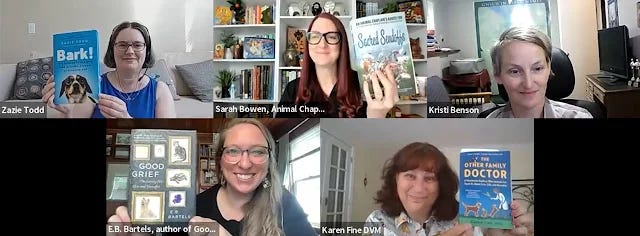
Another way to support a friend grieving the loss of a dog, cat, horse, bunny, or other animal is to share with them this BARK!fest panel on loving and losing a pet, which is now available on YouTube. Hosted by Zazie Todd, PhD, creator of Companion Animal Psychology and moderated by dog trainer and northern anthropologist Kristi Benson. Here’s what you or your friend(s) will find:
Loving pets means thinking of them both in life and after their loss. In the poignant and personal Good Grief: On Loving Pets, Here and Hereafter, E.B. Bartels takes us on a global tour of how we love and mourn our pets. Sarah Bowen shares her deep insights on the lives and loss of all animals—pets and wildlife—in Sacred Sendoffs: An Animal Chaplain’s Advice for Surviving Animal Loss, Making Life Meaningful, and Trying to Heal the Planet. And Karen Fine DVM’s heartwarming memoir about becoming a veterinarian, The Other Family Doctor: A Veterinarian Explores What Animals Can Teach Us About Love, Life, and Mortality, is full of tales about what we can learn from the animals in our lives.
The conversation includes these highlights:
The way that grief for a lost pet is often disenfranchised
What an animal chaplain is and why Sarah Bowen wrote her book Sacred Sendoffs
Blending science with spirituality, and practical tips to help when someone loses a pet
What it's like being a veterinarian, how Dr. Karen Fine was influenced by her grandfather, and why she wrote The Other Family Doctor
The value of making home visits as a veterinarian, and helping other pets cope when one of their fellow pets has passed
Why E.B. Bartels wrote her book Good Grief and what she learned about how people memorialize their pets, including taxidermy and mummification
Plus each author reads from their book
If you haven’t already read Dr. Fine’s The Other Family Doctor, I can’t recommend it highly enough.
Thank you for reading this edition of the More Than Tuna newsletter. I understand you’re probably swamped with emails, and that makes it all the more meaningful that you took the time to read this. If you found this post helpful, here are four simple ways to support Tuna and this Substack:
Give P.S. I Love You More Than Tuna to a friend, family member or colleague who is grieving an animal friend.
Subscribe to this Substack, if you don’t already
Upgrade to a paid subscription (bonus: you’ll be supporting a Canadian 🇨🇦!)
Click or tap the heart icon to like this post
Share this post by ‘restacking’ (use the ‘quote’ function to say what helped you the most about this post)
Leave a review wherever you purchase the book
Forward this email to a friend or share the link on social media
No posts
Comments
Nothing yet. Say the first thing.
Sign in to join the conversation.