
A disclaimer: this Substack has sixteen subscribers at the time of writing this (hi mom!) so while I mention some products here, I do not receive any compensation from the respective companies.
Welcome back! This post is about my journey with AI, and why it has led me to start writing for fun.
I will never forget my first interaction with ChatGPT. We were having a mini family reunion and had rented an Airbnb in Florence, Oregon. It was a classic Oregon day: the sun was nowhere to be found and while it didn’t rain hard, it just felt wet. We were inside playing cards and chatting. I don’t quite remember what — either a text from a friend or just seeing it pop up in the news — but something brought my attention to ChatGPT. The hype was immense, so I decided to take a look. I was awestruck at first prompt. I knew I had to share this with my family but wanted to have some fun with it. So I gave ChatGPT some personal information about my Uncle Jim (such as where he works, what he likes to do, etc) and asked it to write a poem about him. I have some interest in poetry and my family knows this.1 I told them that I had written a poem about Uncle Jim and would like to read it. I recited the ChatGPT-generated poem to my amused family, who had not the slightest idea I was not the author. The poem was filled with details about Jim’s life. Almost more importantly, it felt and sounded like real poetry. They were all in disbelief when I told them I had “an AI” write this and the whole thing took less than five minutes.
Fast forward to the start of 2025 and my life hadn’t changed much as I would have expected on that dreary Oregon day. Yes, I was getting some writing tasks done faster, brainstorming with it occasionally, and used it sporadically for random things. But overall: LLMs had not made a dramatic impact on my life. That changed in mid-2025, when I left my job at a large financial institution. At the time, the “cutting-edge” AI tools had not made much headway at the company (for good reason given their sensitive data) so I had not been using AI at work. After leaving, I started educating myself on new AI tools and started to use ChatGPT to help me code some personal projects. I was shocked at how good it was. So much so that it accelerated a career pivot for me as I realized my expertise in R syntax would just not be as valuable in the coming years.
Fast forward again to today — Feb 1st, 2026. I look back at coding with ChatGPT in July of 2025 as if it were the Stone Ages. I now use Claude Code, which involves much less copy and pasting. And frequently, I am not even typing.2 I use wisprflow, which intelligently does voice-to-text to prompt Claude Code to write a lot of my code. Wild. On a more basic level: I am using LLMs for way more day-to-day tasks that I would have Googled in the historic days of early 2025. Instead of sifting through 1,000 ads to get to a recipe, I take a picture of what six sad ingredients I have to work with and ask ChatGPT for a suggestion.3
My perception of time has been distorted because of how quickly things seemed to move in 2025. I felt (and feel) like I am constantly behind on new AI tooling. Over the holidays, I was finally able to slow down and reflect a bit. I had a realization: AI has been great for my productivity but bad for my attention span and possibly is making me worse at some things (like writing). I get things done faster but go less deep on the things I am getting done.
I first became aware of issues with my (and society’s) attention span in 2020 — inspired by a popular movie, The Social Dilemma. I was looking at Instagram too much. I concluded that the only defense I had against their army of data scientists trying to hook me was to not use the product altogether. So I deleted (not logged out/deactivated) my Instagram, Facebook, and Twitter accounts.4 In his 2024 book, The Anxious Generation, Jonathan Haidt provides a detailed account of how GenZ have suffered immensely from heavy social media use at crucial points during their childhood. In the book, Haidt quotes Nicolas Carr:
Once I was a scuba diver in a sea of words. Now I zip along the surface like a guy on a Jet Ski.
Carr said this in his 2010 book and was referencing “internet reading” in general, lamenting the loss of his own ability to focus. The quote is perhaps even more relevant to today with AI. Now, the sea of words is endless and expanding rapidly. While AI is undoubtedly making me more productive in many regards, I fear it is harming my attention span in a different way than social media. I started this Substack because since my life became “AI-ified,” I do not write as much. Routine writing tasks (such as editing emails or documents) are delegated to a LLM. In general, this is good for my productivity because spending time on routine writing tasks costs precious time. However, I am worried this will make me a worse writer over time. I may already be losing my grasp on what was my voice. A friend that read a draft of this commented that I sound a bit like AI — and not just the em-dashes. Ethan Mollick recently tweeted about this, and it’s not just me that is starting to sound like AI. If my writing sounds like AI, it reinforces my conviction that I need to write. For a similar reason, I have started to spend more time reading again.
As far as my attention span goes, AI is having a different impact than social media. What makes AI different is that it takes what were previously difficult and/or time-consuming tasks and gives you an answer quickly. So many hard things are so much easier and it becomes tempting to rely on AI for all kinds of tasks. Things that a few years ago would have taken real “blood, sweat, and tears” to get done. This is exactly the problem: to gain knowledge we need struggle. Scott Cunningham gave a talk about Agentic AI in Economics Research (slides) at the Fed recently and had a nice diagram to sum up the issue:
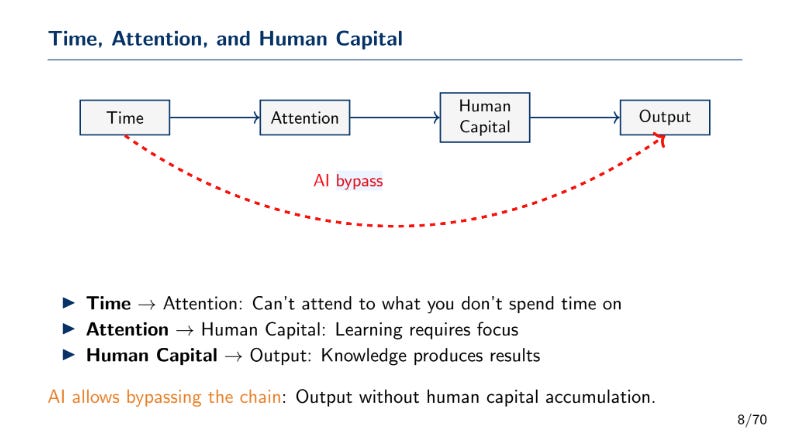
Scott goes into more detail and comes to a lot of thoughtful conclusions. He even titles the first section of the talk “The Paradox: Why Better Technology Can Make Us Worse Off.”
The struggle (attention + time) is why we make students sit with difficult texts. The specific content of the texts is less important sometimes than the mental pushups you need to do to understand the content. Not anymore. No more pushups. You can now ask “explain this paragraph of X to me in simple terms,” and get a sensible answer on a wide range of topics. To be clear, I have benefitted immensely from doing exactly this. In many cases, it has helped my understanding because it can phrase things in ways that are easier for me to understand. But long term, what does this mean for my acquisition of skills? In a 2025 paper titled, Protecting Human Cognition in the Age of AI, the authors break down the mechanisms through which we might lose out on learning via AI.
Dewey argues that reflective thought is most essential for deep and meaningful learning, and describes several prerequisites for it:
A state of perplexity, confusion or doubt prompting inquiry
Prior experience and knowledge to draw upon
Active, persistent consideration of ideas
Suspended judgment during further inquiry and a tolerance for uncertainty, or “mental unrest and disturbance”
The ability to connect and evaluate related ideas GenAI can potentially disrupt these prerequisites in several ways.
This is a great paper and I highly suggest reading it. It is easy to see how AI reduces our engagement with the different dimensions of “deep and meaningful” learning.
A lot of research has been done on AI’s impact on cognition. Some studies, like Your Brain on ChatGPT: Accumulation of Cognitive Debt when Using an AI Assistant for Essay Writing Task from MIT researchers measure the impact of an LLM on brain activity when doing a task and finds that LLM usage reduces neural activity compared to standard internet search or not using the internet. Other papers use different methods but come to a similar conclusion: AI reduces cognitive load.5
All of the studies though are (more or less) studying the short-term impacts of AI on cognition. We have not had a long-term yet. These are new technologies that have seen rapid adoption. A lot of folks are voicing concerns and emphasizing the importance of how we use AI to mitigate long term consequences to skill building. For educators and teachers, this is a reasonable call-to-action. I am less optimistic that we can expect people to use these things in a way that will be beneficial for their “deep” learning in aggregate. AI is the easy button, for almost everything. I am still learning when to hit the button and when to hunker down and grind through something. Asking people to make the easy button a little bit harder “because it is good for them” just does not strike me as a viable (read: scalable) strategy.
I’ll conclude by saying I wrote this post because AI has fundamentally changed the way I work. I am getting more work done and able to cover ground faster than ever before. The speed at which I can bring my ideas to life and execute is still hard to believe. It really is exhilarating. However, I believe embracing some caution may be prudent for my own knowledge and skill-building. Despite getting more done, my own understanding of what I am doing is often shallower. With learning, there is a tradeoff between depth and speed, and with LLMs we have put our feet on the throttle. I will leave you with an Opus-4.5 generated haiku about this post.6
Words once hard-won fade—
machines think, fingers grow still,
yet the pen calls back
I thank Russ Roberts of EconTalk for my appreciation of poetry. A fantastic episode with Dana Gioia sparked my interest in poetry. Gioia’s poem, Meet Me at the Lighthouse is still to this day my favorite. I strongly suggest you listen to this poem. It will hit different than just reading it.
This post, and all of my other posts, do not use voice-to-text. AI is only used for spell checking, grammar suggestions, or included when explicitly stated.
For another fun use of AI that seemed impossible when we “just” had ChatGPT: My friend used an LLM to write a song about housing regulations and unaffordable housing in SF. It’s like the YIMBY anthem.
Somewhat ironically, this Substack is giving me an incentive to get back on social media to promote my posts. I will hold off for now.
See footnote 2 about AI usage in my Substack posts.
No posts
Comments
Nothing yet. Say the first thing.
Sign in to join the conversation.