
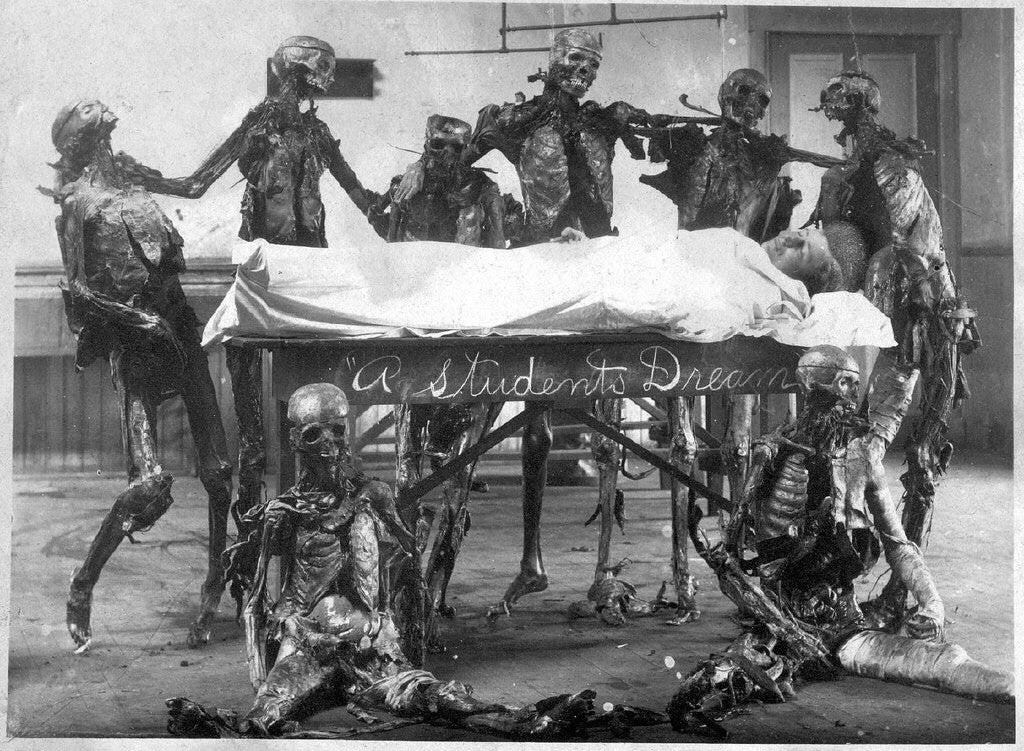
It was taken sometime around 1905 or 1906.
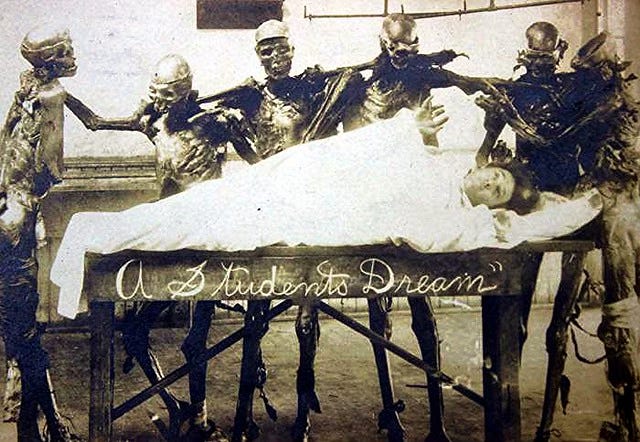
Six cadavers—in various states of decay—are meticulously positioned around a dissection table.
On the table, flat on his back as though waiting to be opened up, is a living medical student. Bald. Comfortable. Playing along.
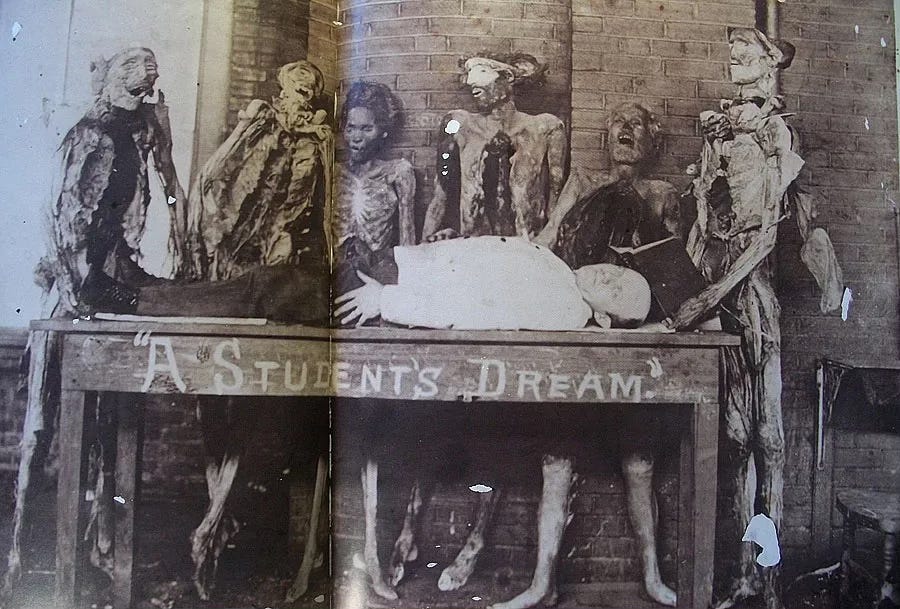
Chalked onto the table beneath him, in the casual handwriting of someone who found this genuinely funny: A Student’s Dream.
I stumbled across this image recently and couldn’t stop staring at it. Not because it was grotesque—though it is—but because of what it reveals about the world that produced it. And this wasn’t a one-off photo… there are many.
These photos weren’t rare.
They weren’t scandals.
Between 1880 and 1930, dissection room photography was a rite of passage in American medical schools. Students posed with cadavers the way other young people posed with friends. Some sent them as Christmas cards. NPR
This would end careers today. And it should.
But I’m less interested in the dark humor of the time than in the question hiding right beneath it.
Those cadavers had to come from somewhere…
Here’s something that doesn’t get talked about enough: for most of American medical history, there was no legal way to donate your body to science.
Sounds simple, right? You die. You want to help. You sign a form.
That system didn’t exist in any meaningful way until after World War II. The Uniform Anatomical Gift Act, which established a donor’s wish as legally binding, wasn’t passed until 1968. History
Before that, medical schools were largely on their own. The law offered almost nothing. The only officially sanctioned source of cadavers was executed criminals EBSCO—and there were never enough of them.
Medical programs were growing. Demand was climbing. And the gap between what the law allowed and what medicine needed kept widening.
So schools filled the gap the only way they could.
They bought bodies.
And they didn’t ask where those bodies came from.
According to Dr. Michael Sappol, senior historian at the National Library of Medicine, nearly every medical college of the era relied on body snatching. The EDU Ledger Not just a few rogue institutions. Nearly all of them.
“If you go through the history of any medical school in the year 1882,” Sappol has said, “there will be some newspaper scandal—rumors or a court case or riot or something—relating to the acquisition of cadavers.” The EDU Ledger
The people doing the digging were called resurrectionists.
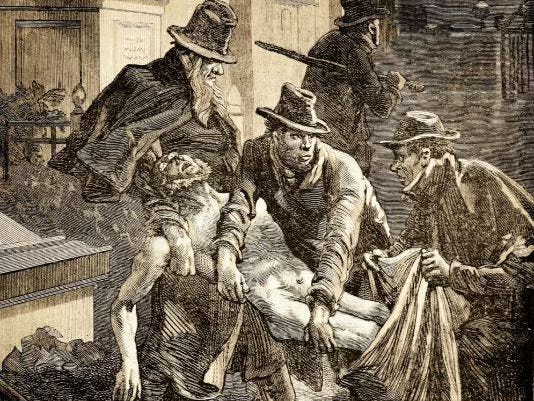
Also: ghouls, buzzards, night doctors.
They worked fast, worked quiet, and sold fresh bodies to anatomy labs that paid well and asked nothing.
Not one of those cadavers in those dissection photos—not a single one—had consented to be there. PubMed Central
The students signed their names on their smocks, chalked their hometowns into photos, made sure history would remember their faces. The bodies on the tables remained nameless. Entirely anonymous. In some cases, deliberately so.
That anonymity wasn’t accidental.
When body snatchers needed graves to rob, they didn’t choose randomly.
In 1780s New York City, the vast majority of bodies ending up on dissection tables were Black—despite Black people comprising only around 15% of the city’s population. Mutter Museum
The pattern held across cities, decades, and institutions. Black graveyards were targeted at a far higher rate than white ones. Black communities tended to be poorer and lacked the social and legal protections afforded to white communities. Black cemeteries were geographically isolated, further from city centers, and less guarded. Mutter Museum
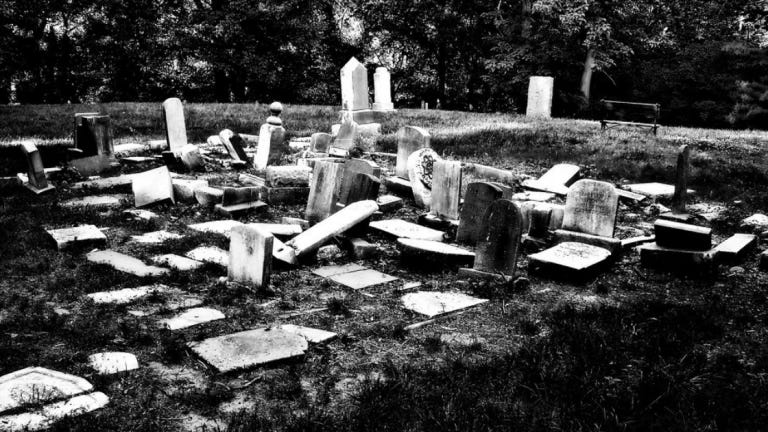
The poor were targeted too.
By the mid-1800s, some states passed laws allowing medical schools to claim unclaimed bodies… the indigent, the imprisoned, the institutionalized. Collegeofphysicians
The message was clear, even if unspoken: respectable people’s graves were safe. Everyone else was a resource.
And nowhere does this story get darker than in Augusta, Georgia.
In 1852, the faculty of the Medical College of Georgia pooled their money and purchased a man.
His name was Grandison Harris.
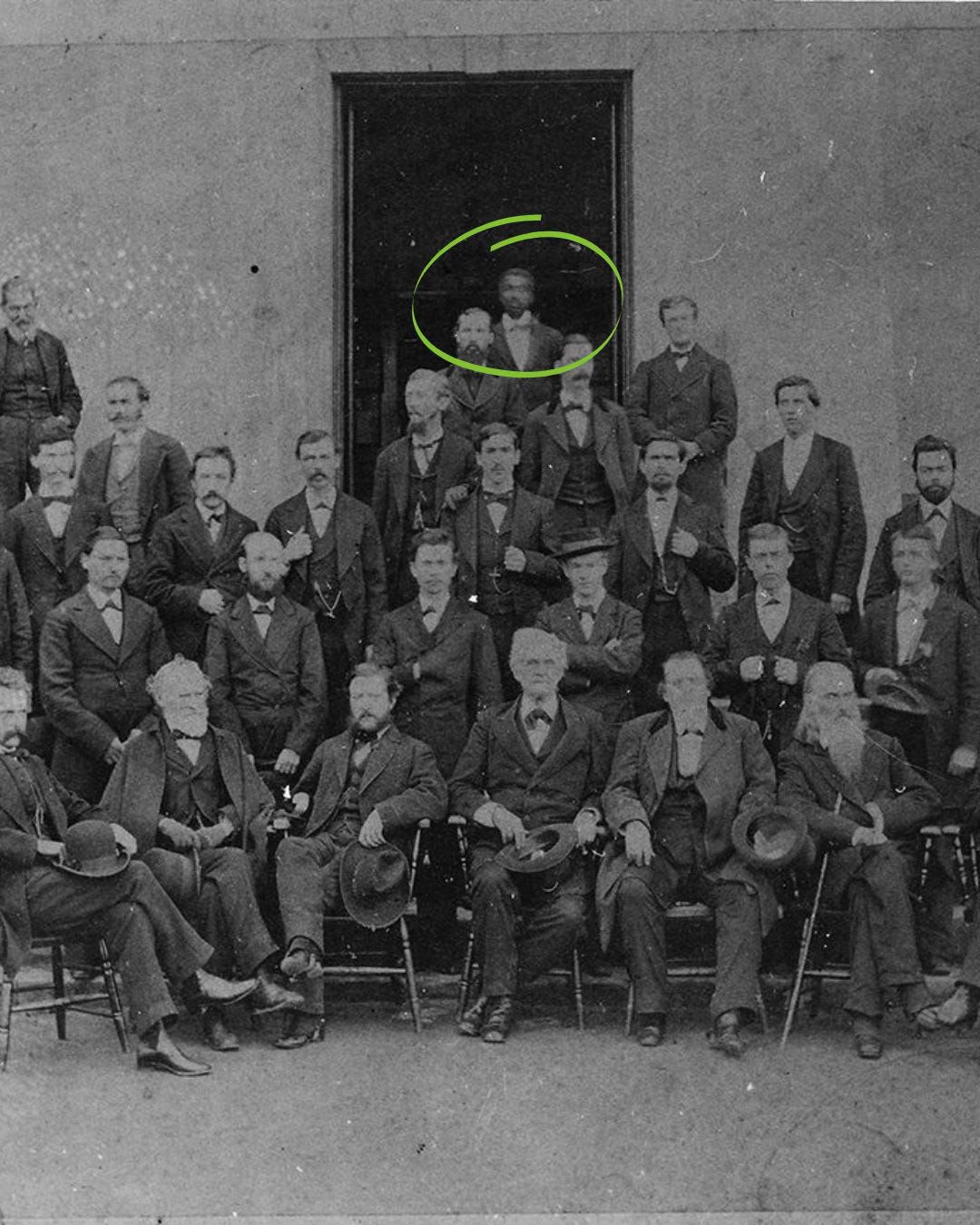
Harris was a Gullah slave, bought at auction in Charleston, South Carolina, and owned jointly by all seven members of the school’s medical faculty. Smithsonian Magazine His official title was porter and janitor.
His actual job was something else entirely.
The faculty taught Harris to read and write—illegal for enslaved people in Georgia at the time—so that he could monitor local obituaries and funeral announcements. Smithsonian Magazine He would note the names. Visit the graves beforehand. Memorize the flower arrangements, the placement of every object on the mound.
Then he would return at midnight, crack open the coffin, haul the body out, replace everything exactly as he’d found it, load the corpse in a sack, and deliver it to the lab before sunrise.
His preferred hunting ground was Cedar Grove Cemetery, which was Augusta’s burial ground for the Black and the poor. It had no fence, no guard, and people there were interred in plain pine boxes so thin they were called “toothpicks.” Smithsonian Magazine
The bodies were preserved in whiskey. Dissected by students. The remains were chopped and buried in the building’s basement under quicklime to mask the smell. In 1989, a construction crew renovating the old building discovered thousands of bones beneath the floor. The Bell Ringer
That’s how the story finally came to light.
Harris robbed graves first as a slave, then, after emancipation, as a paid employee, for over fifty years. He died in 1911 and was reportedly buried in the same ground he’d spent decades raiding… Cedar Grove Cemetery. Smithsonian Magazine
Yet, as strange and unhinged as this whole setup sounds, he was not unique.
At the Medical College of Virginia in Richmond, a man named Chris Baker played the same role from the 1860s until his death in 1919, stealing cadavers from Black cemeteries and delivering remains to a well beneath the campus that became known as the “limb pit.” Atlas Obscura
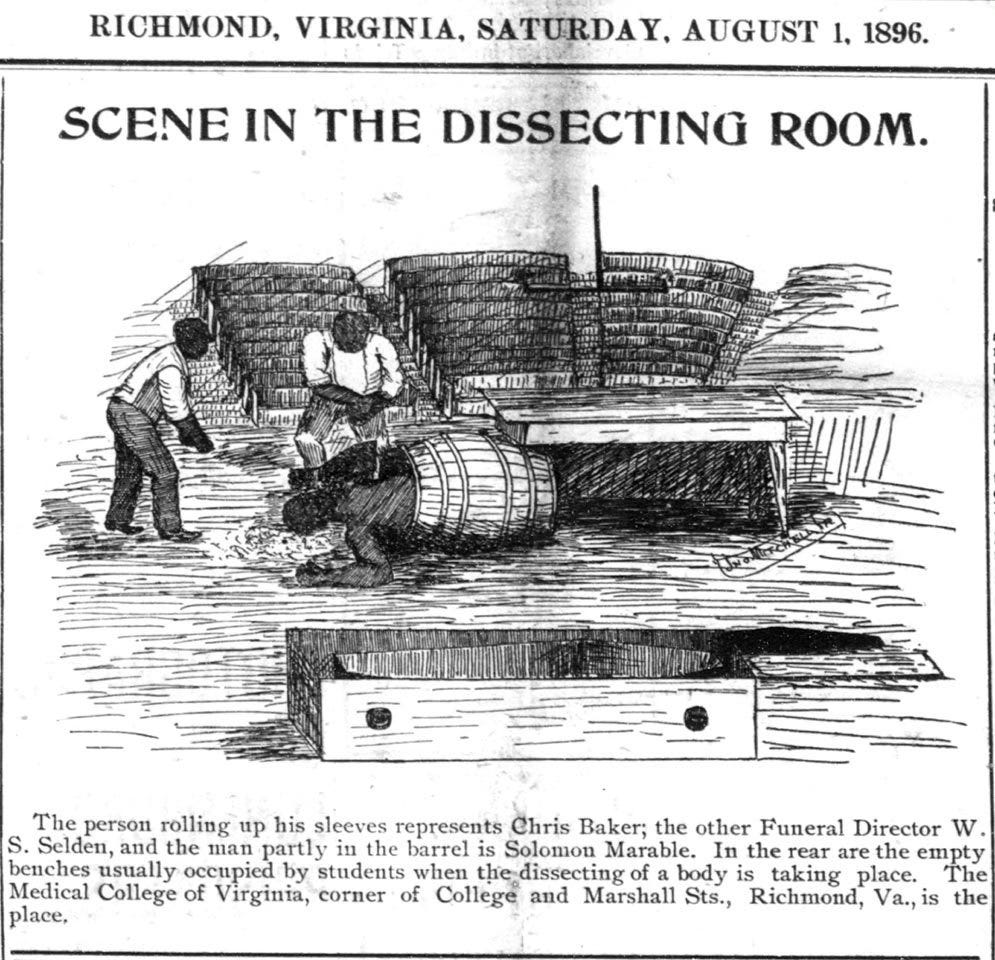
Black children in Richmond grew up being warned not to go near the medical school after dark.
The boogeyman was real.
And he had a paycheck.
Go back to that image we began with.
The living student on the table. The cadavers arranged around him like colleagues. The chalk inscription.
A Student’s Dream.
It’s funny if you don’t ask the next question.
Whose dream required whose body?
As one historian has put it, those bodies were subjected to “a complete destruction of identity and dignity... rendered possible through casual racism, and all in the name of science.” JSTOR
The students in those photographs knew, on some level, where their cadavers came from. The schools knew. The cities knew. It was, as one account puts it, an open secret—especially in the Black community, where it was simply called what it was: theft.
Medical knowledge advanced. That’s real, and it matters. But the question worth sitting with is at whose expense that knowledge was built. And just who exactly decided those bodies were available for the taking?
Virginia Commonwealth University officially apologized for this practice in 2022. In early 2023, Virginia lawmakers failed to pass a resolution formally acknowledging it. The Conversation
Progress is slow. History is patient.
And the names of the people in those basements?
Still mostly unknown.
History can be a lot of things…
…including MORBID.
-Thomas Gloom
Comments
Nothing yet. Say the first thing.
Sign in to join the conversation.