
When we think of courage, we often picture dramatic acts—running into burning buildings or taking life-or-death risks.
But there’s another kind of courage, one that happens in the everyday moments of our lives, often unseen and uncelebrated: moral courage.
Moral courage is the willingness to stand up for what is right, even when it’s uncomfortable, unpopular, or risky. It’s speaking out against injustice, challenging unethical behavior, and refusing to compromise our values—even when silence feels safer.
It’s not about grand gestures. It’s about integrity in action.
In high-stakes professions like healthcare, law, education, and social work, ethical dilemmas are unavoidable. A doctor might be pressured to rush through patient care due to time constraints. A teacher may witness discrimination in their school system. A researcher might see data being manipulated to fit a preferred outcome.
Fear is a reaction, but courage is a decision.
In these moments, moral courage is what separates passive complicity from active integrity. It’s what allows individuals to advocate for their patients, students, clients, or communities—even when there might be a price to pay.
I’m not going to lie—practicing moral courage can be hard. It often carries potential personal and professional risks. Speaking up can mean losing opportunities, facing retaliation, or feeling isolated. So why do it?
Because without moral courage, injustice thrives, harm continues, and our own sense of integrity erodes.
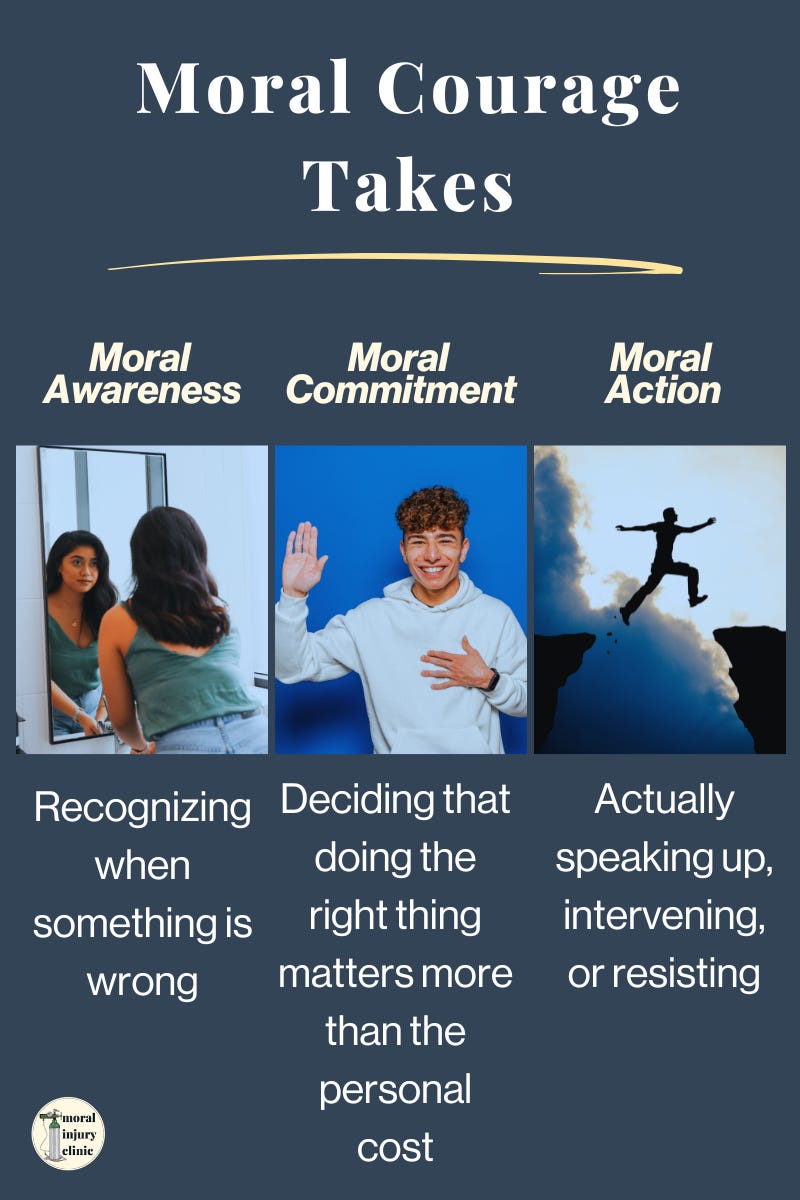
Moral courage isn’t just about taking a stand. It has three key elements:
Not every ethical issue is black and white. Many injustices are normalized, hidden, or framed as “just the way things are.” Developing moral awareness means sharpening our ability to recognize harm, even when it’s subtle.
It’s one thing to see a problem. It’s another to decide that you cannot ignore it. Moral commitment is the point where you choose to act, even if it’s inconvenient or risky.
Knowing what’s right isn’t enough. Feeling strongly about it isn’t enough. Moral courage requires action—whether that’s reporting misconduct, questioning unethical policies, or refusing to participate in harm.
Moral courage isn’t something you either have or don’t. It’s more like a muscle.
Moral courage is a skill you can strengthen.
Here’s how:
What are the ethical principles that matter most to you? Fairness? Honesty? Compassion? Clarity on your values makes it easier to recognize when they’re being violated—and to take action.
Not sure what your values are? Here’s a free assessment tool to identify some of the values that stand out for you.
You don’t have to take on massive injustices right away.
Practice moral courage in everyday moments: correct misinformation, challenge biases, or offer support to someone being mistreated.
Speaking up is easier when you’re not alone. Seek out colleagues, mentors, or advocacy groups who share your values and can provide support.
Not everyone will welcome ethical challenges. Expect pushback - frankly, when I get pushback for doing what I think is right, I know I’m on to something important. Prepare responses. Know your rights. Having a strategy can help you navigate difficult situations with confidence.
Each time you take a stand—whether the outcome is positive or not—reflect on what worked, what didn’t, and what you’d do differently next time.
Growth happens in the learning process. These reflections help us grow into our courage.
It’s tempting to stay quiet, to do nothing. To tell ourselves it’s not our fight. To believe that someone else will step up.
But silence has consequences. When we fail to act, we contribute to harm, injustice, and the erosion of ethical standards. When we miss courageous opportunities, we often feel it in our bodies. Failing to act can lead to moral injury.
Finding even the smallest ways to make a difference protects ourselves and our moral communities.
Moral courage isn’t about being fearless. It’s about feeling the fear and acting anyway. And in a world that often rewards compliance over integrity, it’s one of the most powerful forms of resistance we have.
So the next time you see something that challenges your values, ask yourself: What would moral courage look like in this moment?
Then take the step that aligns with who you truly are.
Who does this post remind you of? Who is morally courageous in your life? Send this to them and start a conversation. 💪
Comments
Nothing yet. Say the first thing.
Sign in to join the conversation.