
In my ethics consultation practice, it’s not unusual to hear from patients, healthcare workers, or administrators with dramatic stories where the person on the line has reached some conclusion and is looking for validation that they are correct. Sometimes, they are even looking for someone to share and amplify their righteous anger.
I’ve been thinking about how easily we fall into reliance on one perspective - our personal perspective. We manifest a single story of what happened and why it happened and what it means. And I’ve been thinking about how this sometimes fuels our moral distress.
The single story of a patient who “just won’t take their medication.”
The single story of a colleague who “doesn’t care about the patient.”
The single story of a hospital policy that “can’t be changed.”
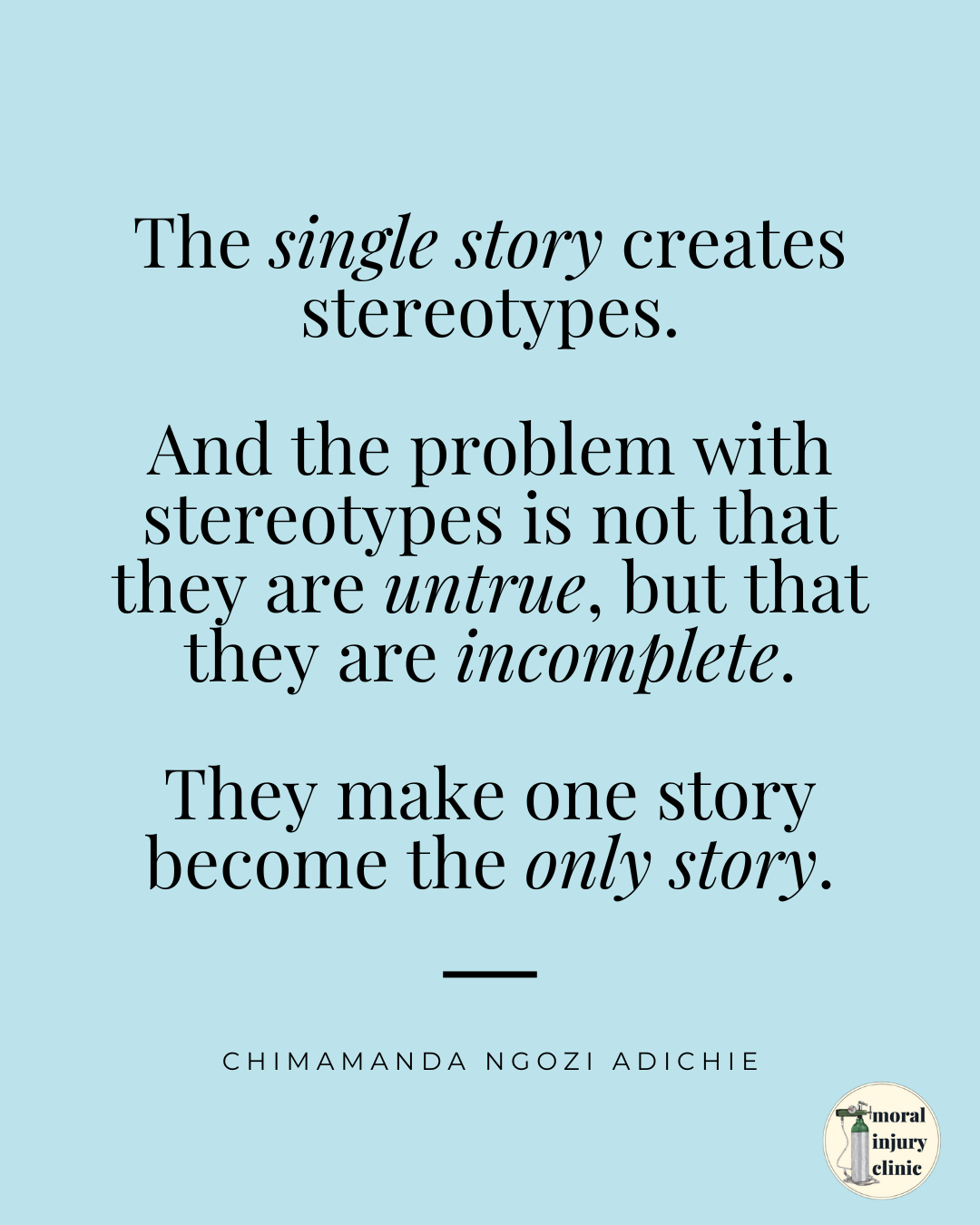
The danger of a single story, as writer Chimamanda Ngozi Adichie once said, is not that it’s entirely wrong - but that it’s incomplete.
When our understanding is incomplete, our moral intuition can point us in the wrong direction.
Moral distress often begins in this gap - the gap between our current reality and what we know to be right and true. We know what reality should be, but find ourselves constrained by policies, hierarchy, or limited resources. Sometimes, this constraint is fueled by our own assumptions. We make assumptions about others’ motives, what we believe a policy says, or by a rumor we heard from our friends or colleagues. That dynamic tension between ethical conviction and external constraint is painful, persistent, and exhausting.
Perspective taking, though, offers an opening.
It’s the discipline of looking at a situation beyond the perspective you have right now. Looking through someone else’s perspective. It doesn’t mean you must agree with that person’s perspective, and it doesn’t mean surrendering your moral stance.
It does mean temporarily suspending judgment long enough to recognize what someone else might be seeing.
Empathy is about feeling with another person. Perspective taking is about thinking with them.
It’s a cognitive skill - one that can be practiced and strengthened. Researchers describe it as the ability to mentally put yourself in another’s situation to understand their thoughts, feelings, and worldview. This can mean collecting and evaluating evidence as a perspective - such as documents, published research, and policies.
Perspective taking helps us:
Understand another’s mind, not just absorbing or reflecting their emotions.
Incorporate source materials to verify or challenge underlying assumptions.
Communicate more clearly to resolve disagreements.
Reduce bias by recognizing how experiences shape our values.
Strengthen our social and ethical reasoning.
Unlike empathy, which can be draining when used as our primary resource, perspective taking provides some balance by drawing on our cognitive flexibility. I see empathy and perspective taking as beautifully complementary. Using cognitive reasoning helps us pause, reflect, and understand without being overwhelmed by someone else’s distress and making it our own.
In a morally complex environment, that balance matters.
Moral distress arises when you know the right thing to do but cannot act on it. In healthcare, education, law, and other fields, it’s often made worse by conflicting professional values and poor communication. I’ve also found that rumors can escalate moral outrage. Sometimes, the folks most impacted by a situation are not the ones with the most distress. The people with the least information about the situation are those with the greatest distress.
A 2021 study in the Journal of Interprofessional Care explored this dynamic among pediatric intensive care staff. Nurses and physicians were asked to rate their moral distress after reading a case from their own perspective - and again after reading it from the other profession’s perspective. Nurses who spend the majority of their time in close personal contact with a small number of patients bring a different perspective than physicians who are overseeing multiple aspects of care for many patients. The results were striking: nurses’ moral distress generally declined after reading the physician’s reflection. They found that physicians in the study were already aware of nurses’ perspectives. This highlighted perspective-taking as particularly beneficial to teams with strong relationships and that can work together towards common goals.
Understanding doesn’t erase disagreement, but it shifts the emotional load. When we realize that another person’s choices stem from values or constraints different from ours, rather not from neglect or disregard, our distress transforms. What was once moral outrage can be flavored by moral curiosity.
Information gathering and perspective taking are not passive. It’s an active moral practice that helps us build resilience and restore collaboration.
Perspective taking and moral reasoning develop together. Ideally, as we mature, our moral decisions rely less on rigid rules and more on fairness, empathy, and context.
Children learn early that other people have separate thoughts and desires. Adults deepen that skill by learning how context, such as social roles, power, history, influences what we see. Cognitive neuroscience shows that perspective taking activates brain regions linked to self-regulation and planning.
In plain terms, it helps us think before reacting.
The better we get at perspective taking, the more sophisticated our moral reasoning becomes. We can hold multiple truths at once - our own and others’ - without losing our integrity.
Thanks for reading The Moral Injury Clinic! This post is public so feel free to share it.
Kowalek K, Bochatay N, Ju M, Van Schaik S. The impact of interprofessional perspective-taking on moral distress in the pediatric intensive care unit. J Interprof Care. 2021 May 25:1-8. doi: 10.1080/13561820.2021.1892613
Comments
Nothing yet. Say the first thing.
Sign in to join the conversation.