
I set out to write a book about my family. Over the years, I felt an on and off again nagging to write it. It oscillated between being stirred by outrage at how outright absurd and dramatic the stories were, and genuine reflection, wanting to understand the falling outs and hurt. I began to draft what I thought was a very clean way to narrate our story, as if it was a TVB drama that though had its ups and downs, could still be wrapped up neatly. Honestly, I was quite proud at how I knit all the pieces together and how cohesive it all felt. I was making sense of my history and this made me feel like I could understand why it happened and that the pain had a purpose.
My father at one point asked me if I would be writing a memoir and I sat with that question, wondering what the alternative would be. Truth, at the end of the day, required a true telling of the goings-ons and happenings. Memoir it must be? He convinced me that with so many characters in our family having since passed on, it would potentially expose me to jabs about the truth-worthiness of my writing, perhaps being relegated to hear-say or gossip and as a result, tossed to the side. And so I began exploring what it could look like to fictionalize our story. A novel. I rationalized, for instance, that there were simply too many characters and that it would make it easier for readers to follow if I condensed some of them into a few. The rationale felt reasonable and respectable.
Before beginning to write, it seemed I was already beginning to lose the plot. To be clear, the plot synopsis was there and written. I was excited about it and it felt interesting, but something felt off. As I began, it felt like I was scratching at the surface. I didn’t like it. I took a break to explore other topics, to try writing without the pressure of forcing the story for this book. And as I wrote about wandering and doodling, I felt better. It felt more authentic, soothing even, to be able to put to words things that had been swirling in my mind. It gave me a way to organize the chaos of my thoughts. I loved how cleverly a last sentence could emerge and how naturally, a neat little bow would appear as if out of thin air. It felt like I was experiencing the elusive state of “being in flow”. And I realized how much I craved that flow, how it felt like a high, a creative narcotic where you’re hooked on the beauty of what you’re creating. I saw through my own writing that I was curious (I wandered for a year!) and that I saw beauty in mundane things (doodles!). Still, it all felt very neat.
It’s something I feel proud of: to be able to see beauty in things people might not necessarily consider beautiful. It feels like something I’ve worked hard for, something that I learned, or earned, perhaps. It feels like a sort of badge that celebrates my hard-earned optimism and implicitly, that pessimism, was the thing I successfully overcame, the bullet I expertly dodged to take my spot on the podium.
I suppose the process of writing persistently forces the question upon a writer: what is it that makes this a story worth writing? Perhaps it is the first question we ask. Perhaps it’s the question that we keep asking. Perhaps it’s the only question that matters. I’ve been thinking about this a lot.
It’s easier for me to remember an ordinary moment from my past than one more, let’s say, significant. My earliest memory is vivid. I was just shy of two-years old and visiting my ancestral village in China with my father and his father (my yeh-yeh). To my left was one of those self-administered-spinning merry-go-rounds. It could very well have just been a piece of sheet metal cut into a circle with metal handle-bars fastened on its topside, a lever to self-administer your spin. You can really make something out of nothing. To my right was a grey-ish concrete structure with a dark, ominous doorless entry. The ‘bathroom’ was uninviting, to say the least, though fitting next to the derelict playground. I remember desperately needing to pee and I imagine I went in the diaper, as a young baby would. But I must have signaled to my father that I needed to be changed, because we began to approach this concrete structure. The moment we entered, I recall just exploding into a tantrum and refusing to be changed inside. At not even two-years old, I was adamant that these were not the conditions I would be changed in. And so he didn’t change me there. I suppose he chose to appease me rather than negotiate with a screaming child, but that’s about all I can remember.
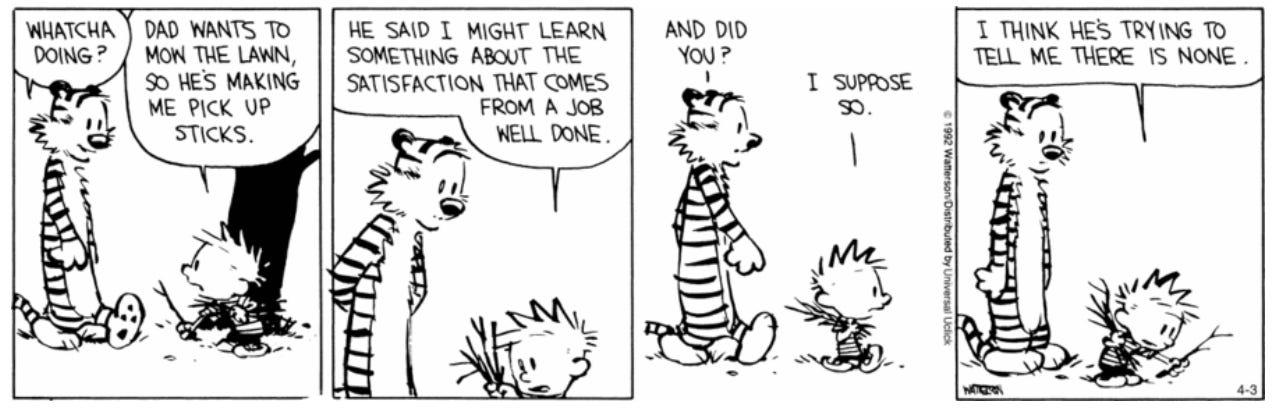
There are plenty of weekend mornings that I can recall easily. They mostly center around breakfast and the newspaper. When I was about 11-years old, we moved into a home with my father’s parents (my yeh-yeh and mah-mah). Both my father and yeh-yeh religiously read the paper. For my father it was the Toronto Star and for my yeh-yeh it was Ming Pao. Somehow I took a liking to reading the paper and since I couldn’t read Chinese, it was the Toronto Star that I read cover to cover every weekend morning alongside both of them. I remember really liking Calvin and Hobbes comic strips, even more than Peanuts. I remember a section of the paper edited specifically for children. One weekend, this section featured a crossword puzzle I was committed to completing, but I was stumped on the final clue. My father coached me and asked thoughtful, leading questions to guide me to the answer on my own. I remember the word: antibodies. To encourage children to play the crossword, the paper invited us to submit our answers for a chance to win a goodie bag of prizes. And funny enough, I did! I remember receiving a few movie passes, a bottle of sunscreen and maybe a t-shirt too. I remember the newspaper was read at the kitchen table during breakfast. And I remember they loved oranges. Breakfast always included the kind of orange juice with extra pulp. I remember they loved omelets. And I remember mistaking scrambled eggs for omelets, thinking that scrambling raw eggs was what made eggs scrambled and that the pancake shape style my father and yeh-yeh loved was in fact, not what people expect when they order scrambled eggs. I remember personally eating lightly toasted white bread with melted butter and white sugar sprinkled on top. I remember the paper had a contest encouraging regular folk to learn the stock market: you pick your top three stocks amongst different Canadian companies and over the four months, see if your picks amounted to the most value. This was my father’s way: he showed me through these morning weekend rituals to read broadly and to be obsessively curious.
I can see how I took on this wandering curiosity from my father. To be hunting for meaning like treasures hiding in plain view. In endeavoring to write a book on my family, I had to scan my own memory bank for inspiration to draw the starting point for my chapters. I was curious and confused that it was mainly fond memories. I know there were painful memories, but somehow even when I travel back to those moments, I feel a sense of acceptance and peace, as though I had already reconciled the hurt. But I wonder about where that pain goes and if it ever left and whether my optimism has been complicit in painting this rose-colored vision of resolution.
Five years would pass before we moved out and away from my grandparents. Before we finally moved out, I spent about eight or nine months not speaking with my father. I was unwavering in my show of disdain for him during this period. Absolute silence. I refused to address him, respond to him or engage with him. I remember this clearly: my cruelty, my stubbornness, my refusal to forgive. What I don’t remember clearly is why. I know something happened, something must have happened, but to recall the inciting incident draws a complete blank. It’s not even fuzzy, it’s just blank. The vivid memory of my own cruelty seems to have washed away what betrayal I must have felt to lead me to act in such an extreme. A testament to the loudness of my own cruelty which silences the rest.
What gets erased versus what gets remembered? Memory is calculating. What doesn’t add up in retrospect is actually precise: a mechanism that turns memory against us. The math here is a system of subliminal but scathing reinforcement that compounds over time. What seems to be a race to the finish line to win the hard-earned peace is what betrays us most. Quietly and insidiously. A systematic sanitizing of anything seemingly difficult. That people preach the gospel of “not going to bed angry” signals just how dirty anger feels. You wouldn’t wear your shoes to bed, but you’re going to go to bed angry? And so we do the dirty work of washing, scrubbing, sanitizing, getting so good at wiping clean the profanity of our history that it’s become a nourishing ritual. Sanitization offers a tangible way to protect our sanity. It’s survival. And it’s also incomplete.
I’ve been asking what makes this story worth writing. But I’m starting to see: the story worth writing is the one I’m avoiding. The one where I find beauty in brutality and where I’m the petulant child who was hurt by something painful she couldn’t name. The one where pain is dirty and hasn’t transmuted into an illuminating insight, it’s just simply there, lingering and quietly nagging at me to write about it. I still don’t quite know how to write about it. Perhaps I’m still avoiding it, even now, with this essay.
No posts
Comments
Nothing yet. Say the first thing.
Sign in to join the conversation.